 Universe Today
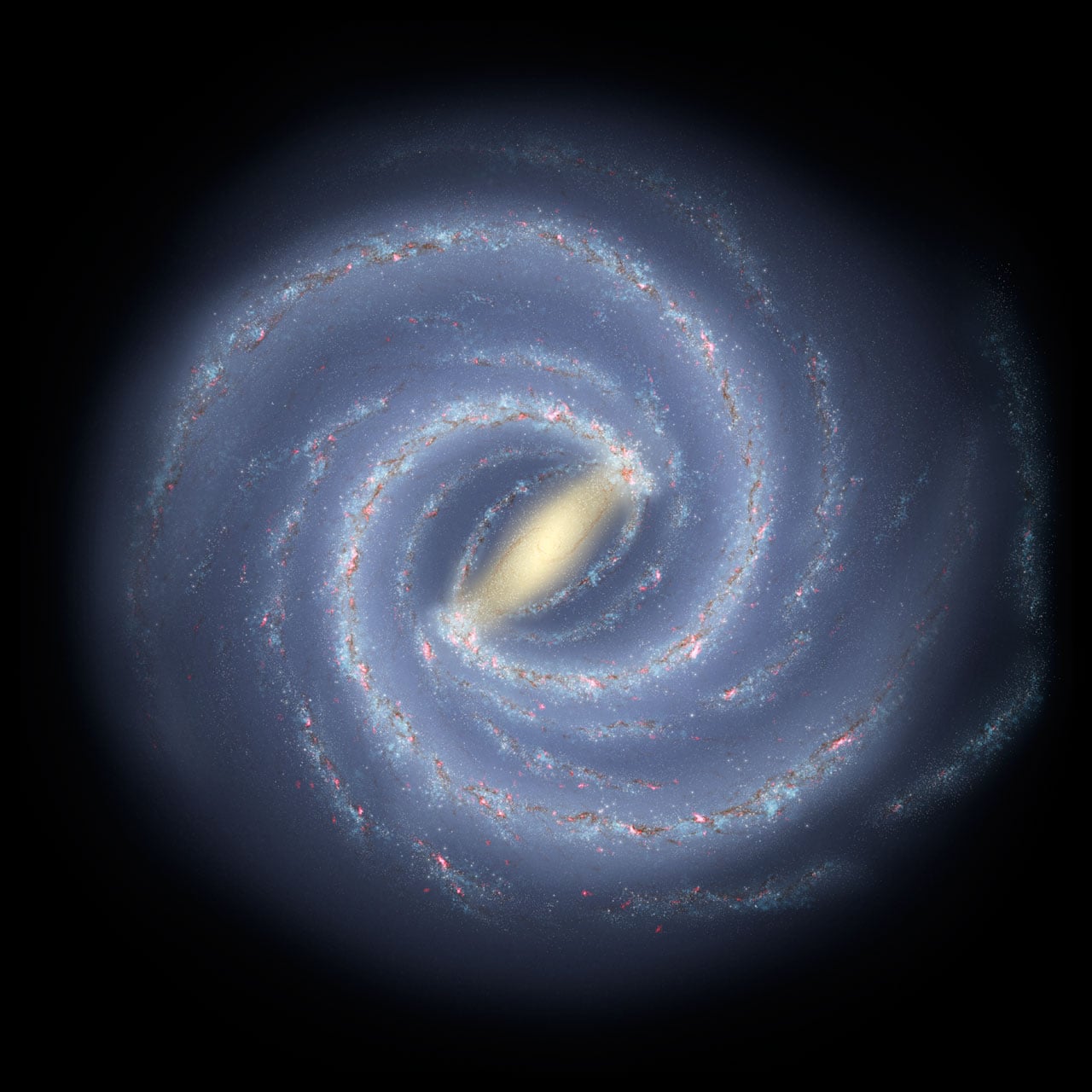
Where exactly is the edge of the Milky Way? That question is harder to answer than one might expect. Since we’re inside of the galaxy itself, it’s obviously hard to judge the “edge” to begin with. But it gets even more complicated when defining what the edge even is - the galaxy simply gets less dense the farther away from the center it goes. A new paper by researchers originally at the University of Malta thinks they have an answer though. The “edge” can be defined as the star-forming region, and in their paper, published in Astronomy & Astrophysics, they very clearly show that “edge” to be between 11.28 and 12.15 kiloparsecs (or about 40,000 light years) from the center.
Even finding that edge was no easy task, though. The researchers had to analyze the ages of over 100,000 giant stars from the data of several different surveys, including APOGEE-DR17, LAMOST-DR3 and Gaia. In the data they found an interesting story about the evolution of the position of stars in the galaxy, and their age.
That relationship can be thought of as a U curve. In this case, the Y axis is age, and the X axis is the distance from the galaxy’s center. A picture (or graph in this case) is worth a thousand words, but in words that simply means that stars closer to the center of the galaxy are older, and get progressively younger out to a certain point, and then start getting older again. That “certain point”, according to the authors, is the end of the galaxy’s star-forming region, and hence, the “edge” of the galaxy.
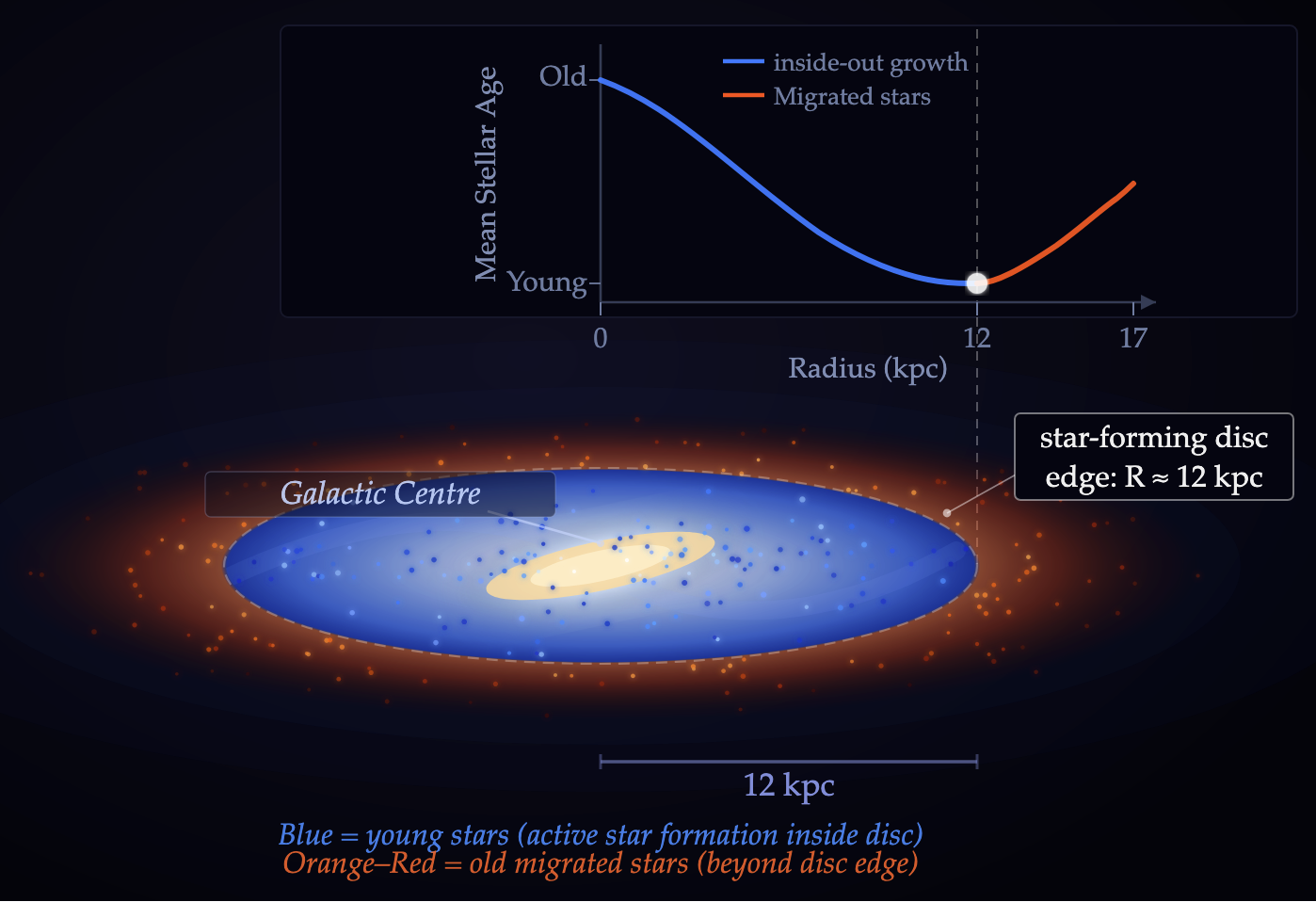 U-Shaped curve of the galaxy's age and depiction of its "edge". Credit - University of Malta / K. Fiteni et al.
So why the U-curve? There are a few reasons. Closer to the black hole at the center of the galaxy, there was much more gas and dust, leading to earlier star formation, and hence older stars. Farther out, gas and dust is more spread out, the gravitational attraction that eventually results in star formation happens more slowly. Hence, stars get younger and younger out to the “edge”.
But what happens beyond that edge? Why are there still stars and why are they older? The simple answer is that the outer reaches past the galaxy’s “edge” are populated with migrant stars that were formed within the star-forming region and then, for one reason or another, were pushed out past it. The two main causes of that migration, according to the paper, are gravitational forces from the spiral arms themselves, or the “central bar” that can cause stars to slingshot out of the star-forming region of the galaxy.
So while the inner regions of the galaxy are made of older stars, the outer regions are as well since they have migrated there over billions of years. But why is there a distinct “cut off” of star formation at 40,000 light years? The paper offers three reasons.
Video showing the tracking of stars in different regions of the Milky Way. Credit - Joseph Caruana YouTube ChannelFirst is the Outer Lindblad Resonance of the central bar of the galaxy which can disrupt gas flow, trapping it in the interior of the galaxy. Second is a “galactic warp” of the galactic plane at this distance, further diffusing the gas over a larger area. A third explanation is that the gas itself might simply become too thin to cool down and accrete into star-forming regions.
Those features have interesting implications for the galaxy itself. It clearly defines the Milky Way as a Type-II (down-bending) disc galaxy, sharing that profile with around 60% of similar galaxies in the local universe. But perhaps more importantly, it helps us understand a wider part of the story of the Milky Way itself. We can clearly define where the Milky Way’s productive youth ends, and its sprawling, quieter outskirts begin. And simply knowing that makes us more connected to our Solar Systems most immediate neighbors, no matter their age.
Learn More:
University of Malta - The Edge of the Milky Way's Star-Forming Disc Revealed in new research co-authored by UM Professor
K Fiteni et al. - The edge of the Milky Way’s star-forming disc: Evidence from a ’U-shaped’ stellar age profile
UT - What Part of the Milky Way Can We See?
UT - Nancy Grace Roman will Map the Far Side of the Milky Way

