 Universe Today
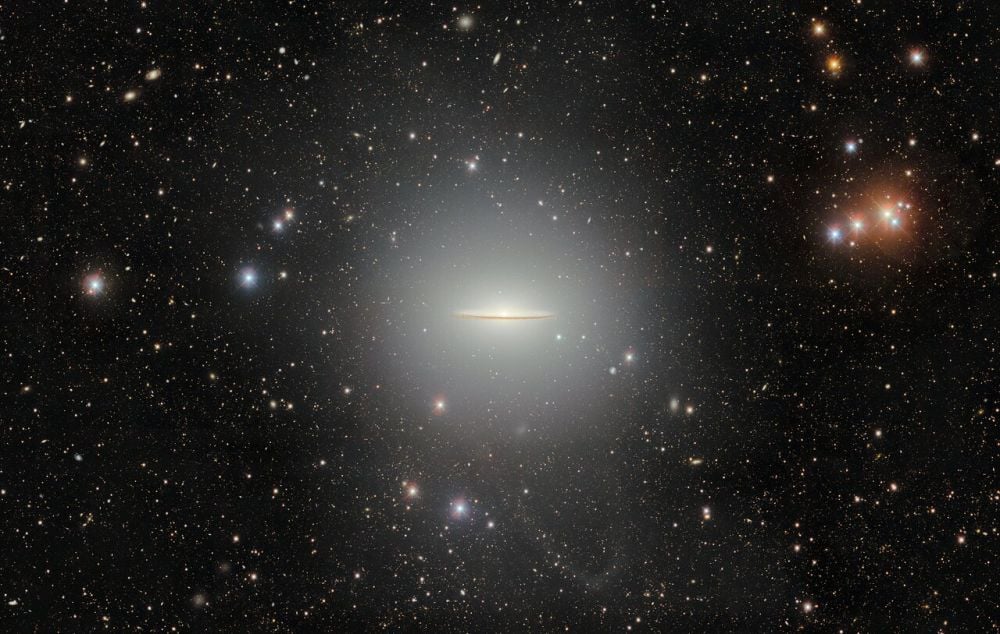
The Sombrero Galaxy is so picture perfect it looks like a painting. It sits in space as if its hung on a gallery wall. It's an iconic deep space object, and a popular target for amateur and professional astronomers alike.
The Sombrero Galaxy, aka Messier 104 and NGC 4594, is recognizable from its swollen central bulge, extended halo, and the dramatic dusty streak in its outer ring. New images from the Dark Energy Camera (DECam) on the Víctor M. Blanco 4-meter Telescope capture the galaxy in exquisite detail. DECam is a 570-megapixel camera, and was the world's largest camera until the Vera Rubin Observatory began observations. Iits high-resolution brings the Sombrero Galaxy into view.
The iconic galaxy is about 31 million light-years away and is part of the Virgo II Groups. It can't be seen with the naked eye, but can be viewed with a small telescope or binoculars.
The Sombrero Galaxy's central bulge, or nucleus, is disproportionately large compared to its disk, and helps create the profile of a hat. In the middle of that bulge is one of the largest supermassive black holes (SMBH) that we know of. It must have at least one billion solar masses according to some research, and is 2,000 times more massive than the SMBH in the Millky Way. Sombrero's SMBH is not very active though.
The Sombrero Galaxy's central bulge is surrounded by about 2,000 globular clusters, compared to between 150-200 for the Milky Way. That's a large number, and is similar to other galaxies with large bulges. The ratio of their luminosity to the galaxy's total luminosity is lop-sided, and that's used to show that the number of globular clusters around a galaxy is related to its bulge size.
Dust and cold hydrogen create the dark lane on the edge of the rim. Overall, the Sombrero Galaxy doesn't form stars rapidly, and the stars that do form are born mostly inside this perimeter. The galaxy's nucleus appears to be devoid of star formation.
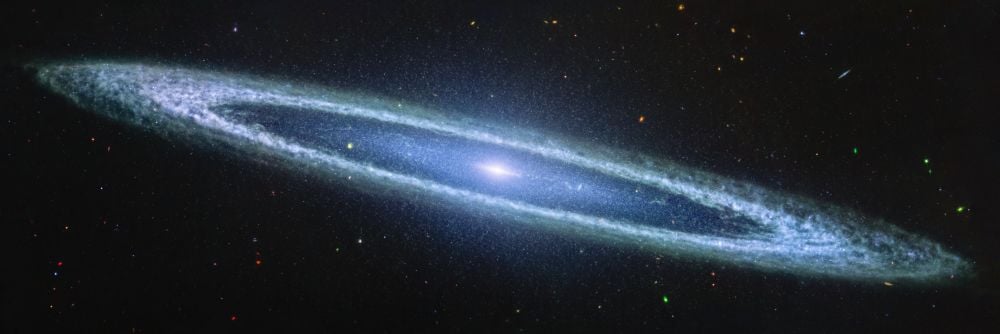 This JWST image of the Sombrero Galaxy brings the dusty lane on the edge of the galaxy's rim into view. This is where almost all of the galaxy's star formation takes place. Image Credit: By Image: NASA, ESA, CSA, STScI - Sombrero Galaxy (MIRI Image), Public Domain, https://commons.wikimedia.org/w/index.php?curid=155778903
The Sombrero has an extended, bright halo which is also part of its signature. It stretches as far as three times the size of the bulge itself. Astronomers aren't certain why it has such an extended halo, but the most widely-accepted cause is past galactic mergers. In this scenario, the halo is the collected debris from smaller galaxies that the Sombrero absorbed billions of years ago. However, all large galaxies are expected to have absorbed smaller galaxies in the past, and their haloes aren't as extended.
This spherical, diffuse halo is exactly what astronomers expect to see from past mergers. The large number of globular clusters is also evidence of past mergers, as is the presence of metal-rich stars in the halo. Yet, unlike other galaxies that have clearly been stretched and misshapen by mergers, the Sombrero Galaxy appears relatively undisturbed.
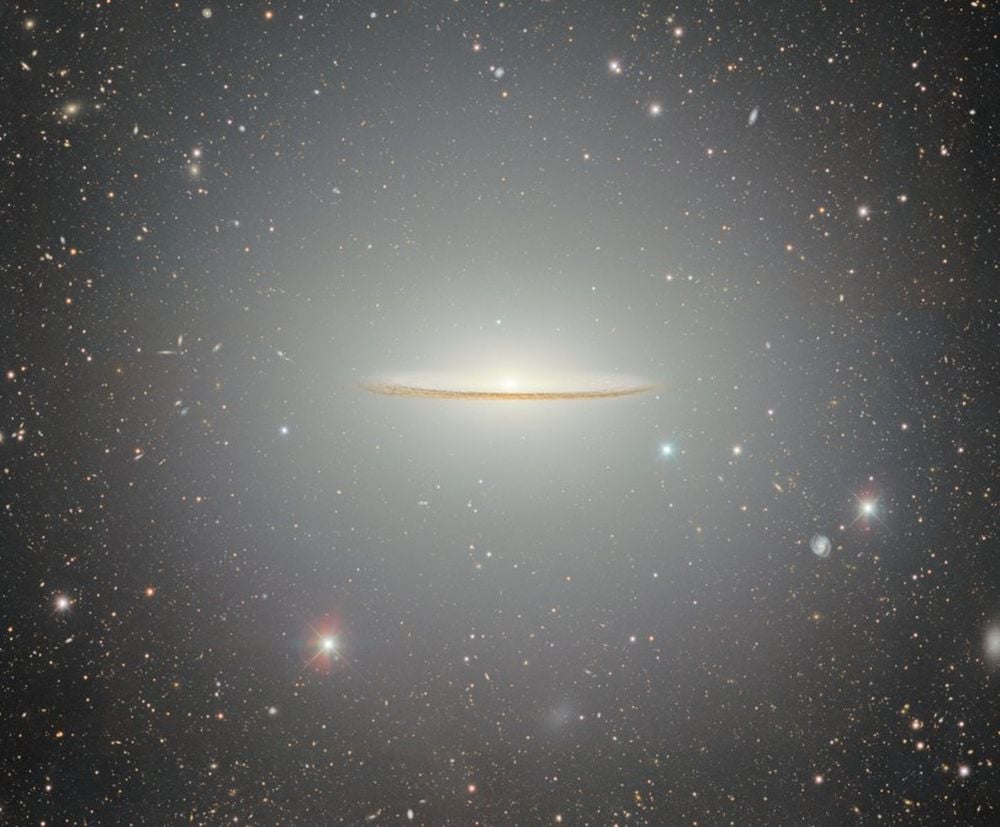 The Sombrero Galaxy's bright, shimmering halo extends outward into space in this zoomed-in image. Image Credit: CTIO/NOIRLab/DOE/NSF/AURA Image Processing: T.A. Rector (University of Alaska Anchorage/NSF NOIRLab), D. de Martin & M. Zamani (NSF NOIRLab)
Less noticeable is the stellar stream that sweeps around to the bottom right of the image. It was only definitively found and traced a few years ago. It may be the remnant of a dwarf galaxy, so it's also evidence of a past merger. Both the halo and the stellar stream are populated with stars from other galaxies, according to astronomers. Since the stream comes from the dense inner halo, scientists think that a compact dwarf or a system of multiple dwarfs managed to penetrate the outer halo and reach the dense inner halo before being torn apart.
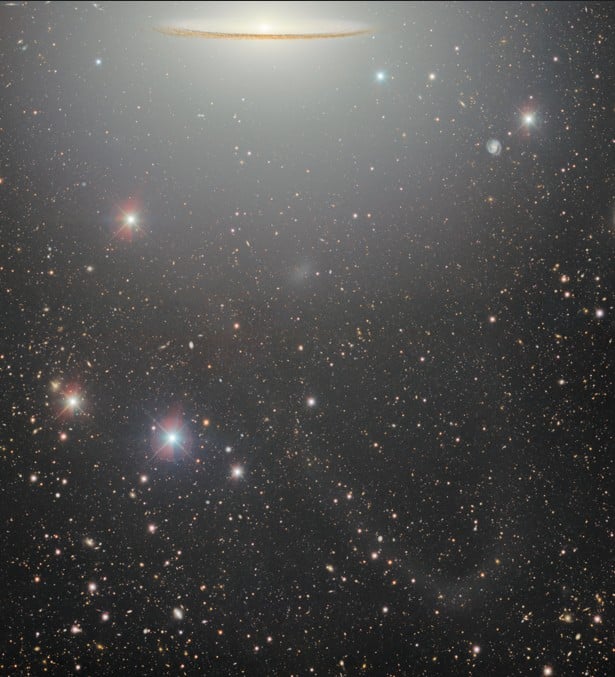 This image shows the faint stellar stream coming from the bottom of the galaxy and sweeping down and to the right. It's likely the remnants of a small dwarf galaxy that the Sombrero Galaxy consumed. Image Credit: CTIO/NOIRLab/DOE/NSF/AURA Image Processing: T.A. Rector (University of Alaska Anchorage/NSF NOIRLab), D. de Martin & M. Zamani (NSF NOIRLab)
The Sombrero Galaxy's stunning visual appeal is only part of what attracts our attention. It's also a scientifically puzzling object. It has a large, smooth halo like an elliptical galaxy, and a disk and dust lane like a spiral galaxy. Some astronomers think it may be a galaxy that's going through a transition from one to the other. It's possible that it underwent a very major merger that enlarged its structure but didn't destroy the disk. Since we can only see it edge-on, its exact nature is elusive.
Gazing at the Sombrero Galaxy means we're gazing at a record of galactic mergers over billions of years. Though mergers can be chaotic and can destroy galaxies, they also yield natural artworks like this.
For fun, you can download and explore a 725 MB image here.

