 Universe Today
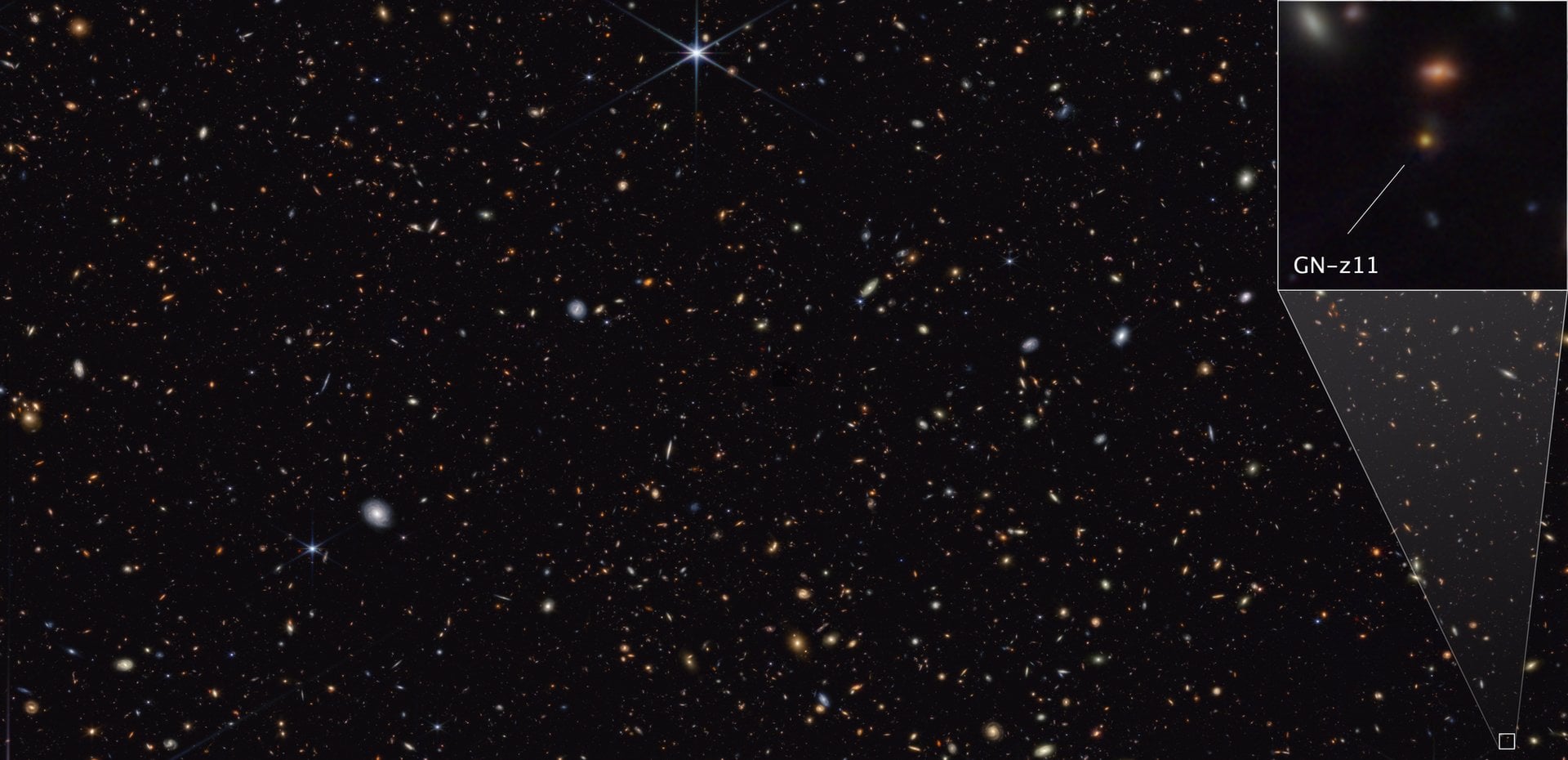
It’s hard hunting down the oldest stars in the universe. These behemoths, known as Population (or Pop) III stars, are a missing link in cosmology between the primordial soup that was the early universe and the complex, “metal”-rich cosmos we’re familiar with today. But we’re slowly getting a better idea of where to look for them, and a new paper available in pre-print on arXiv from Alessandra Venditti of the University of Texas at Austin and her co-authors, highlights some of the recent advances and potential new surveying techniques that could eventually help us definitively find these massive, bright, early sparks in the universe.
So what makes a Pop III star a Pop III star? One defining feature is they lack “metals” - which to astronomers means anything with a higher atomic number than helium. Heavier elements had to be formed either by the fusion going on in the stars themselves, or in the supernovae that happened when they die. Since none of those processes had happened yet when the earliest stars formed, they simply didn’t have any metals to incorporate into themselves.
That means they were also huge. The paper estimates a Pop III star to have massed in the dozens of solar masses - potentially up to 100-1000 times the size of our Sun. That also meant they were extraordinarily bright, and they “died with passion” as the creator Bill Wurtz once put it. These massive core-collapse or pair-instability supernovae happened after a relatively short stellar lifetime, violently seeding the universe with the metals that would be the Pop III star’s own demise.
Fraser talks about the biggest stars in the universe.At least in terms of star categorization. Once metal becomes a significant fraction of a star’s makeup, it is defined as a Pop II star, which are much more common and easily identifiable. Several factors conspire to make Pop III stars hard to differentiate, despite their size and luminosity. First is distance - these are some of the earliest stars in the universe, and, therefore, are located at galaxies with extremely high redshifts (i.e. ones where we’re looking back in time). Unfortunately, even with the most powerful telescopes we have, such as the James Webb Space Telescope, the most distant galaxies we can find still appear to be “polluted” with metal.
Which brings us to the idea of “hybrids”. If it’s impossible for us to find a pristine non-metallized galaxy, why not search for Pop III stars in galaxies that have some Pop II stars as well. After all, there’s nothing saying they can’t exist alongside each other. In fact, according to cosmological simulations, metal enrichment in the early universe was notoriously inefficient, so there could still be pockets of pristine Pop III stars hiding in otherwise polluted galaxies filled with Pop II stars.
Differentiating those two stellar types in galaxies far far away is no easy task though. To do so, astronomers look for particular types of ionizing rays that produce very strong Helium II emission lines when they hit surrounding clouds of gas. While there are some other astronomical phenomena that can mimic those emission lines, such as Active Galactic Nuclei or X-ray binaries, astronomers have already started to find some potential Pop III candidates using this technique.
Fraser talks about when the very first stars formed.One of the most promising is a system dubbed “Hebe”. Located about 3 kiloparsecs away from the high-redshift galaxy GN-z11, it has emission lines that are perfectly consistent with what astronomers expect a massive cluster of Pop III stars forming in a pristine dust and gas halo would look like.
But spectral matching alone doesn’t confirm anything. One of the most powerful techniques astronomers hope to use to actually directly image a Pop III star directly is a classic one for getting a better magnification - gravitational lensing. Galaxy clusters can bend light from background objects around themselves, creating a massive lens that can magnify the light from those background objects by up to 10,000 times. If we happen to get lucky enough to have a foreground galaxy cluster lensing a background galaxy with grouping of Pop III stars, JWST might be able to directly resolve individual Pop III stars.
For now that’s still just speculation, but we are definitely entering a “golden era” of Pop III star searching. New radio telescopes coming online and more and more survey data will combine with the JWST’s capabilities and gravitational lenses that we know of to unlock new areas of the universe where these elusive stars might still be hiding. And as our technology keeps getting better and better, soon there will be nowhere in the universe left for them to remain undetected.
Learn More:
A. Venditti et al. - How can we finally see the first light? Status and perspective in the search for Population III stars
UT - The Universe's First Stars Were Shaped By Turbulence and Were Not As Massive as Thought
UT - Astronomers Think They've Found Examples of the First Stars in the Universe
UT - If We Can't Detect the First Stars, Maybe We Can See Their First Galaxies

