 Universe Today
If you're looking for uniformity in Nature, you won't find it in the asteroid belt. Not only are asteroid compositions different because they come from different parent bodies, but their shapes are different, too. They're not massive enough to round themselves like planets do.
This is more than just another space factoid; asteroid shapes matter. It's a near-certainty, given enough time, that a dangerous asteroid will head directly for a collision with Earth, and that's something scientists are actively studying. They want to develop ways to knock an asteroid off course, if necessary. That's what NASA's Double Asteroid Redirection Test (DART), and the ESA's follow-up Hera mission were about.
There are multiple concepts for redirecting a dangerous asteroid. One of them is a nuclear weapon. Not to obliterate an asteroid, but to bombard it with radiation by exploding the nuclear weapon in close proximity to the asteroid. This is called a stand-off X-ray mitigation scenario. The radiation pulse will change an asteroid's course, if done soon enough and done correctly.
But the outcome of the pulse needs to be predictable to work, and that's where asteroids' different shapes come into play.
"The effectiveness of deflecting Near Earth Objects (NEOs) using pulsed radiation is challenging to quantify because it hinges critically on surface topography, which is often unknown," write the authors of new research in Icarus. The research is "Efficient computation of vapor ejecta over asteroid geometries during pulsed energy deflection," and the lead author is Nathan Moore. Moore is a physicist at Sandia National Laboratories.
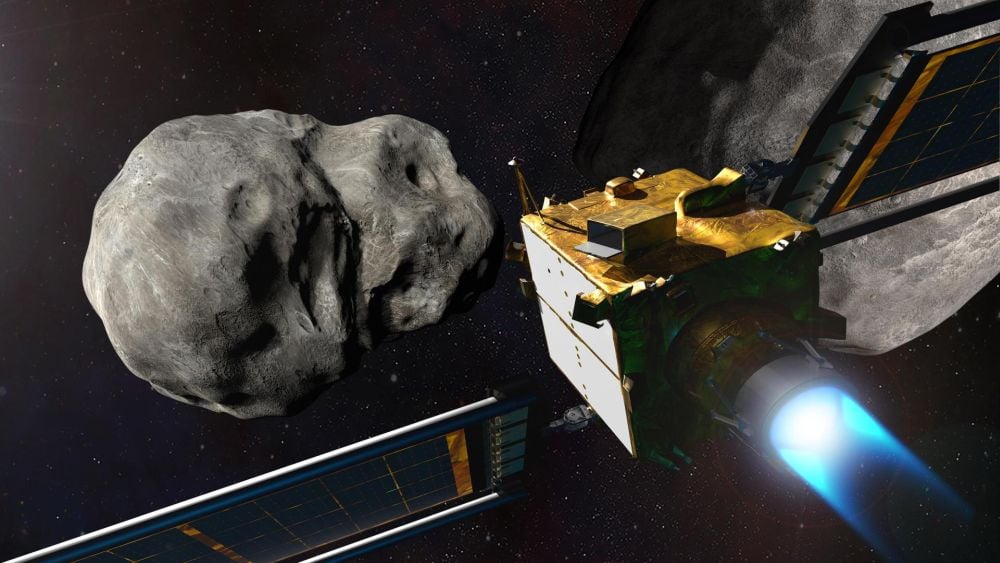
A simple kinetic impactor is probably the preferred choice for deflecting an asteroid. That's what the DART mission did, and it appeared to be successful. Though it only changed the velocity of its target Dimorphos by a little, it was done soon enough to create a substantial change in its position over years.
But the more pertinent issue concerns an asteroid, or perhaps a comet, that's on a collision course with Earth, but isn't discovered soon enough for an impactor to effectively change its trajectory.
"While considered an option of last resort, it has been argued that late-time interception of a near-Earth object (NEO) or comet, either for disruption or deflection, might only be possible with the higher energy concentration available from detonation of a pulsed energy device," the authors write. 'Pulsed energy device' is one way of saying nuclear weapon. In space, there's no atmospheric shock wave from a nuclear explosion, only radiation, which is released in a powerful pulse.
"Stand-off energy bursts—those detonated far from the surface—hold a potential advantage compared to surface explosions in that they might permit deflection with less disruption to the original structure, allowing for more controlled steering of the asteroid and its debris," the authors write. Disrupting the original structure might make for a good action sequence in a movie, but it would multiply the hazard to Earth by creating a swarm of debris, some of which could strike our planet.
Researchers have simulated using nuclear weapons and their radiation pulses to deflect asteroids, but their irregular shapes have stymied them. These shapes are far more difficult to model, so most research has focused on spherical asteroids. Moore and his colleagues developed a new algorithm to overcome these limitations.
“Our new algorithm is over 1,600 times faster, which was critical to this breakthrough,” Moore said. “With the old models, computers just couldn’t handle it.”
In this research, the authors simulated known asteroids with more irregular shapes, an important improvement on previous work.
"The approach improves on earlier methods by accounting for the actual topography of the asteroid fully in three dimensions without unacceptably increasing computational cost or reducing accuracy," the authors explain. "As a demonstration, we predict the deflection of three bodies of different shape—asteroid (101955) Bennu, asteroid (25143) Itokawa, and asteroid (6489) Golevka—from both near-field and far-field irradiations."
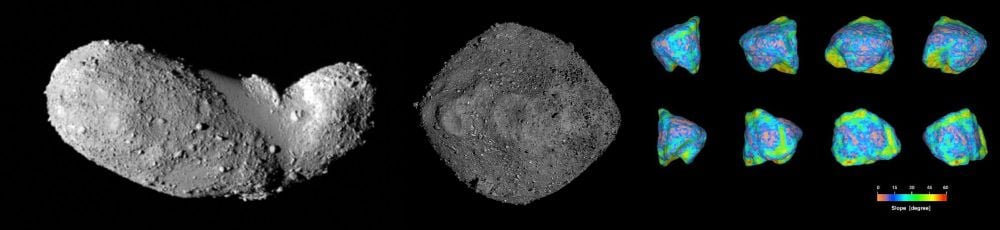 These images of asteroids Itokawa (left) and Bennu (middle), and a computer model of asteroid Golevka (right), show how asteroid shapes can be very different from one another. Image Credits: Itokawa: By ESO, CC BY 4.0, https://commons.wikimedia.org/w/index.php?curid=170826264. Bennu: By NASA/Goddard/University of Arizona - Public Domain. Golevka: By NASA/JPL - NASA - Jet Propulsion Laboratory. Public Domain.
A sequence of events unfolds after a nuclear device is detonated near an asteroid. First, an intense x-ray pulse is directed at one side of the asteroid. Then there's rapid surface vaporization, and that creates most of the deflection thrust. Next is an internal shock wave, a powerful blow that travels through the asteroid's body. Finally, the internal structure of the asteroid is fractured, and that can blow chunks of the asteroid off the surface opposite the blast, and off of the asteroid's sides.
So despite there being no atmospheric shock wave, the asteroid is still disrupted.
The results highlighted how important an asteroid's shape is. Depending on which side of the asteroid was facing the radiation blast, the deflection velocity can be up to five times greater. "We find that the orientation of the body at time of intercept can increase the deflection velocity by up to nearly 2× for Bennu, 4× for Itokawa, and 5× for Golevka, compared to the minimum response for each body," the authors write.
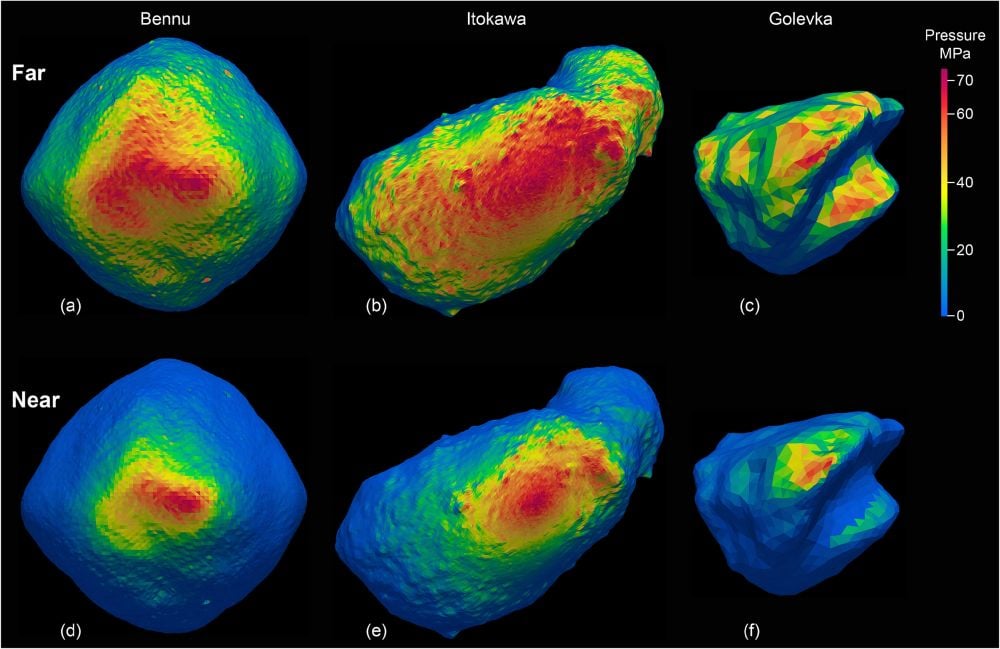 This figure shows the pressure distribution as averaged over the first 20 μs of vapor expansion, for asteroid (a) Bennu, (b) Itokawa, and (c) Golevka, for near and far Height Of Bursts (HOB). The vaporization is what creates most of the deflection thrust. Image Credit: Moore et al. 2026. Icarus.
“We expected aim to matter,” said lead author Moore in a press release. “What surprised us was how much.”
The simulation in this work can be used on any asteroid that's been mapped by a spacecraft during a flyby. The size of the explosion, the distance, and the surface exposed to it can all be calculated in advance. By calculating the surface vaporization, the main factor in deflection, the simulation determines how hard the asteroid will be pushed, how fast it will rotate, and how much of the surface might break up.
The interior structure of asteroids can be quite different, and that's beyond the capabilities of this model to account for. "Right now, our computer model only considers breakup of rocks on the surface. We can’t predict breakup of the entire asteroid body accurately yet," Moore said.
Real life is always different from simulations, and that means that these results can't tell us with absolute certainty what will happen. But it's a step forward, one that drives home how critical the aim is to a successful asteroid deflection, should one be needed in the future.
"The strong sensitivity of deflection and disruption to asteroid topography is especially pertinent given that the shape of an incoming NEO might not be known, and its orientation at time of intercept may be uncontrolled," the authors write. Their work as it stands now can at least be used to make estimates, which is better, far better, than nothing.
"Alternatively, effort could be made to obtain high-resolution topographic characterization of an incoming NEO to improve accuracy of the deflection model, such as using spacecraft-based imagery or altimetry acquired before detonation," the authors explain.
It's possible that asteroid-mapping spacecraft could stand at the ready in space, waiting to be deployed. They could even be paired with asteroid-disrupting spacecraft carrying nuclear weapons. Or the two capabilities could be combined into one spacecraft. Placing atomic weapons in space would be extremely tricky in our fractured geopolitical world, but it's still a possibility, maybe the only possibility.
But however we prepare for an incoming asteroid, this work highlights how important it is that our aim is true.
“Our study shows how important it is to aim carefully,” Moore said. “Pick the right side and you win. Guess wrong and it could be a bad day.”