 Universe Today
Most of us could spend our entire lives looking at the night sky and see very few changes. The Moon becomes more or less illuminated, the planets drift placidly through the sky, satellites and the ISS intrude for a few moments at a time, and the bright, momentary streak of a meteor punctuates the occasional evening of star-gazing.
If we're really lucky, we get a chance to witness one of the prominent comets: a regular visitor like Halley's Comet, or a once-in-several-millenia comet like Hale-Bopp. A very small number of us might be truly fortunate and witness a distant supernova.
But the apparent uneventfulness of the night sky is an illusion, even for those with a typical backyard telescope. It's the result of a selection bias based on our ability to see only visible light. The reality of the night sky is much different. Calamitous and transient events are nearly continuous, if you have the right eyes to see. Many astronomical phenomena, like stellar flares and exploding stars, only reveal themselves fully in ultraviolet (UV) light, which is beyond our ability to see without technological help.
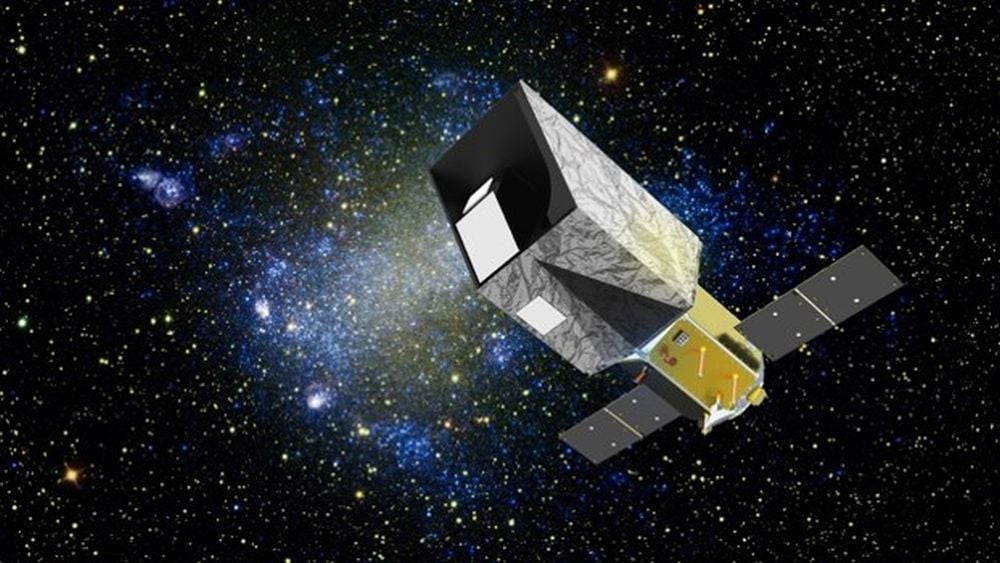
Soon we'll have a new space telescope that sees exclusively in UV. NASA has announced that UVEX, the UltraViolet EXplorer, will launch in 2031. The UVEX mission, which will be led by CalTech, will perform an all-sky survey in near and far-ultraviolet.
"Every time you look at the skies in a new wavelength, you learn something new and unexpected." Kareem El-Badry, UVEX team member, Caltech.
"UVEX is a bold leap forward in our exploration of the ultraviolet universe," said Caltech President and professor of astronomy Ray Jayawardhana.
Light across all wavelengths, from radio to gamma-rays, floods our Universe. We can only really understand what's creating all of the light if we can see all of the light. UVEX will fill a gap in our observations by providing an all-sky survey in UV that will complement surveys by other telescopes like the Nancy Grace Roman Space Telescope, the Vera Rubin Observatory, and the ESA's Euclid Space Telescope.
When most people think of telescopes and space telescopes, they likely imagine powerful telescopes that can see long distances, bringing exquisite views of distant objects into view. After all, images of nebulae and other objects are eye candy, they grace websites landing pages and help generate public interest in space and astronomy.
But survey telescopes play a huge role in science. The Nancy Grace Roman Space Telescope will perform three separate surveys in infrared, the Vera Rubin Observatory will image the night sky repeatedly over a decade, and Euclid is performing three deep-field surveys in visible light, capturing over 10 billion sources (galaxies). Another NASA telescope, SPHEREx, is also conducting an all-sky survey in near-infrared.
These vast datasets are invaluable in modern astronomy, and UVEX will contribute to this growing, detailed picture of the Universe. It will also gather focused observations on individual targets.
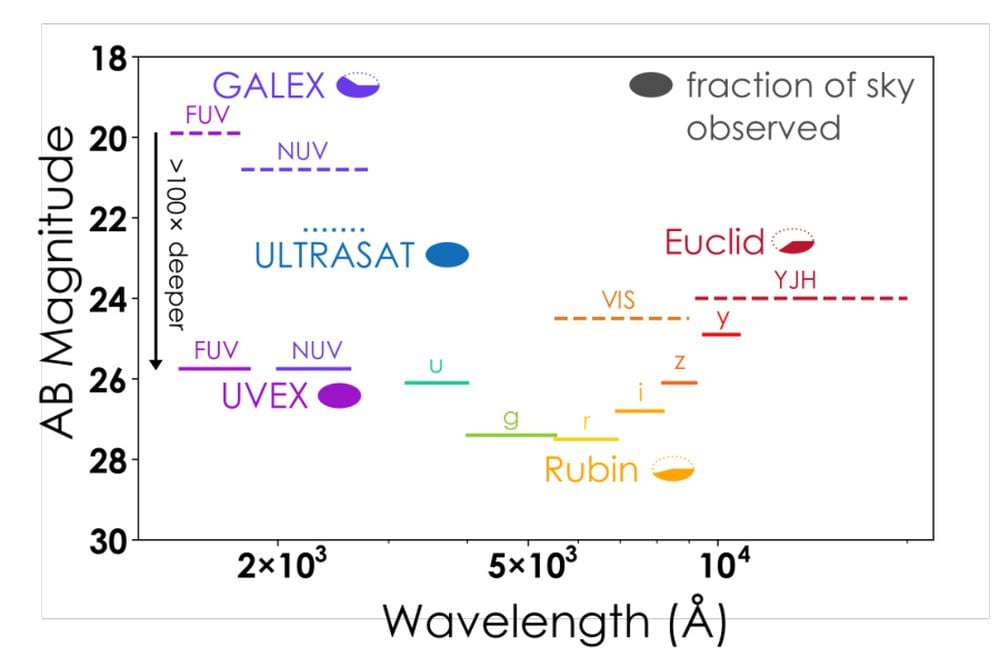 This figure shows how UVEX will provide deep, two-band UV data to complement planned deep, wide-field (> 10,000 deg2) optical and near-IR surveys by Rubin and Euclid. Together, they will build a multiwavelength survey of the sky. Image Credit: Kulkarni et al. 2023.
"In its two-year baseline mission, UVEX will perform a multi-cadence synoptic all-sky survey 50/100 times deeper than GALEX in the NUV/FUV, cadenced surveys of the Large and Small Magellanic Clouds, rapid target of opportunity followup, as well as spectroscopic followup of samples of stars and galaxies," the authors of a white paper about UVEX wrote. GALEX was a NASA ultraviolet space telescope whose mission ended in 2013. But UVEX will be up to 100 times more sensitive than GALEX.
In particular, UVEX will observe nearby low-mass galaxies that are bright in UV, and those observations will complement observations by the JWST and the Nancy Grace Roman Space Telescope (NGRST).
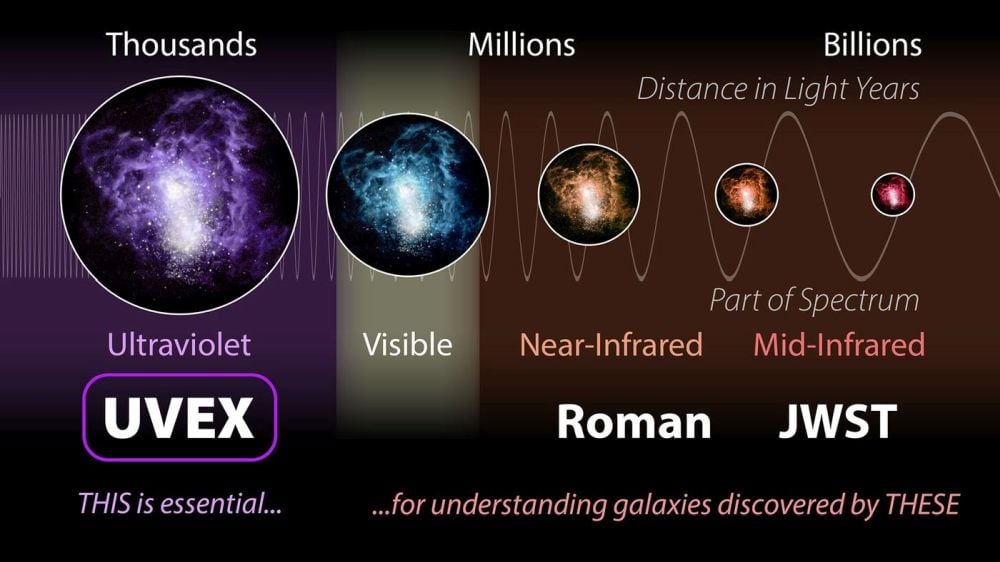 This infographic explains some of what's behind the UVEX mission. UVEX will focus on relatively nearby low-mass galaxies and their bright ultraviolet light. These same galaxies exist billions of light years away, but their light is red-shifted, meaning its now infrared light. The JWST and the Roman Space Telescope can see them. By examining the closer counterparts to these galaxies in UV, UVEX will complement the infrared observations from the other two telescopes. Image Credit: Caltech/Robert Hurt (IPAC-SElab)
The low-mass galaxies that UVEX will focus on are important in the Universe for the role they play. In a paper describing the UVEX mission, the authors explained that UVEX is based on three "pillars," the first of which is low-mass galaxies.
"First, UVEX will explore the low-mass, low-metallicity galaxy frontier through imaging and spectroscopic surveys that will probe key aspects of the evolution of galaxies by understanding how star formation and stellar evolution at low metallicities affect the growth and evolution of low-metallicity, low-mass galaxies in the local universe," the authors wrote. This galaxy population contains half of the Universe's mass, and they're analogs for the Universe's first galaxies.
"Second, UVEX will explore the dynamic universe through time-domain surveys, and prompt spectroscopic followup capability will probe the environments, energetics, and emission processes in the early aftermaths of gravitational wave-discovered compact object mergers, discover hot, fast UV transients, and diagnose the early stages of stellar explosions," the authors explain.
Lastly, UVEX, like other survey missions, will generate a vast treasure trove of UV data accessible to researchers studying a wide range of objects and phenomena. This is very similar to what the ESA's recently-completed Gaia mission did. Gaia's data is used in a wide variety of research areas, and will likely be relied upon for a long time.
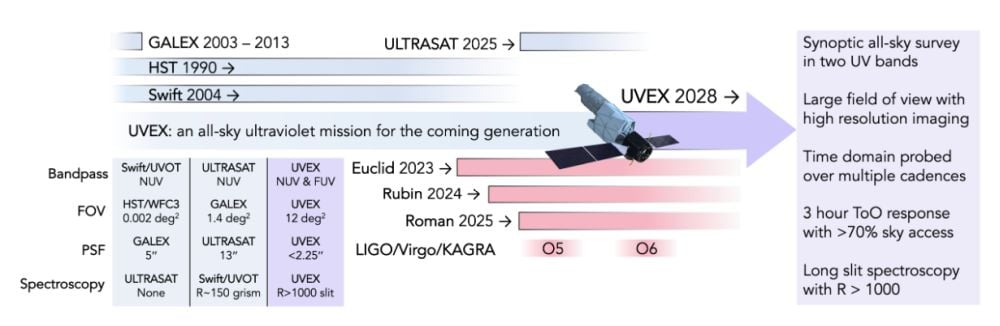 This infographic puts UVEX into context with other telescopes and surveys. It also shows how it stacks up against other UV observatories. Image Credit: Kulkarni et al. 2023.
UVEX will bring things into view that were simply too dim to be seen before. Explosions, stellar mergers, tidal disruptions events, and more will now will be visible more than ever. These transient events are some of the most dramatic happenings in the Universe, and along with with its steady surveying activity, UVEX will be able to quickly point at transient events and watch as they unfold.
While several powerful telescopes have launched in the last few years, this is the first new UV telescope in 20 years. And it will be the very first UV mission to create deep-sky maps in UV. With its extreme sensitivity and spectroscope, it will discern the different wavelengths of light coming from distant objects, clarifying which chemical elements are present.
UVEX will also complement gravitational-wave observatories. Gravitational waves are ripples in space-time (predicted by Einstein) that are generated when extremely dense objects, like neutron stars and black holes, merge. When generational waves are detected, alerts go out to other telescopes which then observe them in wavelengths including radio and gamma rays. When UVEX is launched, it will add UV observations.
"With UVEX, we will now be able to follow up on gravitational-wave events in ultraviolet light," explains UVEX team member Mansi Kasliwal (PhD '11), a professor of astronomy at Caltech and director of the Palomar Observatory. UVEX's detailed spectra will reveal more information than ever about these events.
Each new mission and telescope is launched with a firm idea of its goals and expected results. But as we keep seeing with telescopes, including the powerful JWST and its observations of early supermassive galaxies, each new telescope also generates some suprises.
"Every time you look at the skies in a new wavelength," said Kareem El-Badry, associate professor of astronomy at Caltech and a member of the UVEX team, "you learn something new and unexpected."

