 Universe Today
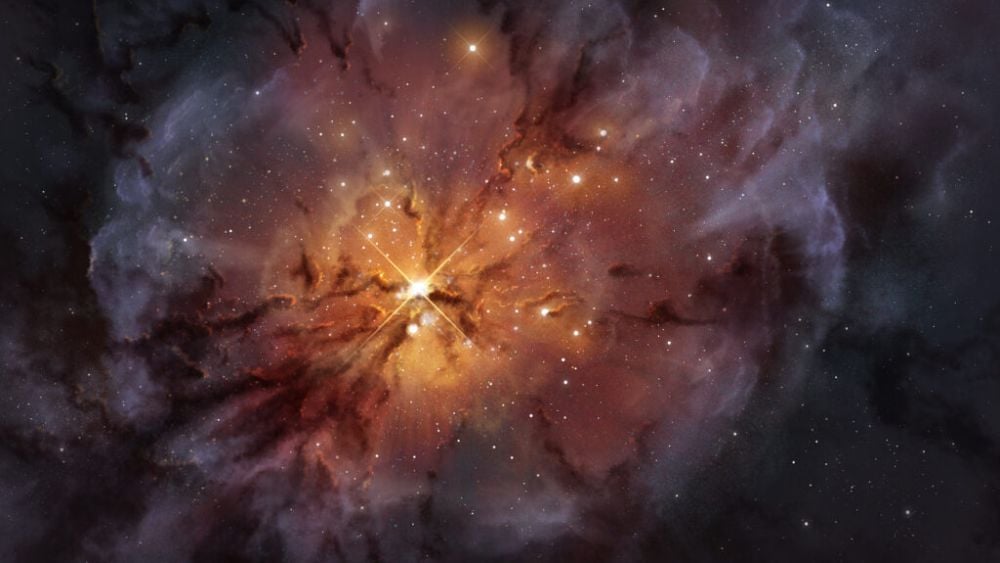
Only a few hundred million years after the Big Bang, during the Cosmic Dawn, bright galaxies populated the Universe in numbers higher than expected. The JWST showed that these galaxies formed very dense, compact clusters of stars. Why their star formation was concentrated in such dense clusters is a puzzle, as is the brightness of their host galaxies.
A pair of researchers may have figured it out. Their work is titled "Lyα Radiation Pressure in Dense Star Clusters: Implications for Star Formation and Winds at Cosmic Dawn," and it's published in The Astrophysical Journal. The authors are Shyam H. Menon and Aaron Smith. Lead author Menon is a research fellow at the Flatiron Institute’s Center for Computational Astrophysics, and co-author Smith is an assistant professor of physics at the University of Texas at Dallas.
The Lyman-Alpha (Lyα) radiation in the paper's title is a very important factor in astrophysics. It's produced when an electron in a hydrogen atom transitions from excited to ground state. Since hydrogen is by far the most abundant element in the Universe, Lyα is a fundamental way to probe the Universe's earliest galaxies, including the interstellar medium (ISM) and the intergalactic medium (IGM).
"Observations with the JWST in lensed fields have revealed that galaxies at cosmic dawn may concentrate their star formation in highly dense, compact, star clusters," the authors write. "The high columns and low metallicities encountered in their birth environments suggest that Lyα radiation pressure may be crucial to their formation and evolution."
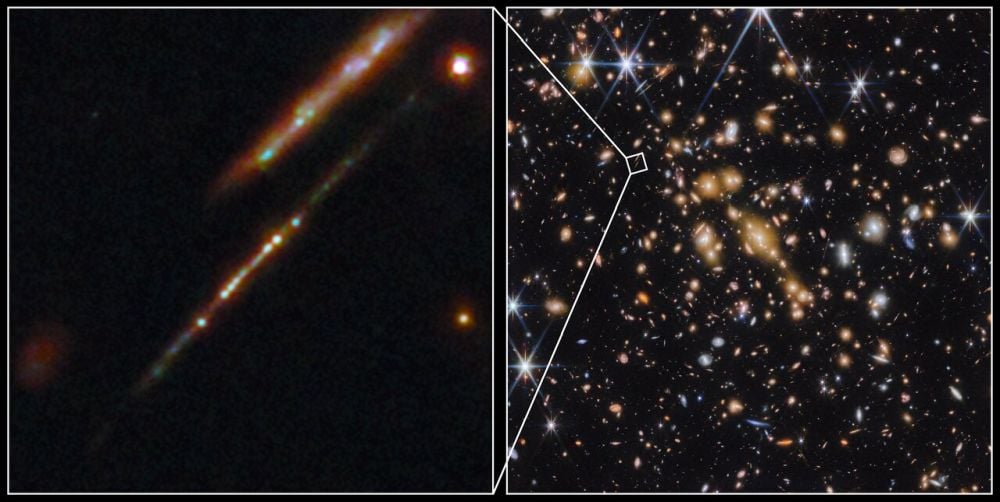 These panels show some of the bright and dense star clusters the JWST found in the early Universe, only about 460 million years after the Big. The panel on the right shows their location in SPT0615-JD1, a strongly-lensed galaxy. Image Credit: ESA/Webb, NASA & CSA, L. Bradley (STScI), A. Adamo (Stockholm University) and the Cosmic Spring collaboration
“Our results show Lyman-alpha radiation can push low-density gas and dust away really, really fast,” lead author Menon said. “It can sort of clear the ‘fog,’ allowing us to see stars in the early universe much more clearly than we would otherwise.”
Lyα's utility as a diagnostic tool also explains its powerful ability to push dust and gas away so quickly. Lyα radiation is different than others. Typically, when an atom absorbs energy, it re-emits it at a different wavelength. But hydrogen atoms absorb Lyα and then re-emit it again almost instantaneously, where it interacts with more hydrogen. This absorption-emission cycle makes it a powerful diagnostic tool, and it also gives Lyα the ability to bully hydrogen gas.
Astrophysicists knew this, but understanding its effect on a large scale was difficult.
“We’ve known for a very long time that Lyman-alpha radiation could be important because it carries a lot of force,” Menon says. “But we’ve never actually been able to estimate how important it is in a realistic environment because of how challenging it is to model.”
Researchers have tried to incorporate it into models, but Lyman-alpha resists those attempts. Some haven't even tried to include it. "The oversight is related to its high dimensionality and complexity, as well as the inherently demanding computational requirements for modeling it self-consistently," the authors write.
The reason it's difficult to model is precisely because of its repeating cycle of absorption and emission. But difficult isn't synonymous with impossible.
Menon and Smith didn't try to simulate it. Instead, they took snapshots from existing simulations and got busy calculating the force necessary to explain the snapshots. "In this study, we address this question by postprocessing snapshots from radiation-hydrodynamic simulations of dense star-cluster-forming clouds with a range of dust abundances using the COLT Monte Carlo code," they explain. COLT stands for Cosmic Lyman-alpha Transfer. Study co-author Aaron Smith is COLT's original creator, and he wrote it to "simulate the production and escape of Lyα from hydrodynamical simulations," according to the COLT website.
In short, they examined simulation snapshots of star-forming regions in the early Universe, and calculated the amount of Lyα necessary to explain what they saw.

These are multiple views of a 2.5-million-year simulation visualizing a gas cloud as it is cleared away and the formation of stars. From left to right, the views show the gas density, ionization and temperature. Credit: Shyam Menon (Flatiron Institute) and Aaron Smith (UT Dallas).
The results showed that Lyman-alpha radiation wasn't strong enough to blow away the gas in the dense star-forming regions found by the JWST. The gravity from the dense gas in those filaments was too strong for Lyman-alpha to overcome. But beyond those dense filaments, it was powerful enough to blow away the more diffuse gas and the dust.
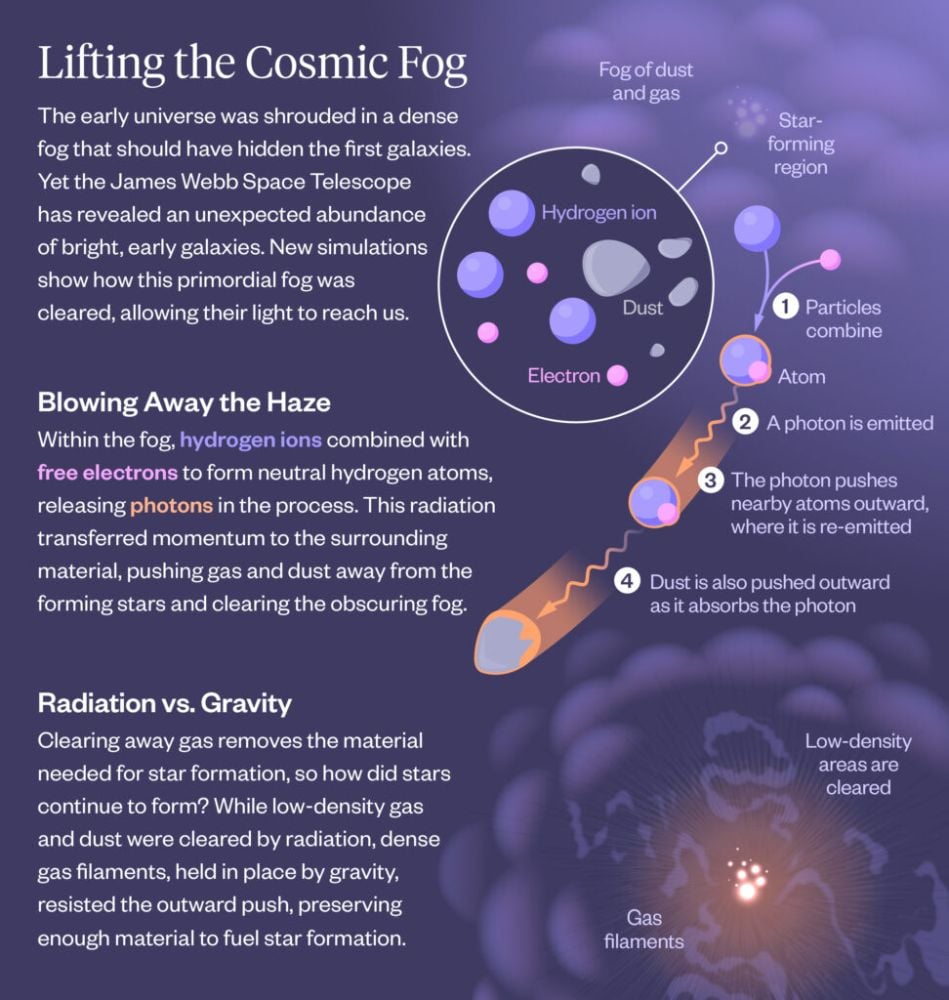 This graphic shows how Lyman-Alpha was able to blow away gas and dust that obscured early galaxies and their dense star clusters. Image Credit: Lucy Reading-Ikkanda/Simons Foundation
The authors outline two simple conclusions in their paper: "Lyα radiation pressure is unlikely to preclude efficient star formation," and "Lyα radiation pressure can drive dynamically significant winds once star formation saturates."
"Therefore, our results suggest that the SFE is likely to remain high in the dense star clusters forming at high-z. On the other hand, a significant fraction of the volume-filling gas can be ejected by Lyα radiation pressure, suggesting implications for the visibility of light from the cluster, ionizing photon escape, and launching outflows from the galaxy," the researchers write in their paper.
So once star formation had proceeded far enough in these dense clusters, Lyman-alpha made them visible by blowing away the rest of the gas.
“When the density is low enough, the Lyman-alpha radiation can push the gas to really high speeds, launching explosive winds that can shoot material clear out of the galaxy,” Menon says. "That cleared away the gas obscuring the dense clusters, making them visible."