 Universe Today
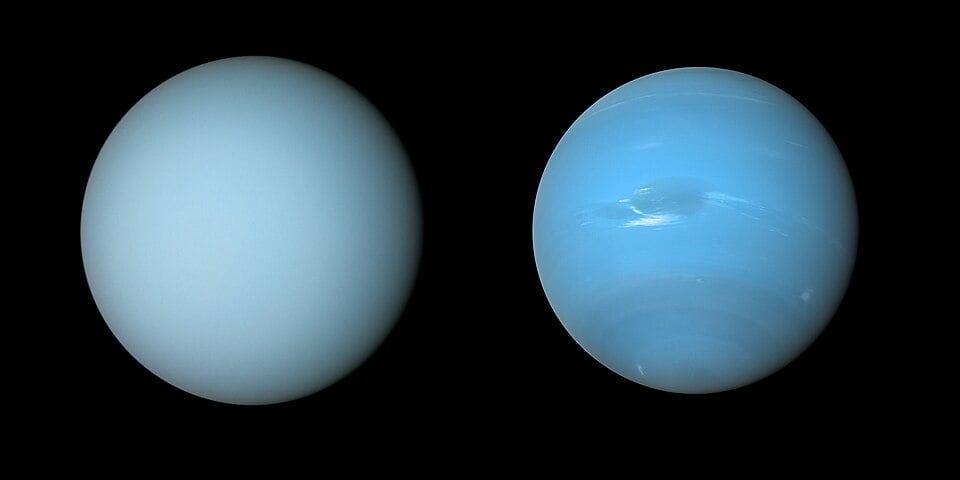
For decades, astronomers have divided the planets in the outer solar system into two distinct camps. Jupiter and Saturn were the “gas giants” made up primarily of hydrogen and helium. Uranus and Neptune were the “ice giants”, and were much smaller but were packed with heavier elements. A new paper from Olivier Mousis of the Southwest Research Institute and his co-authors, available in The Planetary Science Journal, explores whether we can use an isotope of a noble gas - argon-40 - to determine whether there are hidden mountains of rock under the ice giant’s thick atmospheres.
Scientists are getting excited because there has been an ongoing debate that these distant worlds are actually covered in rock. But we can’t simply fly a probe out a few billion miles and drill down into their surfaces to determine that for ourselves. Instead, they decided to use proxies, such as the concentration of argon-40, as a rough measurement for how much rock there is below the atmosphere.
Understanding why the presence of one noble gas isotope leads to understanding whether rock is present or not requires a bit of a diversion into the world of bananas. Or at least, it gives me an excuse to talk about bananas in a planetary science article. Bananas are radioactive, and the thing causing their radioactivity is potassium-40 - a relatively unstable form of a very common element. When potassium-40 decays, it turns into argon-40, which, as a noble gas, hardly interacts with anything.
Fraser talks about how to plan a mission to Uranus.Most of this radioactive decay takes place in rocks containing potassium-40, rather than bananas, so one of the most common sources of argon-40 is literally rocks. After it is created, it bubbles up out of those rocks and escapes into its host planet’s atmosphere. In fact, it makes up around 1% of the air you’re breathing right now.
On the ice giants, this same process could hold - argon-40 could form inside a rocky surface, and then bubble up into the planet’s atmosphere over billions of years. So we should be able to send a probe to measure the concentration of argon-40 in their atmospheres, and that would serve as an effective proxy for the existence of rock under the atmosphere.
There’s just one catch - rocks aren’t really the only source of argon-40. In fact, there was already plenty of it floating around in the protosolar nebula that the Sun and all the planets eventually formed out of. Therefore, Uranus and Neptune could have “trapped” this leftover argon-40 before they were even mature, causing argon-40 to eventually appear in their atmosphere, but not from rocky surfaces.
Fraser talks about efforts to go back to visit the ice giants of the solar system.According to the paper, the amount of argon collected by the early versions of Neptune and Uranus depends entirely on where they formed with regards to the “argon ice line”. This line, which happens around 23-35 Kelvin, the temperature that argon freezes into solid ice, or is trapped inside water ice, is the determining factor of how much primordial argon Neptune and Uranus had sucked up.
Unfortunately, there’s still a lot of debate about where exactly in the solar system the ice giants formed. If they formed close to the Sun and eventually migrated back out to the edges of the solar system, they might not have captured much argon ice, and the majority of the argon in their atmospheres would be due to release from rocks. On the other hand, if the theories about them actively moving through the solar system soon after their creation are true, then they would likely have captured a large amount of argon-40, making it useless as an indicator of whether or not the planets have a rocky surface.
Luckily, there is a way to potentially solve this puzzle. Argon-40 has a lighter isotopic cousin, known as argon-36, which is non-radioactive, and doesn’t form in decaying rocks. Measuring its level would act like a control group, allowing scientists to estimate how much of the argon present in the atmosphere would have been swallowed at birth, as we have other estimates of the ratio between argon-40 and argon-36 in the early solar system.
It’s good these sorts of insights are coming out now, as there is currently a mission, Uranus Orbiter and Probe, which is in active development and planned to arrive in the system in the 2040s. That still gives us some time to finalize our theories about what we would expect to find there. And perhaps, once it does arrive, we’ll be able to definitively answer whether or not the “Ice giants” have a truly solid surface or not.
Learn More:
SwRI - SwRI team studies interior composition, origins of ice giants
O. Mousis et al - Primordial and Radiogenic Argon 40 in Uranus and Neptune
UT - Argon – The First Noble Gas Molecules Discovered In Space
UT - Webb Sees a System That Just Finished Forming its Planets