 Universe Today
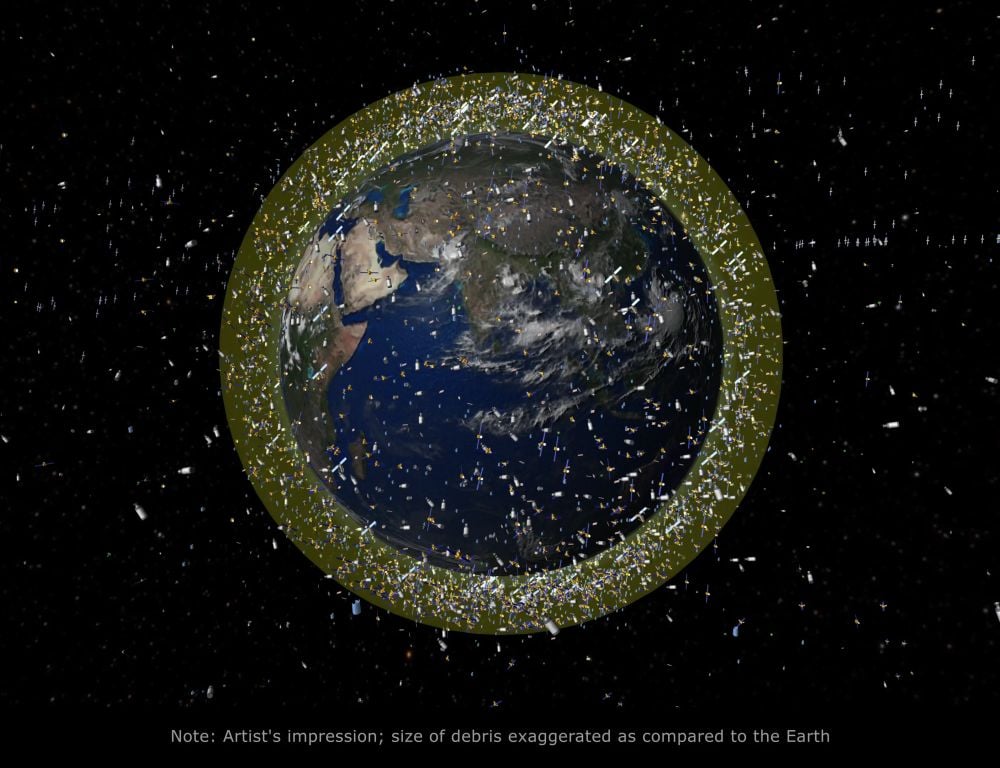
The growing problem of satellites crowding one another is generating concern in the space community, for good reason. Almost 20,000 satellites orbit Earth now, and with more satellite constellations and other satellites being launched every year, Low-Earth Orbit (LEO) is starting to look like it's reaching its limit. Of particular concern are the 3,500+ plus satellites that are basically zombies. They are either completely non-functional or not sending any signals alerting other satellites to their presence.
A collision between two satellites could be catastrophic. Satellite constellations have some built-in redundancy which would help deal with the loss, but there's an additional risk. A collision could also create a debris cloud, multiplying the ongoing risk. The Kessler syndrome describes a cascade of collisions generated from debris created in a single, initial collision, that goes on to create even more collisions. It's like a feedback loop that keeps getting worse.
Somehow, this problem must be dealt with. The existing debris is one thing, but intact zombie satellites are another. These have lost the ability to communicate and warn other satellites of their presence. These can be repaired, and that's the subject of new research in Acta Astronautica. It's titled "CORTEX: An autonomous, end-to-end, convex-based framework for close-range rendezvous trajectory design and guidance with hardware testbed validation," and the lead author is Minduli Wijayatunga, a new aerospace engineering faculty member in The Grainger College of Engineering, at the University of Illinois Urbana-Champaign.
This work is all about the growing idea of Rendezvous and Proximity Operations (RPO). Spacecraft docking operations have been custom-designed solutions for individual situations, like docking with the ISS. But with thousands of zombie satellites, custom docking solutions aren't realistic.
"Rendezvous and Proximity Operations (RPO) are shifting from bespoke demonstration missions such as Northrop Grumman’s Mission Extension Vehicles, China’s Tianyuan–1, and Astroscale’s ADRAS-J, to routine missions due to the growth of in-orbit assets and the resulting demand for inspection, servicing, assembly, and debris mitigation," the authors write. They point out that while there were only about 13,700 tracked objects in LEO in 2019, there were more than 24,000 in 2025. That's a shocking increase, and there's no signs of it slowing down.
That's forcing scientists to develop autonomous ways to deal with the overpopulation. The growing population of satellites isn't the only thing dictating an autonomous solutions. Autonomous repair is also critical because of the time delay in communications between the ground and LEO, and because satellites are best observed in and maneuvered with in windows when they're illuminated by sunlight.
“These spacecraft must be able to track the trajectories of uncooperative objects autonomously but also make go/no-go decisions without waiting for the ground to decide,” Wijayatunga said. “Suppose your thruster fails or you encounter high-order orbital perturbations that push you away from your nominal trajectory. In those instances, how do you make those decisions?” she added.
That's what CORTEX is being designed to do.
"This paper presents CORTEX (Convex Optimization for Rendezvous Trajectory EXecution), an autonomous framework for close-range rendezvous trajectory design and guidance under sensing, actuation, and dynamics uncertainties," the authors write.
"Among RPO phases, the close-range rendezvous, where the servicer locates the docking port axes and approaches the client, is particularly safety-critical. It must satisfy strict operational constraints (e.g., keep-out zones, approach corridors, plume/line-of-sight constraints, illumination/eclipses) under limited actuation authority and imperfect relative navigation," the authors write.
Wijayatunga's PhD involved trajectory and guidance using something called convex optimization. Convex optimization is a method that lets a spacecraft approach a target using math and trajectories, not input commands. It basically solves a math problem of trajectories and thruster commands until the lone, best answer is arrived at. The answer should mean a successful docking. The idea is to reach that docking state with minimal fuel use while also following constraints like the targets no-go zones or keep-out zones. Those are places on the target satellite that might house sensitive equipment like sensors or antennae.
This work expanded to include the idea of sunlight windows. Cortex also includes options other than aborting if things went sideways. Instead of calling the docking off, CORTEX can reconsider its options. It even takes into account situations that arise where thrusters can't be fired.
“I wanted to bring that same idea into developing CORTEX and expand it, taking into consideration sunlight windows so we don't have to operate in darkness. That, and the replanning versus abort architecture, are novel in CORTEX,” Wijayatunga said.
“CORTEX has trajectory design and guidance, so if you deviate significantly from your nominal mission trajectory, it replans the trajectory and re-approaches unless you are in severe violation of your keep-out zone, in which case it returns to a passively safe orbit. It's an algorithm to recover from the unexpected. We tried instances where you're supposed to use your thrusters, but you can't for whatever reason. And CORTEX was very robust to that.”
CORTEX is being tested in a particular modelled docking scenario. It's what's called an ISAM, an In-orbit Servicing Sssembly and Manufacturing. It's designed for what will most likely be fairly typical in the future. It involves a Client Spacecraft Object (CSO) in LEO and is designed to test autonomous approach, servicing, and inspection of the CSO by a servicing spacecraft with a Guidance Navigation and Control (GNC) system for proximity operations.
Hold positions are an important part of CORTEX. In the modelled scenario, there are two of them that let the servicing spacecraft pause and re-evaluate in a fixed relative position. One is at the beginning of the fly around, and the other is at the start of the final approach. They are there to let the servicer pause during eclipses, a new idea in CORTEX.
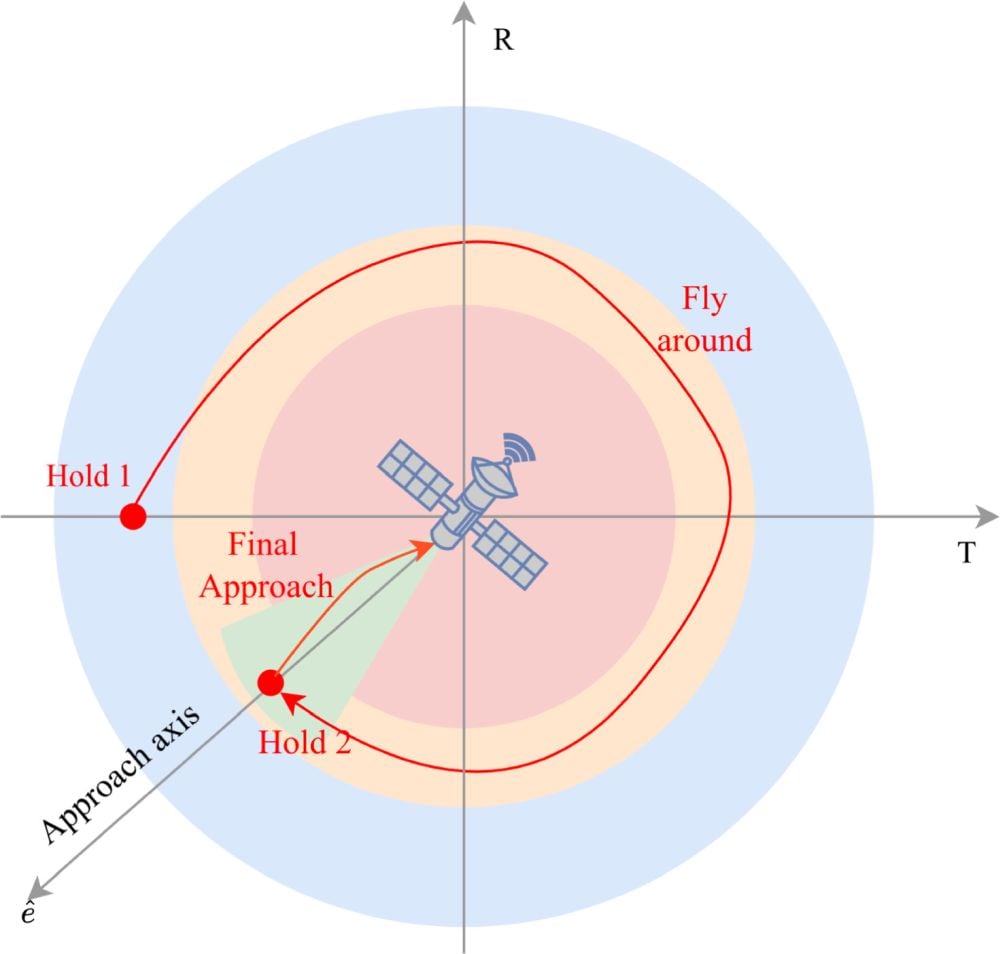 This figure shows some aspects of CORTEX controlling a servicing spacecraft while it approaches and rendezvous with a client satellite. Blue shows the Rendezvous Sphere, orange shows the Approach Sphere, and red is the Keep Out Sphere. The approach axes is identified as CORTEX's successful solution to the docking problem. Image Credit: Wijayatunga et al. 2026. Acta Astronautica.
One way of looking at CORTEX is as a flow chart governed by four things. "The goals of CORTEX are: (i) minimize fuel and time consumption, (ii) ensure that both the fly-around and final approach occur entirely in sunlight, (iii) avoid the KOS during the fly-around phase, and (iv) satisfy the approach corridor constraint and avoid plume impingement during the final approach," the authors write.
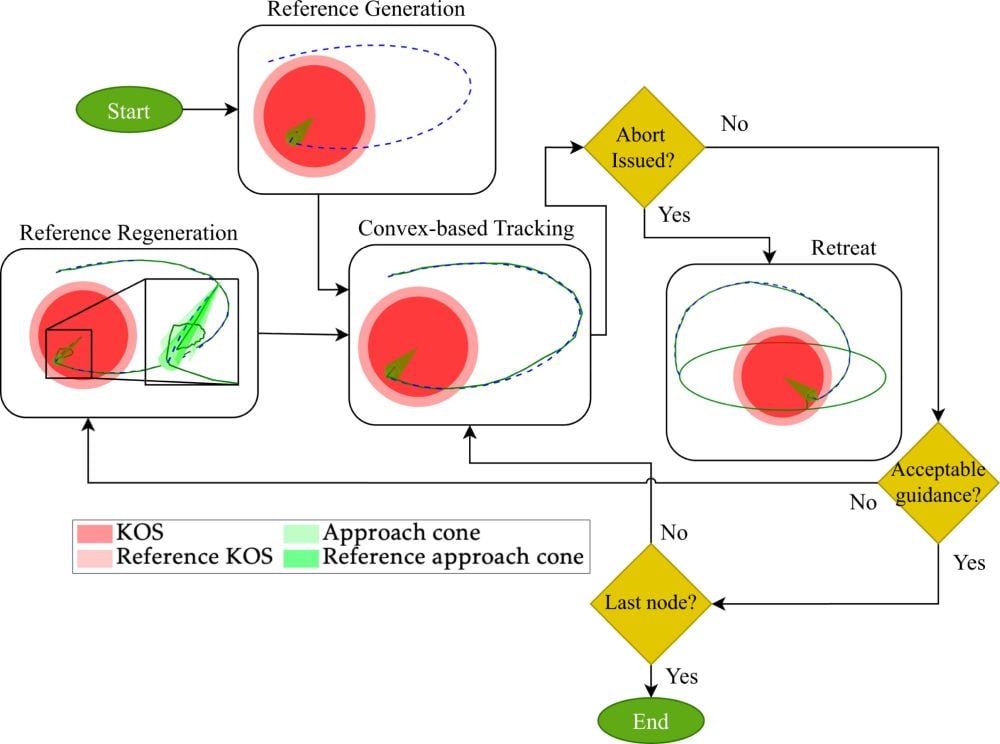 This schematic flow-chart shows how CORTEX works. CORTEX has the ability to abort its approach if necessary, and instead of giving up, it can determine how to re-approach its client. Image Credit: Wijayatunga et al. 2026. Acta Astronautica.
In the tests, the servicing spacecraft was forced into an odd, unexpected situation and CORTEX had to deal with it. Its orbit was unexpectedly perturbed, and thruster operation was impaired, not firing when they were supposed to. Other errors were also introduced, corresponding to unexpected factors like solar storms and thrust errors.
CORTEX fared well in the tests and was able to deal with the unexpected situations in the models. "In all cases, the framework either recovered successfully while respecting safety constraints or executed a safe retreat before entering unsafe regions," the authors write.
“In some of the hardware tests, if the servicer violates the approach corridor, it leaves the keep-out zone and retreats to a safe position and in others, the servicer is able to recover and carry on with its mission,” Wijayatunga said.
Satellite close approach and recovery isn't purely hypothetical. The Japan Aerospace Exploration Agency (JAX) launched Astroscale's ADRAS-J in 2024. It successfully maneuvered within 50 meters of a typical piece of space debris, a spent rocket stage, considered to be an 'uncooperative target.' It flew around the object, catching multiple images from different angles. It used sensors and autonomous navigation to accomplish this.
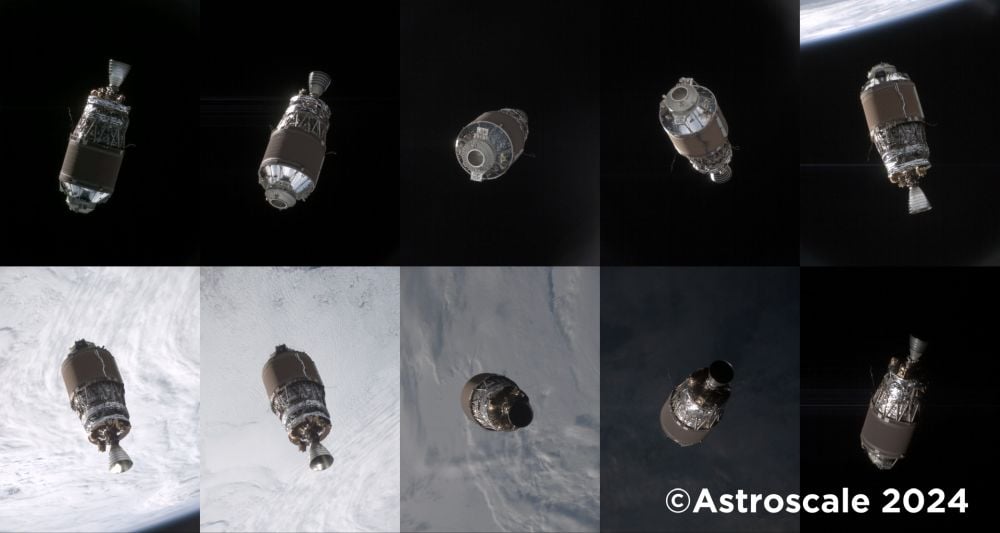 Astroscale's ADRAS-J autonomous spacecraft approached a spent rocket booster, a typical piece of space debris, and captured images of it from multiple angles. It's a step toward eventual servicing of zombie satellites. Image Credit: Astroscale/JAXA.
The hallmark of the past few decades is rapidly-advancing technology. Among other things, it's led to a crowded LEO and a growing population of zombie satellites.
Maybe we'll end up using technological tools like CORTEX, enabled by AI and machine learning, to manage the problems technology has helped generate in the first place.