 Universe Today
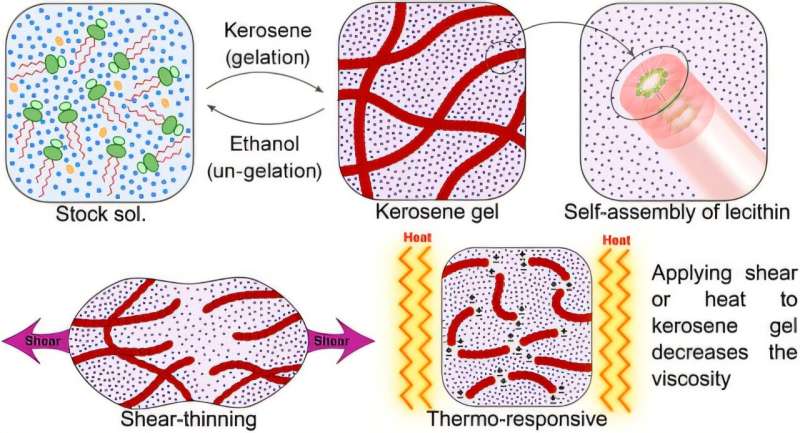
In propulsion system design, engineers have long faced a trade-off between solid and liquid rocket fuels. Each has advantages and disadvantages, and in an effort to try to min/max the efficacy of different types of fuel, researchers have long placed an emphasis on a hybrid between solids and liquids - in other words they’ve been working with gels. Unfortunately, gels have their own sets of problems to deal with. But a new paper published by Pranay Mudaliar and Jerin John of Concordia in the journal Langmuir uses an uncommon ingredient to elegantly solve some of those problems, but which is typically used in a completely different area of human activity - lecithin.
Solid rocket boosters, like those that powered the Space Shuttle, are very stable, durable, and quick to ignite. However, they are also impossible to turn off - you have to burn through all the propellant at once.
Liquid fuel, on the other hand, is much more flexible, much like automotive fuel. Liquid fueled engines can be throttled up and down, restarted multiple times, and generally are much more controllable than their solid cousins. However, they also float and slosh around in tanks, which is a particular problem in zero-gravity environments, as that sloshing can cause vapor pockets that can break a turbopump if not filtered out beforehand. Liquids also have a tendency to leak or evaporate over long periods, making them less than ideal for multi-year journeys through the solar system.
Fraser talks about some of the difficulties of orbital refueling.On paper, gels offer a great solution to that. While sitting in a tank, they would act like a dense solid, but can also act like a liquid when forced into a combustion chamber. However, they suffer from their own challenges, such as shelf life and temperature dependent phase changes.
The paper details a new type of fuel that uses an unexpected special ingredient. Lecithin might sound familiar, but not in the context of rocket fuel. It’s commonly used as an emulsifier in food. It’s commonly used to keep chocolate smooth, and salad dressing cohesive, and can be found on thousands of supermarket food labels. In the context of rocket fuel, lecithin acts simply as an organic gelling agent.
When combined with a trace amount of calcium chloride salt, lecithin molecules self-organize into microscopic worm-like structures called micelles. Chains of these form an invisible 3D mesh that can trap and hold kerosene molecules, a more traditional type of rocket fuel, in place. Lecithin also has the added advantage of being an organic compound made up of carbon and hydrogen, so it will burn right alongside the kerosene rather than acting as simply dead-weight like may other non-combustible thickening agents previously used to create gel fuels.
Scott Manley talks about the engineering behind solid rocket boosters. Credit - Scott Manley YouTube ChannelBut perhaps the most interesting feature of the new fuel is a physical phenomenon known as shear thinning. When the gel is sitting under normal conditions in a tank, it holds it shape firmly like a gelatin, eliminating the sloshing features that cause so many problems in liquid-fuel rockets. However, as soon as there’s a mechanical pressure or shear force applied - such as when the spacecraft pressurizes the fuel lines - the micellar mesh breaks apart, causing the gel to temporarily quickly collapse into a liquid.
Measurements detailed in the paper show the gel’s viscosity dropping by a factor of more than 100, creating an easily pumpable liquid that can be sprayed through injector nozzles. But when the pressure stops, the material snaps back to its rest state as a gel. There are also two other environmental stimulants that can cause this liquid transformation - if the gel is heated up to between 59 and 68 degrees C, or splashed with a small amount of ethanol. In other words, localized thermal or chemical triggers could easily intentionally force specific amounts of fuel to liquefy without requiring the bulk of the fuel to do so.
Another appealing feature of the gel, from an experimental standpoint anyway, is that it’s clear. Therefore researchers can watch it with optical high-speed cameras and lasers to analyze its structure as well as its spray patterns. And a final appealing feature is its shelf life - the gel stayed stable in a tank for over a year, with no visible signs of a phase separate that plagues many other gelatin-like fuels.
It is still a very long road from the benchtop to the launchpad though. The new fuel hasn’t actually been sprayed through the high-pressure injectors that would be used on an actual rocket engine. Nor has it shown that it’s capable of withstanding the vibrations and temperature shocks that come from being launched into space. But as the Concordia researchers continue its development, this new gel is looking promising for potentially powering a future mission.
Learn More:
Concordia University - RESEARCH: New gel fuel could make rocket and satellite propulsion easier to control
P. Mudaliar & J. John - Rheology and Thermal Characterization of Lecithin-Based Kerosene Gels for In-Space Propulsion