Universe Today
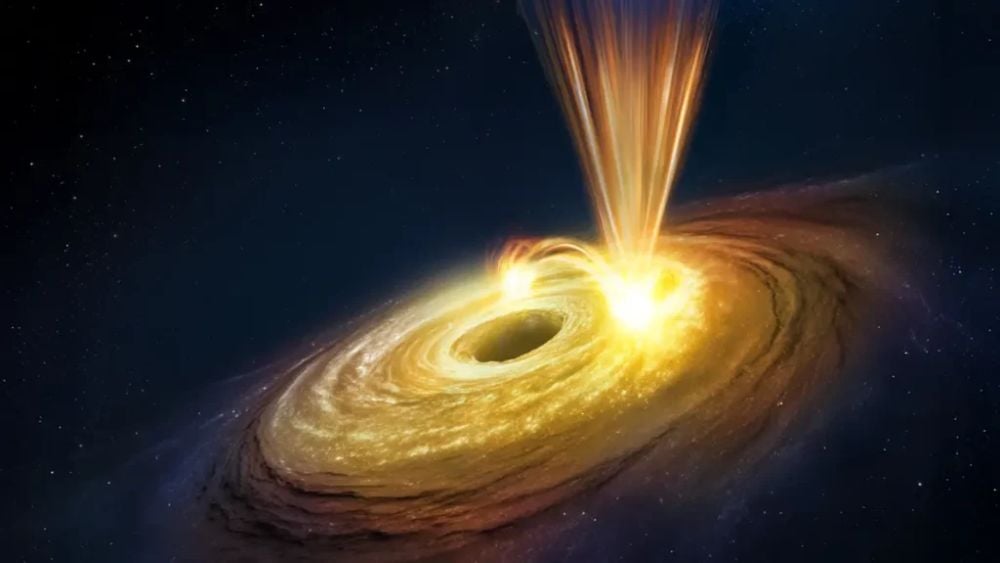
Astronomers have found a unique blast coming from a distant supermassive black hole (SMBH). The SMBH is in a barred spiral galaxy about 135 million light-years away named NGC 3783. The Hubble recently imaged this face-on galaxy, showing its beautiful spiral arms and its center, tightly-packed with shining stars.
All large galaxies host SMBH like these, as far as astronomers can tell. On their thrones at the center of these galaxies, SMBH go about their business accreting matter. When they're actively accreting matter, they're called active galactic nuclei (AGN). As the matter gathers in a rotating disk around the hole, it heats up and emits powerful, multispectral radiation. Often times, that radiation triggers powerful outbursts.
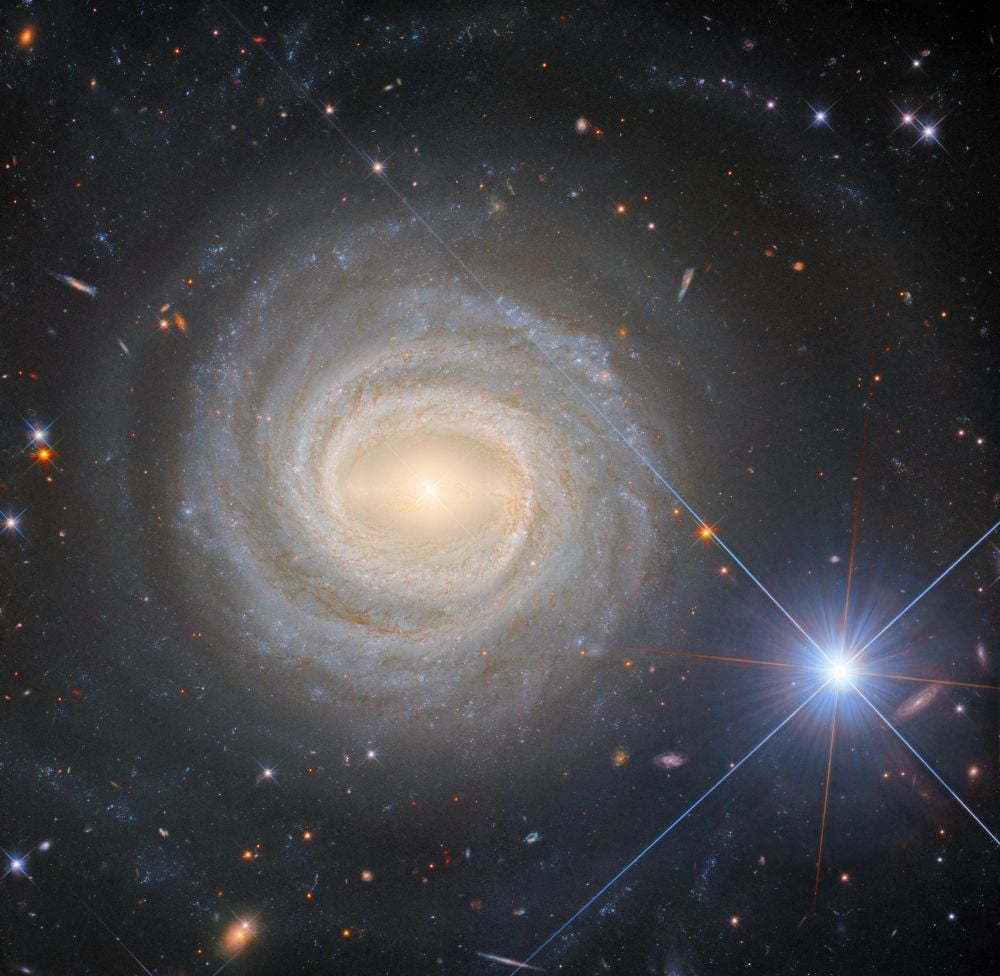 This Hubble Space Telescope image shows NGC 3783, a bright barred spiral galaxy about 130 million light-years from Earth. It has an extremly bright core, making it a Seyfert galaxy. A supermassive black hole powering an AGN lurks in its center, and recent observations detected an extraordinarily fast-moving ejection of material from its accretion disk. Image Credit: ESA/Hubble & NASA, M. C. Bentz, D. J. V. Rosario. LICENCE: CC BY 4.0 INT or ESA Standard Licence
In recent observations, astronomers at Space Research Organisation Netherlands (SRON) observed the SMBH with the XRISM and XMM-Newton x-ray space telescopes. Over a ten-day period of observations, the team detected the type of powerful outbursts typical of these black holes and their AGN. Variations in the SMBH's x-ray brightness accompanied the outbursts, which is typical for them.
But they also detected something else. There was a simultaneous gas ejection from the SMBH's accretion disk. The gas travelled at 60,000 km/second, or about 20% the speed of light. This is extremely fast, and unexpected for this type of object. Astrophysicists call the outbursts ultrafast outflows (UFO).
The discovery is in new research in Astronomy and Astrophysics titled "Delving into the depths of NGC 3783 with XRISM III. Birth of an ultrafast outflow during a soft flare." The lead author is Liyi Gu from SRON, the Space Research Organisation Netherlands.
“We’ve not watched a black hole create winds this speedily before,” said lead author Gu in a press release. “For the first time, we’ve seen how a rapid burst of X-ray light from a black hole immediately triggers ultra-fast winds, with these winds forming in just a single day.”
“AGNs are really fascinating and intense regions, and key targets for both XMM-Newton and XRISM,” adds Matteo Guainazzi, ESA XRISM Project Scientist and co-author of the discovery. “The winds around this black hole seem to have been created as the AGN’s tangled magnetic field suddenly ‘untwisted’ – similar to the flares that erupt from the Sun, but on a scale almost too big to imagine.”
The ejections are more similar to the Sun's coronal mass ejections (CME). During a CME, the Sun hurls massive amounts of its plasma from its corona out into space. Sometimes these CME strike Earth's magnetosphere, where they're responsible for aurorae and potentially damaging geomagnetic storms. They come from the Sun's lower corona, where magnetic fields are dominant.
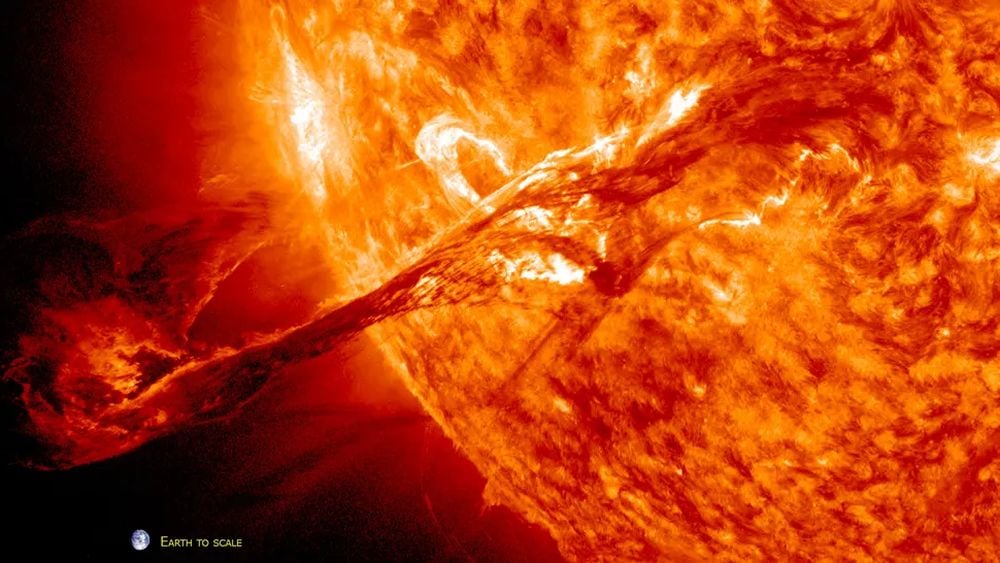 This image shows a 2012 coronal mass ejection from the Sun. It travelled at about 1500 km/second, a small fraction of the 60,000 km/sec ejection speed from the AGN. Image Credit: NASA
The fact that the UFO from the SMBH are more similar to CMEs and are driven by magnetic field activity is unexpected. Adding to the surprising nature is that the UFO wasn't necessarily a singular event. It may be part of a longer outburst. "This outflow may not be an isolated event but rather part of a broader outburst that lasted approximately three days," the researchers write. "A secondary outflow, with a velocity of about 3700 km s−1, was also detected coincident with the UFO."
The event had multiple smaller flares along with the primary, most powerful flare. To investigate the variation in the main flare, the researchers divided it into five different periods. They also plotted the x-ray variability of the main, prominent flare.
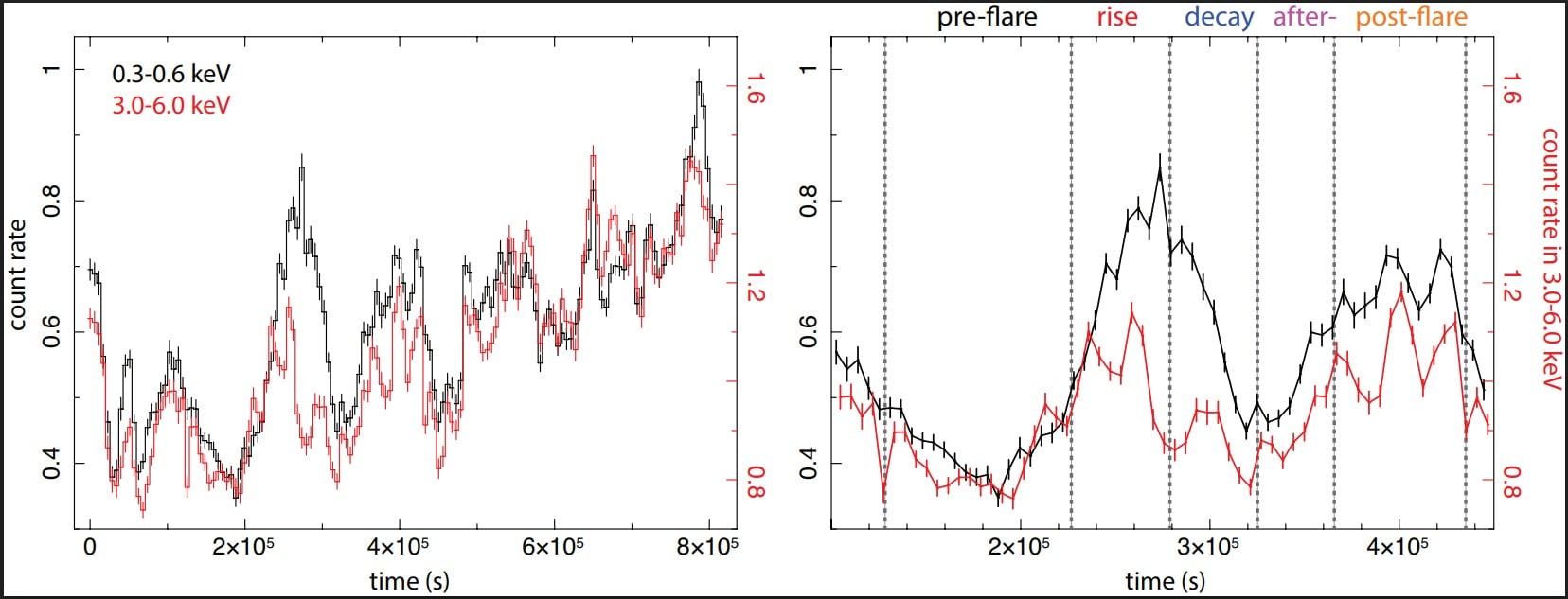 This panel on the left shows the flare divided into five periods. The panel on the right shows the main flare and its x-ray variability. Image Credit: Gu et al. 2025. A&A
The researchers determined that the flare originated from a location at a distance of about 50 times the size of the SMBH. This is an extreme region, where the powerful forces emanating from the SMBH combine in chaotic ways. Extreme gravity and extreme magnetic forces dominate the region. The researchers think that the outburst was triggered by magnetic reconnection. In magnetic reconnection, magnetic fields are rearranged, and when that happens, some magnetic energy is converted to kinetic energy. That kinetic energy drives plasma out of the system, and that's exactly what the researchers found at NGC 3783.
NASA's Solar Dynamics Orbiter caught magnetic reconnection happening on the Sun in this video.
This discovery is more than just an oddity. AGN are a central part of black hole feedback. Not only do SMBH absorb material, they also create powerful jets and winds that feed material back into their host galaxies. Stars like to form from cold gas, and SMBH feedback heats gas up and inhibits star formation. These jets can elso evict star-forming gas from the galaxy, preventing it from ever forming stars in that galaxy. Feedback can also aid the formation of stars when shocks from the AGN slam into gas and compress it, leading to more stars forming. But astrophysicists aren't certain what turns the feedback on or off.
“Windy AGNs also play a big role in how their host galaxies evolve over time, and how they form new stars,” said Camille Diez, a team member and ESA Research Fellow. “Because they’re so influential, knowing more about the magnetism of AGNs, and how they whip up winds such as these, is key to understanding the history of galaxies throughout the Universe.”
XMM-Newton and XRISM teamed up to make this discovery. XMM-Newton tracked the initial flare, while XRISM observed the flare and the winds, and studied the winds speed and structure in detail, trying to discover how they were emitted from the AGN. While the UFO from the AGN is similar to the Sun's CMEs, its power dwarfed anything the Sun can produce. The eruption was 10 billion times more powerful than a Solar CME. That's not surprising, since the black hole has about 30 million solar masses.
“By zeroing in on an active supermassive black hole, the two telescopes have found something we’ve not seen before: rapid, ultra-fast, flare-triggered winds reminiscent of those that form at the Sun," said ESA XMM-Newton Project Scientist Erik Kuulkers. "Excitingly, this suggests that solar and high-energy physics may work in surprisingly familiar ways throughout the Universe.”