 Universe Today
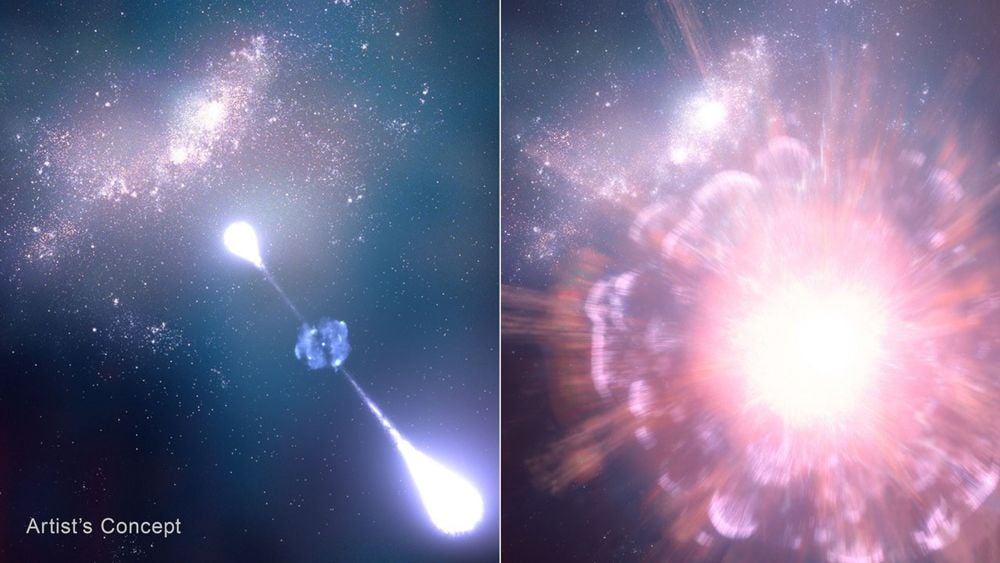
Supernovae aren't one of the JWST's main science themes, but the perceptive telescope is full of surprises. Recently, it pinpointed a single star in a galaxy when the Universe was only about 730 million years old. It wasn't just any random star; this one was a supernovae responsible for a gamma-ray burst (GRB) detected back in March, 2025.
This stunning accomplishment trumps the telescope's previous most distant supernova, which the JWST discovered only 1.8 billion years after the Big Bang.
The GRB is named GRB 250314A, and a pair of recent papers in the journal Astronomy and Astrophysics Letters outline its properties and how it was observed. One is titled "JWST reveals a supernova following a gamma-ray burst at z ≃ 7.3," and the lead author is Andrew Levan from Radboud University in Nijmegen, Netherlands. The second paper is "SVOM GRB 250314A at z ≃ 7.3: An exploding star in the era of re-ionization," and the lead author is Bertrand Cordier from CEA Paris-Saclay.
“Only Webb could directly show that this light is from a supernova - a collapsing massive star,” said lead author Levan in a press release. “This observation also demonstrates that we can use Webb to find individual stars when the Universe was only 5% of its current age.”
Finding a supernova from the Era of Reionization is no small feat, since the Universe was only a fraction of its current age. The fact that this SN triggered a Long Gamma-Ray Burst (LGRB) makes the finding even more important, since it allows astrophysicists to compare stars then and now.
"The majority of long-duration gamma-ray bursts (GRBs) are thought to arise from the collapse of massive stars, making them powerful tracers of star formation across cosmic time," Levan and his co-authors write. "Evidence for this origin comes from the presence of supernovae (SNe) in the aftermath of the GRB event, whose properties in turn link back to those of the collapsing star. In principle, thanks to GRBs, we can study the properties of individual stars in the distant Universe."
Cordier and his co-authors are likewise intrigued by this opportunity. "Long gamma-ray bursts (LGRBs) have long been regarded as powerful tools for exploring the early Universe," they write. "Their direct association with individual stars makes them key tracers of star formation, including when their host galaxies are too faint to be observed directly through emission lines, even with sensitive facilities such as the James Webb Space Telescope (JWST)."
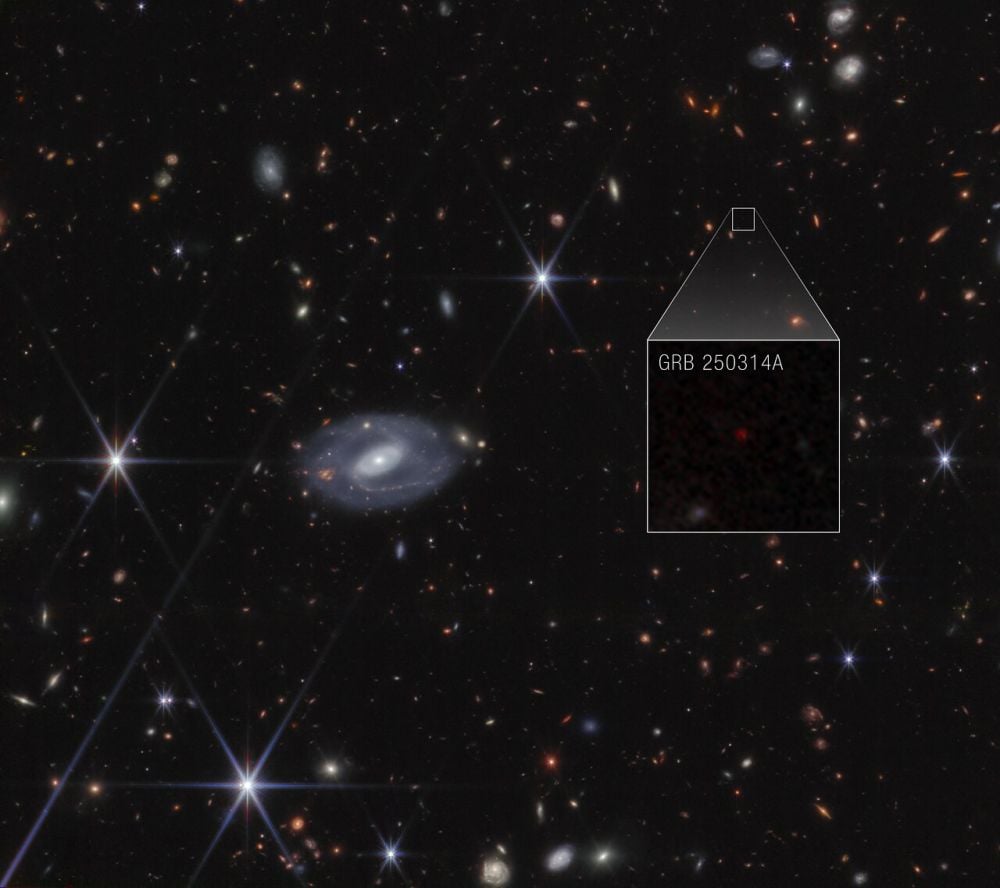 This JWST NIRCam image shows the location of the GRB and supernova embedded in a field of innumerable galaxies. Pinpointing a single star from the ancient Universe is an impressive feat. Image Credit: NASA, ESA, CSA, STScI, A. Levan (IMAPP), Image Processing: A. Pagan (STScI)
Most supernovae that astronomers observe aren't so far back in time. Typically, their light increases over several weeks before beginning to dim. But this one was different. Since it's so ancient, it's light is stretched by the expansion of the Universe, and it brightened over several months. Astronomers know this, and they waited until about 3.5 months after the GRB ended to search for the supernova with the JWST. That was when the SN responsible for the burst was projected to be its brightest and easiest to observe.
“Webb provided the rapid and sensitive follow-up we needed,” said Benjamin Schneider, a co-author on the Levan paper and a postdoctoral researcher at the Laboratoire d'Astrophysique de Marseille in France.
Overall, the SNe progenitors of GRBs are a fairly homogenous group. But their host galaxies aren't, and when the objects are so distant and ancient, it makes understanding them difficult. The fact that there are so few of these ancient detections adds to the difficulty, and the excitement. "There are only a handful of gamma-ray bursts in the last 50 years that have been detected in the first billion years of the Universe,” Levan said. “This particular event is very rare and very exciting.”
The GRB was first detected by SVOM, the Space-based multi-band astronomical Variable Objects Monitor. SVOM is a small space telescope developed jointly by China and France. It studies exploding stars by detecting GRBs and observing x-rays and visible light. SVOM first detected the GRB on March 14th, 2025. Then NASA's Neil Gehrels Swift Observatory pinpointed the source of the x-rays. Observations with other telescopes, including the Nordic Optical Telescope on the Canary Islands and the VLT in Chile, gathered more data. Weeks later, the JWST identified the single star behind it all.
Since they knew months in advance that they were going to use the JWST to search for the progenitor SN, the researchers took the time to model and predict the light curves they hoped to detect. "The photometry is entirely consistent with the predictions made prior to the observations and is supportive of the detection of SN light at z ≃ 7.3," Levan and his co-authors write.
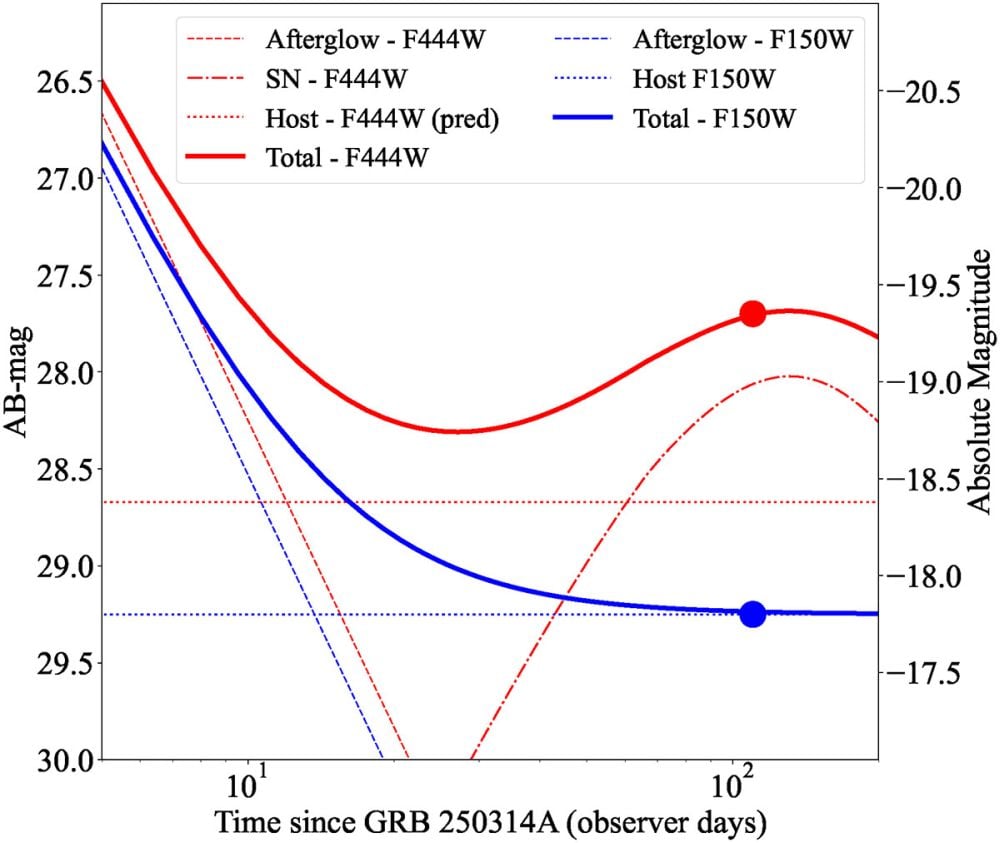 This figure shows the light curve of GRB 250314A as expected in the JWST's F150W2 and F444W bands.It includes components form the afterglow, the SN, and the host galaxy. Image Credit: Levan et al. 2025 A&A
Even though the Universe has changed a lot since the time of this GRB, the JWST showed that the supernova that generated is shockingly similar to modern day supernova. During the Era of Reionization (EOR), stars were more massive and lived shorter lives. They also had lower metallicity, since generations of stars hadn't lived and died yet, spreading their heavier elements out into the interstellar medium. The gas between galaxies was also opaque during the EOR, and high-energy light couldn't pierce it.
“We went in with open minds,” said Nial Tanvir, a co-author and a professor at the University of Leicester in the United Kingdom. “And lo and behold, Webb showed that this supernova looks exactly like modern supernovae.” But astrophysicists will need a deeper, more detailed look before any small differences will become apparent.
As for the galaxy that hosts the SN, it appears to be similar to its contemporaries. However, the galaxy is little more than a smudge of reddened light that occupies a few pixels, so differences might become apparent with more data, too.
With this success, Levan and his co-researchers have been given more JWST observing time to study the ancient supernovae and GRBs in the early Universe. The goal is to capture the warm afterglow from GRBs, and use it to learn more about ancient galaxies. “That glow will help Webb see more and give us a ‘fingerprint’ of the galaxy,” Levan said.
There are some underlying uncertainties that more observations could help settle. In their paper, Levan and his colleagues point out that there's some uncertainty around how much of the light they're detecting is coming from the SN and how much is background light from the galaxy. "The host galaxy is the most difficult element to constrain," they explain in their research.
It comes down to variability.
"Although the observations match the expectations of the canonical model, they do not currently demonstrate the variability of the source and, thus, it is relevant to consider if they could also be described by alternative solutions," they write. "Perhaps a more pressing issue in this context is whether the light could be entirely dominated by the host galaxy with a smaller (or even zero) contribution from the underlying SNe."
However, the agreement between the emissions expected from a SN and what they observed largely overrides any concerns. "In the case of GRB 250314A, the agreement of the data to model expectations prior to the observations is remarkable," Levan and his co-authors write in their conclusion. "Ultimately, the host contribution can be accurately determined via a second epoch of observations."
In Cordier et al.'s paper, the authors point out how a dedicated mission could help advance our understanding of ancient GRBs, supernovae, and galaxies. "In the future, we stress that a game-changing GRB mission capable of autonomously localising and performing spectroscopy of high-redshift GRBs would be transformative," they write in their conclusion.

