Universe Today
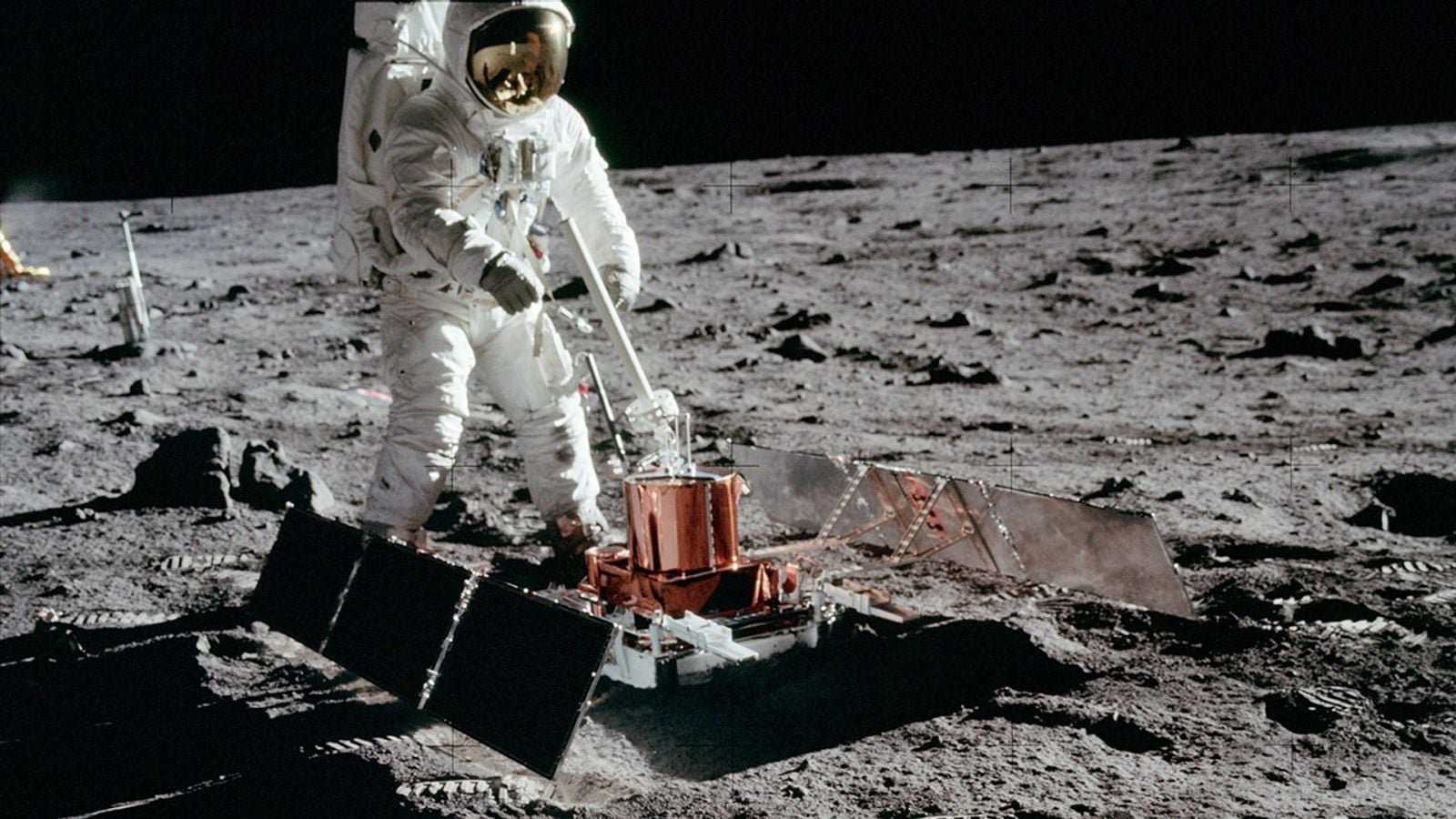
With tomorrow’s launch of the Artemis II mission to the moon, NASA’s focus on our natural satellite is again gaining traction. To that end, two recent papers in the journals Earth and Space Science and Icarus point out how ordinary fiber optic technology could be deployed on the lunar surface to detect our ancient neighbor’s seismic activity.
To date, the only technology capable of catching such activity had been the now-defunct Apollo-era seismometers (which over an eight-year operational period) detected over 12,000 seismic events. But hopefully that will soon change.
The core idea is that distributed acoustic sensing (DAS) converts a single thin fiber-optic cable into thousands of sensors over many kilometers, Carly Donahue, a co-author on both papers and a physicist in the Earth and Environmental Sciences Division at Los Alamos National Laboratory in New Mexico, told me via email. That makes it a very attractive option for the Moon, where mass and cost are major constraints and deploying large numbers of individual instruments is difficult, Donahue tells me.
DAS uses a fiber‐optic cable to measure ground motion along its entire length, effectively turning the cable into thousands of vibration sensors, the authors of the Earth and Space Science paper write. This method offers dense spatial coverage and could simplify deployment compared to conventional instruments, they write.
A joint project with ETH Zurich, Donahue is principal investigator of this project to explore optical fiber sensors on the moon.
With traditional seismology, every station is a separate instrument with its own power, communications, and deployment requirements, says Donahue. With DAS, a single fiber can become thousands of sensors, so instead of deploying a large network of individual instruments, you can deploy one system that serves as array-scale coverage, she says. That makes it a very efficient way to collect dense seismic data within the mass and cost constraints of a lunar mission, says Donahue.
In fact, DAS can operate using standard telecommunications optical fiber.
Cables exceeding 10 km would enable deep interior studies, while shorter deployments of hundreds of meters would suffice for characterizing thermal moonquakes and local shallow structure, the authors of the Earth and Space Science paper note.
Even After 12 astronauts walked on the moon at six different nearside locations and several high-tech lunar orbital mappers delivered reams of data, we still know very little about the moon’s interior and how it evolved. That is, after it formed in the aftermath of a Mars-sized impactor that struck earth some 4.5 billion years ago.
The moon has a layered interior—crust, mantle, and a small core—but scientists are still unsure about key details like the exact size and state of the core, the structure of the mantle, and why the near and far sides are so different, says Donahue.
A Plethora Of Lunar Science
DAS could significantly improve our ability to image the lunar subsurface, says Donahue. With very dense spatial sampling along the fiber, we can observe how seismic waves change as they travel, she says. That kind of resolution could help us map variation in the shallow crust, identify buried structures, and potentially map and detect features like lava tubes, says Donahue.
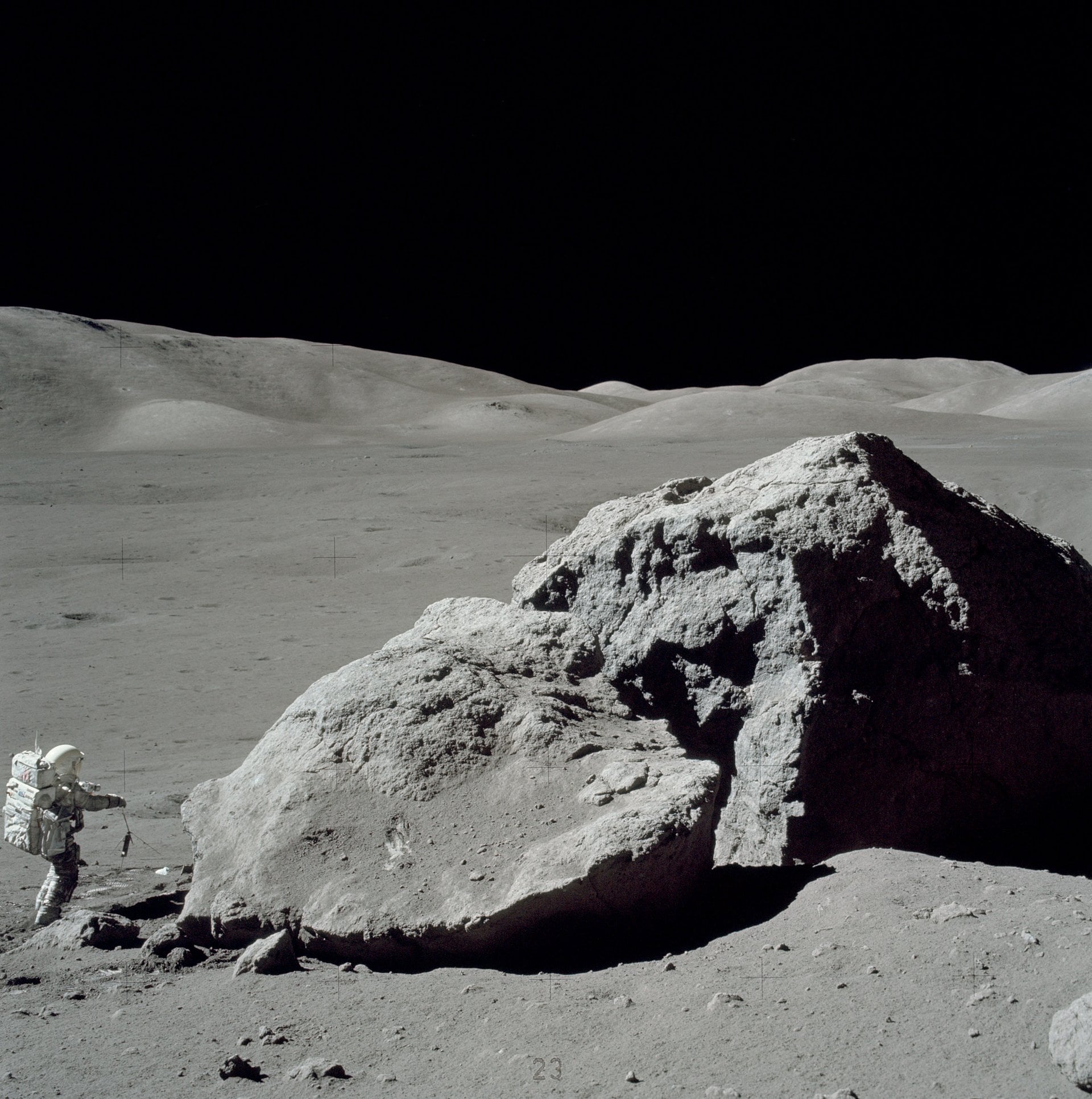 Scientist-Astronaut Harrison H. Schmitt standing next to a huge, split boulder during Apollo 17 mission. Credit: Cernan/NASA via Wikipedia.
Project costs would likely range into the tens of millions of dollars which given the scientific payoff is a small price to pay.
A DAS payload could also fit naturally within the Artemis program as well as with NASA’s Commercial Lunar Payload Services (CLPS) delivery program.
Together, these studies show that fiber-optic sensing is a promising and efficient way to monitor moonquakes, even without deeply burying the cable, which could simplify how we deploy seismic instruments on the lunar surface, says Donahue.
The timeframe to develop the sensing technology for a future mission could advance on relatively short timescales, on the order of a couple of years.
But that mainly involves adapting the system to the space environment, including hardening it for temperature extremes, radiation, and launch vibration, says Donahue. Actual deployment would depend on developing a reliable way to lay fiber and then integrate it into a flight opportunity, she says.
Robots could set it all up.
I would be thrilled to see a robot deploying fiber, says Donahue.
And since the moon has no real atmosphere, Donahue says there would be no air resistance and with the moon’s reduced gravity, she expects that a surface-based optical fiber line launcher could easily distribute the optical fiber over significant distances.
The Bottom Line?
Our nearby natural satellite is crucial in understanding both our Earth-Moon system as well as the rest of the solar system. With the current renewed emphasis on a human presence on the lunar surface as well as robotic missions to the surface, we should at long last begin to capitalize on the fact that our closest planetary body lies so easily within reach.