 Universe Today
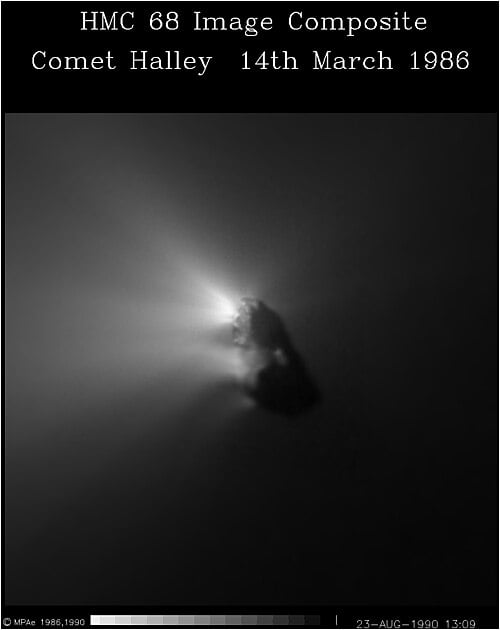
Halley’s comet captures the imagination in a way that few other astronomical objects do. When it last made its approach toward the Sun (admittedly when this author, who is now middle-aged, was one year old in 1986), humanity responded with a fleet of spacecraft known informally as the “Halley Armada”. Yet, because of the comet’s trajectory, those spacecraft were only able to visit their target for a fleeting few hours, leaving planetary scientists wanting more. Now, a new paper by researchers at Khalifa University and their co-authors, and available in pre-print on arXiv, describes a mission plan that would allow a spacecraft to actually rendezvous with this most well-known comet for the first time ever.
To be fair, getting there will still not be easy. Halley’s comet has a retrograde orbit, and is extremely inclined at 162°. Such a trajectory would require a massive amount of energy to match - which is why the spacecraft in the Halley Armada, such as ESA’s Giotto and the Soviet Vega probes, only performed flybys, and were only able to collect data in the comet’s halo for a few hours, leaving many unanswered questions about the comet’s surface.
After the excitement of even those brief visits, various groups around the world started planning a rendezvous mission. However, they relied on speculative technologies, such as high-power nuclear-electric propulsion systems or super-heavy launchers that hadn’t been developed yet - and still haven’t been fully vetted. So the authors decided to take a different tack - using not one but two planetary gravitational assists.
Fraser explains what comet tails are made out ofA traditional, single gravity assist wouldn’t fit the bill alone, as many previous mission architectures had discovered. However, by dancing around the gravity wells of both Jupiter and Saturn, the authors found a sweet spot where they could use simple low-power Hall-effect thrusters, which, crucially already exist, to catch up to the comet in-situ and still have enough “dry” mass left over to do some interesting science.
First, the craft would launch with around 2000kg of instrumentation and propellant, and do a slow continuous burn of its Hall-effect thruster, powered by a flight-proven Radioisotope Thermal Generator (RTG). A flyby at Jupiter would offer the first speed boost, launching the spacecraft towards Saturn and its rings. A subsequent gravity assist at Saturn alters the spacecraft’s orbital plane to match Halley’s high inclination while not requiring it to burn through any additional chemical propellant.
It would reach Halley in 2060, around a year before its next perihelion, and safely outside the orbit of Mars. Getting nearby so early means the spacecraft would be ready to watch the fireworks as the cometary nucleus heats up during its approach to the Sun. And it would be able to do so with plenty of scientific instrumentation - the mission architecture budgets for 750 kg of payload for science operations. The spacecraft itself could stay in the vicinity for months, rather than hours, allowing planetary scientists to get close-up data from a comet as it goes through its stunning transformation.
Fraser explains why it is technically difficult to land on a comet.Critically, this mission architecture has a design constraint - the best windows to launch it are in August 2036 and September 2037. Yes, that means it will take more than 20 years for the spacecraft to reach the rendezvous point. But it also means we have about 10 years to get the project from start to launch.
That’s a tall ask in these times of budgetary constraint. But if there’s one thing that brings even non-astronomy nerds out to look at the night sky it’s a comet. And Halley’s is the most famous of them all. We already know where and when it will be. At this point we as a species just have to make a commitment of whether we want to truly visit it for a long time or not - now we have a blueprint to show us how to.
Learn More:
R. Flores et al - Double Gravity-Assist Rendezvous Trajectory to Halley's Comet Using Deep-Space Low Thrust
UT - Famed Halley's Comet Passes Aphelion This Weekend
UT - Was the Repeating Passage of Halley's Comet Known of in Ancient Times?

