 Universe Today
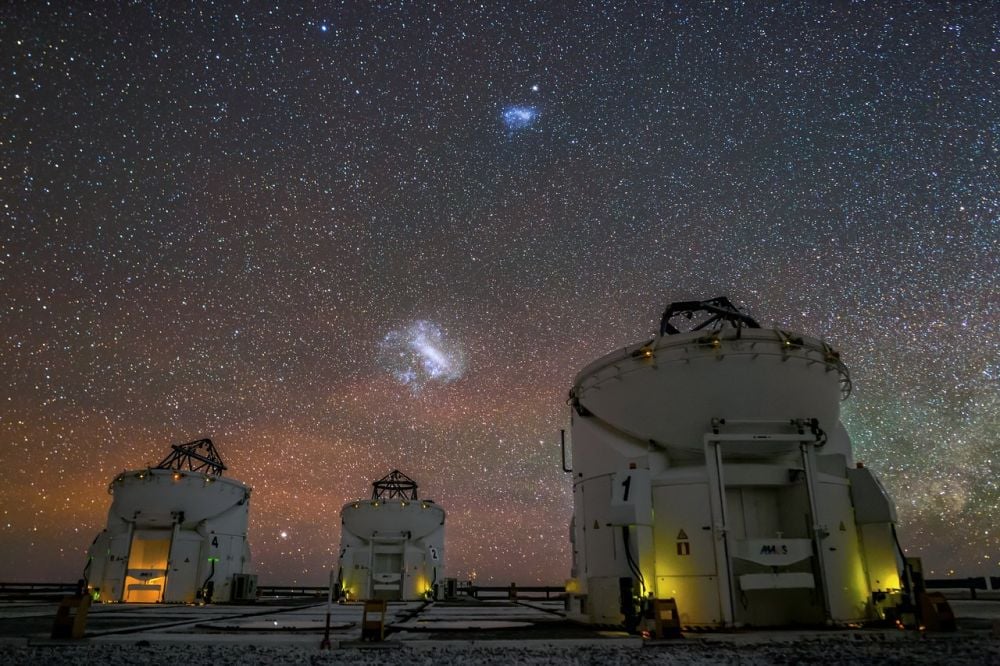
The Large and Small Magellanic Clouds are irregular dwarf galaxies and satellites of the Milky Way. The LMC is about 163,000 light-years away and the SMC is about 206,000 light-years away, and their close proximity makes them excellent laboratories for the study of galaxies in general. The Clouds are the focus of a new research group being formed at the Leibniz Institute for Astrophysics Potsdam (AIP).
Both clouds are home to numerous objects and regions that capture astronomers' attention. The LMC hosts the Tarantula Nebula, an extremely active star-forming region that contains some of the largest stars known. The SMC hosts NGC 346, an open star cluster that contains numerous massive stars and is still forming many high-mass stars. The Clouds also contain variable stars that act as standard candles in the cosmic distance ladder. That's just a sample from a long list of the clouds' interesting features.
It can be easier to study things like star formation in galaxies other than the Milky Way, because we're inside the MW and can't see all of it. The Large and Small Magellanic Clouds are excellent natural laboratories to study how galaxies evolve because astronomers can see them from a good vantage point.
The new research group will focus on how galaxies form and how their properties change over time. Resolving individual stars is the key to understanding the bigger picture of galaxy evolution. The group's work will be based on the results from 4MOST, the four-metre Multi-Object Spectrograph Telescope installed on the VISTA Telescope at Paranal Observatory.
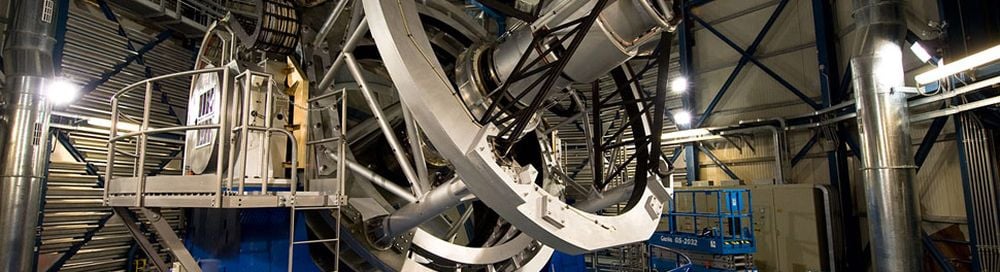 The VISTA telescope features a three-ton, 67 megapixel digital camera with a wide field-of-view combined with the sensitivity to detect very faint sources. Image Credit: ESO
VISTA (Visible and Infrared Survey Telescope for Astronomy) is a wide-field telescope with a 4.1 meter primary mirror that sees in part of the infrared spectrum. It's dedicated to a survey of the southern sky in near-infrared (NIR) and is the largest facility in the world to dedicated to that. VISTA features a three-ton, 67 megapixel digital camera, and 4MOST is a fibre-fed spectroscopic survey instrument attached to VISTA. For a five year period, VISTA and 4MOST will be completely dedicated to a program of surveys that excludes all other observations. 4MOST saw first light in October, and is currently in the commissioning phase. Full science operations are scheduled to start in the second quarter of 2026.
Dr. Lara Cullinane will head the new research group. Cullinane is a post-doc at AIP who focuses on the detailed photometric, kinematic, and chemical properties of individual stars in their wider galactic contexts. "My current reserch focusses on the Magellanic Clouds; I'm co-PI of the 4MOST consortium survey One Thousand and One Magellanic Fields (1001MC), and I aim to trace the effects of interactions between the Clouds by analysing the kinematics and abundances of their stellar populations, particularly in the outskirts," Dr. Cullinane writes in her bio.
The One Thousand and One Magellanic Fields (1001MC) survey will gather the spectra of about half a million stars in the Magellanic Clouds. It will measure both the elemental abundances and the kinematics of different stellar populations in the Clouds to open a window into how they formed and interacted with each other.
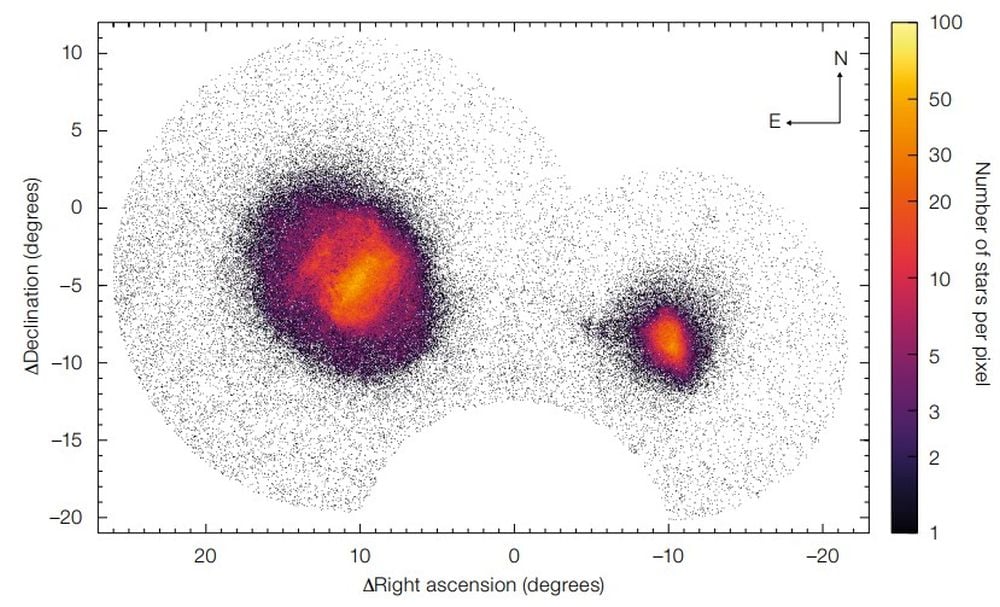 This image shows the 4MOST survey area. The survey will capture not only the Magellanic Clouds but their outlying regions. "This area comprises targets that trace the extent of different stellar populations and that describe substructures throughout the Magellanic Clouds," the ESO document explains. Image Credit: 4MOST Consortium Survey 9: One Thousand and One Magellanic Fields (1001MC)
"My work involves looking in detail at the photometric, kinematic, and chemical properties of resolved stellar populations in nearby galaxies in order to trace their history, and learn more about the processes that drive their evolution across cosmic time,” Cullinane said in a press release.
The Magellanic Clouds are more gas-rich than the Milky Way, meaning that a greater fraction of their masses is hydrogen and helium. But they have lower metallicity, and seem to form stars in episodic bursts rather than at a steady pace. However, their stars range from the very young to the very old, indicating that star formation has been ongoing for a long time.
There are many unanswered questions about the Clouds. As satellites, astronomers thought that both galaxies have been orbiting the MW for a long time. But data from the ESA's Gaia mission suggest that they may be on their very first passage by the MW.
The Magellanic Stream is a massive stream of gas contained in high-velocity clouds that trails behind the Clouds and into the MW's galactic south pole. The Leading Arm feature is ahead of the Stream. What created these? Was it ram-pressure, tidal stripping, interactions between the clouds, or a combination of all three?
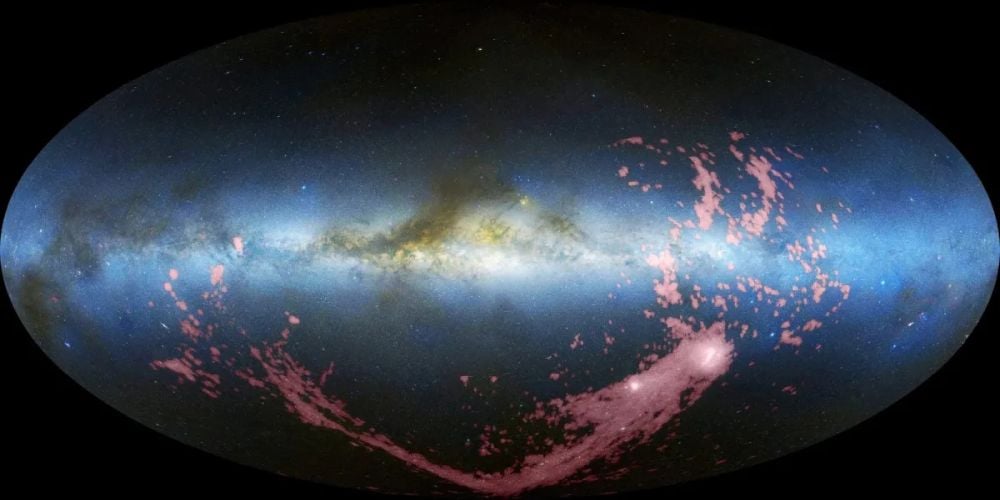 The Magellanic Stream extends behind the Large and Small Magellanic Clouds and through the Milky Way's southern galactic pole. Image Credit: NASA
Why do the clouds form stars in bursts? What triggers the bursts? Do interactions between the Clouds or with the MW trigger them? Or do internal processes?
How did the chemical abundances and the metallicity gradients in the Clouds evolve over time? What do they tell us about star formation across cosmic time scales, and about how gas flows and mixes?
As we see so often in astronomy, it takes large datasets to find answers to these types of questions. Large survey missions have proven their scientific value, and some of them have been focused on the Magellanic Clouds. This includes the VISTA survey of the Magellanic Clouds system (VMC), the SMC in Time: Evolution of a Prototype interacting late-type dwarf galaxy (STEP) survey, the Survey of the MAgellanic Stellar History (SMASH), and the Optical Gravitational Lensing Experiment (OGLE).
But according to the European Southern Observatory document describing 4MOST, these were photometric surveys and lack the necessary spectroscopic data. "Next to this wealth of photometric observations, which have yet to reach their full exploitation (also including data from the Gaia satellite), there is a pronounced lack of spectroscopic observations across the range of stellar populations and substructures of the Magellanic Clouds."
What spectroscopic observations there are lack the high-resolution required for chemical tagging, a powerful tool for determining the history of stellar population. 4MOST's One Thousand and One Magellanic Fields will address this shortcoming by acquiring high-resolution spectroscopy for half a million stars. This will allow "A comprehensive study of the kinematics and chemistry of a large number of stars at different evolutionary phases and with a wide spatial distribution," according to the ESO document.
The Large and Small Magellanic Clouds represent an opportunity to learn more about the life of galaxies, how they form stars and move gas around, how they interact with each other, and how they evolve. At the end of the survey, astronomers will have much more data that will hopefully help them find some of the answers they seek.

