Universe Today
(This is Part 1 of a series exploring the mythic side of the Big Bang!)
Let’s say you are transported back in time to some ancient culture. And along the way you somehow forget everything you knew about modern cosmology (don’t worry about the details, it’s just to get us going here, pretend if you have to that it’s a very strange and selective sort of amnesia introduced by the time traveling device). Doesn’t matter where or when, as long as it’s before the advent of the modern scientific method. And let’s say this culture you’ve been dropped into, whether it’s a complex, large civilization or just a small collection of tribes, decides to make you their equivalent of a priest or shaman or other kind of generic religious leader.
They are a bright, curious people, just as bright and curious as people are today. They’ve noticed lots of weird things about the universe around them. They see the sun and moon arcing overhead. They see thousands of tiny dots of light in the sky every night. There are mountains, rivers, and seas, filled with creatures – some of which are friendly, others not so much. They have their own legends and stories, passed down from generation to generation.
And they’ve got some questions for you. Specifically, they are asking you, oh wise one, what is the universe and where did it all come from? Why are the mountains the way they are, why are the stars the way they are? Why are people here, and not somewhere else. And what are we doing here anyway?
Congratulations, you are now the local cosmologist, and you have to tell your new people a story. A creation story. In this story, you have to explain the origins of the universe, you have to explain the contents and structure of the universe, and you have to explain our place in the universe and our relationship with the universe.
You have to explain why the universe came to be, how it came to be, when it came to be, and who or what was responsible for the universe coming to be.
You have no telescopes. Not even a gnomon at your disposal. You have no laboratories, no data processing algorithms. You have no calculus, no theories of gravity or force or motion.
But to build your cosmological creation story, you do have some tools available to you. You have raw observations, at least what you can ascertain from your senses and from the memories and experiences of your people. You might or might have some mathematics, perhaps from simple geometry or even trigonometry.
You have some philosophical guides, as well, some time to sit down and think about how to think and how to organize your thoughts, how to decide which questions are worth asking, which observations are most important, how to decide which statements are valid and which are useless.
You have the history of the people, the memories of the memories of the memories, who remember in some way where they came from, or what animals are useful and friendly, or what stars appear at what times of the year.
What else do you have to craft your story? Well you also have theology and divine revelation. Presumably your people have some sacred texts or important stories and traditions. Perhaps they have a collection of gods or spirits and other divine, supernatural entities. SURELY they played a role in the creation of the universe, right?
So what do you do with all this? On one side you have the job to do – the creation and structure of the universe and our place within it. And on the other you have your resources: observations, mathematics, divine revelation, and so on.
What story do you tell?
Every culture in the world and throughout history has faced this monumental task, the task of creating a creation myth. Myths aren’t just simple stories. They are ways for a culture or civilization to teach its people about themselves and the world. They have to make sense within the cultural context within which they appear. They have to inform and guide people. They have to let people say “oh, yeah, I get it, that’s why the stars come out every night, and why the ground is on the bottom and the sky is on the top. Oh yeah, and that’s why we’re here and what we’re supposed to do, and also why we aren’t too fond of the people in the next valley over.”
Our modern theory of the evolution of the universe is generally known as the big bang theory, is…a story. Yes, it’s a story rooted in mathematics and empiricism and the skeptical inquiry into the natural world that is the hallmark of science, but it’s still…a story. And because it’s a creation story, it still has to fulfill all the same jobs as all the other creation myths that have come before. The big bang theory has to explain where the universe came from, when it was born, how it came to be, and what our place in the cosmos is.
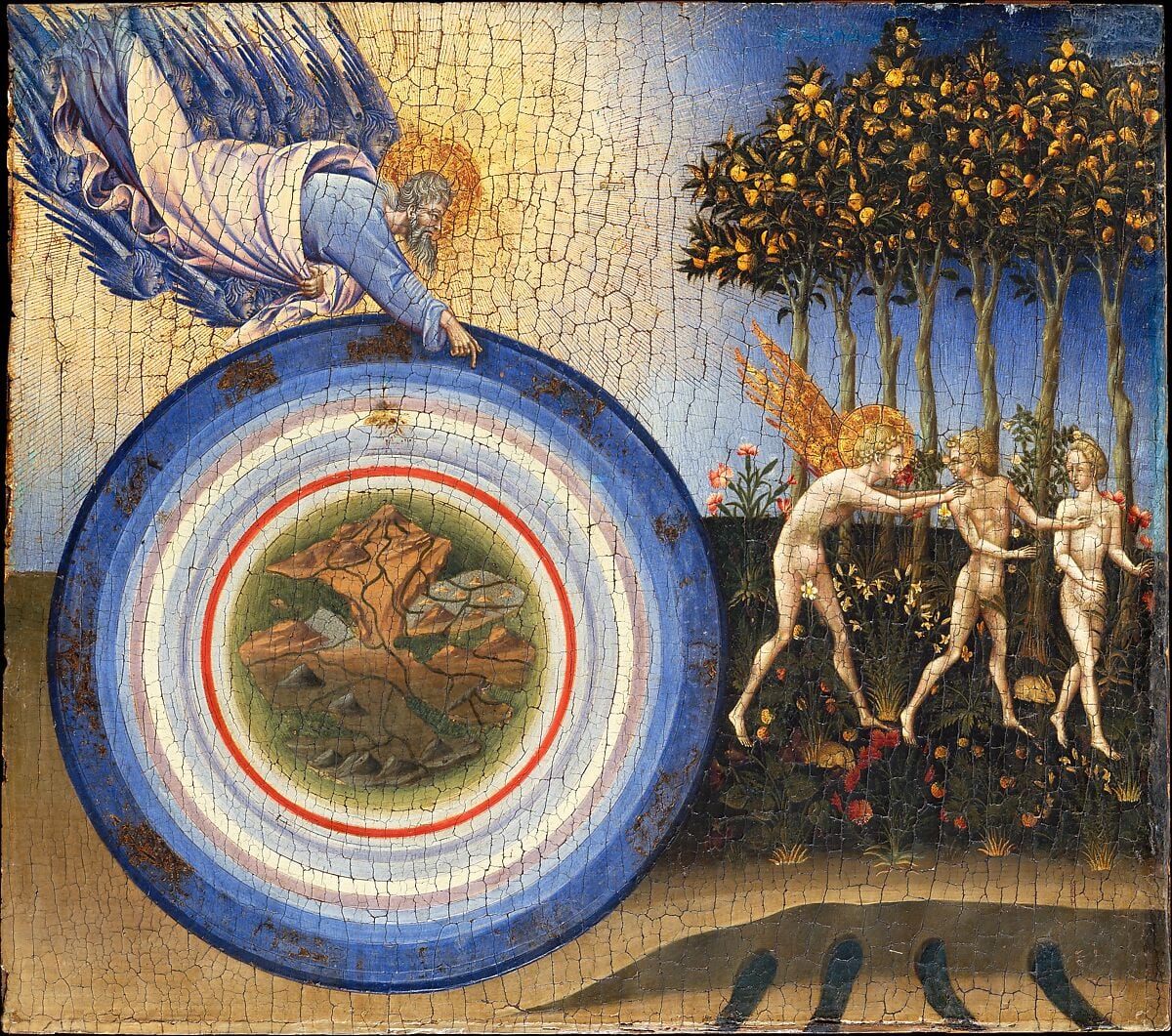
Not only is the big bang theory a great story, with lots of action and drama and pathos, it also shares many aspects and similarities to myths throughout time. While there are far too many creation stories to recount here, anthropologists have divided them into five broad categories:
Ex Nihilo, where a supernatural entity creates the universe out of nothing (and sometimes the universe manages to do this all on its own)
Creation from chaos, which often shares a blurry line where at first there’s a formless expanse of largely nothing (but somehow different than the NOTHING nothing of ex nihilo, but let’s not get into that right now). Perhaps there’s some sort of substance, like fog or an endless ocean, but it’s generally chaotic and not a fun place to be. From there, order, and a sensible universe, emerges onto the scene.
Another category, called world parent, sees some sort of divine being splitting into the components of the world.
In emergence myths, the universe has always existed but in a different form, and has transformed or evolved into the present-day world.
And lastly, in earth-diver myths, a supernatural entity dives down into the depths to bring up pieces of the world to build, bit by bit.
Let’s dig down into our modern creation story, the big bang theory, to see if it shares any of these elements…
To be continued!