Universe Today
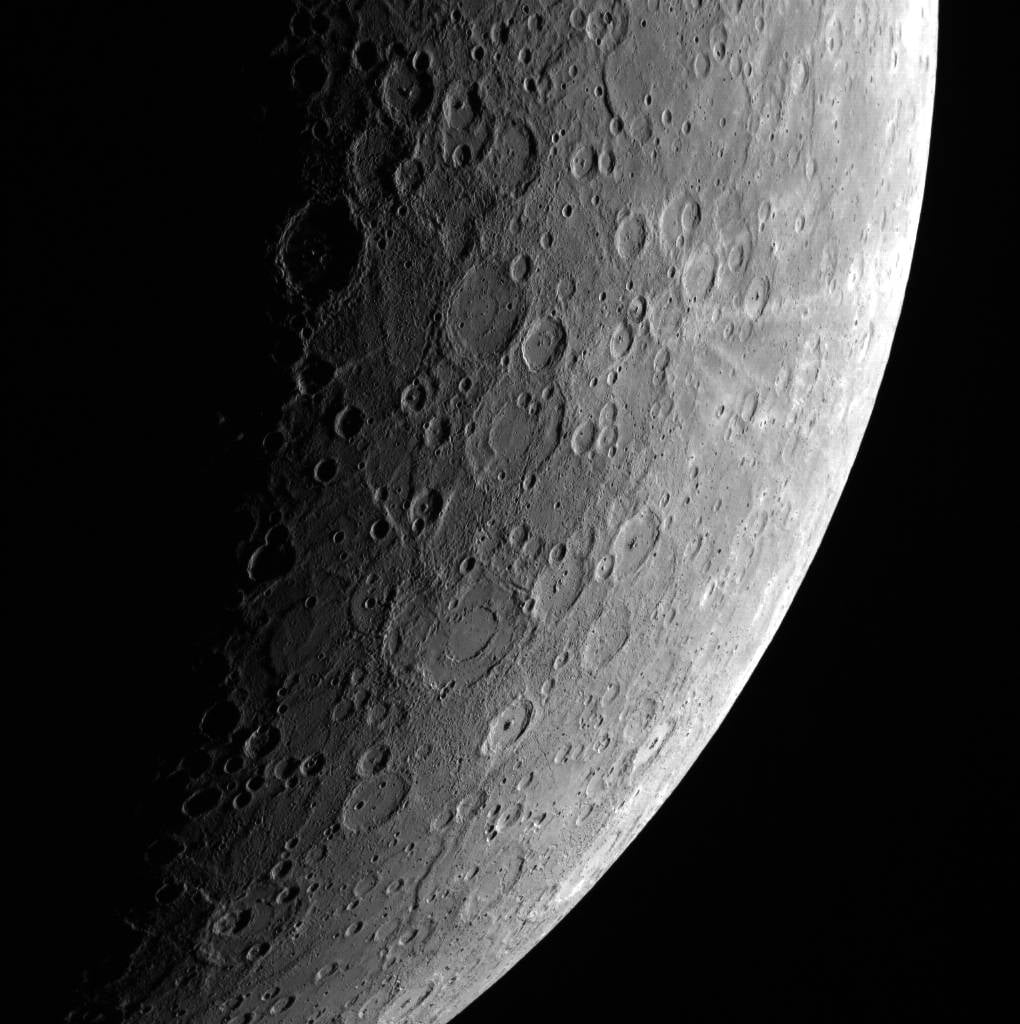
The closest planet to our Sun, Mercury, experiences extreme temperature variations. Since the planet has no atmosphere to speak of, it is in a constant cycle of where one side is extremely hot and the other extremely cold. On the Sun-facing side, temperatures reach a scorching 427 °C (800 °F), enough to melt tin and lead, and the surface is exposed to extremely lethal levels of radiation. On the night side, temperatures plunge to a chilling −173 °C (-279.4 °F), cold enough to freeze most liquids, including those used in battery manufacturing.
All of this makes exploring Mercury's surface very challenging. On the one hand, a rover would be subject to interference from the Sun's radiation on the Sun-facing side and would likely melt down. On the other hand, a solar-powered rover cannot operate on the night side, and a battery-powered vehicle would likely lose power quickly as its batteries die. But in the Terminator, the region between night and day on Mercury, temperatures are stable enough, and there is sufficient light for a solar-powered rover to study surface features and conduct science operations.
This is the proposal put forth by a research team from the Hawai’i Institute of Geophysics and Planetology (HIGP) at the University of Hawai’i at Mānoa. The team included Mari Murillo, a Planetary Science PhD Student at HIGP, and Paul G. Lucey, a prominent researcher with HIGP and Murillo's PhD advisor. The paper detailing their proposal was presented at the 2026 Lunar and Planetary Science Conference (2026 LPSC).
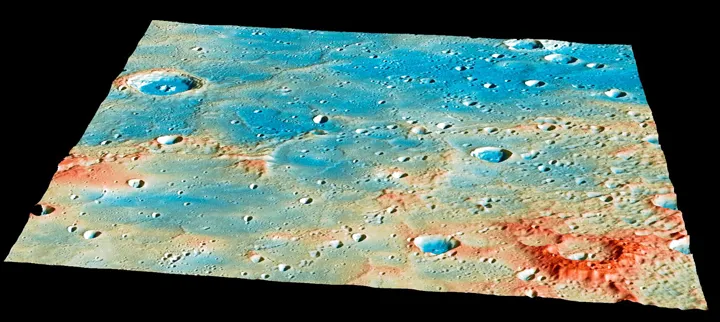 A false colour image of the area where MESSENGER is believed to have impacted. Credit: NASA/JHUAPL/Carnegie Institution of Washington
As they note in their paper, a Mercury lander mission would create opportunities to study unique geological features. These studies would address the unanswered questions scientists have regarding Mercury’s formation, volcanic history, and tectonic evolution. The idea of staying ahead of the Sun on Mercury has been explored extensively by scientists and through science fiction. Examples include Kim Stanley Robinson's 2312, and Charles Stross's Saturn's Children.
In both cases, a city on rails moves across the surface of Mercury, staying within the perpetual twilight of the Terminator region. This concept takes advantage of Mercury's 3:2 spin-orbit resonance, where the planet spins three times on its axis (58.6 Earth days) for every two orbits it completes around the Sun (88 Earth days). This resonance means that a single solar day, or the time it takes for the Sun to return to the same place in the sky (24 hours on Earth), lasts a whopping 176 Earth days.
As a result, a rover mission would only need to travel fast enough to stay ahead of the Sun, and would still be able to draw enough power from its solar arrays. The rover described by Murillo and Lucey in their paper would be equipped with a specific suite of scientific instruments for elemental analysis and mineral identification, including a Laser-Induced Breakdown Spectroscopy (LIBS) instrument, X-ray and gamma-ray spectrometers, Raman and infrared spectrometers, and an X-ray diffraction instrument. As they note:
These tools would provide critical insights into Mercury's regolith, enhancing our understanding of volatile-driven processes and space weathering effects. Key areas of geologic interest on Mercury include: Hollows. Volatile-rich, shallow depressions that provide insight into Mercury's unique geology.; often found in bright, high-albedo regions.
Specific features include pyroclastic pits and large tectonic scarps, which could offer clues about the planet's internal processes, composition, and lithospheric dynamics. Low-albedo patches are potential sites for organic material, while fresh impact craters would serve as natural probes into subsurface material. Then there's the polar regions, which are known to contain water ice and organic molecules, elements that are thought to have been delivered by asteroids and comets during the Late Heavy Bombardment (ca. 4.1 to 3.8 billion years ago).
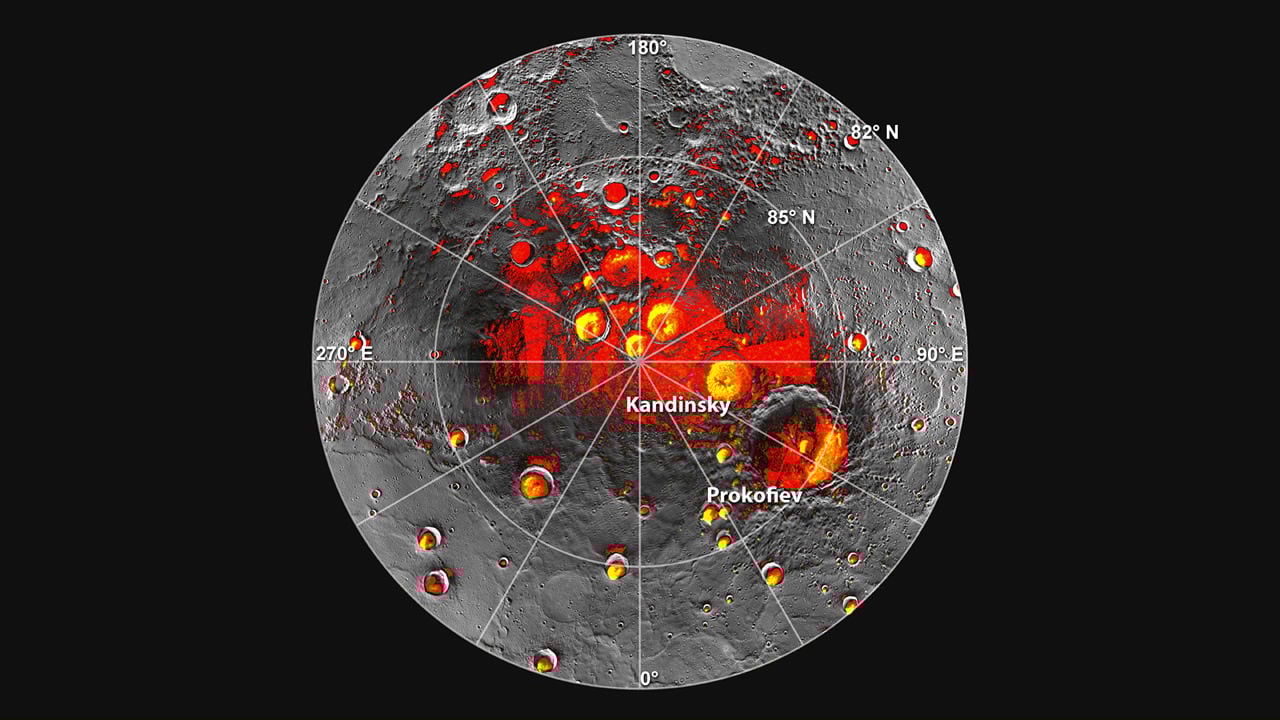 Mercury's northern polar region (red areas indicate water ice) based on data obtained by NASA's MESSENGER probe. Credit: NASA/JHUAPL/Carnegie Institution of Washington/NAIC/Arecibo Observatory
The rover's path would need to be selected to maximize scientific returns by providing access to these features and enabling sampling of diverse surface materials, while remaining within the designated Terminator region. "A preliminary traverse plan starts at a hypothetical landing site near the equator, chosen to optimize solar exposure and orbital mechanics," they wrote. "From this point, the rover can travel to latitudes where the Terminator’s velocity is slower, enabling sustained exploration. A detailed path considers sites of geologic interest as well as potential obstacles."
To accomplish these goals, the rover would need to traverse at speeds that match the Sun's apparent motion across Mercury's surface, depending on the latitude at which it is operating. To calculate the Terminator velocity, Murillo and Lucey used orbital ephemeris data from the Horizons System, developed by the Solar System Dynamics group at NASA's Jet Propulsion Laboratory. From this, they calculated a maximum velocity of ~6 km/h (3.7 mph) at the equator and 4.25 km/h (2.64 mph) at 45 degrees North or South. As they wrote:
In order to remain within a temperate region for exploration, a Mercury rover would not need to move at exactly the same speed as the terminator. It is only necessary for this rover to move quickly enough to remain within a designated band of temperate longitudes around the terminator. The angle of this temperate region is determined through consideration of such parameters as thermal inertia of the planetary surface.
Using historical examples, such as Apollo's Lunar Roving Vehicle, the Soviet Lunokhod 2 rover, and modern Mars rovers like Curiosity and Perseverance, they determined that a Terminator-tracking rover is feasible with existing and novel technologies. However, certain technological challenges remain, including solar panels that must function at low Sun angles and energy storage systems that ensure continuous operation during interruptions. The rover will also need autonomous navigation systems to maintain its position within the Terminator region while avoiding obstacles.
Further Reading: 2026 LPSC