 Universe Today

Sometimes it can seem like science has Nature all figured out. In mainstream press, that idea is hard to avoid, even if it's never stated overtly. But scientists, and maybe astronomers especially, see things differently.
When you're a scientist you understand better than most that our names for things like types of stars or stellar remnants are convenient dividing lines of our own devising. They're practical, useful, and serve an important purpose. But there are always objects that don't fit neatly into the dividing lines. One way of dealing with that is to create sub-types of objects, and sub-types of sub-types in an illustrative hierarchy.
But there comes a point where an object can't really be shoe-horned into an existing definition and sub-type. Gather enough examples of this object and it's time for a new category.
That's what's happening with a new type of stellar remnant.
White dwarfs are the stellar end-state of stars with less than 8 to 10 Earth masses. These stars have exhausted their nuclear fuel, left the main seqence, and shed their outer layers into space. What's left is an extremely dense object. Since stars are often found in binary systems, so are white dwarfs.
When they're in binary pairs, white dwarfs behave in particular ways. The compact, dense white dwarf can draw material away from its companion star, sometimes triggering a Type Ia supernova. Regardless of whether a supernova is triggered or not, the accretion of material generates x-rays, and these x-rays are like the white dwarf's signature.
In 2021, astronomers detected a white dwarf that had no binary partner, yet was emitting the tell-tale x-rays. They called it "Moon-sized" since it's the same size as Earth's moon. The name has kind of stuck and it's now referred to as "Moon". It also has other notable features like rapid rotation and an extremely powerful magnetic field. White dwarfs like this are not typically magnetic.
This is where "Gandalf" comes in.
When Gandalf was first found, it had no partner, and appeared to be surrounded by circumstellar material. It was the first instance of a solitary white dwarf exhibiting the x-ray signatures of a white dwarf binary. “We initially thought it was a binary system,” says Andrei Cristea, a PhD student at the Institute of Science and Technology Austria, and first author of the paper published in Astronomy & Astrophysics describing Gandalf. “At the remnant’s extremely high level of magnetism, its spin should be synchronized with its companion’s orbit, similarly to Earth’s rotation with the Moon’s orbit.”
But the fastest rotation period ever observed in a pair of white dwarfs is 80 minutes, while Gandalf's rotation period was only 6 minutes.
“If Gandalf were involved in a binary system, it would have been highly unsynchronized, which might have made it even more puzzling than it already is," said Cristea. "But we never found a companion. So, where does the circumstellar material come from?”
To answer that question, researchers led by Cristea used optical emission spectra. Those spectra showed two separate peaks in hydrogen, something often seen when a star is surrounded by circumstellar material.
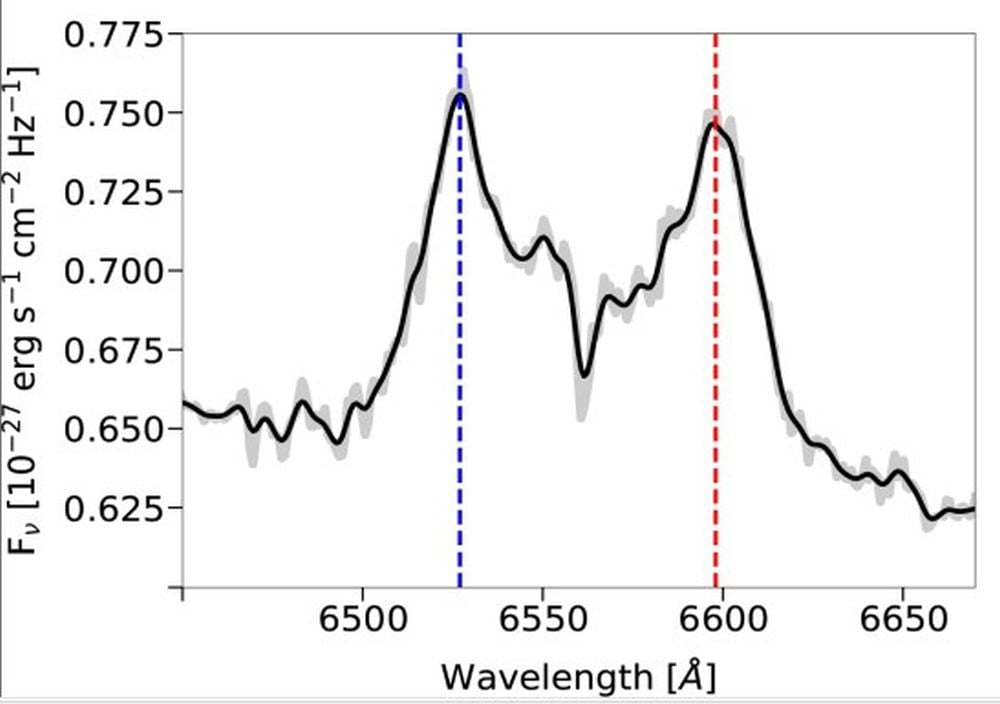 This figure from the research shows the double hydrogen peak in the optical spectra. It indicates that a star is surrounded by a disk of circumstellar material. Image Credit: Cristea et al. 2026. A&A
“We saw hydrogen emission spectra that exhibited a double-peaked signature, similar to cat ears,” said Cristea. “Usually, this signature indicates the presence of a disk of material surrounding a merger remnant. However, by examining the signal more closely, we realized that it was alternating between the two peaks over the remnant’s six-minute spin period. We have never seen anything like that before in any white dwarf,” he added. These observations match with a star surrounded by a half-ring of circumstellar material, an unusual observation in need of an explanation. Since Gandalf in Lord of the Rings is known for speaking in riddles, they named the object Gandalf.
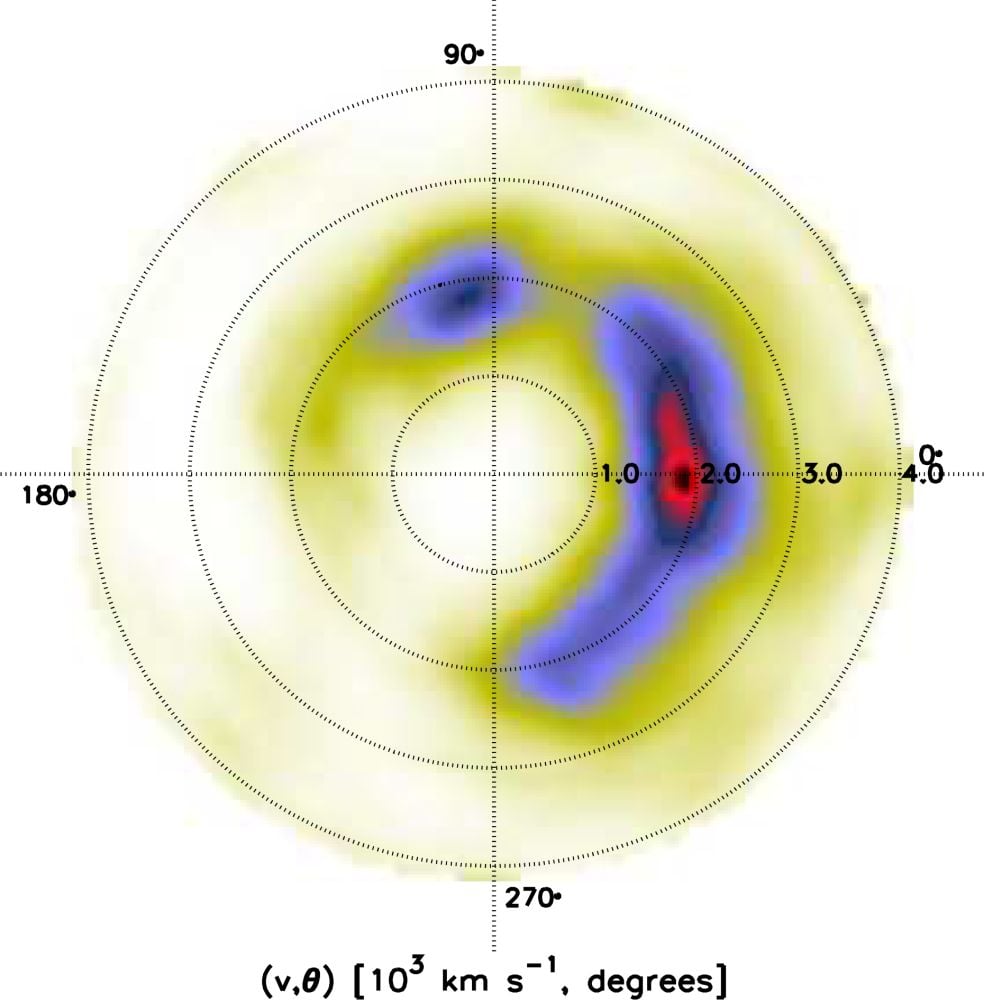 This is a doppler tomography image of Hydrogen-alpha emissions from Gandalf. The red indicates the region of strongest emissions. The remnant sits in the very middle. Image Credit: Cristea et al. 2026. A&A
The only way that circumstellar material could be trapped in a half-ring is if the object it surrounds has a strong, asymmetric magnetic field. But what could cause that?
So now Moon-Sized isn't alone and has Gandalf for a partner. The researchers found that Moon-Sized and Gandalf share five characteristics that distinguish them from other stellar objects: They're ultra-massive, highly magnetic, rapidly rotating, companionless, and they both emit X-rays. Because of these five properties in common, the scientists proposed that they're the same type of object.
But what are they?

According to new research in Astronomy and Astrophysics, both are the result of mergers and are called merger remnants. The authors of the paper say they're the first members of a new class of objects.
“If we find one new object in the vastness of the Universe, what are the chances of it being the only one? Usually, one stellar object with new characteristics is more than enough for us to start looking for similar ones," said co-autho Ilaria Caiazzo, assistant professor at ISTA. "But here, we actually found two objects with five overlapping features. This is plenty for a new class of star remnants!”

This animation shows how a half-ring of circumstellar material can remain intact around a rotating object with a powerful and asymmetric magnetic field. Credit: Russell C. J. Kightley italic text
The researchers came up with three separate explanations for the Gandalf and Moon-Sized.
If the white dwarf is rotating rapidly enough and has a powerful enough magnetic field, the material surrounding it could've been extracted from the white dwarf itself.
“This is my favorite scenario because it only accounts for the white dwarf itself rather than material originating from outside the star remnant,” said co-author Aayush Desai. This type of outflow scenario can occur around pulsars according to some research, but it's never been modelled around a white dwarf.
The second explanation is that material left-over from the merger forms the half-ring. It's possible that some of the material from the merger didn't accrete onto the white dwarf remnant and is orbiting it at a high-eccentricity, explaining the double hydrogen peak.
The third is that debris from another source, like planets or asteroids, is forming a half-ring around the remnant. “They are so dense that we would expect external material, such as asteroids or even disrupted planetary bodies, to collapse onto them,” said Desai. This type of pollution is found in other white dwarfs, though they never detected this type of pollution on Gandalf, only on Moon-Sized. The idea has merit, but unfortunately, it can't explain the x-rays detected from both merger remnants.
It appears that a new class of objects has been discovered. But with only two members, a healthy skepticism will accompany this research. The key, as it is in most scientific endeavours, is more and better evidence.
“The two objects we identified so far have lots of similarities, but also differences,” explained Desai. “Finding more such remnants will help us exclude scenarios and perhaps find other explanations altogether.”

