 Universe Today
In the early moments of the Big Bang, two elements were forged: hydrogen and helium. Technically, the tiniest traces of light elements such as lithium were produced as well, but nothing of consequence. The early Universe was about 3 parts hydrogen to 1 part helium. All the heavier elements, from the oxygen in your lungs to the iron in your blood, were created through astrophysical processes. Fused in stars, formed in supernovae, or scattered by the collisions of neutron stars. Even in the present cosmos, heavier elements are so cosmically rare that astronomers group them all as metals.
One of the ways astronomers study the Big Bang is through the relative abundance of different elements. In particular, the primordial abundance of hydrogen and helium. That might seem easy, since they were the two elements formed by the Big Bang, but there is a catch. Although all the helium we observe was formed during the Big Bang, not all the helium we observe was. Most of the helium was formed way back in the beginning, but helium is also the most common by-product of stellar fusion. So while stars are producing all the atoms we need to make data centers and Labubu dolls, they are also producing lots of helium. This means that over billions of years the relative abundance of helium has been increasing, and this skews the data.
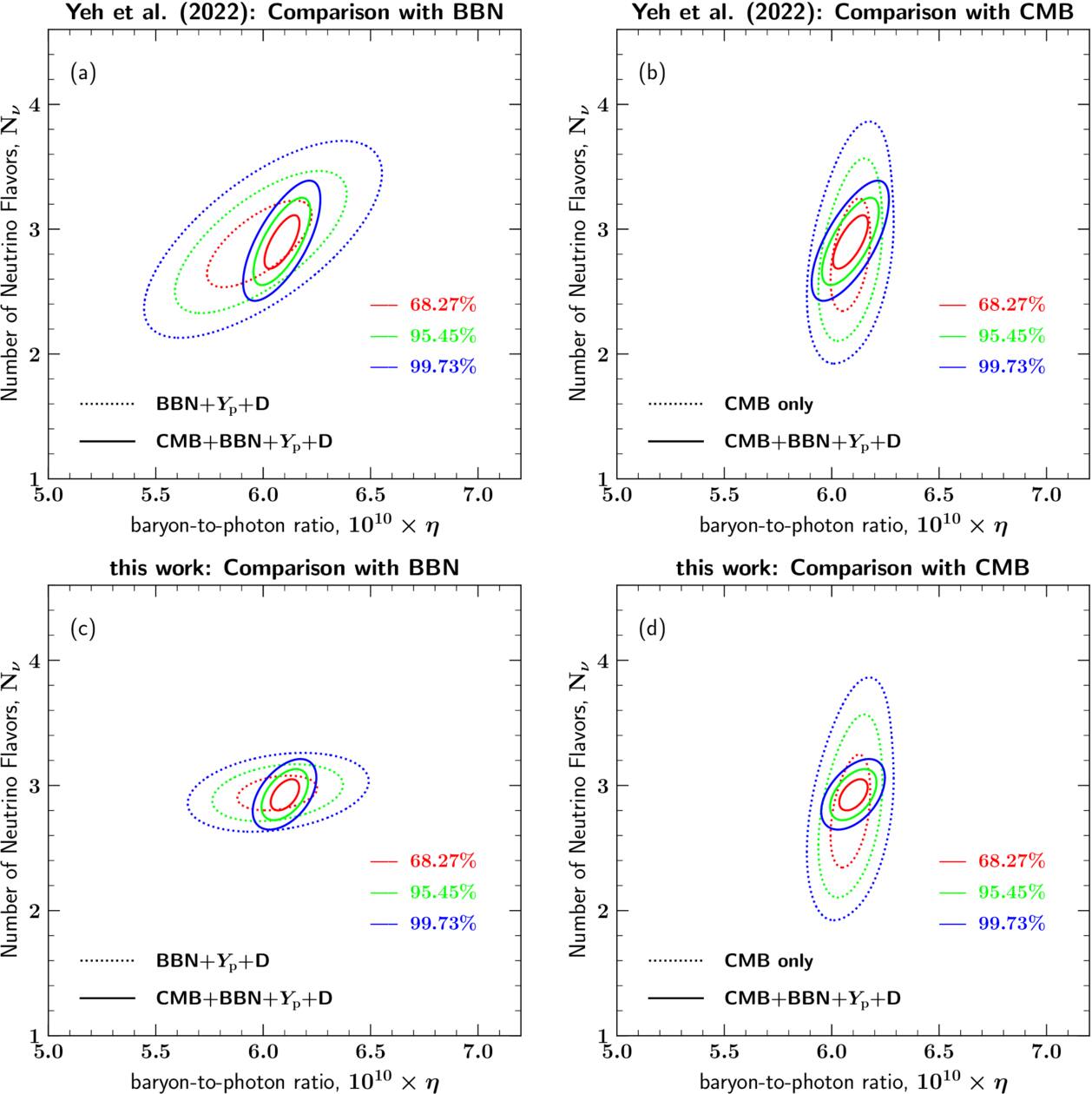 A comparison of this result to other cosmic measures of helium abundance. Credit: Yeh, Tsung-Han, et al
The Large Binocular Telescope Primordial Helium Abundance (LBT YP) Project is trying to overcome this issue and has recently published a series of results. The study focused on measuring hydrogen and helium levels within metal-poor galaxies. Distant galaxies that contain mostly early stars, so they don't have much in the way of heavy elements. The idea is that if they are low in metals, they also aren't contaminated by stellar helium.
Based on a sample of interstellar gas regions within 54 galaxies, the team found that primordial helium makes up 24.58% of the initial matter of the cosmos by mass. This agrees well with the estimate from Planck observations of the cosmic microwave background, which gave a result of 24.67%. This result further strengthens one of the three pillars of the Big Bang model.
Comparing this result to more local measures of helium abundance, the team found that about 90% of cosmic helium is primordial, while the other 10% was formed through stellar fusion. This gives us clues to the rate of star formation within galaxies. It could also help us better understand how different elements are formed.
Reference: Skillman, Evan D., et al. "The LBT YP Project. I. An Improved Determination of the Primordial Helium Abundance—Project Description, Sample Selection, Observations, and Methodology." The Astrophysical Journal 1008.2 (2026): 237.
Reference: Aver, Erik, et al. "The LBT YP Project. IV. A New Value of the Primordial Helium Abundance." The Astrophysical Journal 1008.2 (2026): 240.
Reference: Yeh, Tsung-Han, et al. "The LBT YP Project. V. Cosmological Implications of a New Determination of Primordial 4He." The Astrophysical Journal 1008.2 (2026): 241.