 Universe Today
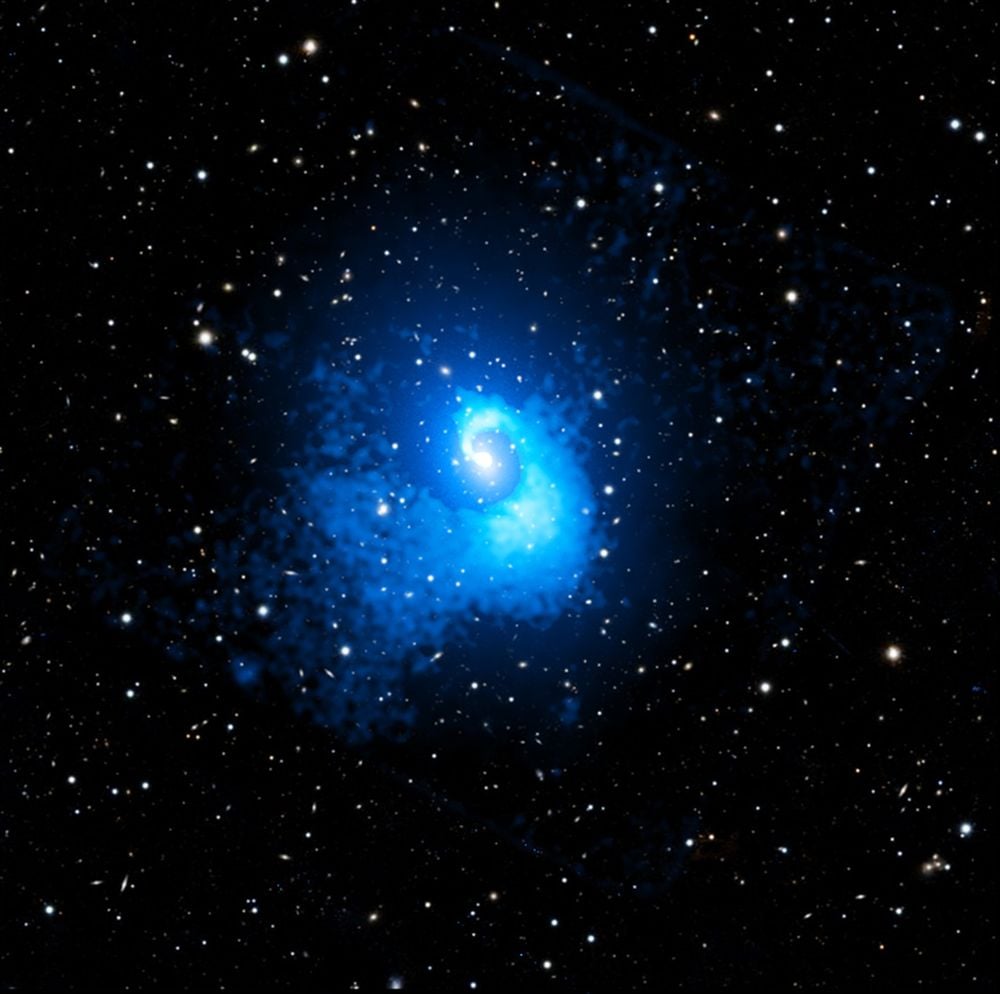
If galaxy clusters were contestants in a pageant, then Abell 2029 would likely win the title of most relaxed cluster in the Universe. But that's only on the surface. The cluster suffered through a powerful merger about 4 billion years ago, and the Chandra X-ray Observatory shows us the evidence.
Galaxy clusters are the largest structures in the Universe and can contain thousands of individual galaxies. Abell 2029 is one of the largest clusters we know of, and contains more than 1,000 individual galaxies. It's also a member of a larger supercluster with a handful of other clusters. The cluster is dominated by a single galaxy in its center, an elliptical named IC 1101, which itself is one of the largest galaxies known.
Super-heated gas is pervasive in the space between galaxies in clusters, and the gas in Abell 2029 appears calm and placid. But new Chandra observations show that the cluster's past was not calm. A merger that occurred 4 billion years ago left its mark on the cluster.
The new observations are in research titled "Deep Chandra X-Ray Observations of A2029: The Merger History of a Relaxed, Strong Cool Core Cluster." It's published in The Astrophysical Journal, and the lead author is Courtney Watson. Watson was a graduate student at Boston University and then a predoctoral fellow at the Center for Astrophysics ∣Harvard & Smithsonian when she conducted this research.
"We present results from very deep (485 ks) Chandra X-ray observations of the relaxed, cool core cluster A2029," the researchers write in their paper. "A2029 hosts one of the longest, most continuous sloshing spirals ever observed, which we find extends nearly 600 kpc from the cluster core."
Sloshing spirals are also called cold front spirals. They're found in the hot intracluster gas, or intracluster medium (ICM) in a galaxy cluster. The spiral is created by alternating hot and cool gas. A2029 isn't the only cluster with a spiral; Chandra has found them in other clusters like the Perseus galaxy cluster, where it's also the result of a merger.
A2029's slosh is one of the longest astronomers have ever seen, and extends for about 2 million light years from the cluster's center. A composite image reveals the slosh's nautilus-like shape. It's spiral shape was created by the powerful gravitational effects of the ancient merger.
The spiral has sub-features that also indicate a past merger. One is a splash, which is made of cooler gas, and one is a bay. The researchers think the bay is an overlap feature. One part is the outer portion of the spiral and one part is gas that was stripped away from the smaller cluster that merged with A2029. The authors acknowledge, however, that there could be other explanations.
"In addition to providing detailed views of the sloshing spiral, imaging and spectroscopic analysis reveals intracluster medium (ICM) substructure related to the merger history, including a broad “splash” of cooler gas and a potential merger shock," the authors write in their paper.
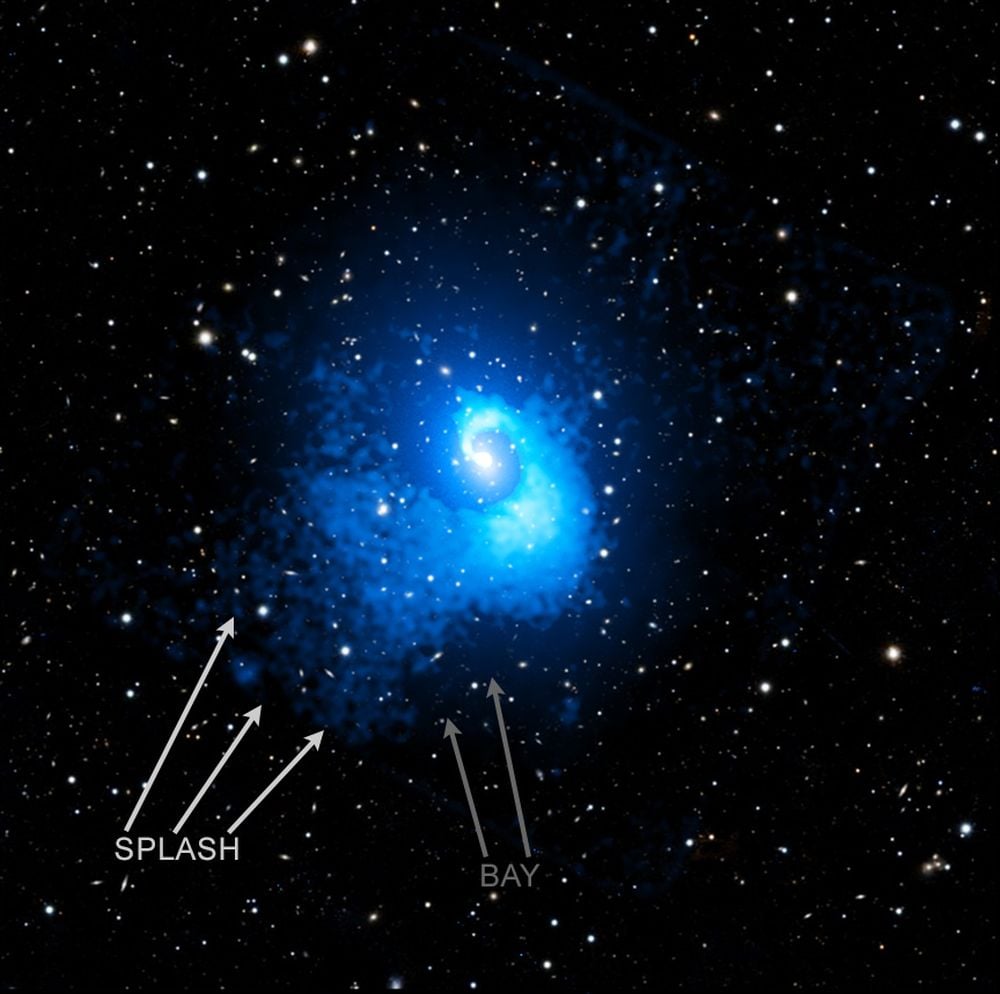 This composite image shows Chandra x-ray data in blue and Pan-STARRS optical data, light from other stars and galaxies, in white. Image Credit: X-ray: NASA/CXC/CfA/C. Watson et al.; Optical: PanSTARRS; Image Processing: NASA/CXC/SAO/N. Wolk and P. Edmonds
The researchers employed advanced techniques to tease as much information as possible from the Chandra x-ray images of A2029. By correcting for background sources, and using Gaussian smoothing, more detail popped out of the images. These efforts helped make the sloshing ICM more apparent by highlighting its spiral-like morphology.
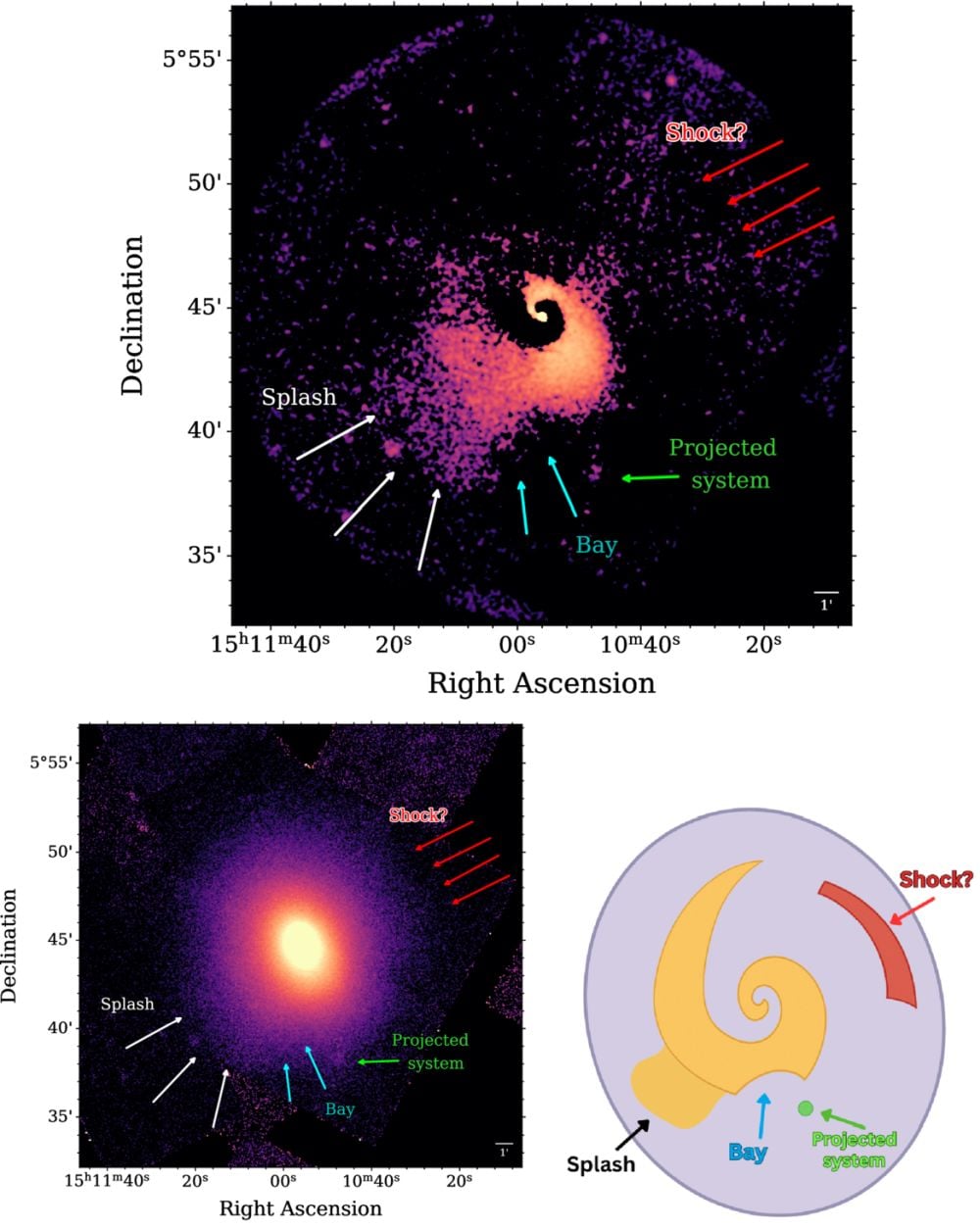 The pair of images reveal more detail in the galaxy cluster that supports the idea of an ancient merger. The cartoon drawing simplifies it and uses arrows to point out notable features. The nature of the projected system is uncertain, but could be ICM emissions from a foreground or background cluster. The shock is the merger shock. Image Credit: Watson et al. 2026. ApJ.
There are other features that indicate a merger. The active galactic nucleus in the central galaxy produces two radio jets, or lobes, that bend into a wide arc, called a Wide Angle Tail (WAT). The usual interpretation of a WAT is that it's created by ram pressure in the ICM as the host passes through it. But these findings suggest that the ICM itself is what's flowing, driven by the sloshing effect. So even though the galaxy itself may be stationary, or moving very slowly, the gas is sweeping past it because of the merger.
"The radio lobes of the central WAT source show evidence of alignment with the sloshing motions, consistent with ICM bulk flow, rather than host-galaxy motion, as the primary driver of lobe bending," the authors write.
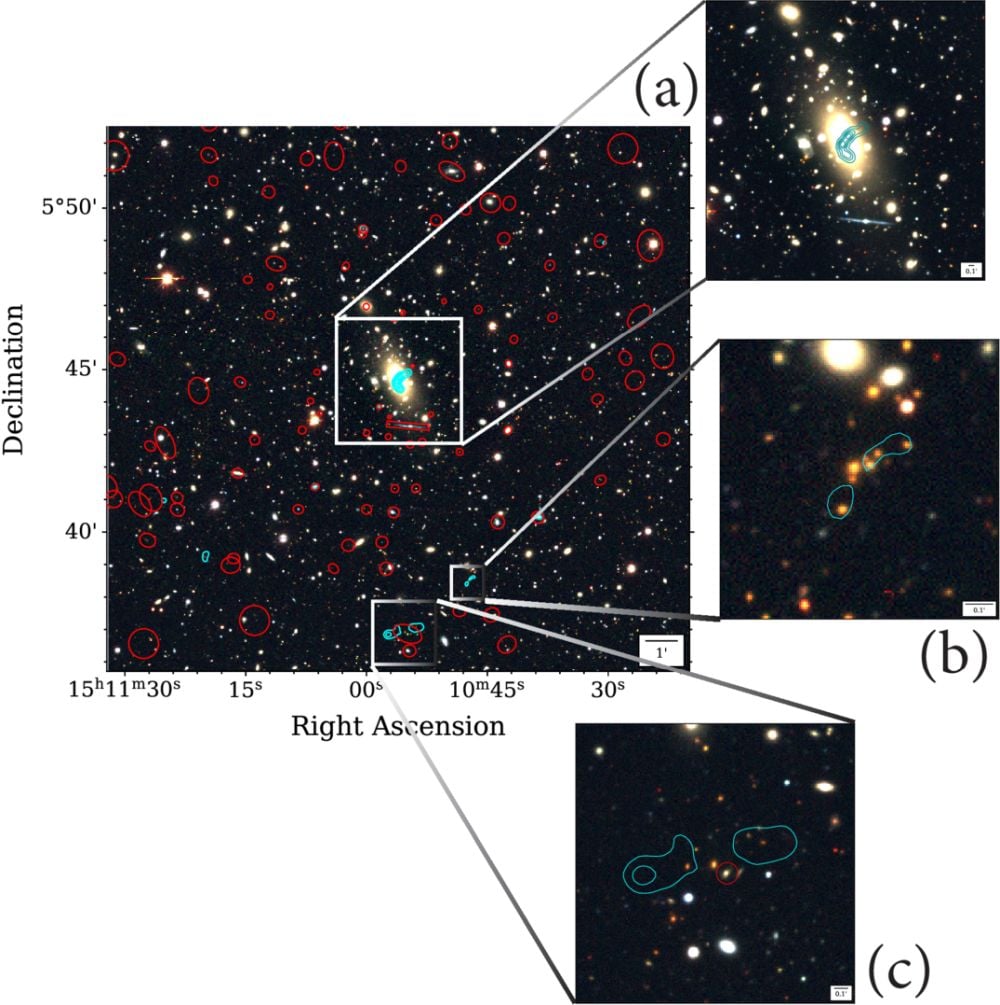 These panels are false-colour optical images that show some of the detailed observations of A2029. The red ellipses are x-ray sources in the cluster, most likely AGN. (A) shows the wide-angle tail from the central source in A2029. Image Credit: Watson et al. 2026. ApJ.
Despite its outward appearance of calm, this deeper analysis unveils evidence of an ancient merger, the effects of which are still apparent and are still shaping the cluster's structure.
"Overall, our results present a coherent picture of A2029 as a dynamically evolving system, shaped by the long-lasting aftermath of a minor, off-axis merger," the authors conclude. "The large-scale sloshing spiral, splash feature, and mild merger-driven shock are all signatures of ongoing dynamical activity despite the overall relaxed appearance of the cluster."

