 Universe Today
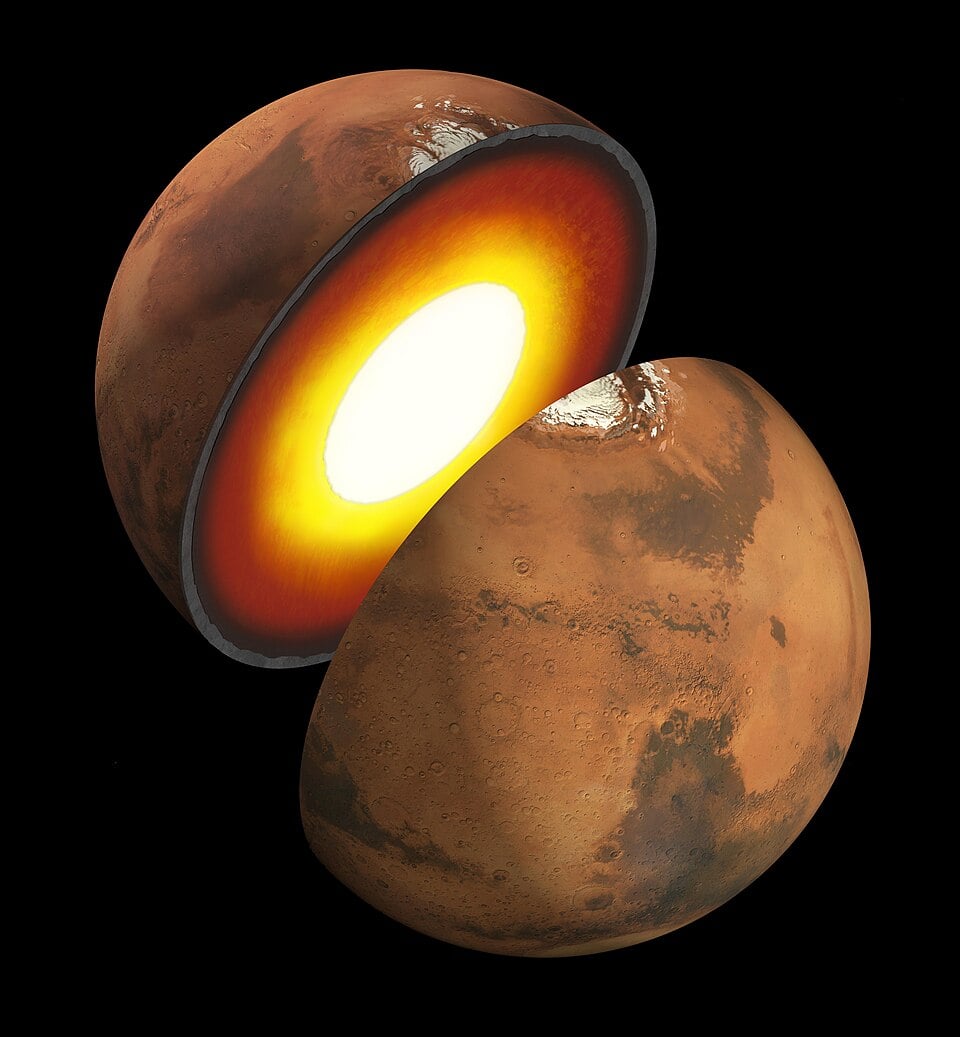
A history of a planet’s volcanic activity is contained in its rocks. And Mars’ rocks - or at least many of the meteorites that have made the journey from it to Earth - were telling a contradictory story. They appeared to be highly oxidized, but our understanding of the internal volcanic forces on Mars meant that they should have been formed in a reducing environment - the exact opposite of what the chemical makeup of the rocks themselves indicate. Now, a new paper published in the Journal of Geophysical Research: Solid Earth from planetary scientists Hideharu Kuwahara and Ryoichi Nakada of Ehime University provides an answer as to why - and it involves a gemstone.
That’s not to say it’d be the type of gemstone that a jeweler would set in a ring. But majorite, a type of garnet that is only formed under massive pressures and temperatures deep within the mantle of planets, appears to be the reason for the contradictory rock signals. But to understand why, first let’s look a little closer at the history of Mars geology.
When the planet first formed four and a half billion years ago, its heavy metals were pulled to the center and formed an iron-rich core, similar to that of Earth. When in the presence of pure metal, like a planetary core, chemical reactions usually have oxygen stripped away immediately, creating what is called a reducing environment. More recently, NASA’s InSight mission also confirmed a 150-kilometer deep layer of molten silicate rock directly above the core - what we would typically call a “mantle”. Since it is formed in the presence of such high levels of pure metal, it should also be extremely reduced. However, evidence from both meteorites and Mars crust samples show them to be extremely oxidized.
Video describing the interior of Mars. Credit - Institut de Ciencies del Mar - CSIC YouTube ChannelThat is the central contradiction the researchers set out to solve, and they suspected majorite might be involved. On Mars, it forms all the way at the base of its mantle - right above the heavily reducing core - at pressures around 18 gigapascals, or 180,000 times the atmospheric pressure at sea level. So, in order to see how this crystal behaves under those conditions, the authors had to subject it to the same environment.
To do so, they enlisted a massive hydraulic press that squeezed synthetic Martian rock between tungsten-carbide blocks inside tiny diamond capsules. Since the rocks were made of silicates, they would form majorite, a type of silicate crystal, at extremely high pressures and temperatures. So they also cranked the temperature of the system up to around 2,150 to 2,200 degrees Celsius, and saturated it with metallic iron to try to mimic the “reducing” conditions near the planet’s core.
Once the samples were sufficiently heated and pressurized, the researchers allowed them to cool then took them to the SPring-8 synchrotron facility, about 250 km away. Inside the synchrotron, the samples were blasted with X-rays to explore how the iron was bound into the mineral grains that had formed under the intense heat and pressure.
Fraser and Pamela discuss InSight's findings and how Marsquake work.According to the paper, the majorite acted almost like an iron sponge, gathering plenty of oxidized ferric iron directly into its crystal structure. Between 11% and 21% of the iron locked inside majorite crystals was oxidized, which was a much higher percentage than the surrounding silicates that had also formed during the experiment. And therein lies the answer to the contradiction.
As Mars’ interior began to crystallize, majorite began precipitating out of the molten rock around it. It then captured some of the ferric iron that would have otherwise been dissolved in the reducing basal layer. Eventually, the constant movement of the planetary mantle would have forced those majorite-rich rocks up closer to the surface, sometimes spewing oxidized volcanic rocks onto the surface, and even into space itself, when volcanoes like Olympus Mons exploded.
This research also has implications for Earth’s own internal workings as well. Since Earth is about twice the diameter of Mars, it has a much deeper mantle, which allows a different mineral called bridgmanite to dominate its lower reaches near the core. Scientists already know that bridgmanite can hold vast amounts of iron - even more so than majorite - so Earth’s deep mantle is noticeably chemically stratified. However, as the mantle rises, the bridgmanite is forced to transform into majorite, and thereby release some of its ferric iron into the surrounding rock, essentially oxidizing that transition zone of the mantle from below.
Ultimately this paper ties together the chemical signatures we see in meteorites with how crystals react under pressure in the presence of molten metal. While these two might not seem directly related, a type of gemstone that only forms deep within the mantle within rocky planets provides a link that can last billions of years.
Learn More:
EurekAlert / Ehime University - Crystallization of ferric iron-bearing majorite from a deep magma ocean on Earth and Mars
H. Kuwahara & R. Nakada - Ferric Iron Content of Majorite Coexisting With Reducing Melt at 18 GPa: Implications for the Mantle Oxygen Fugacity of Mars and Earth
UT - Mars May Have Vast Magma Systems Beneath Its Surface
UT - There's a Giant Magma Plume on Mars, Bulging the Surface out Across a Vast Region

