 Universe Today
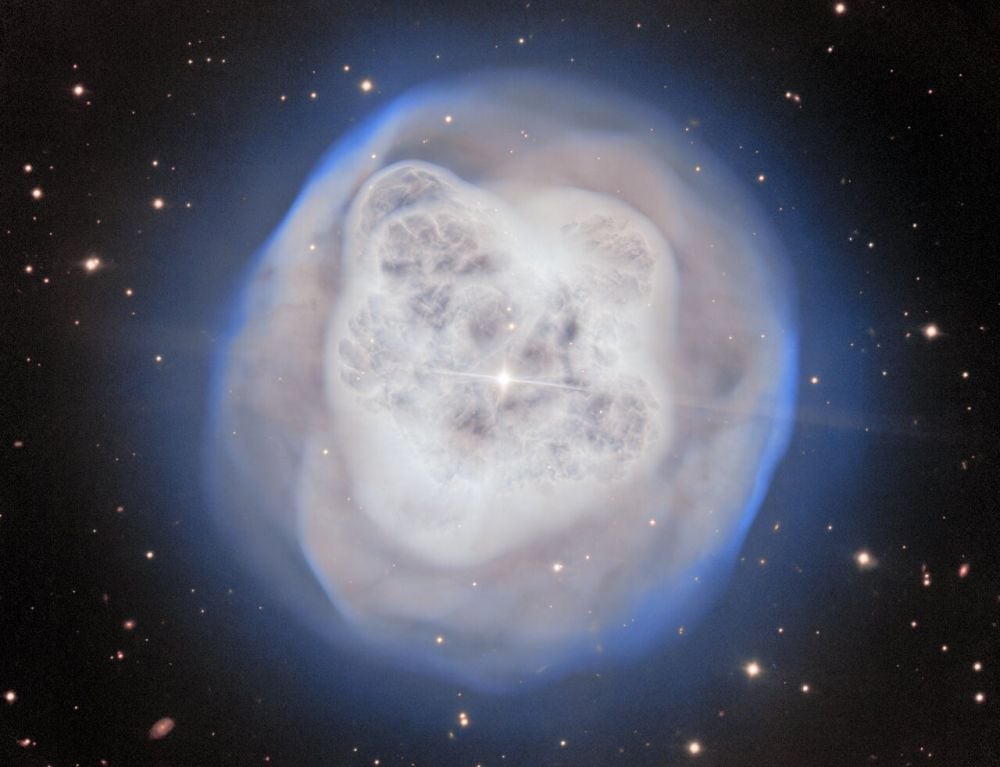
Planetary nebulae like the Crystal Ball Nebula (NGC 1514) are sort of like stellar obituaries. Though crystal balls supposedly reveal the future, the Crystal Ball Nebula tells us more about the past. It shows us how a binary pair of stars met their end. And since NGC 1514 is 1500 light years away, we're seeing what it looked like 1500 years ago.
Planetary nebula have nothing to do with planets. They just looked like planets in early telescopes, and astronomer William Herschel, who discovered the Crystal Ball Nebula, is the one who coined the term.
Planetary nebula are purely stellar. They occur when a low-mass or intermediate-mass star expels its outer envelopes of gas as it nears the end of its life of fusion. The expelled gas creates a more or less spherical shell. But over time the sphere is altered by turbulence and uneven emissions of gas. This is what's happened with the Crystal Ball Nebula. Its lumpy and multi-lobed, with wisps and voids of gas and dust.
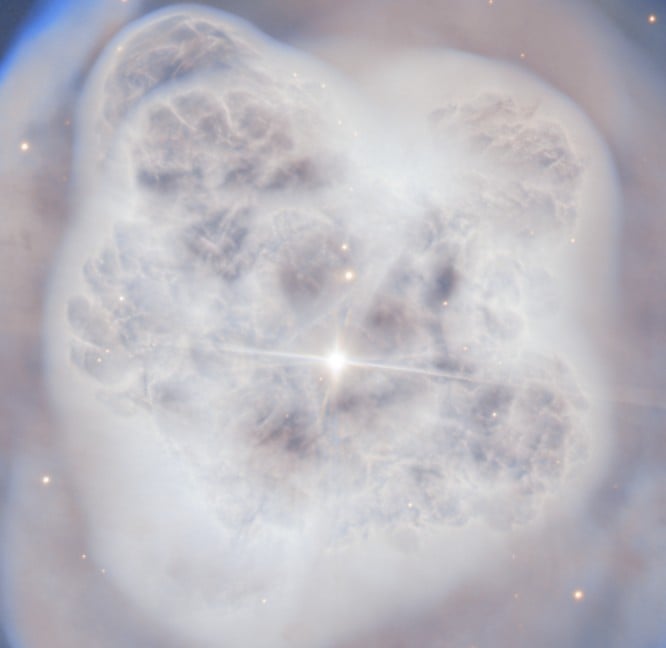 This zoom-in of NGC 1514 shows some of the gaseous structure inside the nebula. The bright star in the image is a foreground star and is not part of the nebula. Instead, an obscured binary star sits in the center. Image Credit: International Gemini Observatory/NOIRLab/NSF/AURA Image Processing: J. Miller & M. Rodriguez (International Gemini Observatory/NSF NOIRLab), T.A. Rector (University of Alaska Anchorage/NSF NOIRLab), D. de Martin & M. Zamani (NSF NOIRLab)
The Gemini North has captured a gorgeous portrait of the Crystal Ball Nebula, but so have other telescopes, including the JWST. Since the JWST is an infrared telescope, it revealed aspects of the nebula that are invisible to Gemini North.
The JWST shows that a pair of rings surrounds the nebula. These are probably from an early episode of mass loss from the central binary. The rings were subsequently shaped by asymmetrical fast winds from the binary pair. Research from 2025 concluded that the rings are likely dust, not gas.
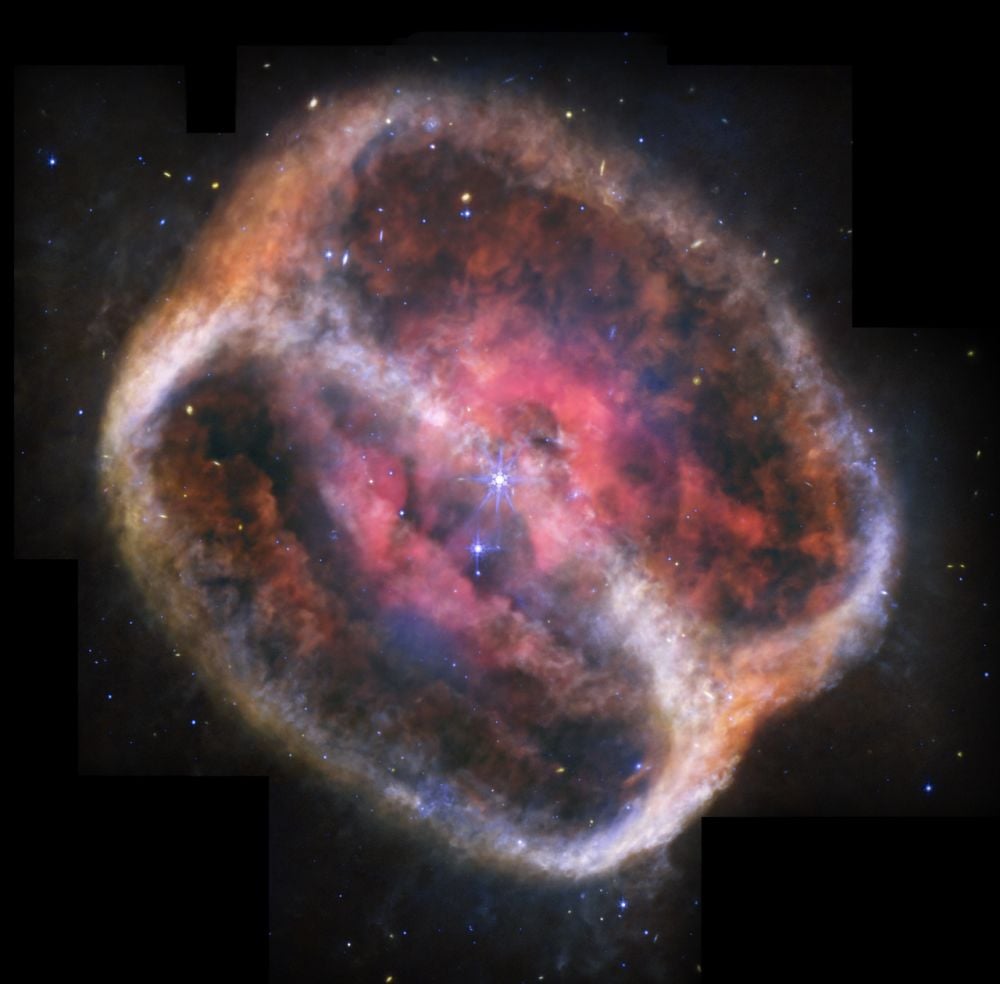 The JWST's infrared image of NGC 1514 shows a pair of rings that aren't seen in optical images. Image Credit: By Image: NASA, ESA, CSA, STScI, Michael Ressler (NASA-JPL), Dave Jones (IAC) - Planetary Nebula NGC 1514 (MIRI Image), Public Domain, https://commons.wikimedia.org/w/index.php?curid=163580365
One of the stars in the central binary pair is a bit of an oddball. It's called a hot, sub-luminous O-type star. They're O-type stars, which are the hottest type of star. But they're also sub-luminous, meaning that for such a hot star, they're dim. This is because they're so tiny, and take up about as much space as Earth's orbit around the Sun. Compare this to regular O-type stars, which are massive, supergiant stars.
Sub-luminous O-type stars are basically exposed stellar cores made of helium. They've typically lost much of their mass to a more massive binary partner, which has happened here. The sub-luminous O-type star in NGC 1514 has lost much of its mass, is finishing helium fusion, and is on its way to cooling down and becoming a white dwarf.
While the sub-luminous star generated most of the nebula in its past, its partner star is doing most of the work in NGC 1514. It's a giant star of type A0III that's exhausted much of its core hydrogen and has left the main sequence. Its energy is lighting the nebula up.
NGC 1514's asymmetry is due to the binary pair. They orbit each other every nine years, which is the longest known orbit for any binary pair in a planetary nebula. As they orbit each other, their powerful winds are shaping the gorgeous nebula and creating the shells, wisps, and clumps revealed in Gemini North's portrait.
Planetary nebula don't last long, typically between about 10,000 and 25,000 years. That's not very long in astronomy. Eventually the gas will dissipate and become one with the interstellar medium, like a child blowing dandelion fluff into the wind.

