Universe Today
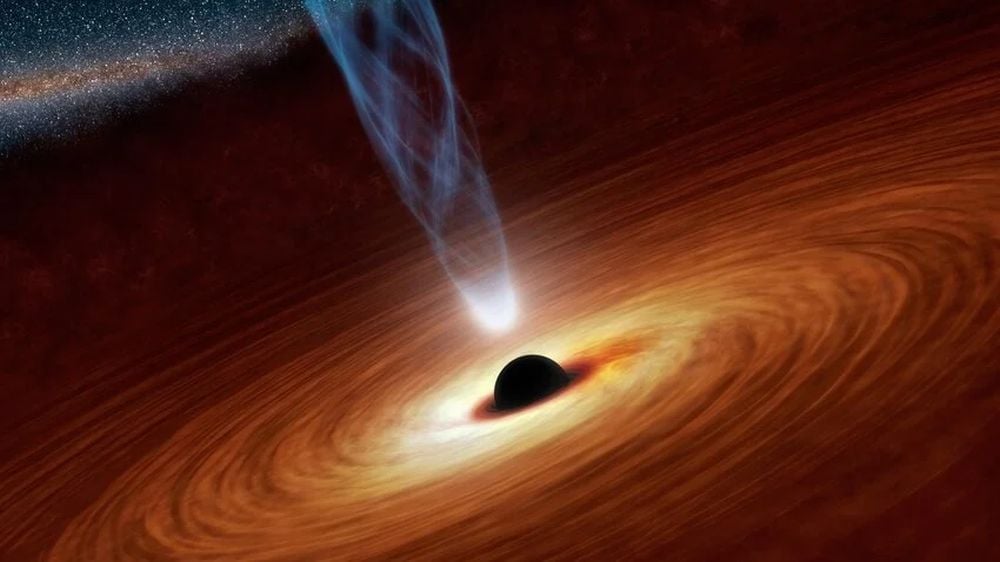
The thinking around exoplanet habitability is mostly concerned with a planet's distance from its star. Too close, and any surface water is boiled away into space. Too far, and surface water is frozen. Both are severe limits on the prospects for life. Habitability depends on an exoplanet being in the Goldilocks Zone, a distance range around a star where liquid water can persist.
But what about the larger context? Even if an exoplanet is within its star's habitable zone, other things can prohibit habitability. If a solar system is too close to a supermassive black hole (SMBH), which are likely at the center of all large galaxies, then it won't matter how close the planet is to its star. The SMBH's overwhelming power will make habitability next to impossible.
New research in The Astrophysical Journal examines the role that SMBH have on exoplanet habitability. It's titled "The Impact of Supermassive Black Holes on Exoplanet Habitability. I. Spanning the Natural Mass Range," and the lead author is Jourdan Waas. Waas is from the Department of Aerospace, Physics and Space Sciences, at the Florida Institute of Technology.
"In recent years, considerable attention has been devoted to understanding the role of high-energy astrophysical events in shaping the habitability of galaxies," the authors write. "Supernovae have long captured the attention of researchers due to their profound implications for planetary habitability." Supernovae emit powerful radiation that could sterilize a planet, and shock waves that could strip away atmospheres, even destroy exoplanets completely. It's why researchers wonder how habitable the Milky Way's tightly-packed bulge could be, given the higher number of supernova explosions in that dense stellar environment.
But supernovae aren't the only high-energy astrophysical events. An actively feeding supermassive black hole is called an active galactic nucleus (AGN), and while a supernova releases an extraordinary amount of energy in a short time, an AGN can be far more energetic on a sustained basis. "A clear understanding of the myriad roles of SMBH activity on galactic habitability would help pave the way for gauging the prospects for extraterrestrial habitability and life in the Universe," the authors write.
SMBH are, of course, extremely massive. They can be billions of times more massive than the Sun. And of course, they're not inert. They wield enormous gravitational power and emit extreme energies when they're active. How do these massive, dynamic objects affect exoplanet habitability? Habitability requires an atmosphere as far as we know, and an exoplanet atmosphere is barely a feather to an active galactic nuclei and its winds.
"While the influence of supermassive black hole (SMBH) activity on habitability has garnered attention, the specific effects of active galactic nucleus (AGN) winds, particularly ultrafast outflows (UFOs), on planetary atmospheres remain largely unexplored," the authors write. This work examines the relationship between the mass of the SMBH, ultrafast outflows, and exoplanetary habitability. "Through simplified models, we account for various results involving the relationships between the distance from the planet to the central SMBH and the mass of the SMBH."
The overall results won't surprise anyone. The researchers show that the more massive a central SMBH is, the more rapid mass-loss is in exoplanet atmospheres, and the more habitability is degraded. "Specifically, we show that increased SMBH mass leads to higher atmospheric heating and elevated temperatures, greater molecular thermal velocities, and enhanced mass loss, all of which diminish with distance from the galactic center," the researchers explain.
AGN create winds that act as feedback on their host galaxies. The researchers examined the two types of winds that come from AGN and how they affected exoplanet atmospheres. The two types are energy-driven and momentum-driven.
AGN outflows start as rapid, small-scale winds. They're launched from the accretion disk and propagate outwards, where they eventually slam into the interstellar medium (ISM). At this point, the system develops into two shocks.
One shock is a reverse shock, which acts to decelerate the wind. The other is a forward shock that pushes into the surrounding ISM. Events at the reverse shock determines whether an energy-driven or momentum-driven wind takes over.
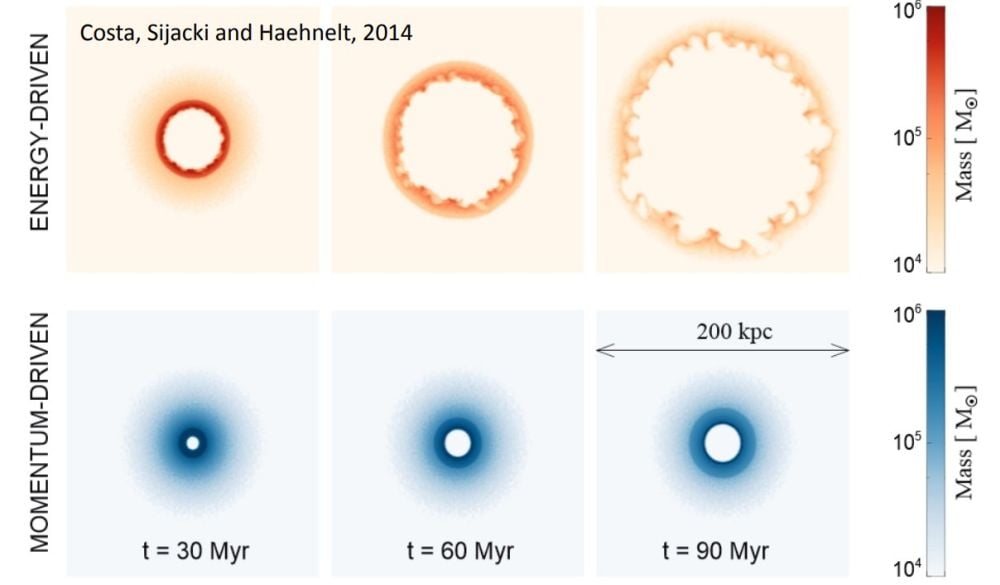 This simple schematic illustrates the difference between energy-driven (top) and momentum-driven (bottom) AGN winds. Image Credit: Costa, Sijacki and Haehnelt, 2014. MNRAS. https://doi.org/10.1093/mnras/stu1632
If the shocked wind cools enough, it can't puff up and expand. In this case it doesn't transfer energy, only momentum, and is a momentum-driven wind. The outflow is more confined, doesn't spread effectively, and has a more limited effect on the galaxy.
If the shocked wind doesn't cool enough, the gas retains its energy and acts like an expanding bubble. This is an energy-driven wind, and it's far more effective at sweeping gas out of the galaxy. It's also more effective at heating and stripping away exoplanet atmospheres.
"Energy-driven winds consistently have a stronger impact than momentum-driven ones," the authors write.
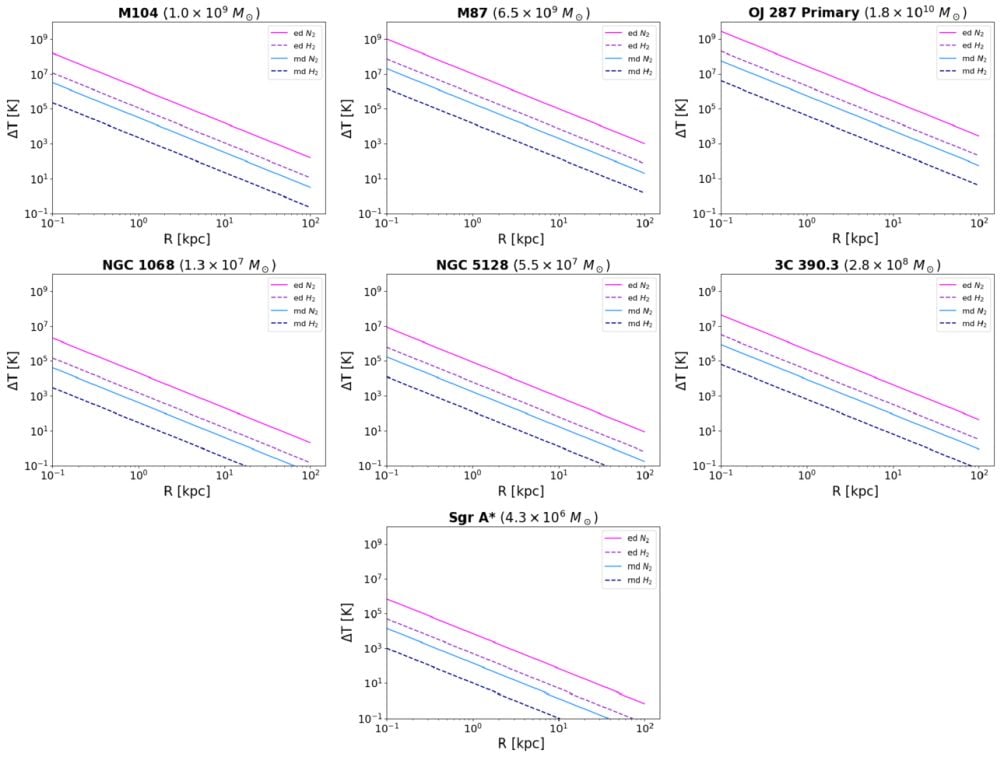 These panels show the "Increase in atmospheric temperature caused by energy- and momentum-driven AGN winds as a function of the distance to the galactic center (in kiloparsecs). The labels N2 and H2 indicate the main element of planetary atmospheric composition, molecular nitrogen or hydrogen, respectively," the authors write. The Milky Way's SMBH, Sagittarius A-star, is at the bottom. Image Credit: Waas et al. 2026. ApJ. DOI 10.3847/1538-4357/ae5e6f
The researchers also examined ozone depletion. Stellar flares produce energetic particles that can produce nitrogen oxides, which can destroy ozone here on Earth. "Given their extreme velocities, it is worth examining whether AGN winds, particularly UFOs with velocities ∼ 0.1c and postshock speeds of O(1000) km s−1, may contribute to ozone depletion in atmospheres similar to Earth’s," the authors write.
They found that ozone depletion increases with BH mass and proximity to the AGN. More massive BH produce more powerful AGN winds and more nitrogen oxides, and as a result ozone depletion is greater. In their models, ozone depletion decreases with distance from the AGN. "Once again, energy-driven winds cause slightly more depletion than momentum-driven ones," the researchers explain.
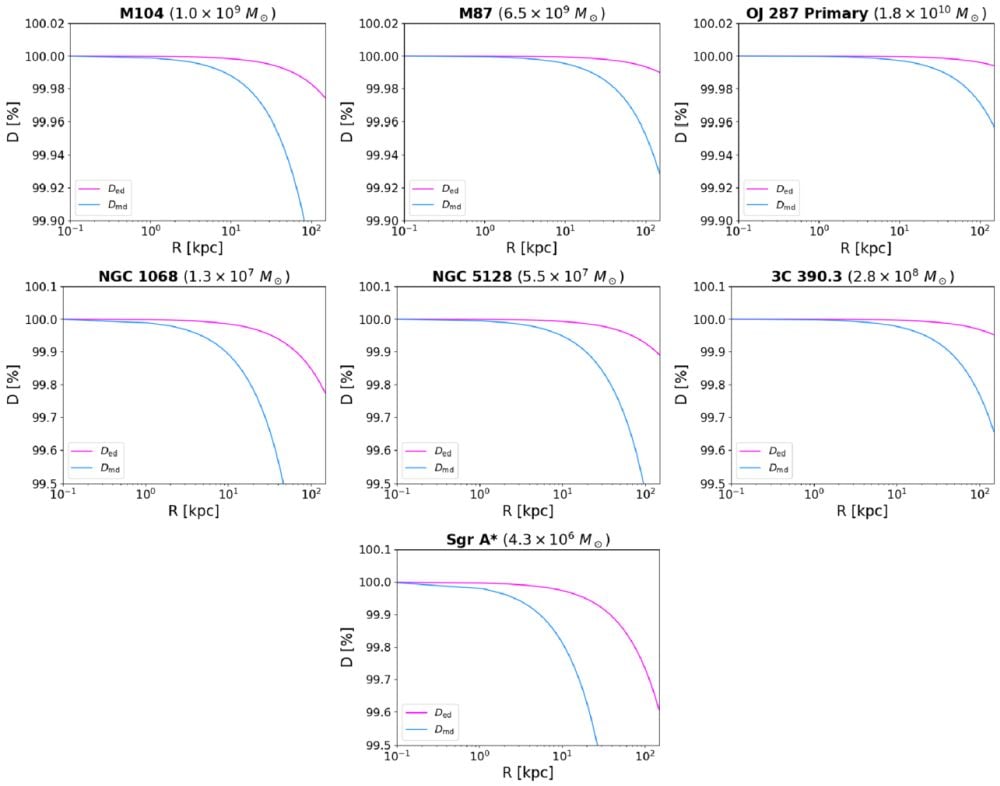 These panels show ozone depletion on Earth-like worlds caused by both momentum-driven and energy-driven AGN winds as a function of the distance to the central galactic SMBH (in kiloparsecs). Image Credit: Waas et al. 2026. ApJ. DOI 10.3847/1538-4357/ae5e6f
"Crucially, ozone depletion is shown to rise with SMBH mass and decrease with distance from the galactic center, with nearly complete ozone loss (∼100%) occurring across galactic scales for SMBH masses ≥ 108 M⊙ in the energy-driven case," they write. This shows that significant ozone loss occurs throughout most of a galaxy's inner regions. This implies that "... the near-complete depletion of ozone may be the most universal and wide-ranging atmospheric consequence of AGN winds."
Ozone depletion doesn't necessarily doom habitability. But it could confine it to oceans. Life on Earth only crawled onto the land once atmospheric oxygen had accumulated and ozone appeared to shield organisms from ultraviolet radiation.
Overall, the study shows that energy-driven AGN ultra-fast outflows (UFO) heat exoplanet atmospheres more effectively than momentum-driven winds. This accelerates atmospheric molecules above escape velocity, stripping away atmospheres. The AGN can also create nitrogen oxides that can destroy ozone. The more massive the SMBH, the greater the effect.
Moreover, the effect could extend a great distance from the galactic center. "These simulations suggest that, for the most massive SMBHs, the effective region of influence extends well beyond the inner galaxy and potentially includes the galactic halo in the energy-driven scenario," the authors write. That could be devastating for habitability. However, the authors also explain that if the ISM is dense, that could shrink the area of effect, but only for the winds, not the particle-driven ozone loss.
Previous research has shown that some regions in the Milky Way make exoplanet atmospheres vulnerable to destruction. XUV-driven atmospheric photoevaporation in the Galactic Bulge is a serious impediment to habitability. But these results suggest that "... AGN winds may influence planetary environments at much larger galactocentric radii than UV or XUV radiation alone," the authors write.
"This implies that kinetic feedback from AGN activity could extend the zone of impact well beyond radiation-based kill zones," the researchers explain.
Future work should examine the combined effects of AGN winds and radiation. "Since our current model does not incorporate radiative effects, the combined influence of winds and high-energy radiation on the Galactic habitable zone should be explored in future studies," the authors explain.