Universe Today
(This is Part 4 of a series exploring the mythic side of the Big Bang. Check out Part 1, Part 2, and Part 3!)
After the first protons and neutrons formed, after the first light elements formed, the universe…wasn’t really all that great. It spent hundreds of thousands of years just expanding and getting cooler, with no huge variations from place to place. There were some dramatic events, like the transition from a hot, dense plasma to a slightly less hot, slightly less dense neutral gas, but even after that the material of the universe just largely hung out for a hundred million years or so.
But behind the scenes, gravity was doing its work. The young universe was almost perfectly uniform. Almost. There were tiny differences, no bigger than one part in a million, with tiny, tiny clumps of matter ever so slightly denser than their surroundings. That was enough for gravity to do its gravitational thing, with that extra density giving those small microscopic clumps more gravitational pull from their surroundings.
Slowly, achingly slowly, over millions of years, those clumps of material grew. As they grew larger, they pulled on their surroundings even more. They drew material away from regions and built themselves to be even larger, even denser. And as they grew, their gravitational pull became even stronger, allowing to build faster and faster.
Eventually some clumps grew dense enough that incredible pressures in their cores could ignite nuclear fusion, and the first stars were born. Then the stars collected into groups, which coalesced into the first galaxies. Over time, the galaxies fed on their surroundings, accreting even more material and merging together, forming the first clusters.
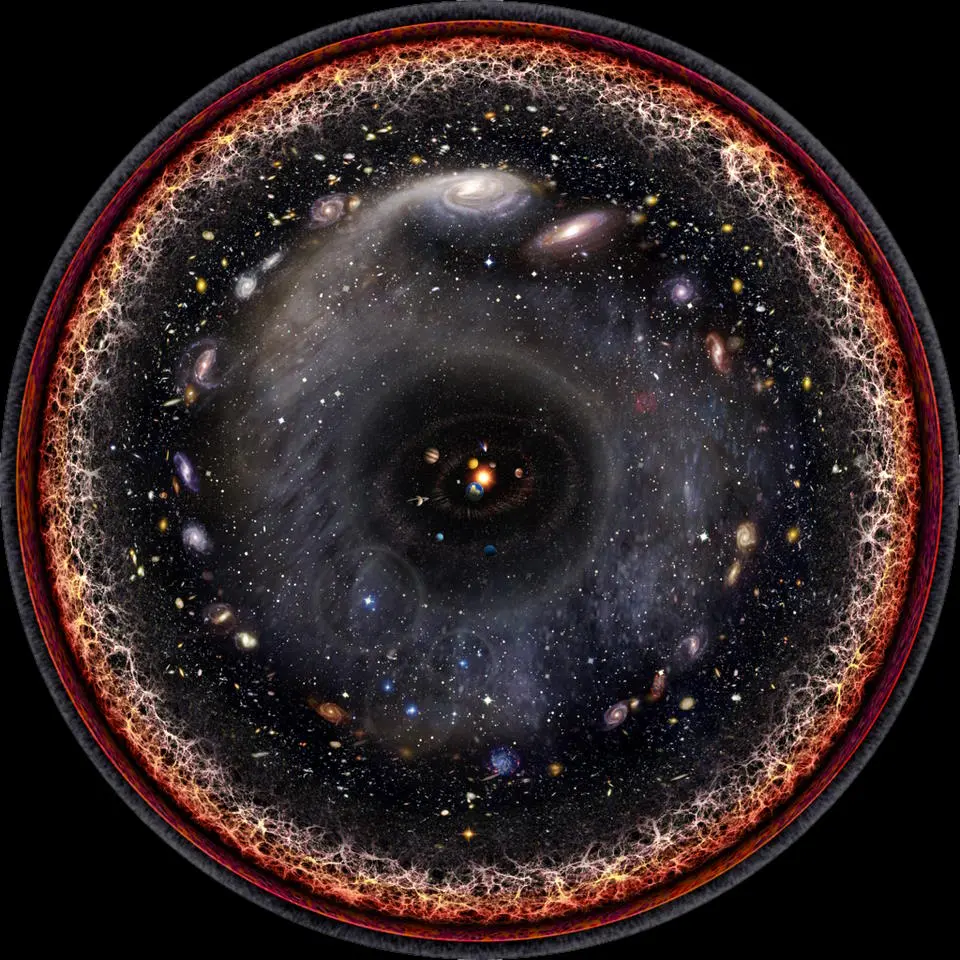
Within a few hundred million years, the cosmic web emerged, the largest pattern found in nature, with clusters, filaments, and walls spanning millions of light-years.
And all that material, all that stuff, had to come from somewhere. It came from the shapeless, formless gas that had previously filled the universe. Today those regions are the cosmic voids, the vast expanses of nothingness, hollowed out by the great building project undertaken by gravity to construct the cosmic web.
I told you, the story of the big bang, from its mysterious origins in the singularity, to the splintering of the forces, the creation of matter and radiation, and the emergence of the cosmic web, is a really great story.
And it fulfills the jobs of any proper cosmological story. It tells us how the present-day universe came to be the present-day universe. It tells us where our universe came from, it tells us what forces and processes and entities were involved, and it tells us about our relationship to the wider universe, that we live on one tiny rock orbiting a normal star, just one of hundreds of billions in our galaxy alone inhabiting a vast, gigantic, ancient cosmos.
Of course, there are differences that set the big bang theory apart from other mythological creation stories. The big bang is a physical theory, a scientific theory. That means that is has a slightly different toolset available for building stories than myths do. Out are divine entities and supernatural forces. By definition, physical theories can only include natural causes and effects. And replacing them are all the wonderful tools that make science so fun and so powerful: the extensive use of mathematics to summarize natural phenomenon and enforce logical consistency and the demands to be empirically rigorous with observations and evidence.
But some anthropologists argue, and I tend to agree, that myths are a sort of proto-scientific theory. They don’t exist in a vacuum. They respond to observations, to data, to evidence, and are attempts to explain those observations with a coherent story that makes sense in the given cultural context – they have jobs to do, and they do it well.
And on the other hand, scientific theories don’t exist in a vacuum either. Look at our story of the big bang. It’s got all the hallmarks of a good creation myth. There’s creation ex nihilo, a singularity just EXSITING, with no prior explanation. The splintering of a parent force into multiple parts that become the domains of the universe. An early chaos that transforms into something more orderly. An evolution from one epoch to another. An entity that digs deep into the formless abyss to build the world around us.
I mean, the big bang theory got its start from a literal catholic priest! I couldn’t make this stuff up if I tried! And the scientists that continue to work on the theory are still humans, they’re still people, they still live in the same cultures with the same histories and backgrounds and stories as all of us. When we are confronted by the evidence, by the observations of a universe that we barely understand, and we try to fashion stories that explain how it all works and how it all came to be, we reach into the same well human ingenuity, creativity, and myth-making that all of us every time we try to write a new story.
The big bang is our current creation story. And if not exactly a myth, it certainly has the same structure as one.
But we know this story is not yet finished. I wonder what new story we’ll come up with next.