 Universe Today
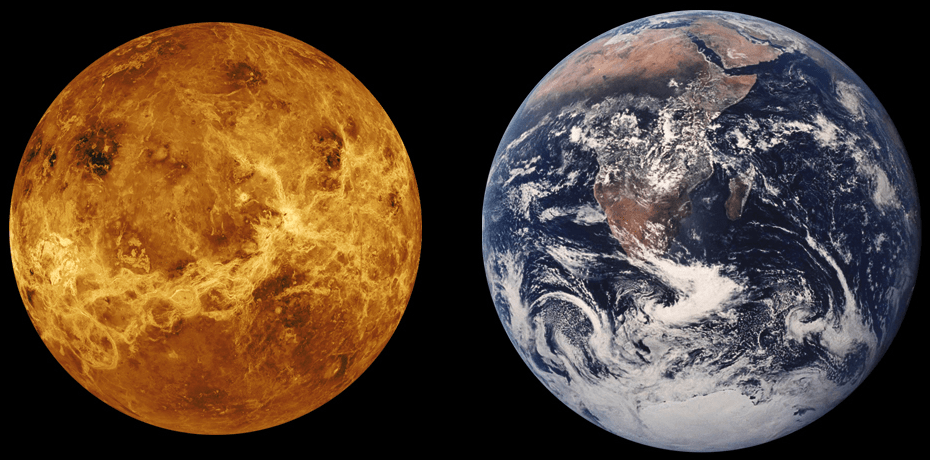
The mass of Venus is 4.868x1024 kg. That is about 82% of the mass of Earth. Alright, end of story and thank you for reading. Okay, we would never do that to you here at Universe Today. There are far too many interesting facts about Venus to leave you hanging like that.
Here are a few other physical characteristics of the second rock from the Sun:
Diameter
12,100 km

Surface Gravity
8.87m/s2

Surface Area
460,000,000 km2

Volume
9.38×10¹¹km3

Surface Atmospheric Pressure
92 times that of Earth

Average Surface Temperature
462 degrees Celsius

Rotation
Retrograde

Density
5.204 g/cm3
Scientists believe that the high mass and density of Venus can be accounted for by its high concentration of rock and metals. They believe that the planet has a liquid metallic core that is surrounded by a molten rock mantle. Actual proof of this is nearly impossible since the reflective nature of the planet's atmosphere makes many types of observation impossible.
Venus was once thought to be a dead planet. There is no life on the surface for many reasons, but recent study of the surface has revealed that there may be active volcanoes on the planet. That means that it is alive, geologically speaking. Previously, scientists had known that the planet had been resurfaced by volcanic activity 300 to 500 million years ago, but had thought that the activity died out during that same time frame.
There have been many missions sent to Venus. The Soviet space program started the race to Venus with the Venera program. It is hard to tell exactly how many Soviet missions to Venus were launched since the program would not announce a probe that failed, but more than a dozen were successful. NASA launched several mission of its own. Early missions from both programs failed because neither was prepared for the extreme pressure within the Venusian atmosphere. Even those that were able to transmit from the surface could only survive for less than one hour.
The Venus Express is currently in orbit around Venus. BepiColumbo is set to launch in 2014. It is hoped that the Akatsuki probe can reawakened to gather information when it arrives in the area in 2016 and the Venus In-Situ Explorer is in the planning stages. Scientists are determined to unravel the planet's mysteries. Like you, they want to know more than the mass of Venus.
Here's an article about the mass of Mercury, and here's an article about the mass of the Earth.
Want more information on Venus? Here's a link to Hubblesite's News Releases about Venus, and here's NASA's Solar System Exploration Guide to Venus.
We have also recorded a whole episode of Astronomy Cast that's just about planet Venus. Listen to it here, Episode 50: Venus.
References: http://solarsystem.nasa.gov/planets/profile.cfm?Object=Venus&Display=Facts http://solarsystem.nasa.gov/planets/profile.cfm?Object=Venus&Display=OverviewLonghttp://solarsystem.nasa.gov/planets/profile.cfm?Object=Venus&Display=Educ
