Universe Today
 *The full trail of galaxies, with an inset image of DF9 taken by the Hubble Space Telescope. Credit: Keim et al. (2026)/DECaLS/HST*](/article_images/YN_DF9-drak-galaxy_20260630_213243.jpg)
In the 1970s, astronomer Vera C. Rubin provided the first solid evidence for the existence of Dark Matter, a mysterious, unseen mass that appeared to be holding galaxies together. Since then, the indirect evidence for Dark Matter has grown considerably, with scientists observing "halos" and gravitational lenses that could not be caused by normal (or "visible") mass. Based on observational data, Dark Matter is estimated to account for 85% of the total mass of the Universe. However, astronomers have also observed a few galaxies that don't fit this pattern.
Using the W.M. Keck Observatory, a team of Yale-led astronomers has discovered the third known galaxy that appears to lack Dark Matter altogether. This faint dwarf galaxy, known as DF9, is part of a linear structure that may have formed from a violent collision between galaxies. This discovery strengthens the evidence for a rare and previously unknown process that could assist astronomers in future studies. The study detailing their findings was published on June 16th in The Astrophysical Journal.
DF9 lies alongside two other unusual galaxies (DF2 and DF4) that also appear to have no Dark Matter. These galaxies are also part of a larger linear structure of seven galaxies, located 45 million light-years from Earth, that appear to have formed in a single event. By measuring the motions of stars within DF9, the team placed its mass at about 100 million Suns, consistent entirely with its visible matter (stars, gas, dust, etc.). This is the most compelling evidence of missing Dark Matter, as its presence would increase that mass by a factor of 100.
These findings are reshaping the most widely accepted models of galaxy formation. Currently, scientists believe that most galaxies formed within torii of dark matter - the aforementioned "halos." However, the discovery of these three galaxies contradicts this model and adds weight to the theory that some galaxies in the Universe have a different formation mechanism. As Michael Keim, a PhD Candidate at Yale University and the lead author on the paper, said in a Yale press release:
A line of galaxies lacking dark matter has never been seen before. The discovery provides some of the strongest evidence yet that these galaxies formed through an extreme and previously unseen process and offers a rare new window into the nature of dark matter itself.
Pieter van Dokkum, the Sol Goldman Family Professor of Astronomy, is Keim's Ph.D. advisor and co-author on the paper. Using data from the Hubble Space Telescope, Dokkum led the original studies that identified the unusual nature of DF2 and DF4. During Keim's doctoral work, he discovered that DF9 was also a faint dwarf galaxy without Dark Matter, and not a black hole (as previously thought).
He further proposed that DF9 be analyzed by Keck's Cosmic Web Imager (CWI), which is specifically designed to study faint light sources in the Universe. “KCWI’s exceptionally high precision enabled us to measure DF9’s extraordinarily low mass with the accuracy needed to demonstrate its lack of dark matter,” said Keim.
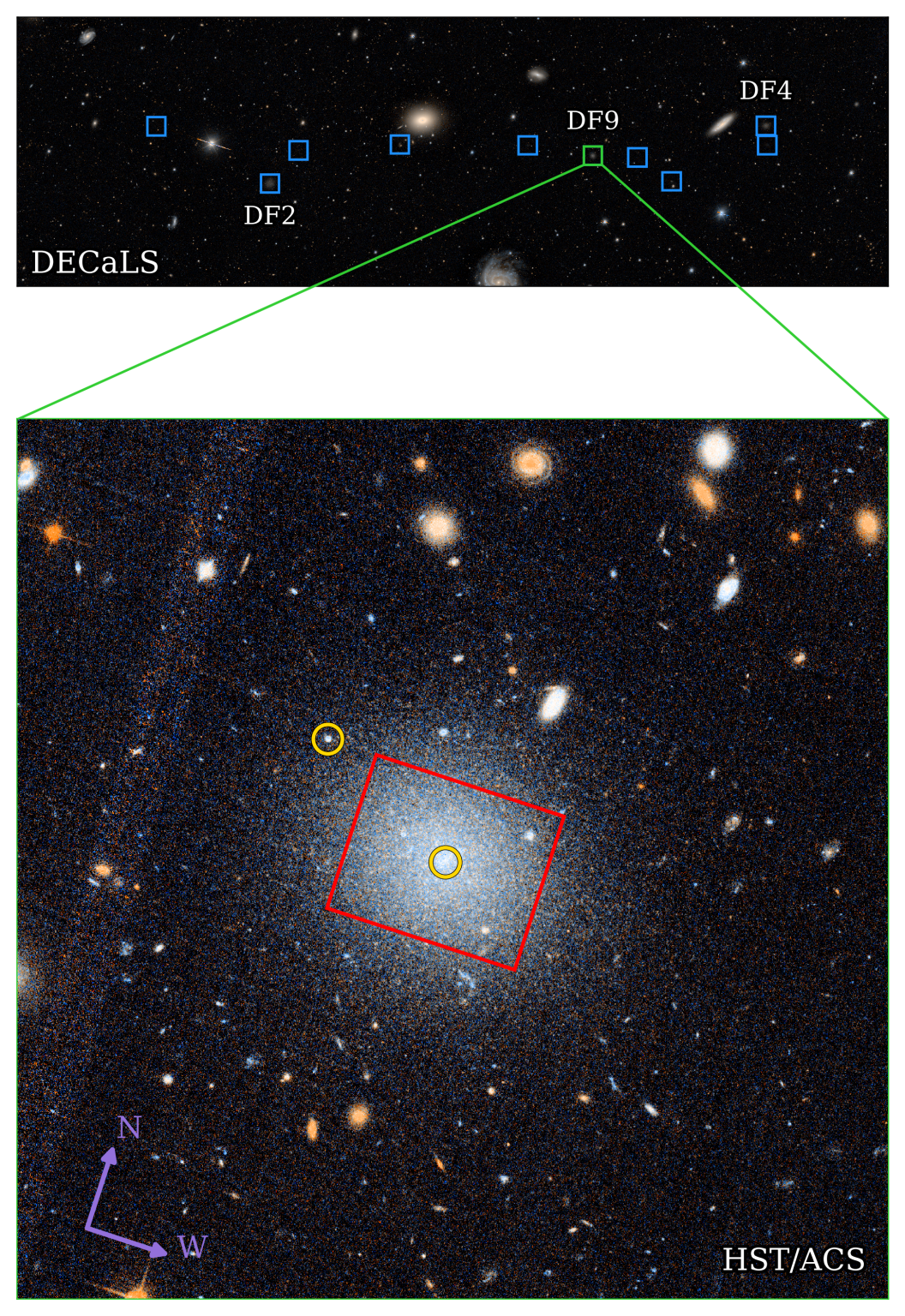 *A close-up Hubble image of DF9 is shown beneath a wider view of the surrounding NGC 1052 region. Credit: Keim et al./DECaLS/HST*
This discovery strengthens the case that DF2, DF4, and DF9 formed together in a violent event, such as a high-speed galaxy collision (check out an animation of the theory here). The team theorizes that this collision may have stripped star-forming clouds of gas from their Dark Matter halos, leading to new galaxies forming from ordinary matter alone. “The finding provides compelling evidence that dark matter behaves as a physical substance rather than the effect of an alternative theory of gravity, particularly at the dwarf-galaxy scale where those theories are most heavily debated,” added van Dokkum.
The team is now conducting follow-up observations with other telescopes to search for any gas left behind from the theorized galactic collision. This includes the new Mothra telescope, co-founded by van Dokkum and Roberto Abraham, an astronomer at the University of Toronto (not associated with this study), as well as future observatories once they come online. These observations will not only help validate the team's theory but will also confirm a new theory of galaxy formation.
Further Reading: Yale News, The Astrophysical Journal