star formation

Anarchic Star Formation Found In Dust Cloud

May 2, 2013

Want to stay on top of all the space news? Follow @universetoday on Twitter If you think that breaking all the rules is cool, then you’ll appreciate one of the latest observations submitted by the Danish 1.54 meter telescope housed at ESO’s La Silla Observatory in Chile. In this thought-provoking image, you’ll see what kind [...]

Read the full article →

Region in LMC Ablaze with Light and Color

January 17, 2013

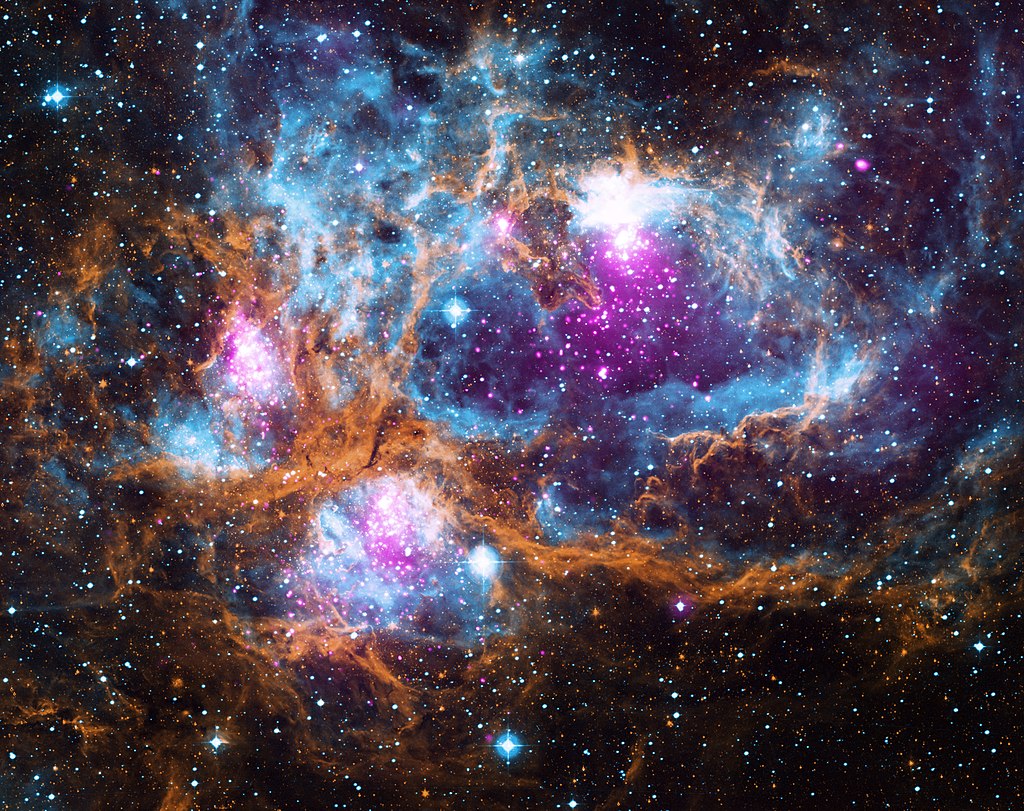
Hubble view of star formation region N11 from the NASA/ESA Hubble Space Telescope. Image credit: NASA/ESA Hubble. Zoom by John Williams/TerraZoom using Zoomify. New computer wallpaper alert. Light from the Large Magellanic Cloud takes nearly 200,000 years to travel to Earth. And it’s worth the wait. Behold LHA 120-N 11, or just simply N11, in [...]

Read the full article →

The Brightest Galaxies in the Universe Were Invisible… Until Now

December 4, 2012

Hubble images of six of the starburst galaxies first found by ESA’s Herschel Space Observatory (Keck data shown below each in blue) Many of the brightest, most actively star-forming galaxies in the Universe were actually undetectable by Earth-based observatories, hidden from view by thick clouds of opaque dust and gas. Thanks to ESA’s Herschel space [...]

Read the full article →

Orion Revisited: Astronomers Find New Star Cluster in Front of the Orion Nebula

November 25, 2012

The well-known star-forming region of the Orion Nebula.  Credit: Canada-France-Hawaii Telescope / Coelum (J.-C. Cuillandre & G. Anselmi) Precise distances are difficult to gauge in space, especially within the relatively local regions of the Galaxy. Stars which appear close together in the night sky may actually be separated by many hundreds or thousands of light-years, [...]

Read the full article →

Star Clusters on a Clandestine Collision Course

August 16, 2012

Astronomers originally thought that just one massive star cluster shone brightly in a huge star forming region of the Tarantula Nebula, also known as 30 Doradus. But closer analysis using data from the Hubble Space Telescope shows that it is actually two different clusters that are just starting to collide and merge. A team of [...]

Read the full article →