The Galaxy is a collection of stars, planets, gas clouds and to the dismay of astronomers, dust clouds. The dust blocks starlight from penetrating so it’s very difficult to learn about the far side of the Galaxy. Thankfully the upcoming Nancy Grace Roman telescope has infrared capability so it can see through the dust. A systematic survey of the far side of the Milky Way is planned to see what’s there and could discover billions of objects in just a month.
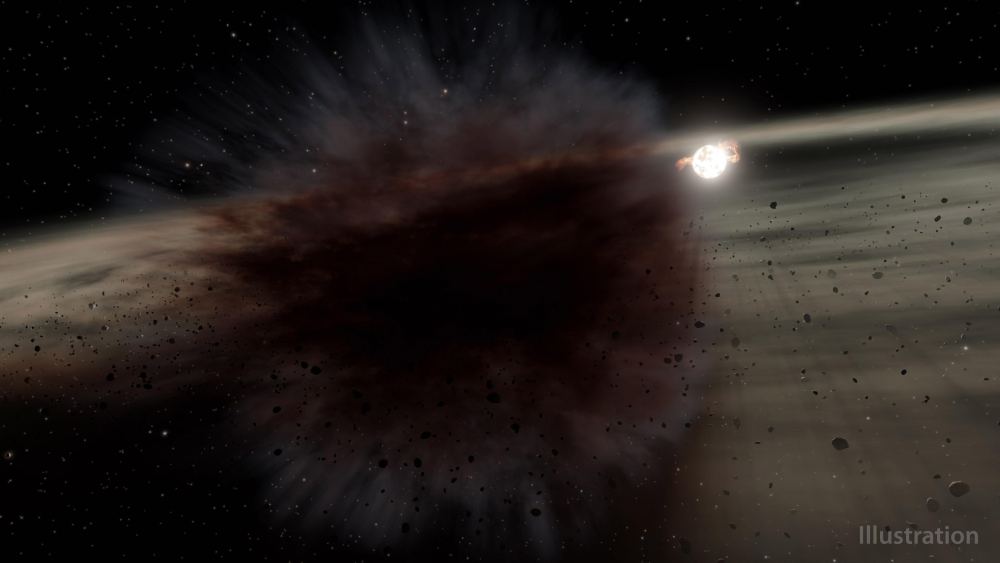
This illustration depicts the result of a collision between two large asteroid-sized bodies. NASA's Spitzer saw a debris cloud block the star HD 166191, giving scientists details about the smashup that occurred. Credit: NASA/JPL-Caltech
Our Solar System was born in chaos. Collisions shaped and built the Earth and the other planets, and even delivered the building blocks of life. Without things smashing into each other, we might not be here.
Thankfully, most of the collisions are in the past, and now our Solar System is a relatively calm place. But frequent collisions still occur in other younger solar systems, and astronomers can see the aftermath.
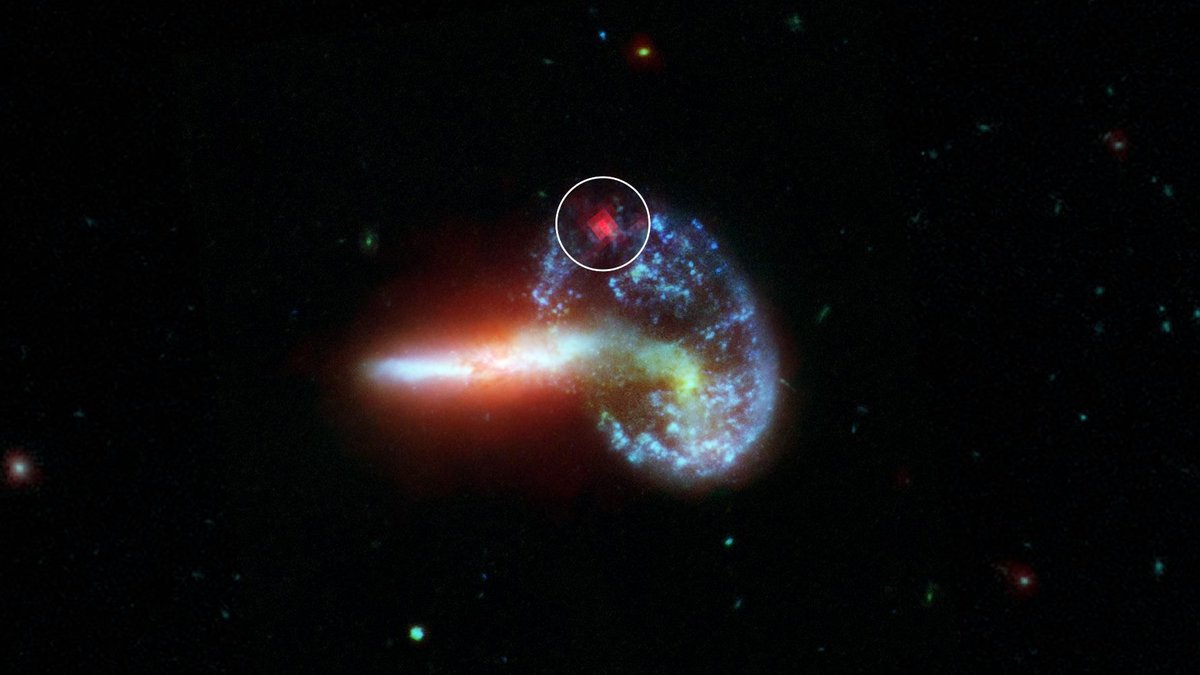
When the poet Horace said “We are but dust and shadow”, he probably didn’t think that dust itself could create a shadow. But it can, and that shadow can obscure even some of the most powerful explosions in the universe. At least that’s the finding from new research from an international team using data from the recently retired Spitzer telescope. It turns out dust in far away galaxies can obscure supernovas.
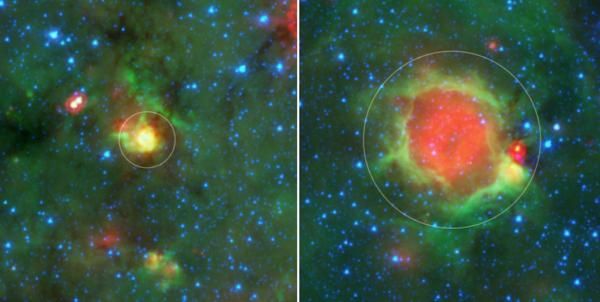
AI is often touted as being particularly good at finding patterns amongst reams of data. But humans also are extremely good at pattern recognition, especially when it comes to visual images. Citizen science efforts around the globe leverage this fact, and recent results released from the Milky Way Project on Zooinverse show how effective it can be. The project’s volunteer team identified 6,176 “yellowballs”, which are a stage that star clusters go through during their early years. That discovery helps scientists better understand the formation of these clusters and how they eventually grow into individualized stars.
A new study indicates that in about a million years, a star will pass close to our Solar System, sending comets towards Earth and the other planets. Credit: NASA/JPL-Caltech
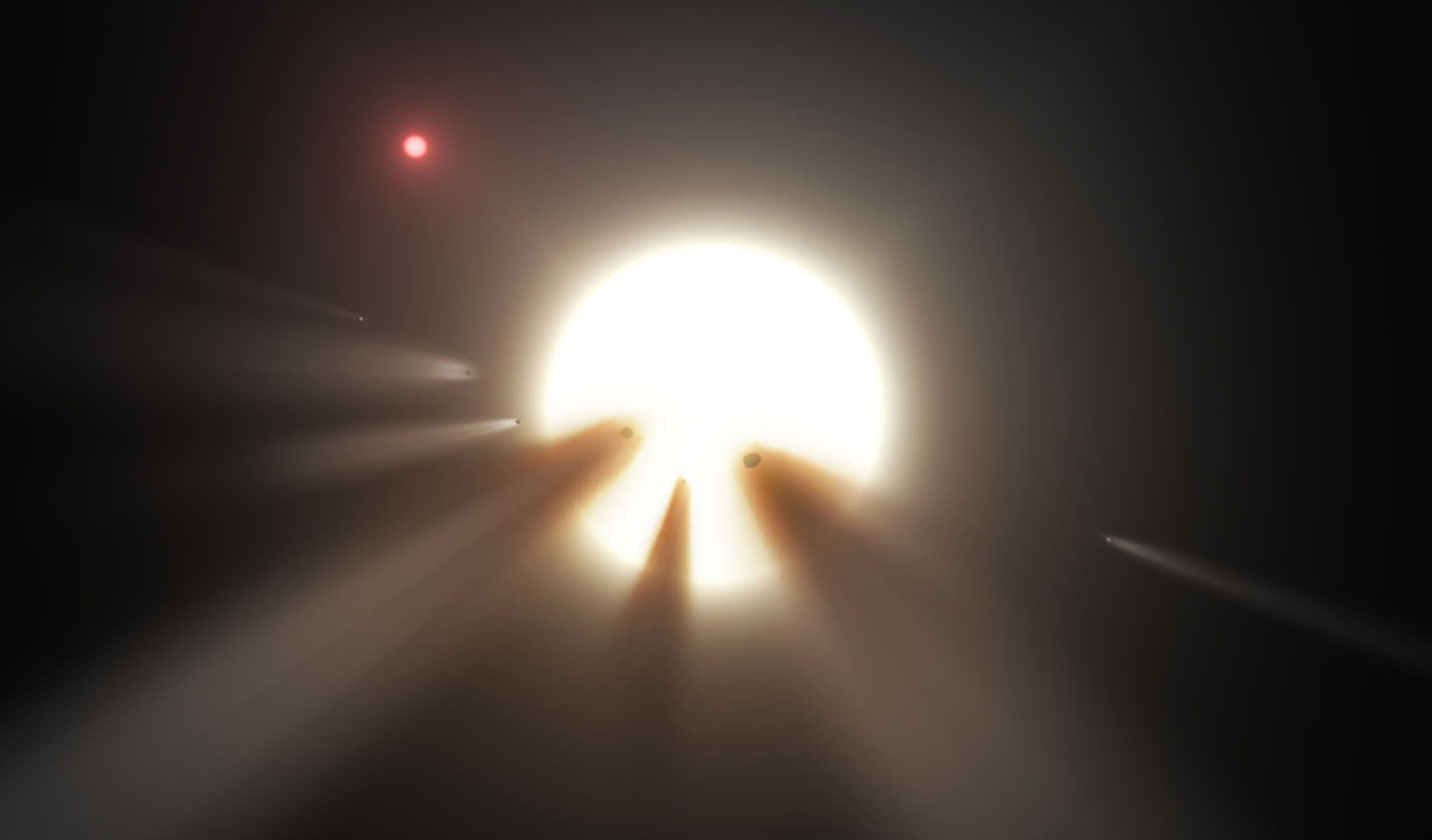
The story of KIC 8462852 appears far from over. You’ll recall NASA’s Kepler mission had monitored the star for four years, observing two unusual incidents, in 2011 and 2013, when its light dimmed in dramatic, never-before-seen ways. Models to explain its erratic behavior were so lacking that some considered the possibility that alien megastructures built to capture sunlight around the host star (think Dyson Spheres) might be the cause.
But a search using the SETI Institute’s Allen Telescope Array for two weeks in October detected no significant radio signals or other signs of intelligent life emanating from the star’s vicinity. Something had passed in front of the star and blocked its light, but what?
The Spitzer Space Telescope observatory trails behind Earth as it orbits the Sun. Credit: NASA/JPL-Caltech
Shattered comets and asteroids were also suggested as possible explanations — dust and ground-up rock would be at the right temperature to glow in the infrared — but Kepler could only observe in visible light where any debris would be invisible or swamped by the light of the star. So researchers looked through older observations made in 2010 by the Wide Field Infrared Survey Explorer (WISE) space telescope. Unfortunately, WISE observed the star before the strange variations were seen and therefore before any putative dust-busting collisions.
Not to be stymied, astronomers next checked out the data from NASA’s Spitzer Space Telescope, which like WISE, is optimized for infrared light. Spitzer just happened to observe KIC 8462852 much more recently in 2015.
“Spitzer has observed all of the hundreds of thousands of stars where Kepler hunted for planets, in the hope of finding infrared emission from circumstellar dust,” said Michael Werner, the Spitzer project scientist and the lead investigator of that particular Spitzer/Kepler observing program.
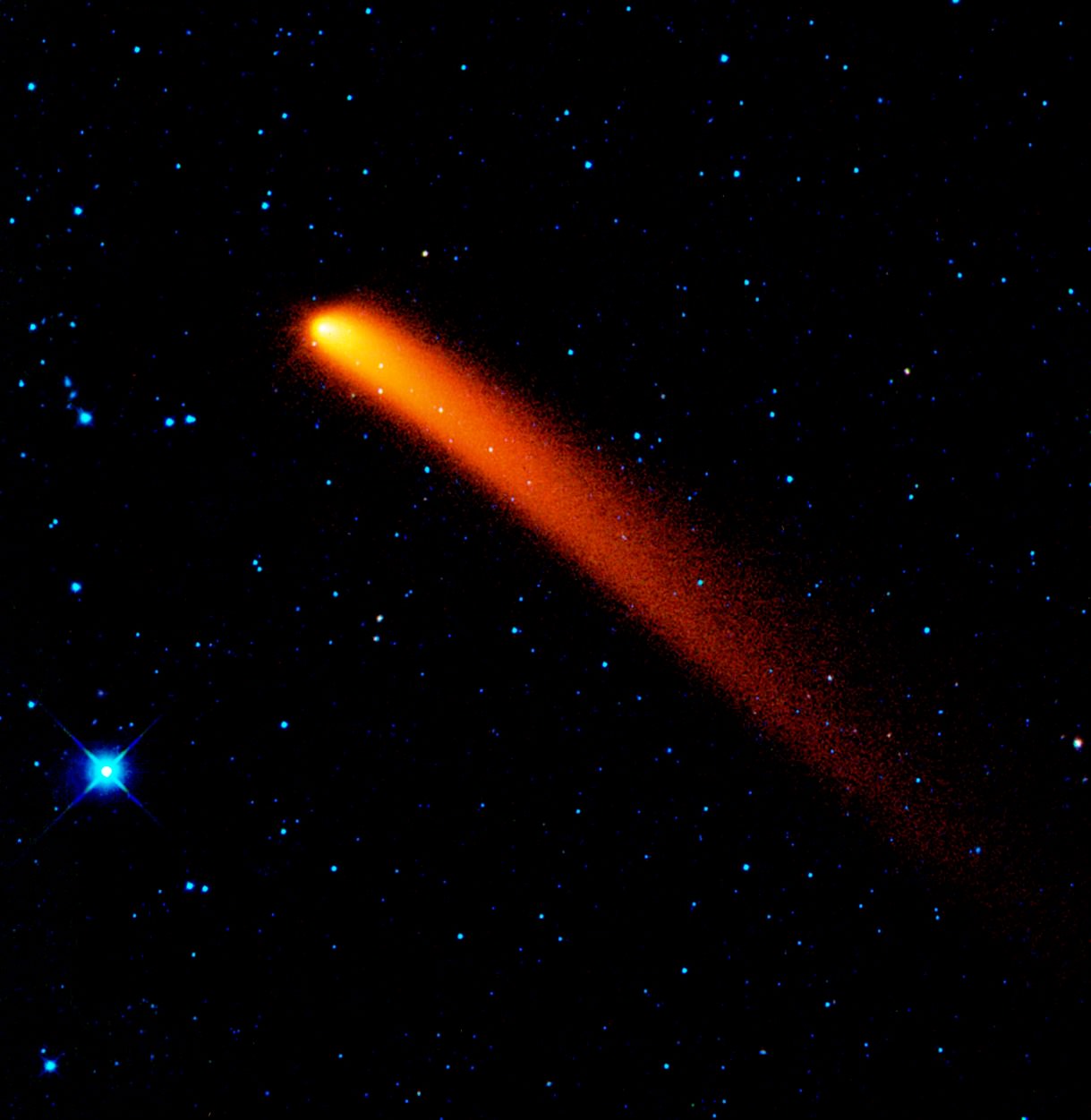
Comet Siding Spring (C/2007 Q3) imaged in the infrared by the WISE space telescope in January 2010. Credit: NASA/JPL-Caltech/UCLA
I’d love to report that Spitzer tracked down glowing dust but no, it also came up empty-handed. This makes the idea of an asteroidal smash-up very unlikely, but not one involving comets according to Massimo Marengo of Iowa State University (Ames) who led the new study. Marengo proposes that cold comets are responsible. Picture a family of comets traveling on a very long, eccentric orbit around the star with a very large comet at the head of the pack responsible for the big fading seen by Kepler in 2011. Later, in 2013, the rest of the comet family, a band of various-sized fragments lagging behind, would have passed in front of the star and again blocked its light. By 2015, the comets would have moved even farther away on their long orbital journey, leaving no detectable infrared excess.
“This is a very strange star,” said Marengo. “It reminds me of when we first discovered pulsars. They were emitting odd signals nobody had ever seen before, and the first one discovered was named LGM-1 after ‘Little Green Men.'”
Clearly, more long-term observations are needed. And frankly, I’m still puzzled why cold or less active comets might still not be detected by their glowing dust. But let’s assume for a moment the the comet idea is correct. If so, we should expect to see similar dips in KIC 8462852’s light as the comet swarm swings around again.
We record the Weekly Space Hangout every Friday at 12:00 pm Pacific / 3:00 pm Eastern. You can watch us live on Google+, Universe Today, or the Universe Today YouTube page.
You can join in the discussion between episodes over at our Weekly Space Hangout Crew group in G+, and suggest your ideas for stories we can discuss each week!
We’ve spent the last few weeks talking about different ways astronomers are searching for exoplanets. But now we reach the most exciting part of this story: actually imaging these planets directly. Today we’re going to talk about the work NASA’s Spitzer Space Telescope has done viewing the atmospheres of distant planets. Continue reading “Astronomy Cast Ep. 367: Spitzer does Exoplanets”
A screen grab of the new zoomable Milky Way mosaic that uses Microsoft's WorldWide Telescope viewer. Click to use. Credit: NASA
Touring the Milky Way’s a blast with this brand new 360-degree interactive panorama. More than 2 million infrared photos taken by NASA’s Spitzer Space Telescope were jigsawed into a 20-gigapixel click-and-zoom mosaic that takes the viewer from tangled nebulae to stellar jets to blast bubbles around supergiant stars.
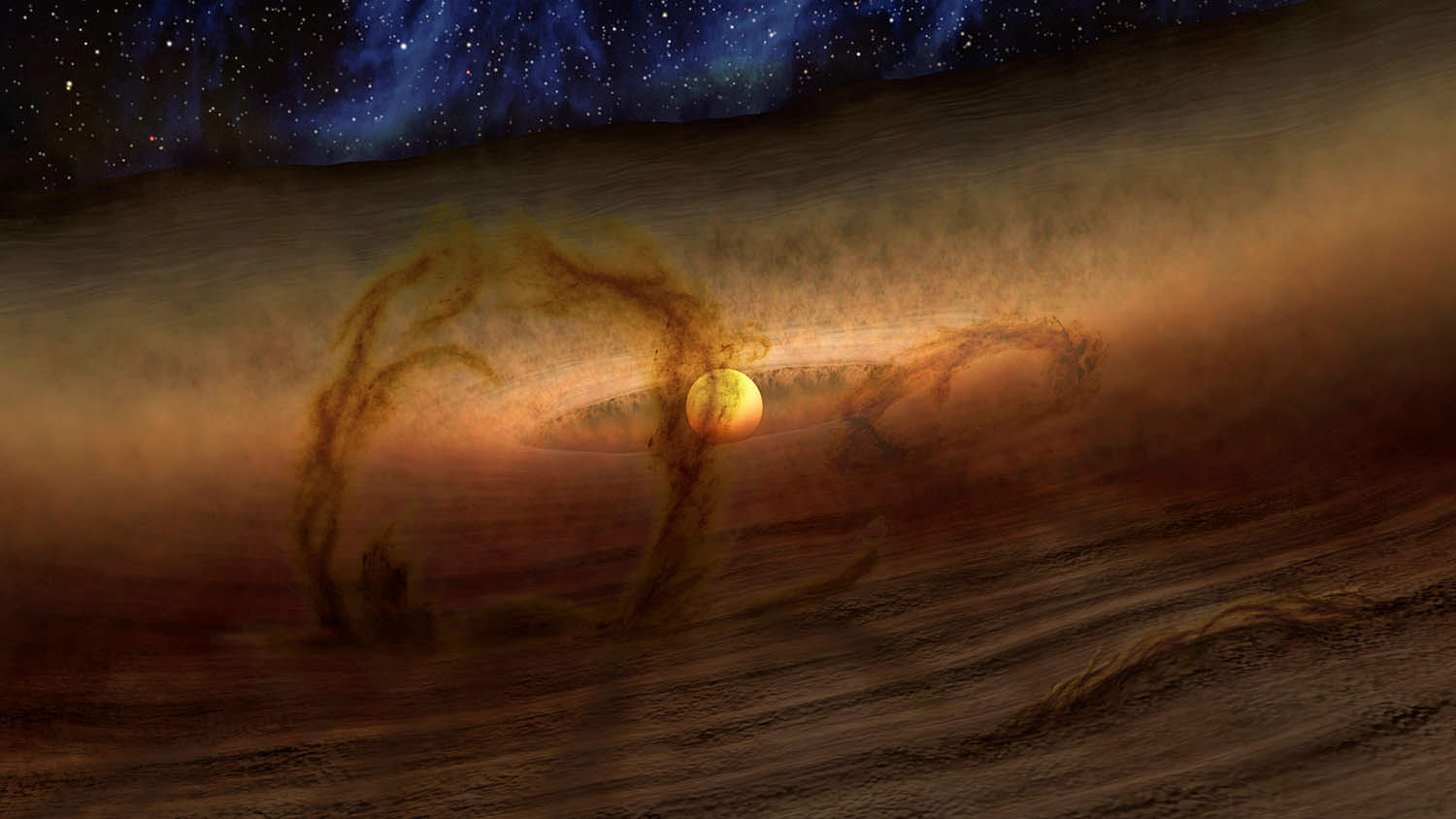
Magnetic loops carry gas and dust above disks of planet-forming material circling stars, as shown in this artist’s conception. These loops give off extra heat, which NASA’s Spitzer Space Telescope detects as infrared light. The colors in this illustration show what an alien observer with eyes sensitive to both visible light and infrared wavelengths might see. Credit: NASA/JPL-Caltech/R. Hurt (IPAC)
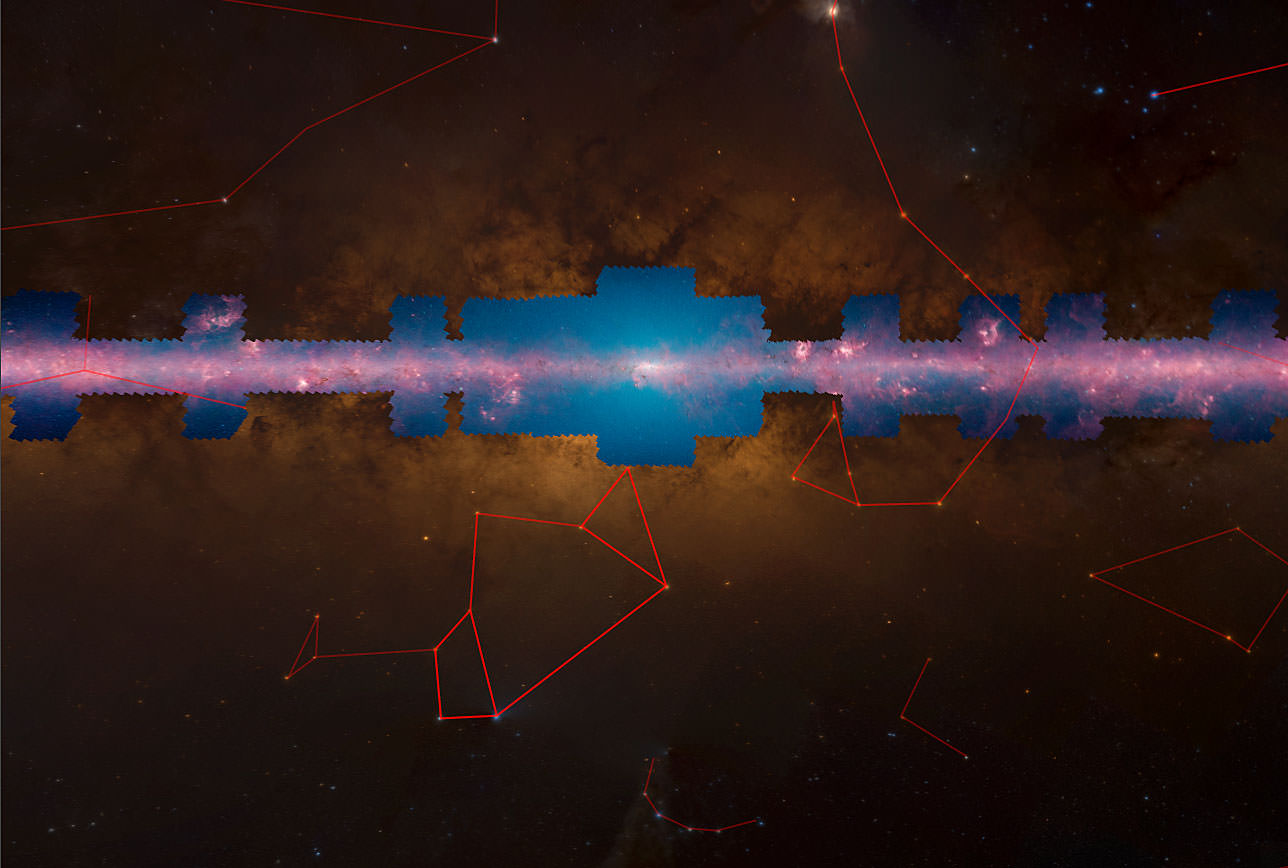
The new composite, using infrared images taken over the past decade, was compiled by a team led by UW-Madison astronomer Barbara Whitney and unveiled at a TEDactive conference in Vancouver, Canada Thursday. Unlike visual light, infrared penetrates the ubiquitous dust concentrated in the galactic plane to reveal structures otherwise obscured.
Catching a GLIMPSE of the Milky Way in this short video presentation
“For the first time, we can actually measure the large-scale structure of the galaxy using stars rather than gas,” explained Edward Churchwell, UW-Madison professor of astronomy and team co-leader. “We’ve established beyond the shadow of a doubt that our galaxy has a large bar structure that extends halfway out to the sun’s orbit. We know more about where the Milky Way’s spiral arms are.”
Named GLIMPSE360 (Galactic Legacy Mid-Plane Survey Extraordinaire project), the deep infrared survey captures only about 3% of the sky, but because it focuses on the plane of the Milky Way, where stars are most highly concentrated, it shows more than half of all the galaxy’s 300 billion suns.
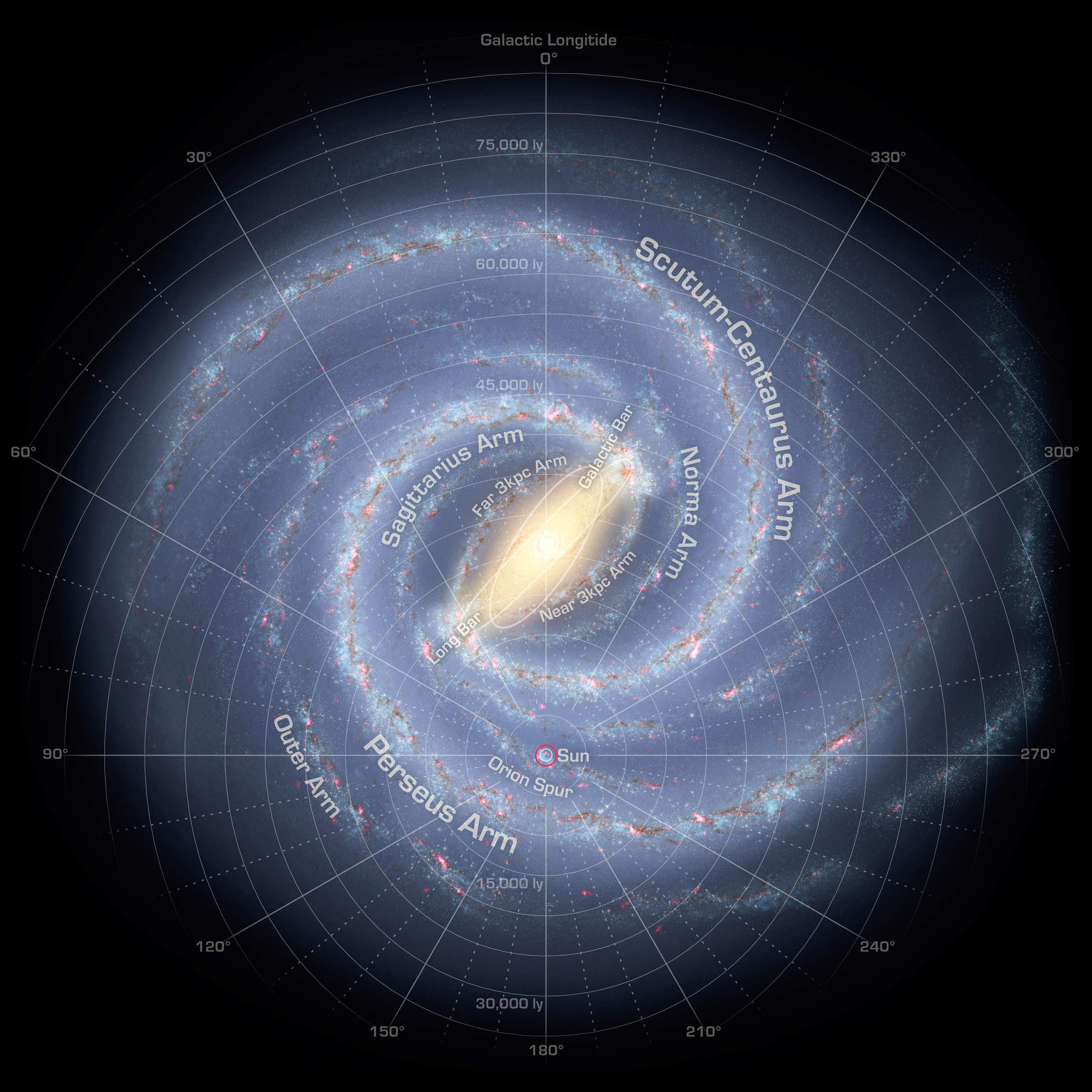
The Milky Way is a spiral galaxy with several prominent arms containing stellar nurseries swathed in pink clouds of hydrogen gas. The sun is shown near the bottom in the Orion Spur. Credit: NASA
Using your imagination to hover high above the galactic plane, you’d see the Milky Way is a flat spiral galaxy sporting a stubby bar of stars crossing its central bulge. The solar system occupies a tiny niche in a minor spiral arm called the Orion Spur two-thirds of the way from the center to the edge. At 100,000 light years across, the Milky Way is vast beyond comprehension and yet it’s only one of an estimated 100 billion galaxies in the observable universe.
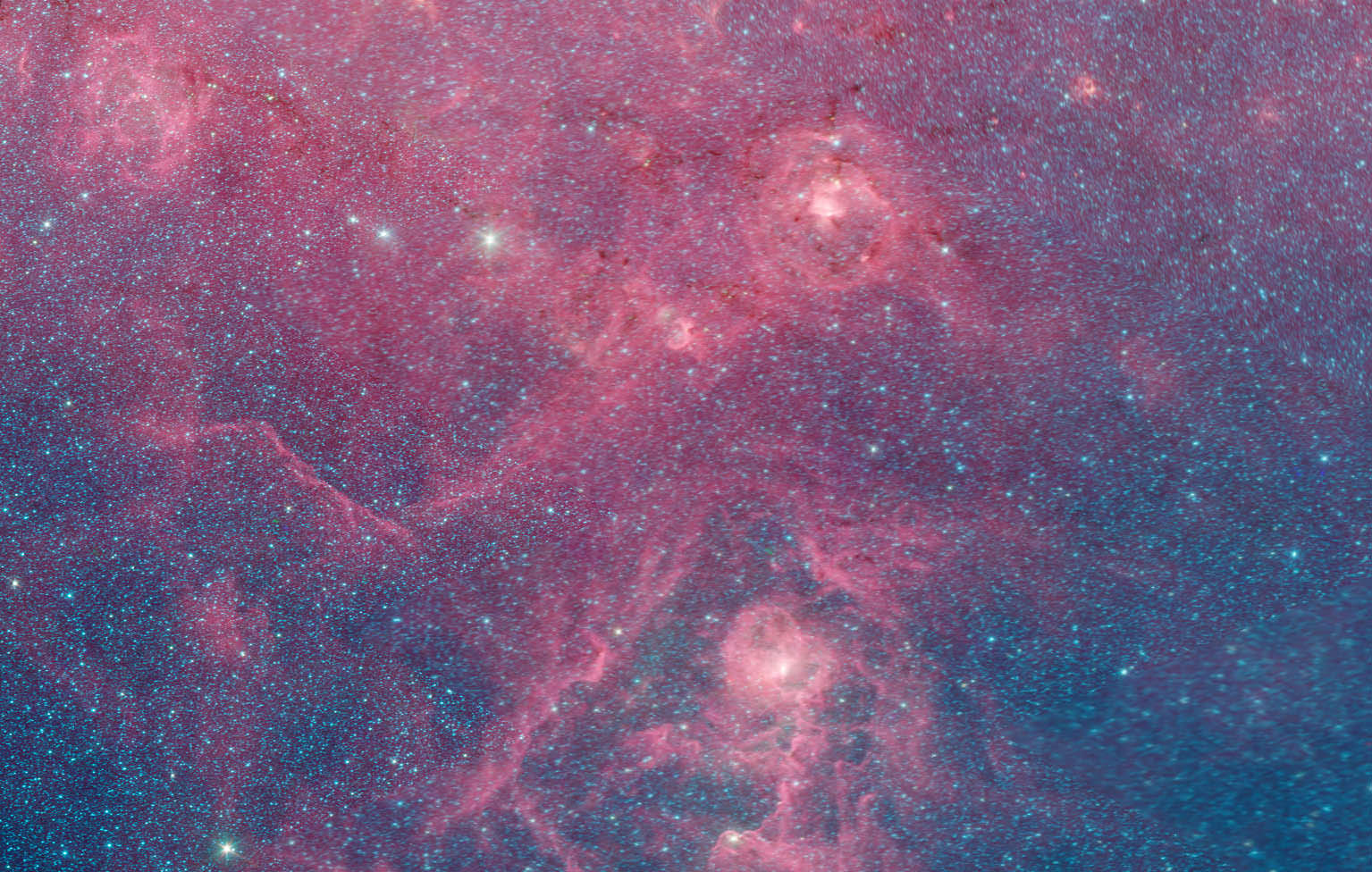
Bubbles of gas and sites of star formation are seen in this close up in a region in the constellation Sagittarius. Credit:
While you and I sit back and marvel at all the stellar and nebular eye candy, the Spitzer images are helping astronomers determine where the edge of the galaxy lies and location of the spiral arms. GLIMPSE images have already revealed the Milky Way to be larger than previously thought and shot through with bubbles of expanding gas and dust blown by giant stars.
Spitzer can see faint stars in the “backcountry” of our galaxy — the outer, darker regions that went largely unexplored before.
Barbara Whitney, co-leader of the GLIMPSE360 team
“There are a whole lot more lower-mass stars seen now with Spitzer on a large scale, allowing for a grand study,” said Whitney. “Spitzer is sensitive enough to pick these up and light up the entire ‘countryside’ with star formation.”
The new 360-degree view will also help NASA’s upcoming James Webb Space Telescope target the most interesting sites of star-formation, where it will make even more detailed infrared observations.
When you play around with the interactive mosaic, you’ll notice a few artifacts here and there among the images. Minor stuff. What took some getting used to was how strikingly different familiar nebulae appeared when viewed in infrared instead of visual light. The panorama is also available on the Aladin viewing platform which offers shortcuts to regions of interest.
Neil deGrasse Tyson, astrophysicist and host of the new Cosmos TV series, gave the third line of our “cosmic address” as the Milky Way after ‘Earth’ and ‘Solar System’. After a few minutes with GLIMPSE360 you’ll better appreciate the depth and breadth of our galactic home.
The speeding rogue star Kappa Cassiopeiae sets up a glowing bow shock in this Spitzer image (NASA/JPL-Caltech)
That might seem like a sensational headline worthy of a supermarket tabloid but, taken in context, it’s exactly what’s happening here!
The bright blue star at the center of this image is a B-type supergiant named Kappa Cassiopeiae, 4,000 light-years away. As stars in our galaxy go it’s pretty big — over 57 million kilometers wide, about 41 times the radius of the Sun. But its size isn’t what makes K Cas stand out — it’s the infrared-bright bow shock it’s creating as it speeds past its stellar neighbors at a breakneck 1,100 kilometers per second.
K Cas is what’s called a runway star. It’s traveling very fast in relation to the stars around it, possibly due to the supernova explosion of a previous nearby stellar neighbor or companion, or perhaps kicked into high gear during a close encounter with a massive object like a black hole.
As it speeds through the galaxy it creates a curved bow shock in front of it, like water rising up in front of the bow of a ship. This is the ionized glow of interstellar material compressed and heated by K Cas’ stellar wind. Although it looks like it surrounds the star pretty closely in the image above, the glowing shockwave is actually about 4 light-years out from K Cas… slightly less than the distance from the Sun to Proxima Centauri.
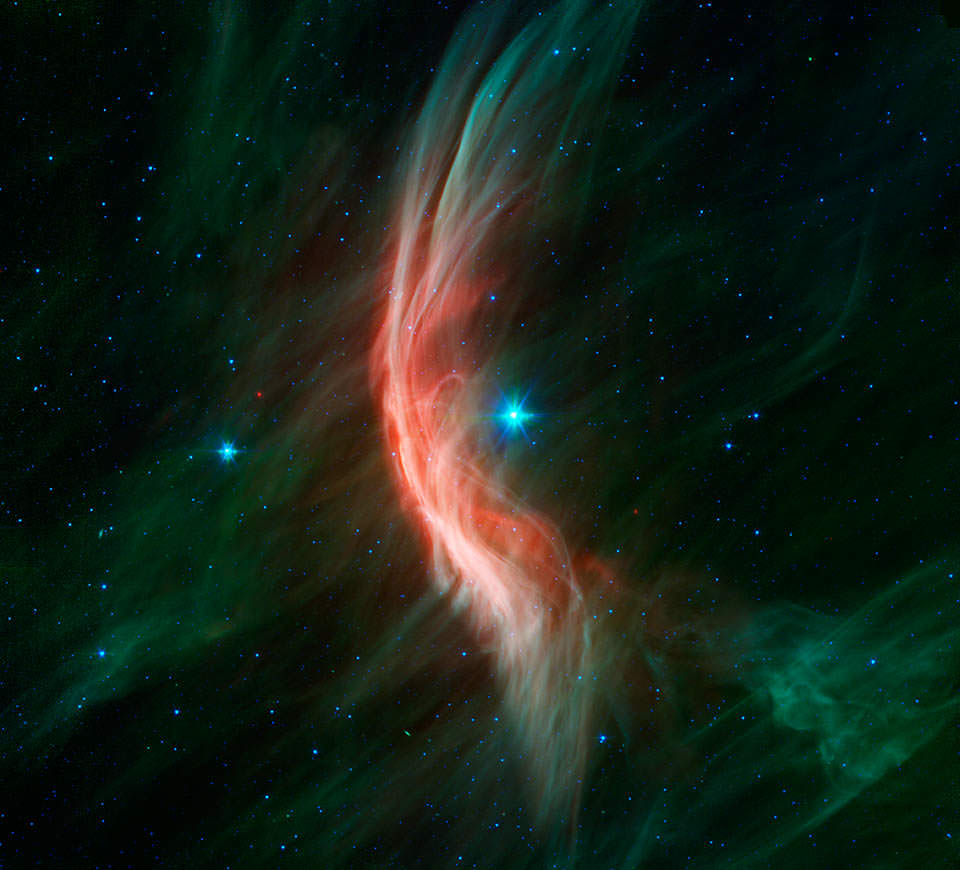
The bow shock of Zeta Ophiuchi, another runaway star observed by Spitzer (NASA/JPL-Caltech)
Although K Cas is visible to the naked eye, its bow shock isn’t. It’s only made apparent in infrared wavelengths, which NASA’s Spitzer Space Telescope is specifically designed to detect. Some other runaway stars have brighter bow shocks — like Zeta Ophiuchi at right — which can be seen in optical wavelengths (as long as they’re not obscured by dust, which Zeta Oph is.)
The bright wisps seen crossing K Cas’ bow shock may be magnetic filaments that run throughout the galaxy, made visible through interaction with the ionized gas. In fact bow shocks are of particular interest to astronomers precisely because they help reveal otherwise invisible features and allow deeper investigation into the chemical composition of stars and the regions of the galaxy they are traveling through. Like a speeding car on a dark country road, runaway stars’ bow shocks are — to scientists — like high-beam headlamps lighting up the space ahead.
Runaway stars are not to be confused with rogue stars, which, although also feel the need for speed, have been flung completely out of their home galaxies.
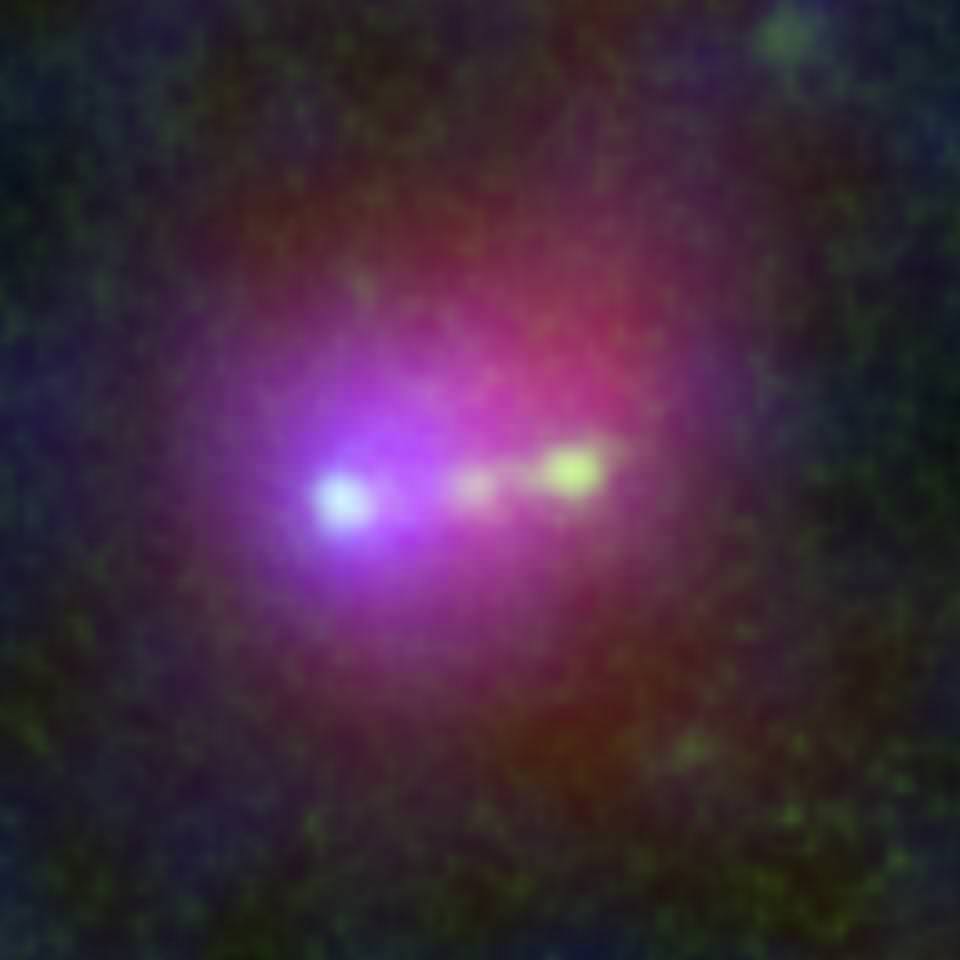
A combined image from the Spitzer, Hubble, and Subaru telescopes show this structure to be three galaxies merging into one (NASA/JPL-Caltech/STScI/NAOJ/Subaru)
An enormous and incredibly luminous distant galaxy has turned out to actually be three galaxies in the process of merging together, based on the latest observations from ALMA as well as the Hubble and Spitzer space telescopes. Located 13 billion light-years away, this galactic threesome is being seen near the very beginning of what astronomers call the “Cosmic Dawn,” a time when the Universe first became illuminated by stars.
“This exceedingly rare triple system, seen when the Universe was only 800 million years old, provides important insights into the earliest stages of galaxy formation during a period known as ‘Cosmic Dawn’ when the Universe was first bathed in starlight,” said Richard Ellis, professor of astronomy at Caltech and member of the research team. “Even more interesting, these galaxies appear poised to merge into a single massive galaxy, which could eventually evolve into something akin to the Milky Way.”
In the image above, infrared data from NASA’s Spitzer Space Telescope are shown in red, visible data from NASA’s Hubble Space Telescope are green, and ultraviolet data from Japan’s Subaru telescope are blue. First discovered in 2009, the object is named “Himiko” after a legendary queen of Japan.
The merging galaxies within Himiko are surrounded by a vast cloud of hydrogen and helium, glowing brightly from the galaxies’ powerful outpouring of energy.
What’s particularly intriguing to astronomers is the noted lack of heavier elements like carbon in the cloud.
“This suggests that the gas cloud around the galaxy is actually quite primitive in its composition,” Ellis states in an NRAO video, “and has not yet been enriched by the products of nuclear fusion in the stars in the triple galaxy system. And what this implies is that the system is much younger and potentially what we call primeval… a first-generation object that is being seen. If true that’s very very exciting.”
Further research of distant objects like Himiko with the new high-resolution capabilities of ALMA will help astronomers determine how the Universe’s first galaxies “turned on”… was it a relatively sudden event, or did it occur gradually over many millions of years?
Watch the full video from the National Radio Astronomy Observatory below:
The research team’s results have been accepted for publication in the Astrophysical Journal.