Illustration of the supermassive black hole at the center of the Milky Way. It's huge, with over 4 times the mass of the Sun. But ultramassive black holes are even more massive and can contain billions of solar masses. Image Credit:
Credit: NRAO/AUI/NSF
Even though the black hole at the center of the Milky Way is a monster, it’s still rather quiet. Called Sagittarius A*, it’s about 4.6 million times more massive than our Sun. Usually, it’s a brooding behemoth. But scientists observing Sgr. A* with the Keck Telescope just watched as its brightness bloomed to over 75 times normal for a few hours.
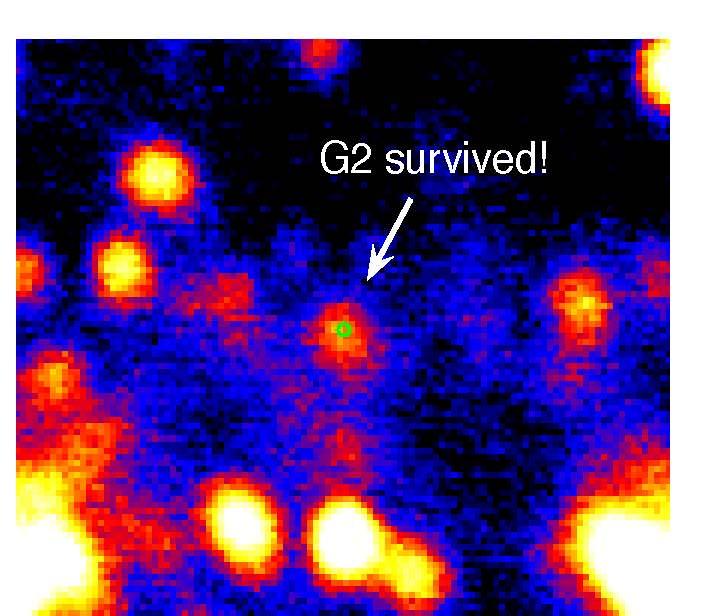
An image from W. M. Keck Observatory near infrared data shows that G2 survived its closest approach to the black hole and continues happily on its orbit. The green circle just to its right depicts the location of the invisible supermassive black hole. Credit: Andrea Ghez, Gunther Witzel/UCLA Galactic Center Group/W. M. Keck Observatory
A mysterious object swinging around the supermassive black hole in the center our galaxy has surprised astronomers by actually surviving what many thought would be a devastating encounter. And with its survival, researchers have finally been able to solve the conundrum of what the object – known as G2 — actually is. Since G2 was discovered in 2011, there was a debate whether it was a huge cloud of hydrogen gas or a star surrounded by gas. Turns out, it was neither … or actually, all of the above, and more.
Astronomers now say that G2 is most likely a pair of binary stars that had been orbiting the black hole in tandem and merged together into an extremely large star, cloaked in gas and dust.
“G2 survived and continued happily on its orbit; a simple gas cloud would not have done that,” said Andrea Ghez from UCLA, who has led the observations of G2. “G2 was basically unaffected by the black hole. There were no fireworks.”
This was one of the “most watched” recent events in astronomy, since it was the first time astronomers have been able to view an encounter with a black hole like this in “real time.” The thought was that watching G2’s demise would not only reveal what this object was, but also provide more information on how matter behaves near black holes and how supermassive black holes “eat” and evolve.
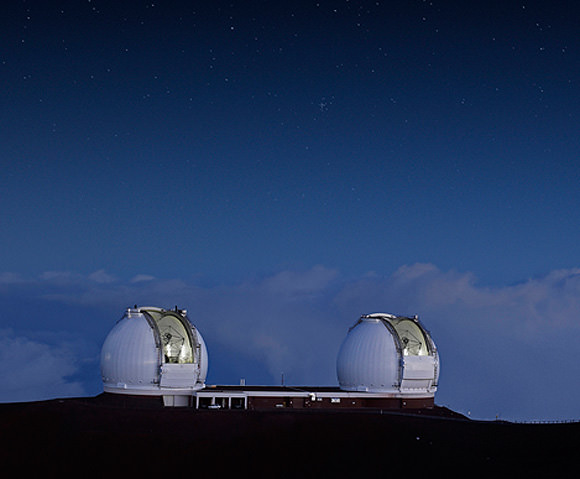
The two Keck 10-meter domes atop Mauna Kea. (Rick Peterson/WMKO)
Using the Keck Observatory, Ghez and her team have been able to keep an eye on G2’s movements and how the black hole’s powerful gravitational field affected it.
While some researchers initially thought G2 was a gas cloud, others argued that they weren’t seeing the amount of stretching or “spaghettification” that would be expected if this was just a cloud of gas.
As Ghez told Universe Today earlier this year, she thought it was a star. “Its orbit looks so much like the orbits of other stars,” she said. “There’s clearly some phenomenon that is happening, and there is some layer of gas that’s interacting because you see the tidal stretching, but that doesn’t prevent a star being in the center.”
Now, after watching the object the past few months, Ghez said G2 appears to be just one of an emerging class of stars near the black hole that are created because the black hole’s powerful gravity drives binary stars to merge into one. She also noted that, in our galaxy, massive stars primarily come in pairs. She says the star suffered an abrasion to its outer layer but otherwise will be fine.
Ghez explained in a UCLA press release that when two stars near the black hole merge into one, the star expands for more than 1 million years before it settles back down.
“This may be happening more than we thought. The stars at the center of the galaxy are massive and mostly binaries,” she said. “It’s possible that many of the stars we’ve been watching and not understanding may be the end product of mergers that are calm now.”
Ghez and her colleagues also determined that G2 appears to be in that inflated stage now and is still undergoing some spaghettification, where it is being elongated. At the same time, the gas at G2’s surface is being heated by stars around it, creating an enormous cloud of gas and dust that has shrouded most of the massive star.
Usually in astrophysics, timescales of events taking place are very long — not over the course of several months. But it’s important to note that G2 actually made this journey around the galactic center around 25,000 years ago. Because of the amount of time it takes light to travel, we can only now observe this event which happened long ago.
“We are seeing phenomena about black holes that you can’t watch anywhere else in the universe,” Ghez added. “We are starting to understand the physics of black holes in a way that has never been possible before.”
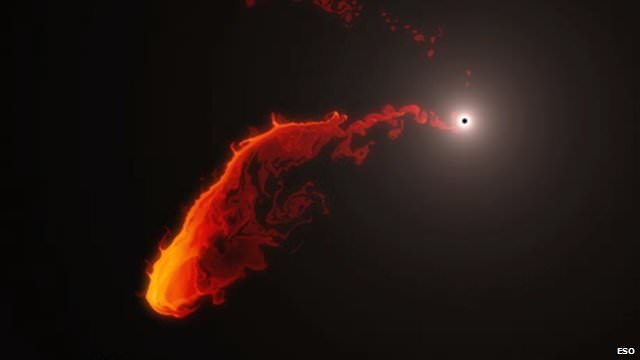
This simulation shows the future behaviour of a gas cloud that has been observed approaching the black hole at the center of the Milky Way. Graphic by ESO/MPE/Marc Schartmann.
The latest observations by the Keck Observatory in Hawaii show that the gas cloud called “G2” was surprisingly still intact, even during its closest approach to the supermassive black hole at the center of our Milky Way galaxy. Astronomers from the UCLA Galactic Center Group reported today that observations obtained on March 19 and 20, 2014 show the object’s density was still “robust” enough to be detected. This means G2 is not just a gas cloud, but likely has a star inside.
“We conclude that G2, which is currently experiencing its closest approach, is still intact,” said the group in an Astronomer’s Telegram, “in contrast to predictions for a simple gas cloud hypothesis and therefore most likely hosts a central star. Keck LGSAO observations of G2 will continue in the coming months to monitor how this unusual object evolves as it emerges from periapse passage.”
We’ve been reporting on this object since its discovery was announced in 2012. G2 was first spotted in 2011 and was quickly deemed to be heading towards our galaxy’s supermassive black hole, called Sgr A*. G2 is not falling directly into the black hole, but it will pass Sgr A* at about 100 times the distance between Earth and the Sun. But that was close enough that astronomers predicted that G2 was likely doomed for destruction.
But it appears to still be hanging in there, at least in mid-March 2014.
Montage of simulation images showing G2 during its close approach to the black hole at the center of the Milky Way. Images by ESO/MPE/Marc Schartmann
Earlier this week, we explained how there were two ideas of what G2 is: one is a simple gas cloud, and the second opinion is that it is a star surrounded by gas. Some astronomers argue that they aren’t seeing the amount of stretching or “spaghettification” that would be expected if this was just a cloud of gas.
The latest word seems to confirm that G2 is more than just a cloud of gas.
This is exciting for astronomers, since they usually don’t get to see events like this take place “in real time.” In astrophysics, timescales of events taking place are usually very long — not over the course of several months. But it’s important to note that G2 actually met its demise around 25,000 years ago. Because of the amount of time it takes light to travel, we can only now observe this event which happened long ago.
We’ll keep you posted on any future news and observations.
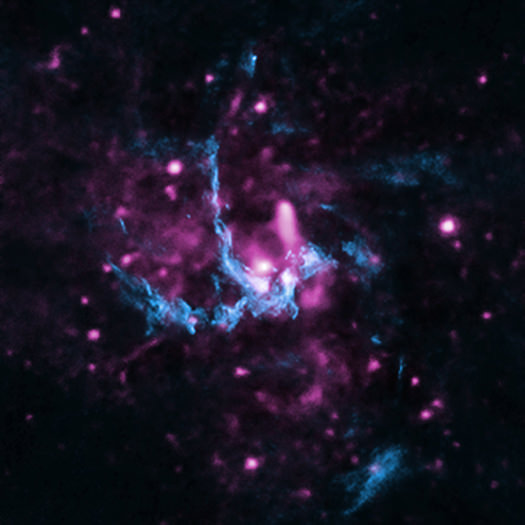
A composite image in X-ray and radio showing a likely candidate for a jet emanating from the supermassive black hole at the center of the Milky Way. X-ray: NASA/CXC/UCLA/Z.Li et al; Radio: NRAO/VLA
Jets of high energy particles emanating from a black hole have been detected plenty of times before, but in other galaxies, that is — not from the supermassive black hole at the center of the Milky Way, known as Sagittarius A* (Sgr A*). Previous studies and other evidence suggested that perhaps there were jets – or ghosts of past jets – but many findings and studies often contradicted each other, and none were considered definitive.
Now, astronomers using Chandra X-ray Observatory and the Very Large Array (VLA) radio telescope have found strong evidence Sgr A* is producing a jet of high-energy particles.
“For decades astronomers have looked for a jet associated with the Milky Way’s black hole. Our new observations make the strongest case yet for such a jet,” said Zhiyuan Li of Nanjing University in China, lead author of a study in The Astrophysical Journal.
The supermassive black hole at the center of the Milky Way is about four million times more massive than our Sun and lies about 26,000 light-years from Earth.
While the common notion is that black holes inhale and ingest everything that comes their way, that’s not always true. Sometimes they reject small portions of incoming mass, pushing it away in the form of a powerful jet, and many times a pair of jets. These jets also feed the surroundings, releasing both mass and energy and likely play important roles in regulating the rate of formation of new stars.
Sgr A* is presently known to be consuming very little material, and so the jet is weak, making it difficult to detect. Astronomers don’t see another jet “shooting” in the opposite direction but that may be because of gas or dust blocking the line of sight from Earth or a lack of material to fuel the jet. Or there may be just a single jet.
“We were very eager to find a jet from Sgr A* because it tells us the direction of the black hole’s spin axis. This gives us important clues about the growth history of the black hole,” said Mark Morris of the University of California at Los Angeles, a co-author of the study.
The study shows the spin axis of Sgr A* is pointing in one direction, parallel to the rotation axis of the Milky Way, which indicates to astronomers that gas and dust have migrated steadily into Sgr A* over the past 10 billion years. If the Milky Way had collided with large galaxies in the recent past and their central black holes had merged with Sgr A*, the jet could point in any direction.
The jet appears to be running into gas near Sgr A*, producing X-rays detected by Chandra and radio emission observed by the VLA. The two key pieces of evidence for the jet are a straight line of X-ray emitting gas that points toward Sgr A* and a shock front — similar to a sonic boom — seen in radio data, where the jet appears to be striking the gas. Additionally, the energy signature, or spectrum, in X-rays of Sgr A* resembles that of jets coming from supermassive black holes in other galaxies.
The Chandra observations in this study were taken between September 1999 and March 2011, with a total exposure of about 17 days.
The early universe was sizzling with active galactic nuclei (AGN) — intensely luminous cores powered by supermassive black holes — most of which could outshine their entire host galaxies and be seen across the observable universe.
While our central supermassive black hole Sgr A* lies rather dormant at the moment, new evidence suggests that it too was once a powerful AGN.
The first hint occurred two years ago when astronomers discovered Fermi bubbles — massive lobes of high-energy radiation that expand 30,000 light years north and south of the galactic center.
Of course the source of these bubbles is “a hot topic today,” Dr. Joss Hawthorn from the Sydney Institute for Astronomy and lead author on the paper, told Universe Today. “Some think the bubbles were inflated by powerful star formation in the disk, others, like me, (think) that they were inflated by a powerful jet from Sgr A*.”
It’s becoming more and more plausible that the Fermi bubbles were created by a recently powerful jet protruding from the center of our galaxy — demonstrating they are remnants of a much more violent past.
But astronomers from the Sydney Institute for Astronomy in Australia, the University of Colorado, Boulder, and the University of Cambridge have found further evidence linking Sgr A* to a recent AGN.
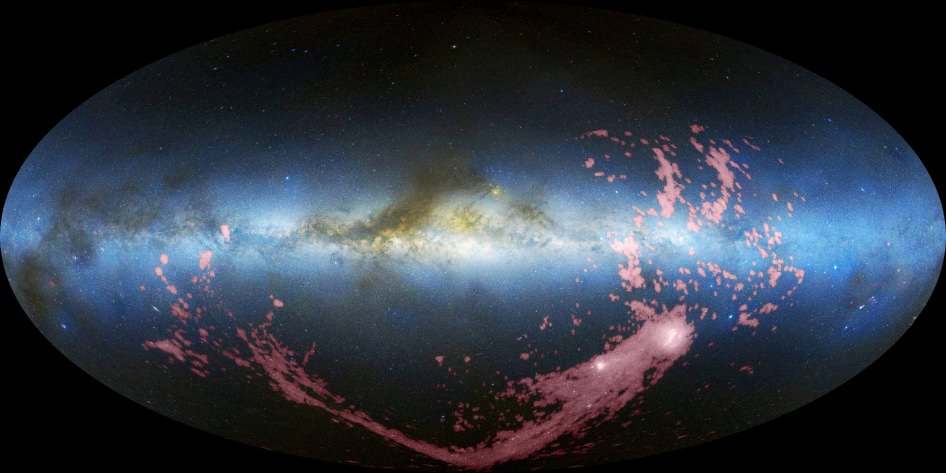
The Magellanic Stream — a long ribbon of gas stretching nearly half way around the Milky Way and trailing our galaxy’s two small companion galaxies, the Magellanic Clouds — is likely to be another ancient remnant of our recent activity.
The problem is that the Magellanic Stream is extremely red. It is emitting a large number of photons that clock in at a particular wavelength: 656 nanometers. This wavelength not only falls in the visible spectrum, but corresponds to a red color.
The Magellanic Stream is emitting so much red light because it contains extremely energetic hydrogen atoms. When atoms have high-energy electrons, these electrons lose energy by emitting photons.
But astronomers cannot explain why the Magellanic Stream has so many energetic hydrogen atoms, why it is such a bright red color — unless they invoke recent AGN activity from the Milky Way galaxy.
If we assume Sgr A* was once very bright, it would have lit up the Magellanic Stream, causing hydrogen atoms to absorb energy from the incoming light — an effect still visible millions of years later.
A huge outburst of energy in our recent past is likely the cause of a Seyfert flare — an eruption of light and radiation when small clouds of gas fall onto the hot disk of matter that swirls around the black hole.
“If you hurl a bucket of water into a sink, you would be shocked if it all disappeared down the plug hole. Of course, the water spins around the plughole first. (The) same thing (occurs) with gas falling onto a black hole. the spinning disk heats up and generates powerful outbursts: Seyfert flares,” Dr. Hawthorn explained.
This provides further evidence that Sgr A* was once a very powerful AGN, causing Fermi bubbles and a brighter Magellanic Stream. It’s likely it was active as recent as one to three million years ago.
The paper has been published in the Astrophysical Journal and is available for download here.
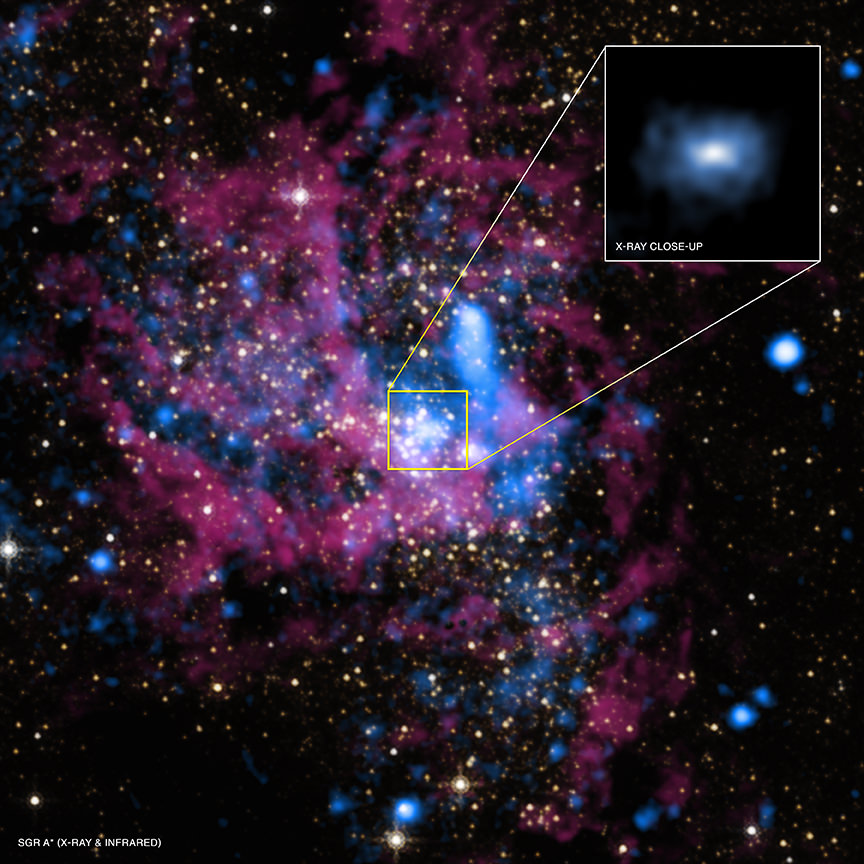
X-ray and infrared image of Sgr A*, the supermassive black hole in the center of the Milky Way
Like most galaxies, our Milky Way has a dark monster in its middle: an enormous black hole with the mass of 4 million Suns inexorably dragging in anything that comes near. But even at this scale, a supermassive black hole like Sgr A* doesn’t actually consume everything that it gets its gravitational claws on — thanks to the Chandra X-ray Observatory, we now know that our SMB is a sloppy eater and most of the material it pulls in gets spit right back out into space.
(Perhaps it should be called the Cookie Monster in the middle.*)
New Chandra images of supermassive black hole Sagittarius A*, located about 26,000 light-years from Earth, indicate that less than 1% of the gas initially within its gravitational grasp ever reaches the event horizon. Instead, much of the gas is ejected before it gets near the event horizon and has a chance to brighten in x-ray emissions.
The new findings are the result of one of the longest campaigns ever performed with Chandra, with observations made over 5 weeks’ time in 2012.
“This new Chandra image is one of the coolest I’ve ever seen,” said study co-author Sera Markoff of the University of Amsterdam in the Netherlands. “We’re watching Sgr A* capture hot gas ejected by nearby stars, and funnel it in towards its event horizon.”
As it turns out, the wholesale ejection of gas is necessary for our resident supermassive black hole to capture any at all. It’s a physics trade-off.
“Most of the gas must be thrown out so that a small amount can reach the black hole”, said co-author Feng Yuan of Shanghai Astronomical Observatory in China. “Contrary to what some people think, black holes do not actually devour everything that’s pulled towards them. Sgr A* is apparently finding much of its food hard to swallow.”
X-ray image of Sgr A*
If it seems odd that such a massive black hole would have problems slurping up gas, there are a couple of reasons for this.
One is pure Newtonian physics: to plunge over the event horizon, material captured — and subsequently accelerated — by a black hole must first lose heat and momentum. The ejection of the majority of matter allows this to occur.
The other is the nature of the environment in the black hole’s vicinity. The gas available to Sgr A* is very diffuse and super-hot, so it is hard for the black hole to capture and swallow it. Other more x-ray-bright black holes that power quasars and produce huge amounts of radiation have much cooler and denser gas reservoirs.
Illustration of gas cloud G2 approaching Sgr A* (ESO/MPE/M.Schartmann/J.Major)
Located relatively nearby, Sgr A* offers scientists an unprecedented view of the feeding behaviors of such an exotic astronomical object. Currently a gas cloud several times the mass of Earth, first spotted in 2011, is moving closer and closer to Sgr A* and is expected to be ripped apart and partially consumed in the coming weeks. Astronomers are eagerly awaiting the results.
“Sgr A* is one of very few black holes close enough for us to actually witness this process,” said Q. Daniel Wang of the University of Massachusetts at Amherst, who led the study.
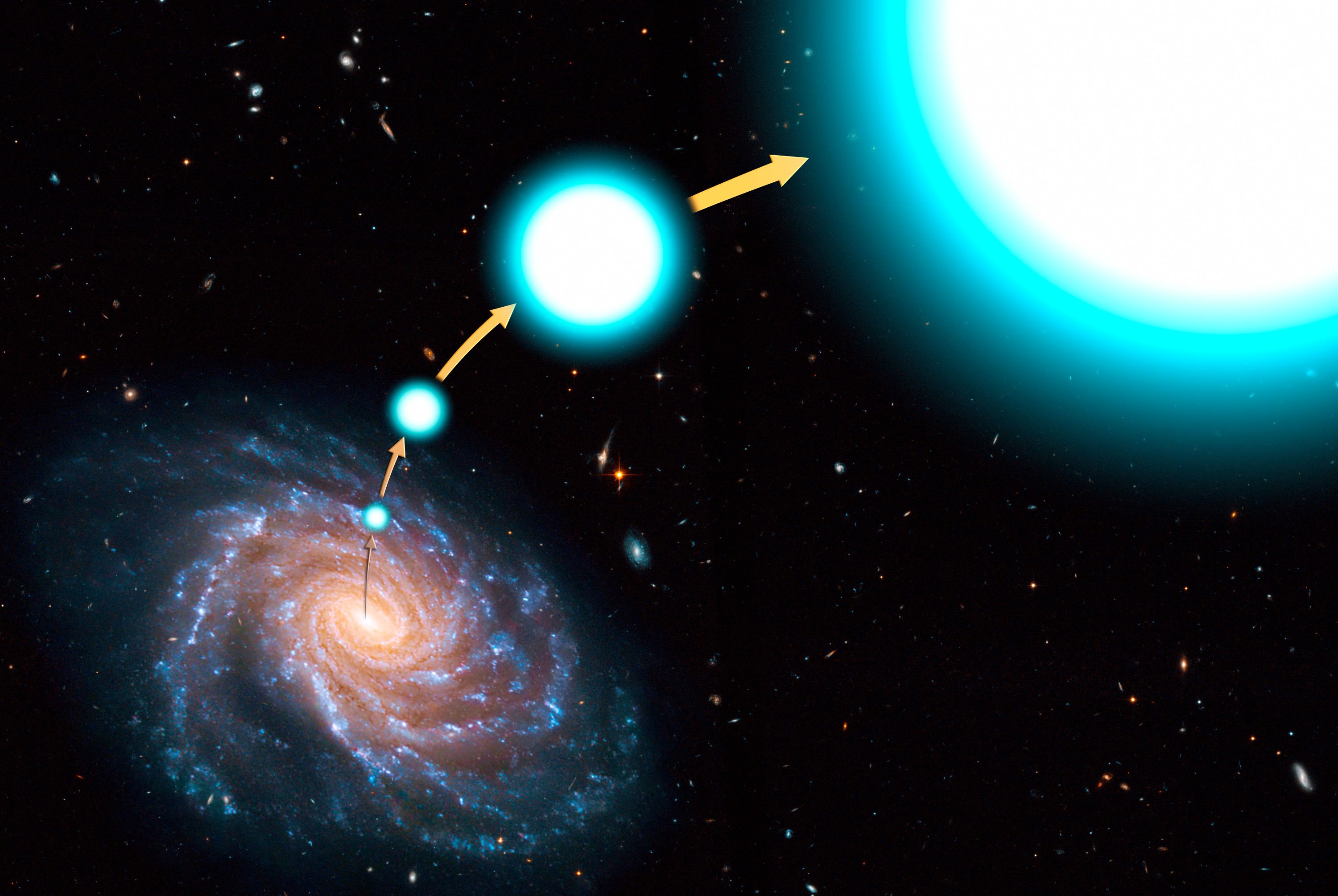
An artist's conception of a hypervelocity star that has escaped the Milky Way. Credit: NASA
The Sun is racing through the Galaxy at a speed that is 30 times greater than a space shuttle in orbit (clocking in at 220 km/s with respect to the galactic center). Most stars within the Milky Way travel at a relatively similar speed. But certain stars are definitely breaking the stellar speed limit. About one in a billion stars travel at a speed roughly 3 times greater than our Sun – so fast that they can easily escape the galaxy entirely!
We have discovered dozens of these so-called hypervelocity stars. But how exactly do these stars reach such high speeds? Astronomers from the University of Leicester may have found the answer.
The first clue comes in observing hypervelocity stars, where we can note their speed and direction. From these two measurements, we can trace these stars backward in order to find their origin. Results show that most hypervelocity stars begin moving quickly in the Galactic Center.
We now have a rough idea of where these stars gain their speed, but not how they reach such high velocities. Astronomers think two processes are likely to kick stars to such great speeds. The first process involves an interaction with the supermassive black hole (Sgr A*) at the center of our Galaxy. When a binary star system wanders too close to Sgr A*, one star is likely to be captured, while the other star is likely to be flung away from the black hole at an alarming rate.
The second process involves a supernova explosion in a binary system. Dr. Kastytis Zubovas, lead author on the paper summarized here, told Universe Today, “Supernova explosions in binary systems disrupt those systems and allow the remaining star to fly away, sometimes with enough velocity to escape the Galaxy.”
There is, however, one caveat. Binary stars in the center of our Galaxy will both be orbiting each other and orbiting Sgr A*. They will have two velocities associated with them. “If the velocity of the star around the binary’s center of mass happens to line up closely with the velocity of the center of mass around the supermassive black hole, the combined velocity may be large enough to escape the Galaxy altogether,” explained Zubovas.
In this case, we can’t sit around and wait to observe a supernova explosion breaking up a binary system. We would have to be very lucky to catch that! Instead, astronomers rely on computer modeling to recreate the physics of such an event. They set up multiple calculations in order to determine the statistical probability that the event will occur, and check if the results match observations.
Astronomers from the University of Leicester did just this. Their model includes multiple input parameters, such as the number of binaries, their initial locations, and their orbital parameters. It then calculates when a star might undergo a supernova explosion, and depending on the position of the two stars at that time, the final velocity of the remaining star.
The probability that a supernova disrupts a binary system is greater than 93%. But does the secondary star then escape from the galactic center? Yes, 4 – 25% of the time. Zubovas described, “Even though this is a very rare occurrence, we may expect several tens of such stars to be created over 100 million years.” The final results suggest that this model ejects stars with rates high enough to match the observed number of hypervelocity stars.
Not only do the number of hypervelocity stars match observations but also their distribution throughout space. “Hypervelocity stars produced by our supernova disruption method are not evenly distributed on the sky,” said Dr. Graham Wynn, a co-author on the paper. “They follow a pattern which retains an imprint of the stellar disk they formed in. Observed hypervelocity stars are seen to follow a pattern much like this.”
In the end, the model was very successful at describing the observed properties of hypervelocity stars. Future research will include a more detailed model that will allow astronomers to understand the ultimate fate of hypervelocity stars, the effect that supernova explosions have on their surroundings, and the galactic center itself.
It’s likely that both scenarios – binary systems interacting with the supermassive black hole and one undergoing a supernova explosion – form hypervelocity stars. Studying both will continue to answer questions about how these speedy stars form.
Illustration of gas cloud G2 approaching Sgr A* . Our central supermassive black hole periodically snacks on clouds and other material like this. That gives off X-rays and other emissions. (ESO/MPE/M.Schartmann/J.Major)
The heart of our Milky Way galaxy is an exotic place. It’s swarming with gigantic stars, showered by lethal blasts of high-energy radiation and a veritable cul-de-sac for the most enigmatic stellar corpses known to science: black holes. And at the center of the whole mélange is the granddaddy of all the black holes in the galaxy — Sagittarius A*, a supermassive monster with 4 million times more mass than the Sun packed into an area smaller than the orbit of Mercury.
Sgr A* dominates the core of the Milky Way with its powerful gravity, trapping giant stars into breakneck orbits and actively feeding on anything that comes close enough. Recently astronomers have been watching the movement of a large cloud of gas that’s caught in the pull of Sgr A* — they’re eager to see what exactly will happen once the cloud (designated G2) enters the black hole’s dining room… it will, in essence, be the first time anyone watches a black hole eat.
But before the dinner bell rings — estimated to be sometime this September — the cloud still has to cover a lot of space. Some scientists are now suggesting that G2’s trip through the crowded galactic nucleus could highlight the locations of other smaller black holes in the area, revealing their hiding places as it passes.
In a new paper titled “G2 can Illuminate the Black Hole Population near the Galactic Center” researchers from Columbia University in New York City and the Harvard-Smithsonian Center for Astrophysics (CfA) in Cambridge, Massachusetts propose that G2, a cloud of cool ionized gas over three times more massive than Earth, will likely encounter both neutron stars and other black holes on its way around (and/or into) SMBH Sgr A*.
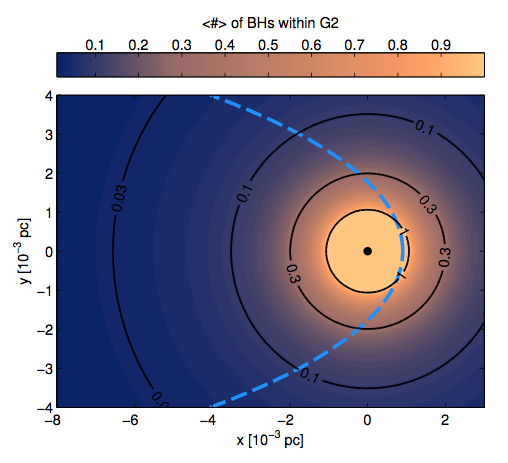
Estimated number of stellar-mass black holes to be encountered by G2 along its trajectory (Bartos et al.)
The team notes that there are estimated to be around 20,000 stellar-mass black holes and about as many neutron stars in the central parsec of the galaxy. (A parsec is equal to 3.26 light-years, or 30.9 trillion km. In astronomical scale it’s just over 3/4 the way to the nearest star from the Sun.) In addition there may also be an unknown number of intermediate-mass black holes lurking within the same area.
These ultra-dense stellar remains are drawn to the center region of the galaxy due to the effects of dynamical friction — drag, if you will — as they move through the interstellar material.
Of course, unless black holes are feeding and actively throwing out excess gobs of hot energy and matter due to their sloppy eating habits, they are very nearly impossible to find. But as G2 is observed moving along its elliptical path toward Sgr A*, it could very well encounter a small number of stellar- and intermediate-mass black holes and neutron stars. According to the research team, such interactions may be visible with X-ray spotting spacecraft like NASA’s Chandra and NuSTAR.
NuSTAR X-ray image of a flare emitted by Sgr A* in July 2012 (NASA/JPL-Caltech)
The chances of G2 encountering black holes and interacting with them in such a way as to produce bright enough x-ray flares that can be detected depends upon a lot of variables, like the angles of interaction, the relative velocities of the gas cloud and black holes, the resulting accretion rates of in-falling cloud matter, and the temperature of the accretion material. In addition, any observations must be made at the right time and for long enough a duration to capture an interaction (or possibly multiple interactions simultaneously) yet also be able to discern them from any background X-ray sources.
Still, according to the researchers such observations would be important as they could provide valuable information on galactic evolution, and shed further insight into the behavior of black holes.
Read the full report here, and watch an ESO news video about the anticipated behavior of the G2 gas cloud around the SMBH Sgr A* below:
This research was conducted by Imre Bartos, Zoltán Haiman, and Bence Kocsis of Columbia University and Szabolcs Márka of the Harvard-Smithsonian Center for Astrophysics.
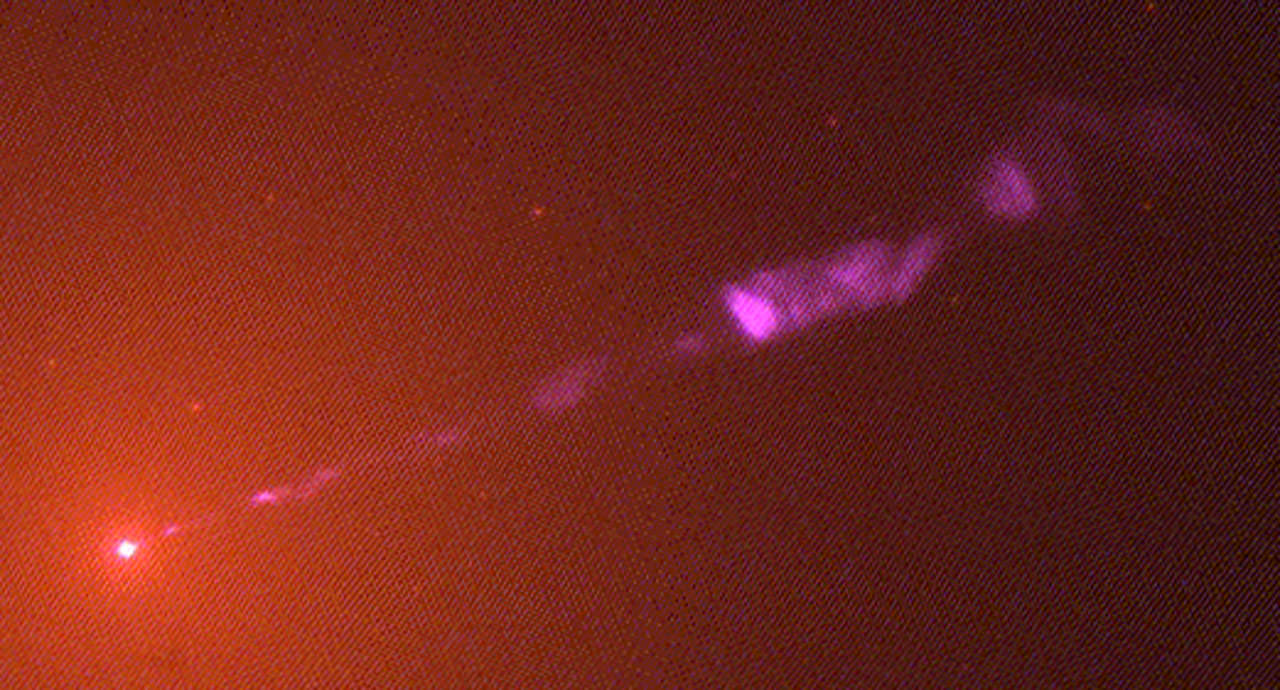
Visible-light Hubble image of the jet emitted by the 3-billion-solar-mass black hole at the heart of galaxy M87 (Feb. 1998) Credit: NASA/ESA and John Biretta (STScI/JHU)
Even though black holes — by their definition and very nature — are the ultimate hoarders of the Universe, gathering and gobbling up matter and energy to the extent that not even light can escape their gravitational grip, they also often exhibit the odd behavior of flinging vast amounts of material away from them as well, in the form of jets that erupt hundreds of thousands — if not millions — of light-years out into space. These jets contain superheated plasma that didn’t make it past the black hole’s event horizon, but rather got “spun up” by its powerful gravity and intense rotation and ended up getting shot outwards as if from an enormous cosmic cannon.
The exact mechanisms of how this all works aren’t precisely known as black holes are notoriously tricky to observe, and one of the more perplexing aspects of the jetting behavior is why they always seem to be aligned with the rotational axis of the actively feeding black hole, as well as perpendicular to the accompanying accretion disk. Now, new research using advanced 3D computer models is supporting the idea that it’s the black holes’ ramped-up rotation rate combined with plasma’s magnetism that’s responsible for shaping the jets.
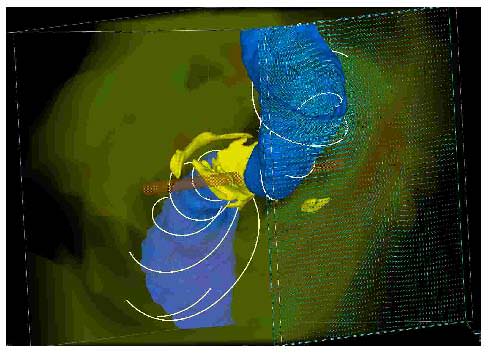
In a recent paper published in the journal Science, assistant professor at the University of Maryland Jonathan McKinney, Kavli Institute director Roger Blandford and Princeton University’s Alexander Tchekhovskoy report their findings made using computer simulations of the complex physics found in the vicinity of a feeding supermassive black hole. These GRMHD — which stands for General Relativistic Magnetohydrodynamic — computer sims follow the interactions of literally millions of particles under the influence of general relativity and the physics of relativistic magnetized plasmas… basically, the really super-hot stuff that’s found within a black hole’s accretion disk.
What McKinney et al. found in their simulations was that no matter how they initially oriented the black hole’s jets, they always eventually ended up aligned with the rotational axis of the black hole itself — exactly what’s been found in real-world observations. The team found that this is caused by the magnetic field lines generated by the plasma getting twisted by the intense rotation of the black hole, thus gathering the plasma into narrow, focused jets aiming away from its spin axes — often at both poles.
At farther distances the influence of the black hole’s spin weakens and thus the jets may then begin to break apart or deviate from their initial paths — again, what has been seen in many observations.
This “magneto-spin alignment” mechanism, as the team calls it, appears to be most prevalent with active supermassive black holes whose accretion disk is more thick than thin — the result of having either a very high or very low rate of in-falling matter. This is the case with the giant elliptical galaxy M87, seen above, which exhibits a brilliant jet created by a 3-billion-solar-mass black hole at its center, as well as the much less massive 4-million-solar-mass SMBH at the center of our own galaxy, Sgr A*.
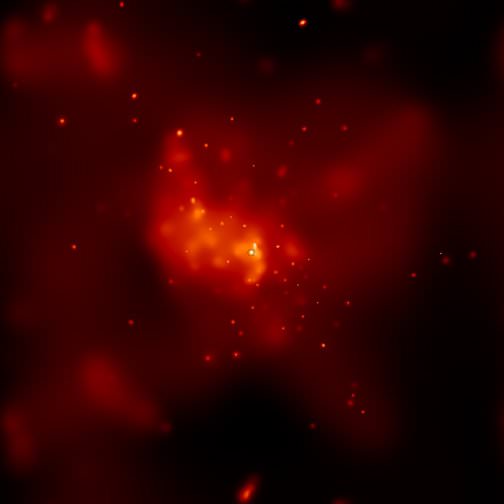
This false-color image shows the central region of our Milky Way Galaxy as seen by Chandra. The bright, point-like source at the center of the image was produced by a huge X-ray flare that occurred in the vicinity of the supermassive black hole at the center of our galaxy.
Image: NASA/MIT/F. Baganoff et al.
For some unknown reason, the black hole at the center of the Milky Way galaxy shoots out an X-ray flare about once a day. These flares last a few hours with the brightness ranging from a few times to nearly one hundred times that of the black hole’s regular output. But back in February 2012, astronomers using the Chandra X-Ray Observatory detected the brightest flare ever observed from the central black hole, also known as Sagittarius A*. The flare, recorded 26,000 light years away, was 150 times brighter than the black hole’s normal luminosity.
What causes these outbursts? Scientists aren’t sure. But Sagittarius A* doesn’t seem to be slowing down, even though as black holes age they should show a decrease in activity.
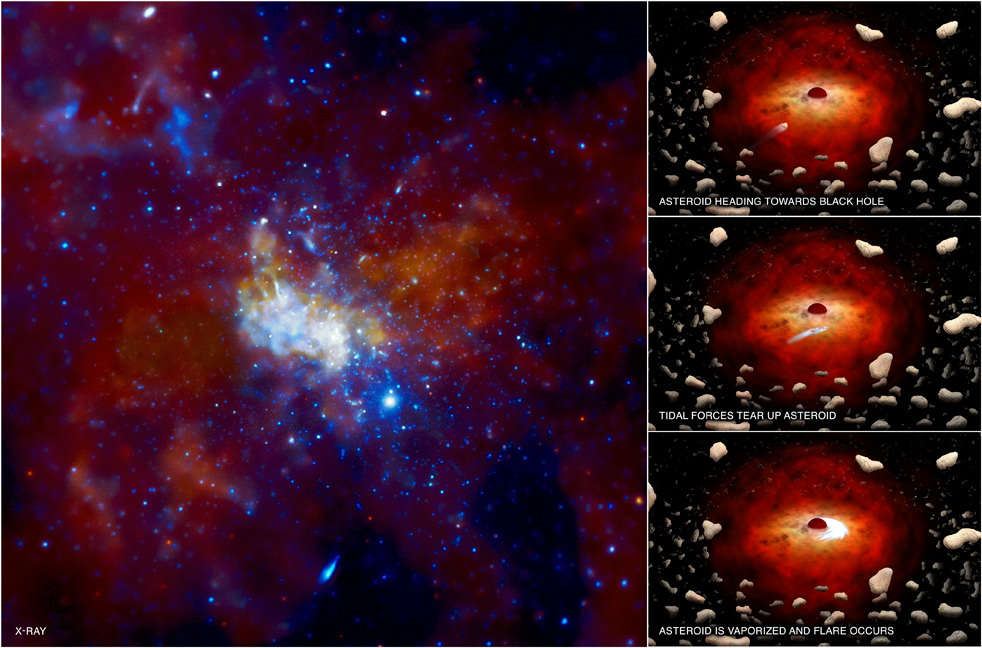
Mysterious X-ray flares caught by Chandra may be asteroids falling into the Milky Way's giant black hole. Credit: X-ray: NASA/CXC/MIT/F. Baganoff et al.; Illustrations: NASA/CXC/M.Weiss
Earlier this year, a group of researchers said that the outbursts may come from asteroids or even wandering planets that come too close to the black hole and they get consumed. Basically, the black hole is eating asteroids and then belching out X-ray gas.
Astronomers involved in this new observation seem to concur with that line of thinking.
“Suddenly, for whatever reason, Sagittarius A* is eating a lot more,” said Michael Nowak, a research scientist at MIT Kavli and co-author of a new paper in the Astrophysical Journal. “One theory is that every so often, an asteroid gets close to the black hole, the black hole stretches and rips it to pieces, and eats the material and turns it into radiation, so you see these big flares.”
Astronomers detect black holes by the light energy given off as they swallow nearby matter. The centers of newborn galaxies and quasars can appear extremely bright, giving off massive amounts of energy as they devour their surroundings. As black holes age, they tend to slow down, consuming less and appearing fainter in the sky.
“Everyone has this picture of black holes as vacuum sweepers, that they suck up absolutely everything,” says Frederick K. Baganoff, another co-author from MIT. “But in this really low-accretion-rate state, they’re really finicky eaters, and for some reason they actually blow away most of the energy.”
While such events like this big blast appear to be relatively rare, Nowak suspects that flare-ups may occur more frequently than scientists expect. The team has reserved more than a month of time on the Chandra Observatory to study Sagittarius A* in hopes of identifying more flares, and possibly what’s causing them.
“These bright flares give information on the flaring process that isn’t available with the weaker ones, such as how they fluctuate in time during the flare, how the spectrum changes, and how fast they rise and fall,” said Mark Morris from UCLA. “The greatest importance of this bright flare may be that it builds up the statistics on the characteristics of strong flares that can eventually be used to [identify] the cause of such flares.”
Even more intriguing to Baganoff is why the black hole emits so little energy. In 2003, he ran the very first observations with the then-new Chandra Observatory, and calculated that, given the amount of gas in its surroundings, Sagittarius A* should be about a million times brighter than it is — a finding that suggested the black hole throws away most of the matter it would otherwise consume.
The physics underlying such a phenomenon remain a puzzle that Baganoff and others hope to tease out with future observations.
“We’re really studying the great escape, because most of the gas escapes, and that’s not what we expect,” Baganoff says. “So we’re piecing out the history of the activity of the center of our galaxy.”
Paper: Chandra/HETGS Observations of the Brightest Flare seen from Sgr A*