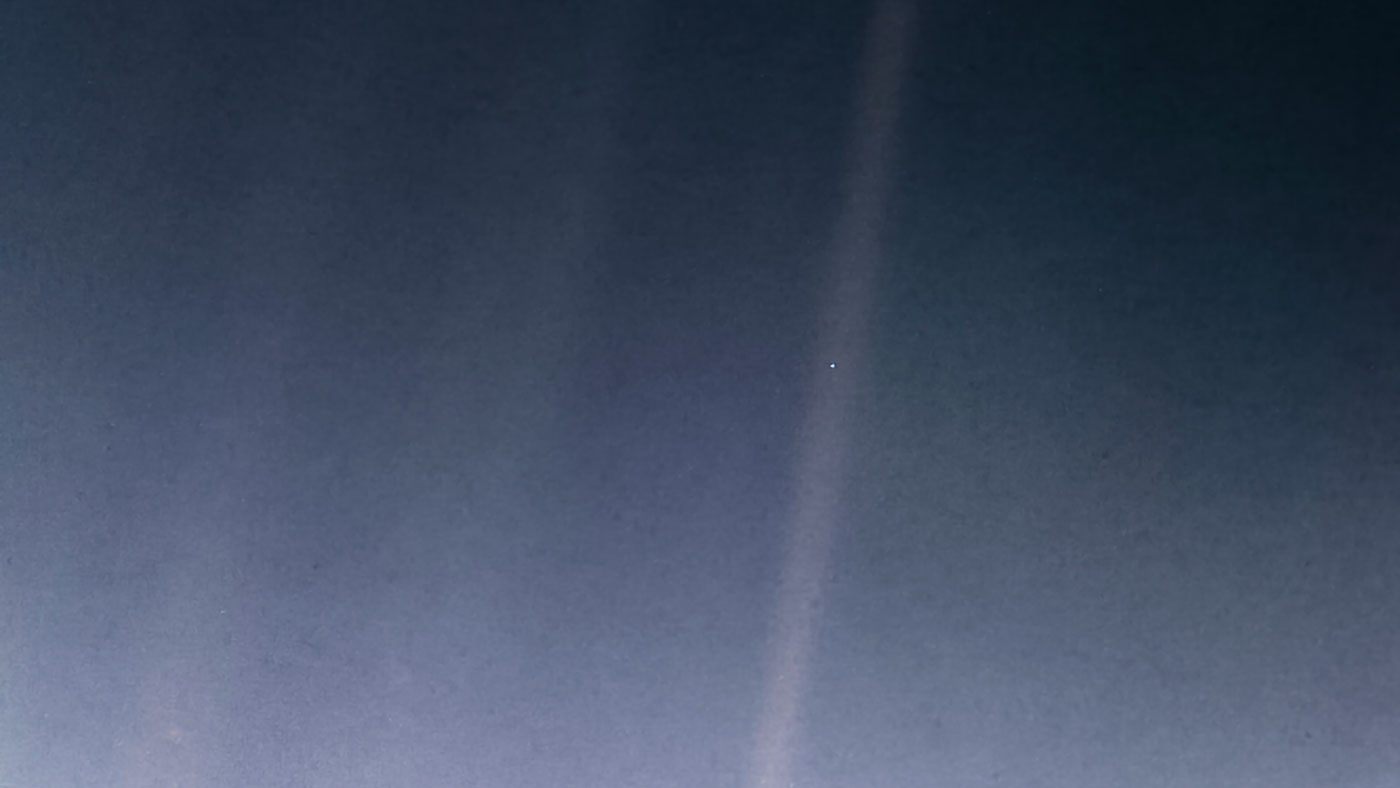
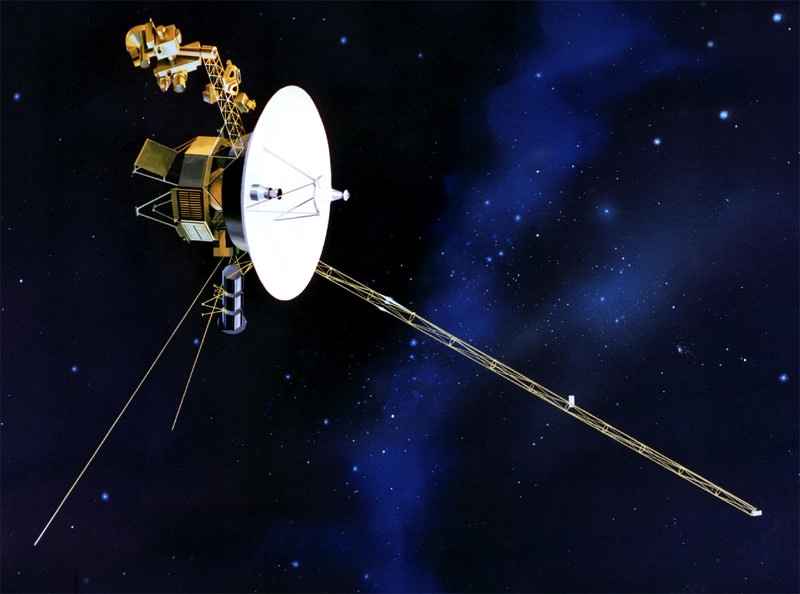
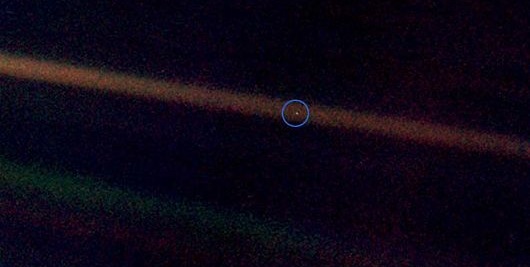
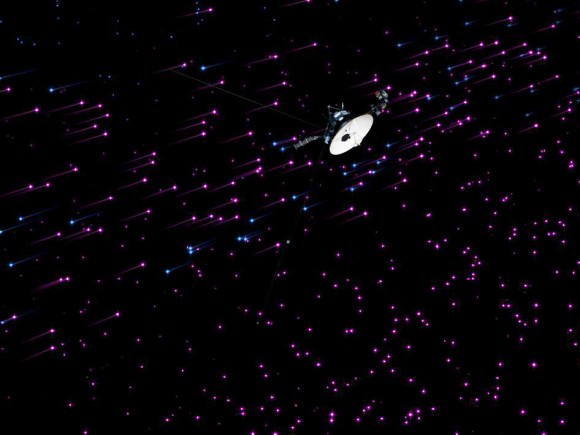
This updated version of the iconic "Pale Blue Dot" image taken by the Voyager 1 spacecraft uses modern image-processing software and techniques to revisit the well-known Voyager view while attempting to respect the original data and intent of those who planned the images.
Credit: NASA/JPL-Caltech
Thirty years have now passed since the Voyager 1 spacecraft
snapped one of the most iconic and memorable pictures in spaceflight history. Known
as the “Pale Blue Dot,” the heart-rending view shows planet Earth as a single,
bright blue pixel in the vastness of space, as seen from the outer reaches of
the solar system.
Now, NASA and the Jet Propulsion Laboratory have provided a
new and improved version, using state of the art image-processing software and
techniques to reprocess the thirty-year-old image. JPL software engineer and
image processor Kevin Gill, whose images we feature often on Universe Today,
led the effort.
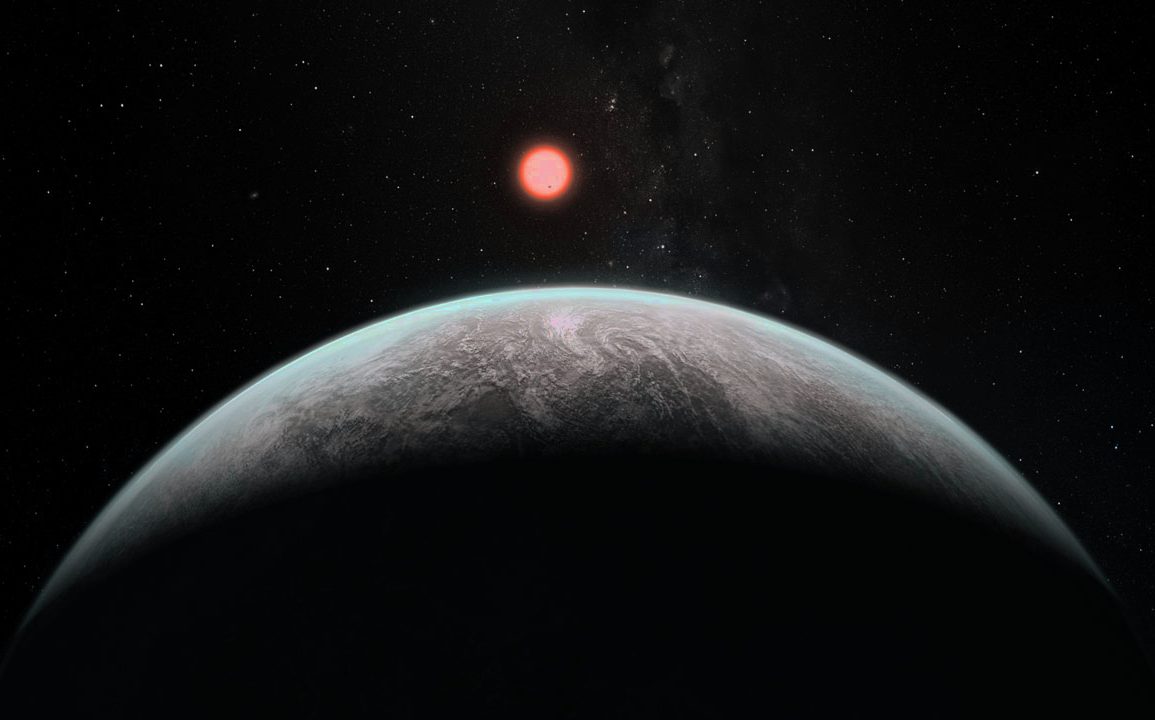
Artist’s impression of how an an Earth-like exoplanet might look. Credit: ESO.
In the past few decades, there has been an explosion in the number of extra-solar planets that have been discovered. As of April 1st, 2018, a total of 3,758 exoplanets have been confirmed in 2,808 systems, with 627 systems having more than one planet. In addition to expanding our knowledge of the Universe, the purpose of this search has been to find evidence of life beyond our Solar System.
In the course of looking for habitable planets, astronomers have used Earth as a guiding example. But would we recognize a truly “Earth-like” planet if we saw one? This question was addressed in a recent paper by two professors, one of whom is an exoplanet-hunter and the other, an Earth science and astrobiology expert. Together, they consider what advances (past and future) will be key to the search for Earth 2.0.
The paper, titled “Earth as an Exoplanet“, recently appeared online. The study was conducted by Tyler D. Robinson, a former NASA Postdoctoral Fellow and an assistant professor from Northern Arizona University, and Christopher T. Reinhard – an assistant professor from the Georgia Institute of Technology’s School of of Earth and Atmospheric Studies.
Thanks to advances in technology and detection methods, astronomers have detected multiple Earth-like planets in our galaxy. Credit: NASA/JPL
For the sake of their study, Robinson and Reinhard focus on how the hunt for habitable and inhabited planets beyond our Solar System commonly focuses on Earth analogs. This is to be expected, since Earth is the only planet that we know of that can support life. As Professor Robinson told Universe Today via email:
“Earth is – currently! – our only example of a habitable and an inhabited world. Thus, when someone asks, “What will a habitable exoplanet look like?” or “What will a life-bearing exoplanet look like?”, our best option is to point to Earth and say, “Maybe it will look a lot like this.” While many studies have hypothesized other habitable planets (e.g., water-covered super-Earths), our leading example of a fully-functioning habitable planet will always be Earth.”
The authors therefore consider how observations made by spacecraft of the Solar System have led to the development of approaches for detecting signatures of habitability and life on other worlds. These include the Pioneer 10 and 11 missions and Voyager 1 and 2 spacecraft, which conducted flybys of many Solar System bodies during the 1970s.
These missions, which conducted studies on the planets and moons of the Solar System using photometry and spectroscopy allowed scientists to learn a great deal about these bodies’ atmospheric chemistry and composition, as well as meteorlogical patterns and chemistry. Subsequent missions have added to this by revealing key details about the surface details and geological evolution of the Solar planets and moons.
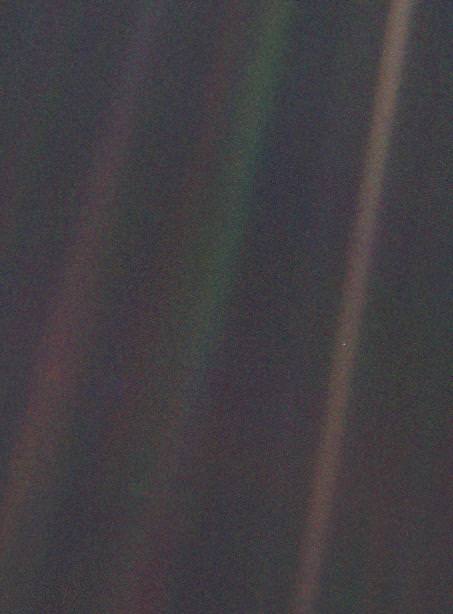
The “pale blue dot” of Earth captured by Voyager 1 spacecraft on Feb 14th, 1990. Credit: NASA/JPL
In addition, the Galileo probe conducted flybys of Earth in December of 1990 and 1992, which provided planetary scientists with the first opportunity to analyze our planet using the same tools and techniques that had previously been applied throughout the Solar System. It was also the Voyager 1 probe that took a distant image of Earth, which Carl Sagan referred to as the “Pale Blue Dot” photo.
However, they also note that Earth’s atmosphere and surface environment has evolved considerably over the past 4.5 billion years ago. In fact, according to various atmospheric and geological models, Earth has resembled many environments in the past that would be considered quite “alien” by today’s standards. These include Earth’s many ice ages and the earliest epochs, when Earth’s primordial atmosphere was the product of volcanic outgassing.
As Professor Robinson explained, this presents some complications when it comes to finding other examples of “Pale Blue Dots”:
“The key complication is being careful to not fall into the trap of thinking that Earth has always appeared the way it does today. So, our planet actually presents a huge array of options for what a habitable and/or inhabited planet might look like.”
In other words, our hunt for Earth analogs could reveal a plethora of worlds which are “Earth-like”, in the sense that they resemble a previous (or future) geological period of Earth. These include “Snowball Earth’s”, which would be covered by glacial sheets (but could still be life-bearing), or even what Earth looked like during the Hadean or Archean Eons, when oxygenic photosynthesis had not yet taken place.
Ice ages are characterized by a drop in average global temperatures, resulting in the expansion of ice sheets globally. Credit: NASA
This would also have implications when it comes to what kinds of life would be able to exist there. For instance, if the planet is still young and its atmosphere was still in its primordial state, life could be strictly in microbial form. However, if the planet was billions of years old and in an interglacial period, more complex life forms may have evolved and be roaming the Earth.
Robinson and Reinhard go on to consider what future developments will aid in the spotting of “Pale Blue Dots”. These include next-generation telescopes like the James Webb Space Telescope (JWST) – scheduled for deployment in 2020 – and the Wide-Field Infrared Survey Telescope (WFIRST), which is currently under development. Other technologies include concepts like Starshade, which is intended to eliminate the glare of stars so that exoplanets can be directly imaged.
“Spotting true Pale Blue Dots – water-covered terrestrial worlds in the habitable zone of Sun-like stars – will require advancements in our ability to “directly image” exoplanets,” said Robinson. “Here, you use either optics inside the telescope or a futuristic-sounding “starshade” flying beyond the telescope to cancel out the light of a bright star thereby enabling you to see a faint planet orbiting that star. A number of different research groups, including some at NASA centers, are working to perfect these technologies.”
Once astronomers are able to image rocky exoplanets directly, they will at last be able to study their atmospheres in detail and place more accurate constraints on their potential habitability. Beyond that, there may come a day when we will be able to image the surfaces of these planets, either through extremely sensitive telescopes or spacecraft missions (such as Project Starshot).
Whether or not we find another “Pale Blue Dot” remains to be seen. But in the coming years, we may finally get a good idea of just how common (or rare) our world truly is.
With its Long Range Reconnaissance Imager (LORRI), New Horizons has observed several Kuiper Belt objects (KBOs) and dwarf planets at unique phase angles, as well as Centaurs at extremely high phase angles to search for forward-scattering rings or dust. These December 2017 false-color images of KBOs 2012 HZ84 (left) and 2012 HE85 are, for now, the farthest from Earth ever captured by a spacecraft. They're also the closest-ever images of Kuiper Belt objects. Credits: NASA/JHUAPL/SwRI
In July of 2015, the New Horizons mission made history by being the first spacecraft to rendezvous with Pluto. In the course of conducting its flyby, the probe gathered volumes of data about Pluto’s surface, composition, atmosphere and system of moons. It also provided breathtaking images of Pluto’s “heart”, its frozen plains, mountain chains, and it’s mysterious “bladed terrain”.
Since that time, New Horizons has carried on to the Kuiper Belt for the sake of conducting more historic encounters. In preparation for these, the probe also established new records when it used its Long Range Reconnaissance Imager (LORRI) to take a series of long-distance pictures. These images, which have since been released to the public, have set the new record for the most distant images ever taken.
At present, the New Horizons probe is at a distance of 6.12 billion km (3.79 billion mi) from Earth. This means that images taken at this point are at a distance of 40.9 Astronomical Units (AUs), or the equivalent of about 41 times the distance between Earth and the Sun. This it slightly farther than the “Pale Blue Dot” image of Earth, which was snapped by the Voyager 1 mission when it was at a distance of 6.06 billion km (3.75 billion mi; 40.5 AU) from Earth.
Image of the “Wishing Well” star cluster, taken Dec. 5, 2017, which temporarily broke the 27-year record set by Voyager 1. Credit: NASA/JHUAPL/SwRI
This historic picture was taken on February 14th, 1990 (Valentine’s Day) at the behest of famed astronomer Carl Sagan. At the time, Sagan was a member of the Voyager imaging team, and he recommended that Voyager 1 take the opportunity to look back at Earth one more time before making its way to the very edge of the Solar System. For more than 27 years, this long-distance record remained unchallenged.
However, in December of 2017, the New Horizons team began conducting a routine calibration test of the LORRI instrument. This consisted of snapping pictures of the “Wishing Well” cluster (aka. the “Football Cluster” or NGC 3532), an open galactic star cluster that is located about 1321 light years from Earth in the direction of the southern constellation of Carina.
This image (shown above) was rather significant, given that this star cluster was the first target ever observed by the Hubble Space Telescope (on May 20th, 1990). While this image broke the long-distance record established by Voyager 1, the probe then turned its LORRI instrument towards objects in its flight path. As part of the probes mission to rendezvous with a KBO, the team was searching for forward-scattering rings or dust.
As a result, just two hours after it had taken the record-breaking image of the “Wishing Well” star cluster, the probe snapped pictures of the Kuiper Belt Objects (KBOs) known as 2012 HZ84 and 2012 HE85 (seen below, left and right). These images once again broke the record for being the most distant images taken from Earth (again), but also set a new record for the closest-ever images ever taken of KBOs.
False-color images of KBOs 2012 HZ84 (left) and 2012 HE85, taken by LORRI, are the farthest from Earth ever captured by a spacecraft. Credit: NASA/JHUAPL/SwRI
“New Horizons has long been a mission of firsts — first to explore Pluto, first to explore the Kuiper Belt, fastest spacecraft ever launched. And now, we’ve been able to make images farther from Earth than any spacecraft in history.”
As one of only five spacecraft to travel beyond the Outer Planets, New Horizons has set a number of other distance records as well. These include the most-distant course-correction maneuver, which took place on Dec. 9th, 2017, and guided the spacecraft towards its planned flyby with the KBO 2014 MU69. This event, which will happen on Jan. 1st, 2019, will be the farthest planetary encounter in history.
In the course of its extended mission in the Kuiper Belt, the New Horizons team seeks to observe at least two-dozen other KBOs, dwarf planets and “Centaurs” – i.e. former KBOs that have unstable orbits that cause them to cross the orbit of the gas giants. At present, the New Horizons spacecraft is in hibernation and will be brought back online on June 4th, – when it will begin a series of checks to make sure it is ready for its planned encounter with MU69.
The spacecraft is also conducting nearly continuous measurements of the Kuiper Belt itself to learn more about its plasma, dust and neutral-gas environment. These efforts could reveal much about the formation and evolution of the Solar System, and are setting records that are not likely to be broken for many more decades!
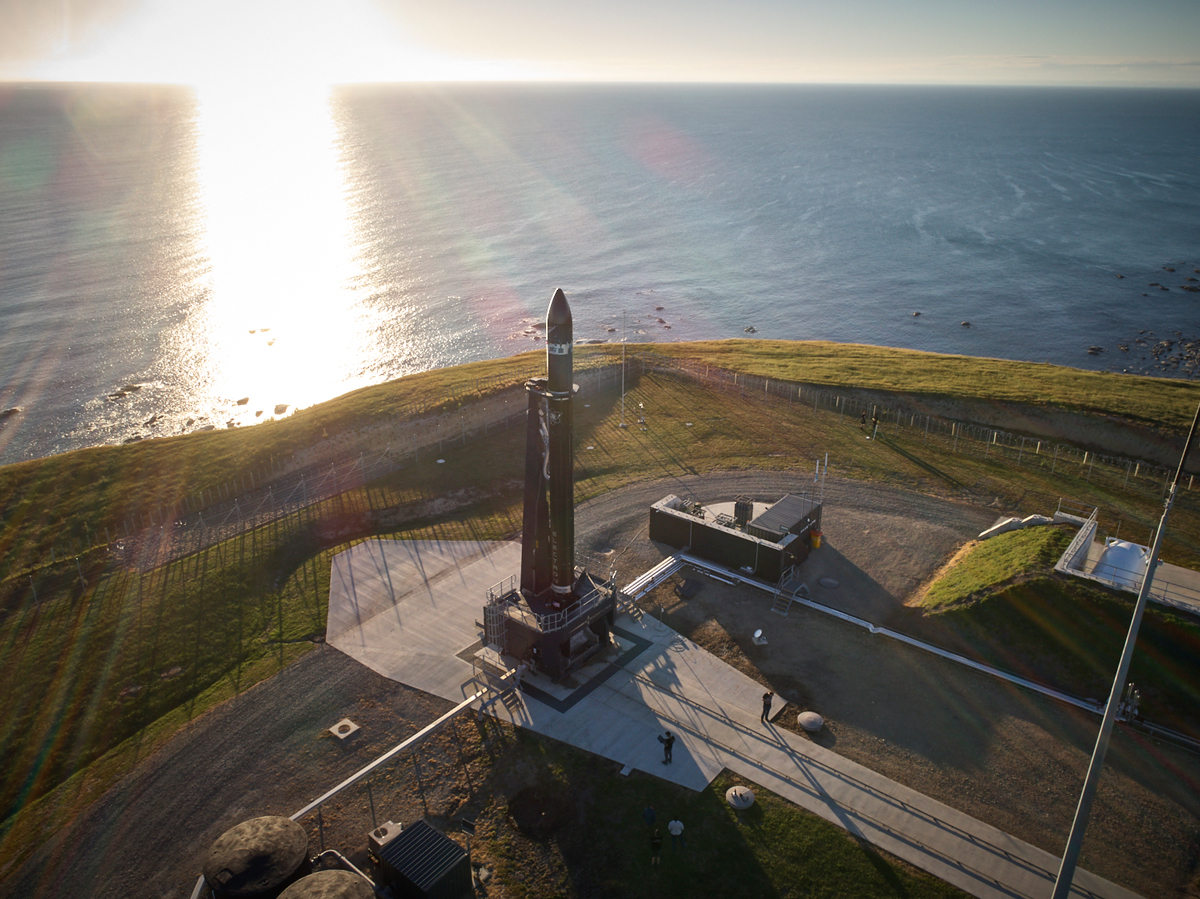
Peter Beck, founder of Rocket Lab, is shown with the Humanity Star.
Credit: Rocket Lab
This past weekend, the New Zealand-based aerospace company Rocket Lab reached another milestone. On Sunday, January 21st, the company conducted the second launch – the first having taken place this past summer – of its Electron booster. This two-stage, lightweight rocket is central to the company’s vision of reducing the costs of individual launches by sending light payloads to orbit with regular frequency.
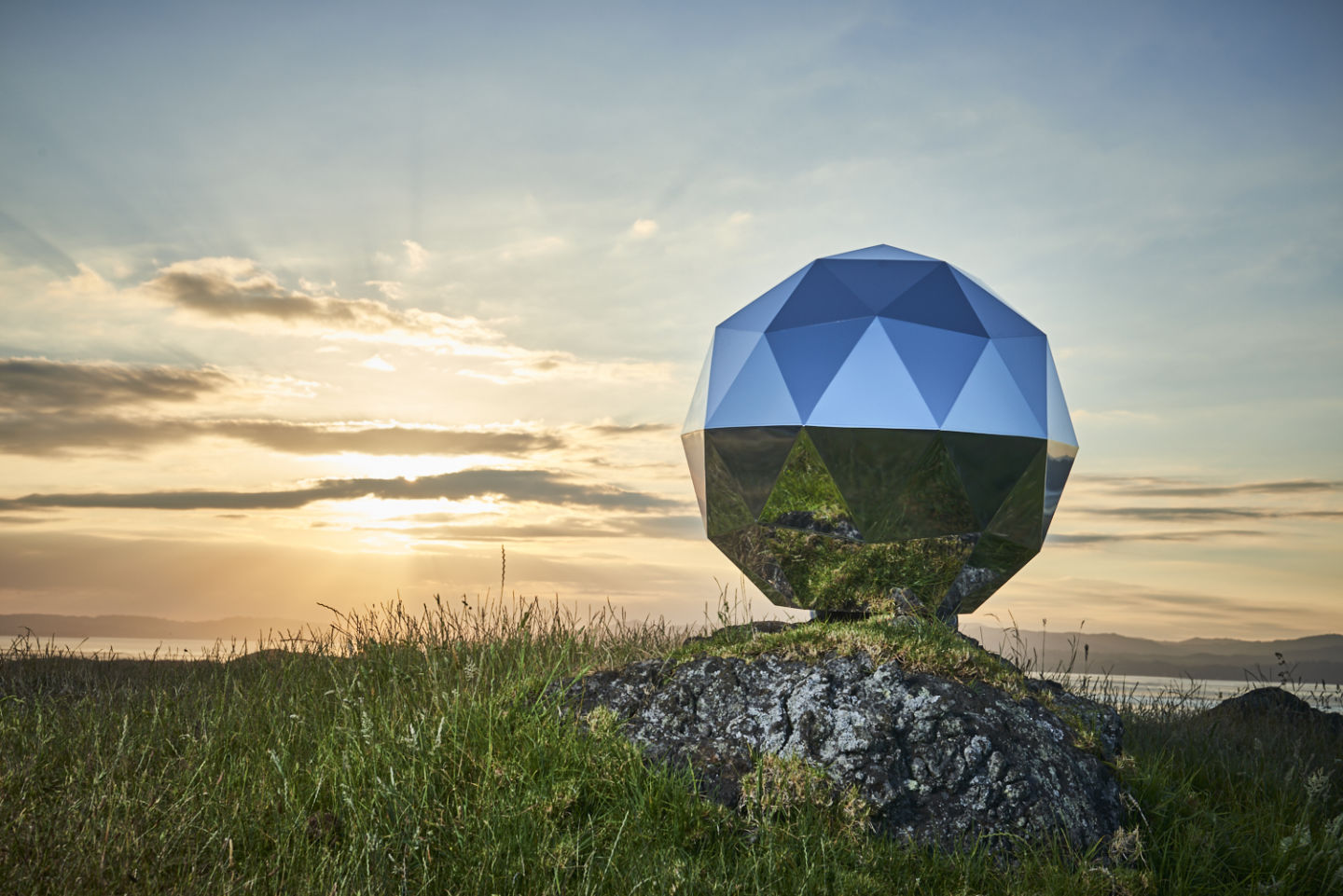
This mission was also important because it was the first time that the company sent payloads into orbit. In addition to several commercial payloads, the launch also sent a secret payload into orbit at the behest of the company’s founder (Peter Beck). It is known as the “Humanity Star“, a disco-like geodesic sphere that measures 1 meter (3.3 ft) in diameter and will form a bright spot in the sky that will be visible to people on Earth.
The Humanity Star is central to Beck’s vision of how space travel can improve the lives of people here on Earth. In addition to presenting extensive opportunities for scientific research, there is also the way it fosters a sense of unity between people and nations. This is certainly a defining feature of the modern space age, where cooperation has replaced competition as the main driving force.
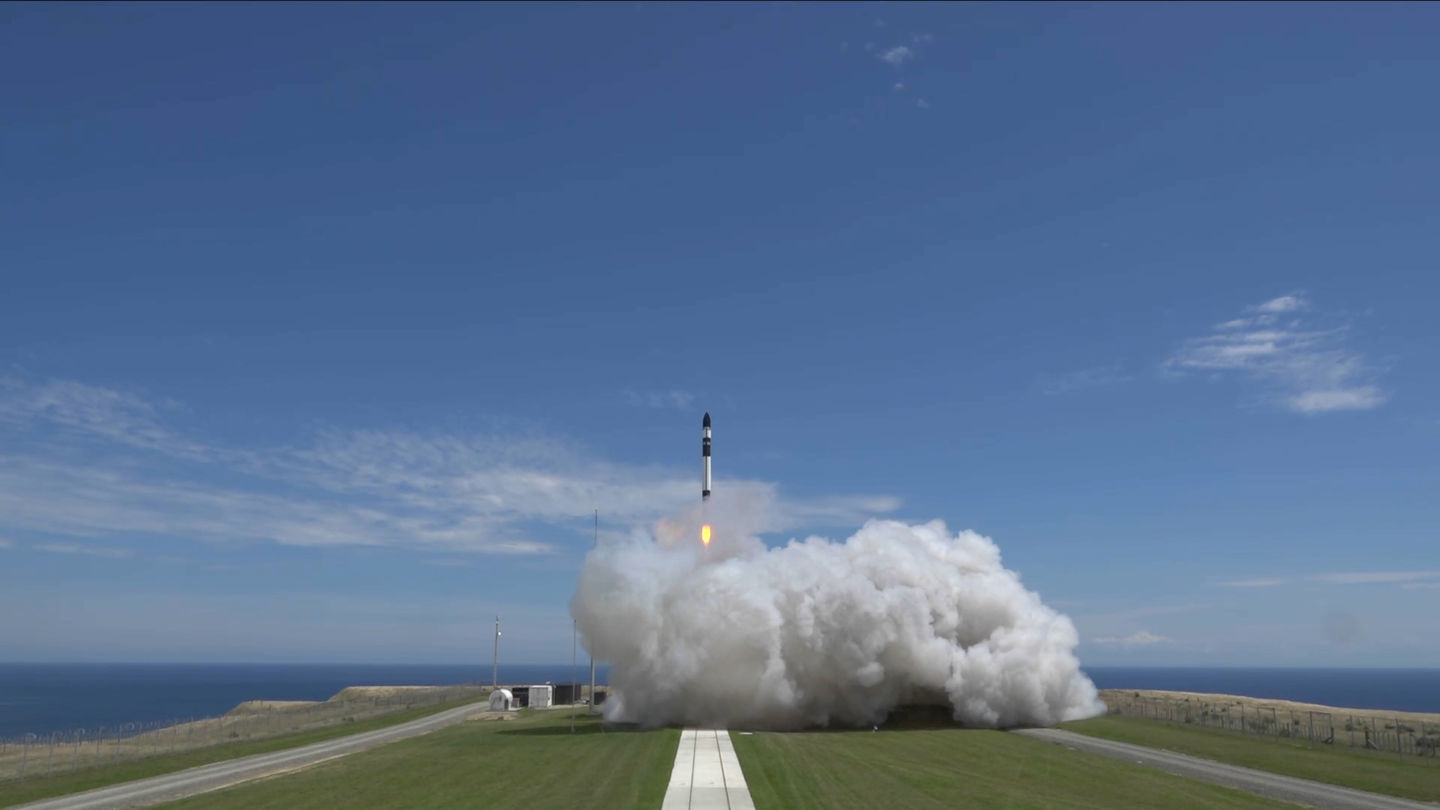
The Electron rocket prepping for its second launch last weekend. Credit: Rocket Lab
As Beck explained to ArsTechnica in an interview before the launch:
“The whole point of the program is to get everybody looking up at the star, but also past the star into the Universe, and reflect about the fact that we’re one species, on one planet. This is not necessarily part of the Rocket Lab program; it’s more of a personal program. It’s certainly consistent with our goal of trying to democratize space.”
Like the Electron rocket, the Humanity Sphere is made of carbon fiber materials and it’s surface consists of 65 highly-reflective panels. Once it reaches an orbit of 300 by 500 km (186 by 310 mi), it will spend the next nine months there reflecting the light of the Sun back to Earth. Whether or not it will be visible to the naked eye remains to be seen, but Rocket Lab is confident it will be.
According to Beck, the sphere will be more visible than a Iridium flare, which are easily spotted from the surface. These flares occur when the solar panels or antennae of an Iridium satellite reflect sunlight in orbit. “Most people will be familiar with the Iridium flares, and this has got much, much more surface area than an Iridium flare,” Beck said. “In theory, it will be easy to find.”
The payload will last for about nine months in orbit. Credit: Rocket Lab
Beck got the idea for the project from talking to people about where they live. In his experience, people tend to think of their locality or nationality when they think of home. Whereas many people he had spoken to were aware that they lived on planet Earth, they were oblivious to where the Earth resided in the Solar System or the Universe at large. In this respect, the Humanity Sphere is meant to encourage people to look and think beyond.
As he states on the website the company created for the Humanity Sphere:
“For millennia, humans have focused on their terrestrial lives and issues. Seldom do we as a species stop, look to the stars and realize our position in the universe as an achingly tiny speck of dust in the grandness of it all.
“Humanity is finite, and we won’t be here forever. Yet in the face of this almost inconceivable insignificance, humanity is capable of great and kind things when we recognize we are one species, responsible for the care of each other, and our planet, together. The Humanity Star is to remind us of this.
“No matter where you are in the world, rich or in poverty, in conflict or at peace, everyone will be able to see the bright, blinking Humanity Star orbiting Earth in the night sky. My hope is that everyone looking up at the Humanity Star will look past it to the expanse of the universe, feel a connection to our place in it and think a little differently about their lives, actions and what is important.
“Wait for when the Humanity Star is overhead and take your loved ones outside to look up and reflect. You may just feel a connection to the more than seven billion other people on this planet we share this ride with.”
The Electron rocket launching on Sunday afternoon, 2:42pm, New Zealand time. Credit: Rocket Lab
The Humanity Star can also be tracked via the website. As of the penning of this article, it is moving south of the equator and should be visible to those living along the west coast of South America. So if you live in Colombia, Peru or Chile, look to the western skies and see if you can’t spot this moving star. After passing south over Antarctica, it will reemerge in the night skies over Central Asia.
Without a doubt, the Humanity Sphere is an inspired creation, and one which is in good company. Who can forget the “Blue Marble” picture snapped by the Apollo 17 astronauts, or Voyager 1‘s “pale blue dot” photo? And even for those who are too young to have witnessed it, the images of Neil Armstrong and Buzz Aldrin setting foot on the Moon still serve to remind us of how far we’ve come, and how much still awaits us out there.
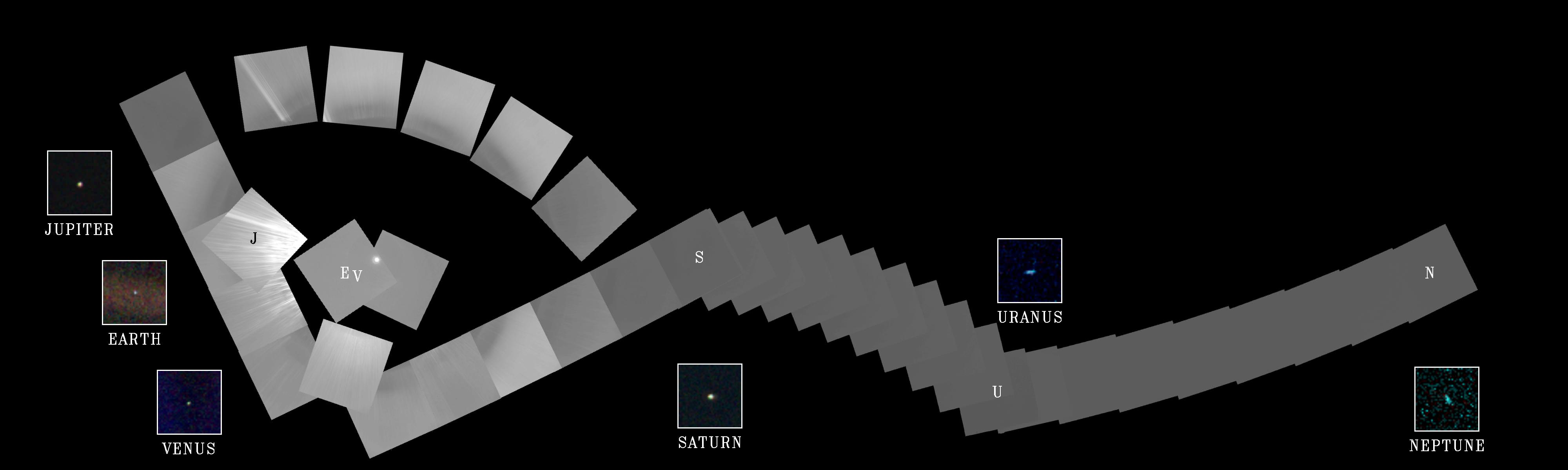
These six narrow-angle color images were made from the first ever "portrait" of the solar system taken by Voyager 1 on Valentine’s Day on Feb. 14, 1990, which was more than 4 billion miles from Earth and about 32 degrees above the ecliptic. Venus, Earth, Jupiter, and Saturn, Uranus, Neptune are seen in these blown-up images, from left to right and top to bottom. Credit: NASA/JPL-Caltech
A quarter of a century has passed since NASA’s Voyager 1 spacecraft snapped the iconic image of Earth known as the “Pale Blue Dot” that shows all of humanity as merely a tiny point of light.
The outward bound Voyager 1 space probe took the ‘pale blue dot’ image of Earth 25 years ago on Valentine’s Day, on Feb. 14, 1990 when it looked back from its unique perch beyond the orbit of Neptune to capture the first ever “portrait” of the solar system from its outer realms.
Voyager 1 was 4 billion miles from Earth, 40 astronomical units (AU) from the sun and about 32 degrees above the ecliptic at that moment.
The idea for the images came from the world famous astronomer Carl Sagan, who was a member of the Voyager imaging team at the time.
He head the idea of pointing the spacecraft back toward its home for a last look as a way to inspire humanity. And to do so before the imaging system was shut down permanently thereafter to repurpose the computer controlling it, save on energy consumption and extend the probes lifetime, because it was so far away from any celestial objects.
Sagan later published a well known and regarded book in 1994 titled “Pale Blue Dot,” that refers to the image of Earth in Voyagers series.
This narrow-angle color image of the Earth, dubbed “Pale Blue Dot,” is a part of the first ever “portrait” of the solar system taken by Voyager 1 on Valentine’s Day on Feb. 14, 1990. Credit: NASA/JPL-Caltech
“Twenty-five years ago, Voyager 1 looked back toward Earth and saw a ‘pale blue dot,’ ” an image that continues to inspire wonderment about the spot we call home,” said Ed Stone, project scientist for the Voyager mission, based at the California Institute of Technology, Pasadena, in a statement.
Six of the Solar System’s nine known planets at the time were imaged, including Venus, Earth, Jupiter, and Saturn, Uranus, Neptune. The other three didn’t make it in. Mercury was too close to the sun, Mars had too little sunlight and little Pluto was too dim.
Voyager snapped a series of images with its wide angle and narrow angle cameras. Altogether 60 images from the wide angle camera were compiled into the first “solar system mosaic.”
Voyager 1 was launched in 1977 from Cape Canaveral Air Force Station in Florida as part of a twin probe series with Voyager 2. They successfully conducted up close flyby observations of the gas giant outer planets including Jupiter, Saturn, Uranus and Neptune in the 1970s and 1980s.
Both probes still operate today as part of the Voyager Interstellar Mission.
“After taking these images in 1990, we began our interstellar mission. We had no idea how long the spacecraft would last,” Stone said.
Hurtling along at a distance of 130 astronomical units from the sun, Voyager 1 is the farthest human-made object from Earth.
Solar System Portrait – 60 Frame Mosaic. The cameras of Voyager 1 on Feb. 14, 1990, pointed back toward the sun and took a series of pictures of the sun and the planets, making the first ever “portrait” of our solar system as seen from the outside. Missing are Mercury, Mars and Pluto. Credit: NASA/JPL-Caltech
Voyager 1 still operates today as the first human made instrument to reach interstellar space and continues to forge new frontiers outwards to the unexplored cosmos where no human or robotic emissary as gone before.
Here’s what Sagan wrote in his “Pale Blue Dot” book:
“That’s here. That’s home. That’s us. On it everyone you love, everyone you know, everyone you ever heard of, every human being who ever was, lived out their lives. … There is perhaps no better demonstration of the folly of human conceits than this distant image of our tiny world.”
Stay tuned here for Ken’s continuing Earth and planetary science and human spaceflight news.
Artist’s impression of how an an Earth-like exoplanet might look. Credit: ESO.
The search for worlds beyond our own is one of humankind’s greatest quests. Scientists have found thousands of exoplanets orbiting other stars in the Milky Way, but are still ironing out the details of what factors truly make a planet habitable. But thanks to researchers at Cornell University, their search may become a little easier. A team at the Institute for Pale Blue Dots has zeroed in on the range of habitable orbits for very young Earth-like planets, giving astronomers a better target to aim at when searching for rocky worlds that contain liquid water and could support the evolution of life.
The Habitable Zone (HZ) of a star is its so-called “Goldilocks region,” the not-too-hot, not-too-cold belt within which liquid water could exist on orbiting rocky planets. Isolating planets in the HZ is the primary objective for scientists hoping to find evidence of life. Until now, astronomers have mainly been searching for worlds that lie in the HZ of stars that are in the prime of their lives: those that are on the Main Sequence, the cosmic growth chart for stellar evolution. According to the group at Cornell, however, scientists should also be looking at cooler, younger stars that have not yet reached such maturity.
The increased distance of the Habitable Zone from pre-main sequence stars makes it easier to spot infant Earths. Credit: Astrophysical Journal Letters.
As shown in the figure above, cool stars in classes F, G, K, and M are more luminous in their pre-Main Sequence stage than they are once they mature. Planets that circle around such bright stars tend to have more distant orbits than those that accompany dimmer stars, making transits more visible and providing a larger HZ for astronomers to probe. In addition, the researchers found that fledgling planets can spend up to 2.5 billion years in the HZ of a young M-class star, a period of time that would allow ample time for life to flourish.
But just because liquid water could exist on a planet doesn’t mean that it does. A rocky planet must first acquire water, and then retain it long enough for life to develop. The Cornell group found that a watery world could lose its aqueous environment to a runaway greenhouse effect if if forms too close to a cool parent star, even if the planet was on course to eventually stray into the star’s HZ. These seemingly habitable planets would have to receive a second supply of water later on in order to truly support life. “Our own planet gained additional water after this early runaway phase from a late, heavy bombardment of water-rich asteroids,” offered Ramses Ramirez, one author of the study. “Planets at a distance corresponding to modern Earth or Venus orbiting these cool stars could be similarly replenished later on.”
Estimations for the HZs of cool, young stars and probable amounts of water loss for exoplanets orbiting at various distances are provided in a preprint of the paper, available here. The research will be published in the January 1, 2015, issue of The Astrophysical Journal.
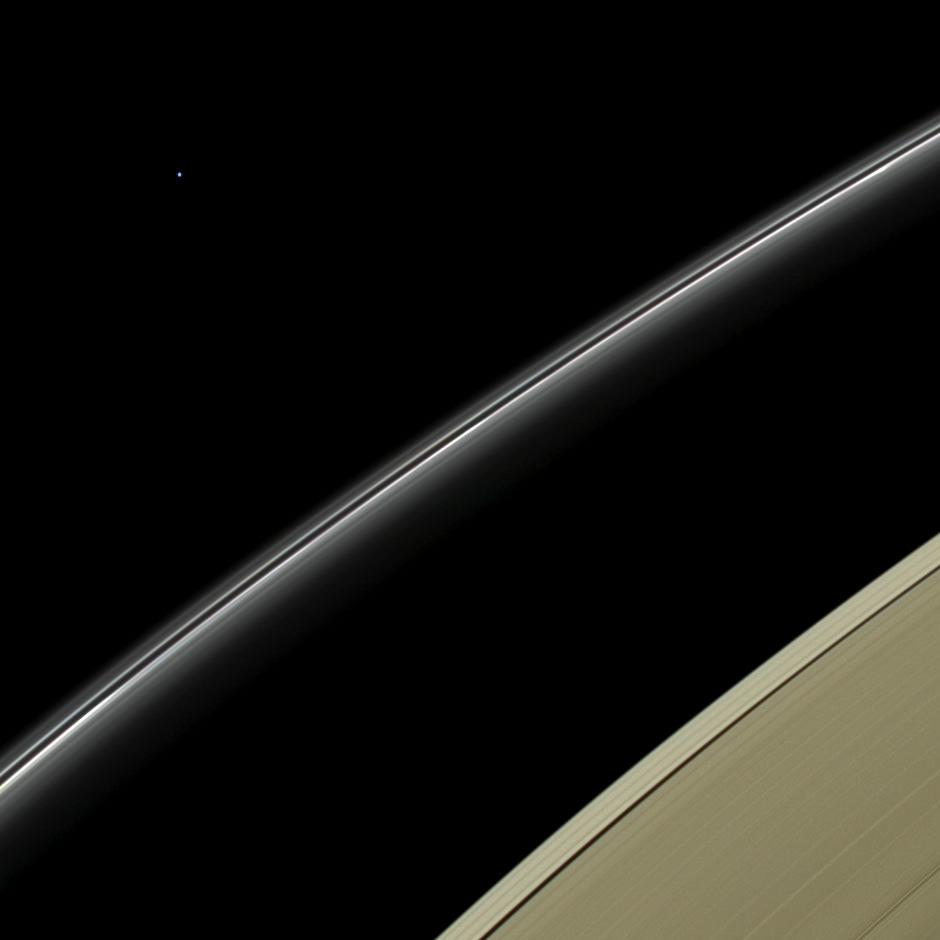
Uranus as seen by Cassini on July 19, 2013 (NASA/JPL-Caltech/SSI)
When you hear the words “pale blue dot” you’re probably reminded of the famous quote by Carl Sagan inspired by an image of Earth as a soberingly tiny speck, as imaged by Voyager 1 on Feb. 14, 1990 from beyond the orbit of Pluto. But there’s another pale blue world in our Solar System: the ice giant Uranus, and its picture was captured much more recently by the Cassini spacecraft from orbit around Saturn on April 11, 2014.
Released today by the Cassini Imaging Team, the image above shows Uranus as a tiny blue orb shining far beyond the bright hazy bands of Saturn’s F ring.
“Do you relish the notion of being a Saturnian, and gazing out from the lofty heights of Saturn at the same planets we see here from the Earth?”
– Carolyn Porco, Cassini Imaging Team Leader
Uranus’ coloration is a result of methane high in its frigid atmosphere. According to the description on the CICLOPS site, “methane on Uranus — and its sapphire-colored sibling, Neptune — absorbs red wavelengths of incoming sunlight, but allows blue wavelengths to escape back into space, resulting in the predominantly bluish color seen here.”
This was also the first time Uranus had been imaged by the Cassini spacecraft, which has been in orbit around Saturn since 2004. In fact its ten-year orbital anniversary will come on July 1.
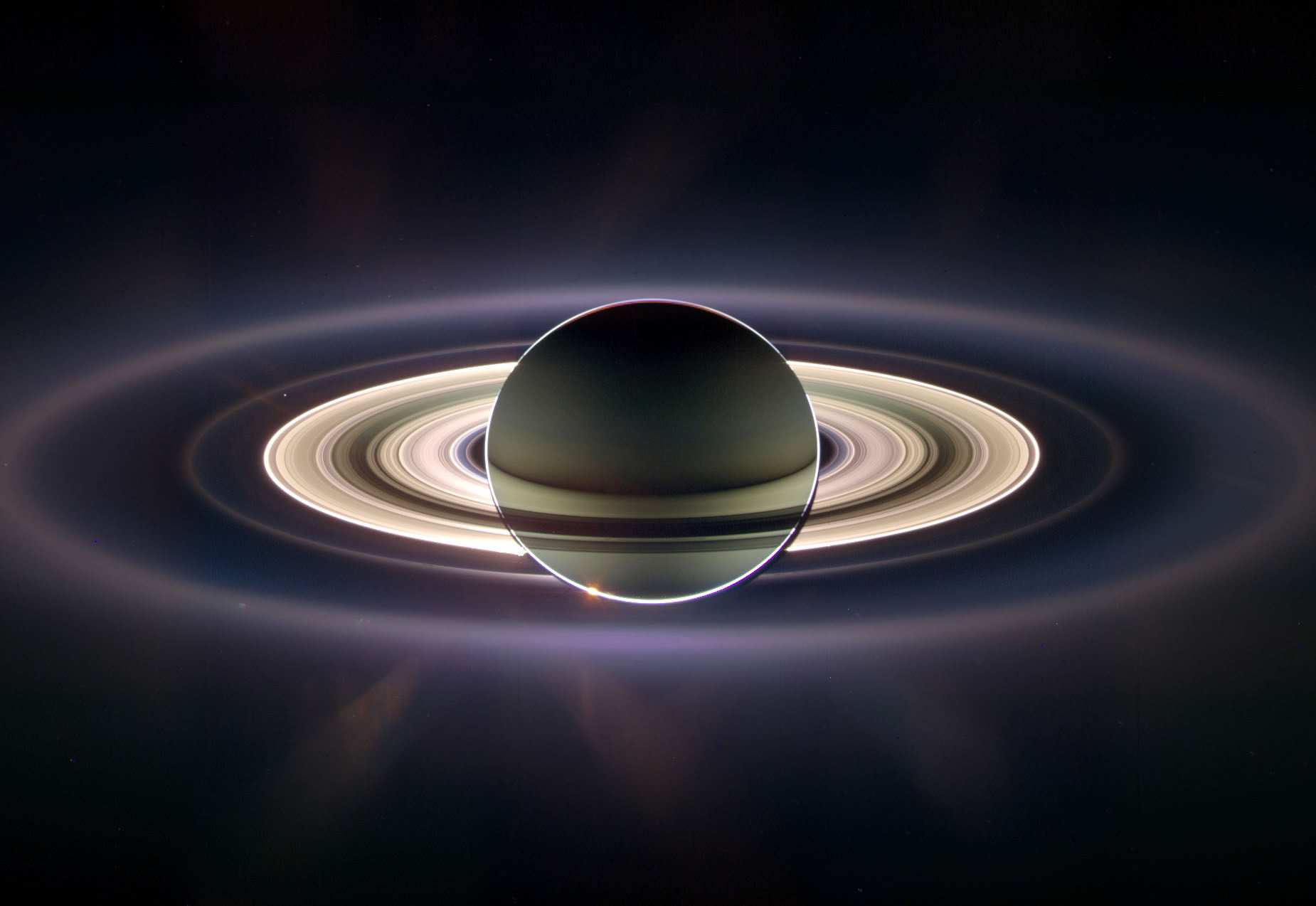
This image adds one more planet to the list of worlds captured on Camera by Cassini, which made headlines last fall when a glorious mosaic was released that featured a backlit Saturn in eclipse surrounded by its luminous rings, the specks of several of its moons, and the distant dots of Venus, Mars, and the Earth and Moon. Made from 141 separate exposures, the mosaic was captured on July 19, 2013 — known by many space aficionados as “the day the Earth smiled” as it was the first time the world’s population was alerted beforehand that its picture would be taken from over 900 million miles away.
Saturn — with its terrestrial spacecraft in tow — was about 28.6 AU away from Uranus when the image was acquired. That’s about 4.28 billion kilometers (2.66 billion miles). From that distance the glow of the 51,118-kilometer (31,763-mile) -wide Uranus is reduced to a mere few pixels (which required digital brightening by about 4.5x, as well.)
The Voyager spacecraft have been on an extensive mission of discovery that has lasted some 36 years. Image Credit: NASA/JPL
Yesterday, NASA announced that as of August 2012, Voyager 1 is in a new frontier to humanity: interstellar space. Our most distant spacecraft is now in a region where the plasma (really hot gas) environment comes more from between the stars than from the sun itself. (There’s still debate as to whether it’s in or out of the solar system, as this article explains.)
The plucky spacecraft is close to 12 billion miles (19 million kilometers) from home, and in its 36 years of voyaging has taught us a lot about the planets, their moons and other parts of space. Here are 10 of some of its most historic moments. Did we miss any? Let us know in the comments.
10. The launch: Aug. 20, 1977
Voyager 1 launches from the Kennedy Space Center on Sept. 5, 1977. Credit: NASA
Voyager 1 blasted off from Cape Canaveral on Sept. 5, 1977. Its twin, Voyager 2, departed Earth 16 days earlier. Each spacecraft carried various scientific instruments on board as well as a “Golden Record” that had sounds of Earth on it, as well as a diagram showing where Earth is in the universe.
9. Capturing the Earth and Moon together for the first time
On Sept. 18, 1977, Voyager 1 took three images of the Earth and Moon that were combined into this one image. The moon is artificially brightened to make it show up better. Credit: NASA
About two weeks after launching, Voyager 1 turned back towards Earth and took three images, which were combined into this single view of the Earth and Moon together in space. This was the first time both bodies were pictured together, NASA said.
8. The ‘Pale Blue Dot’ image
Voyager 1 pale blue dot. Image credit: NASA/JPL
On February 14, 1990, Voyager 1 was about 3.7 billion miles (6 billion kilometers) away from Earth. Scientists commanded the spacecraft to turn its face towards the solar system and snap some pictures of the planets. Among them was this famous image of Earth, which astronomer Carl Sagan called the Pale Blue Dot. “Look again at that dot. That’s here. That’s home. That’s us,” wrote Sagan in his 1997 book of the same name. In 2013, the spacecraft Cassini also took a picture of Earth, and NASA encouraged everyone to wave back.
7. Finding moons “shepherding” Saturn’s F ring
Prometheus, a small potato-shaped moon of Saturn, shown in this Voyager 1 picture interacting with the planet’s F ring. Credit: NASA/JPL/SSI
Voyager 1 spotted Prometheus and Pandora, two moons of Saturn that keep the F ring separate from the rest of the debris, as well as Atlas, which “shepherds” the A ring. More recently, astronomers have found even more interesting things in Saturn’s rings — such as rain.
6. Spotting what appeared to be a LOT of water ice on Saturn’s moons
Encaladus, a moon of Saturn, as shown in this Voyager 1 image. Credit: NASA
After many years of seeing Saturn’s moons as mere points of light, Voyager 1 buzzed several of them in its quick flyby through the system: Dione, Enceladus, Mimas, Rhea, Tethys and Titan among them. Many of these moons appeared to be icy, which was a surprising find since astronomers previously thought water was pretty rare in the Solar System. We know better now.
5. Imaging Titan’s orange haze
Saturn’s moon Titan lies under a thick blanket of orange haze in this Voyager 1 picture. Credit: NASA
Voyager 1 pictures such as this tortured astronomers for decades — what lies beneath this mysterious haze surrounding Titan, Saturn’s moon? That mystery, in fact, inspired the European Space Agency to send a lander to the moon, called Huygens, which successfully reached the surface in 2005.
4. Finding active volcanoes on Io
Io’s blotchy volcanoes are clearly visible in this image from Voyager 1. Credit: NASA
Voyager 1 helped show us that the Solar System is full of very interesting moons. At Io — a moon of Jupiter — it turns out the moon flexes during its 42-hour orbit of massive Jupiter, which powers a lot of volcanic activity.
3. Voyager 1 becomes the most distant human object
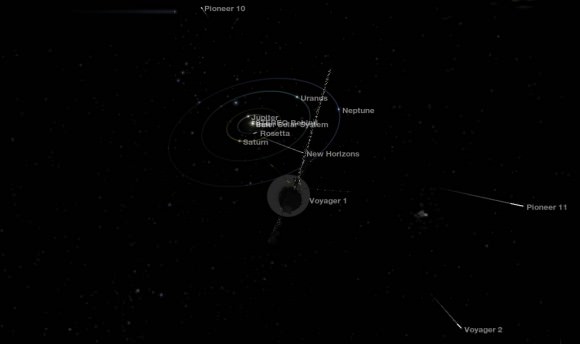
A 2013 computer-generated snapshot riding along with Voyager 1’s looking back at the Sun and inner solar system. The positions of Voyager 2 and Pioneers 10 and 11 show within the viewport as well.
On Feb. 17, 1998, Voyager 1’s distance surpassed that of another long-flying probe, Pioneer 10. This made Voyager 1 the farthest-flung human object in space.
2. Riding the “magnetic highway”
Artist concept of NASA’s Voyager 1 spacecraft exploring a new region in our solar system called the “magnetic highway.” Credit: NASA/JPL-Caltech
In December, NASA said Voyager 1 had reached an area (as of July 28, 2012) where high-energy magnetic particles were starting to bleed through the bubble of lower-energy particles from our sun. “Voyager’s discovered a new region of the heliosphere that we had not realized was there. It’s a magnetic highway where the magnetic field of the Sun is connected to the outside. So it’s like a highway, letting particles in and out,” said project scientist Ed Stone at the time. After that point, as more measurements were analyzed by different teams, there was a lot of debate as to whether Voyager had reached interstellar space.
1. Reaching interstellar space
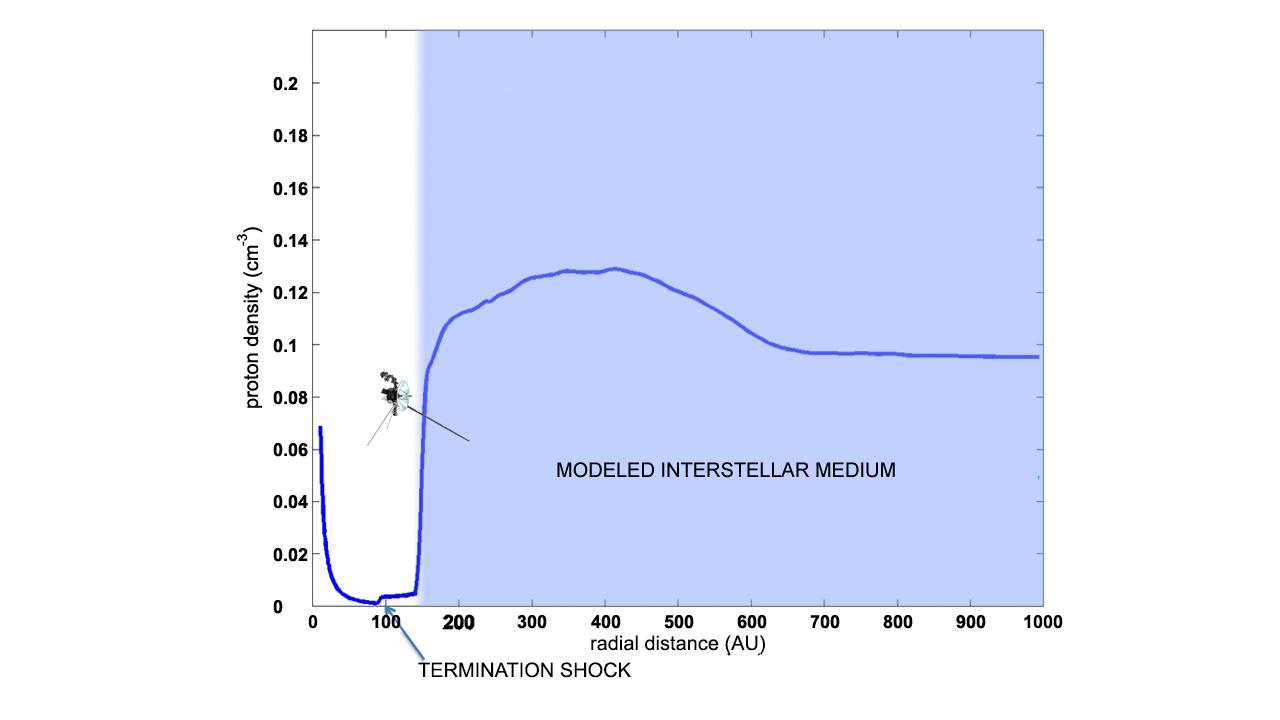
This graphic shows the main evidence that Voyager 1 has reached interstellar space. The blue line shows particle density, which dropped as Voyager 1 moved away from the sun, and then jumped again after it crossed the “termination shock” that is where the sun’s solar wind (particles streaming from the sun) slows down. Credit: NASA/JPL-Caltech
With Voyager 1 now known to be in interstellar space, we’re lucky enough to have a few years left to communicate with it before it runs out of power. All of the instruments will be turned off by 2025, and then engineering data will be available for about 10 years beyond that. The silent emissary from humanity will then come within 1.7 light years of an obscure star in the constellation Ursa Minor (the Little Bear) called AC+79 3888 in the year 40,272 AD and then orbit the center of the Milky Way for millions of years.
Earth and Moon imaged from Cassini on July 19, 2013
Did you smile and wave at Saturn on Friday? If you did (and even if you didn’t) here’s how you — and everyone else on Earth — looked to the Cassini spacecraft, 898.4 million miles away.
Hope you didn’t blink!
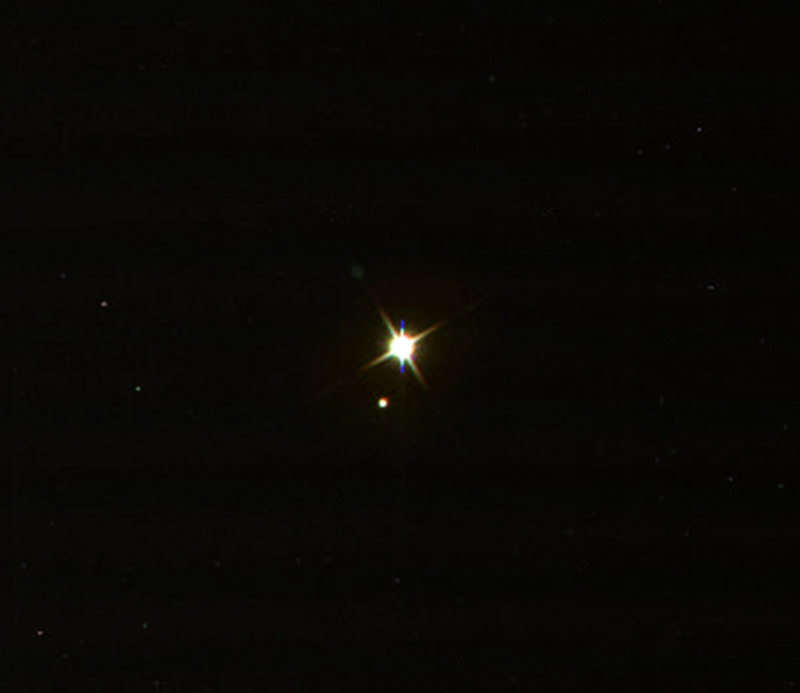
The image above is a color-composite made from raw images acquired by Cassini in red, green, and blue visible light wavelengths. Some of the specks around the edges are background stars, and others are the result of high-energy particle noise, of which some have been digitally removed.
The Moon is the bright dot just below and to the left of Earth. (An original raw image can be seen here.)
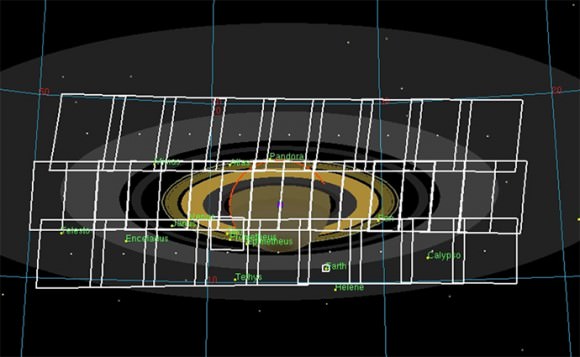
Cassini acquired the images while capturing views of Saturn in eclipse against the Sun between 22:24:00 UTC on July 19 and 02:43:00 UTC on July 20 (6:24 to 10:43 pm EDT July 19.) On Cassini time, the Earth imaging took place between 22:47:13 UTC (6:47:13 pm EDT) and 23:01:56 UTC (7:01:56 pm EDT) on the 19th.
Full mosaic arrangement acquired by Cassini on July 19-20 UTC. Earth was positioned just below the planet. (NASA/JPL-Caltech/SSI)
The world was invited to “Wave at Saturn” beginning 5:27 pm EDT on Friday — which allowed enough time for the photons from a waving world to actually reach Cassini’s camera just beyond Saturn, 1.44 billion kilometers away. (Did you wave? I did!) It was the first time Earth’s population was made aware beforehand that their picture would be taken from such a cosmic distance.
A crowd gathered on the mall at NASA’s Jet Propulsion Laboratory in Pasadena to wave at Saturn on July 19 (NASA/JPL-Caltech)
The image of our planet and moon, seen as merely a couple of bright points of light against the blackness of space, recalls Sagan’s poignant “pale blue dot” passage from Cosmos…
“From this distant vantage point, the Earth might not seem of any particular interest. But for us, it’s different. Consider again that dot. That’s here, that’s home, that’s us. On it everyone you love, everyone you know, everyone you ever heard of, every human being who ever was, lived out their lives. The aggregate of our joy and suffering, thousands of confident religions, ideologies, and economic doctrines, every hunter and forager, every hero and coward, every creator and destroyer of civilization, every king and peasant, every young couple in love, every mother and father, hopeful child, inventor and explorer, every teacher of morals, every corrupt politician, every “superstar,” every “supreme leader,” every saint and sinner in the history of our species lived there – on a mote of dust suspended in a sunbeam.
The “pale blue dot” of Earth captured by Voyager 1 in Feb. 1990 (NASA/JPL)
The Earth is a very small stage in a vast cosmic arena. Think of the rivers of blood spilled by all those generals and emperors so that, in glory and triumph, they could become the momentary masters of a fraction of a dot. Think of the endless cruelties visited by the inhabitants of one corner of this pixel on the scarcely distinguishable inhabitants of some other corner, how frequent their misunderstandings, how eager they are to kill one another, how fervent their hatreds.
Our posturings, our imagined self-importance, the delusion that we have some privileged position in the universe, are challenged by this point of pale light. Our planet is a lonely speck in the great enveloping cosmic dark. In our obscurity, in all this vastness, there is no hint that help will come from elsewhere to save us from ourselves.
The Earth is the only world known so far to harbor life. There is nowhere else, at least in the near future, to which our species could migrate. Visit, yes. Settle, not yet. Like it or not, for the moment the Earth is where we make our stand.
It has been said that astronomy is a humbling and character-building experience. There is perhaps no better demonstration of the folly of human conceits than this distant image of our tiny world. To me, it underscores our responsibility to deal more kindly with one another, and to preserve and cherish the pale blue dot, the only home we’ve ever known.”
— Carl Sagan (1934–1996)
A full mosaic of Cassini’s imaging of Saturn silhouetted against the Sun is expected in the coming weeks.
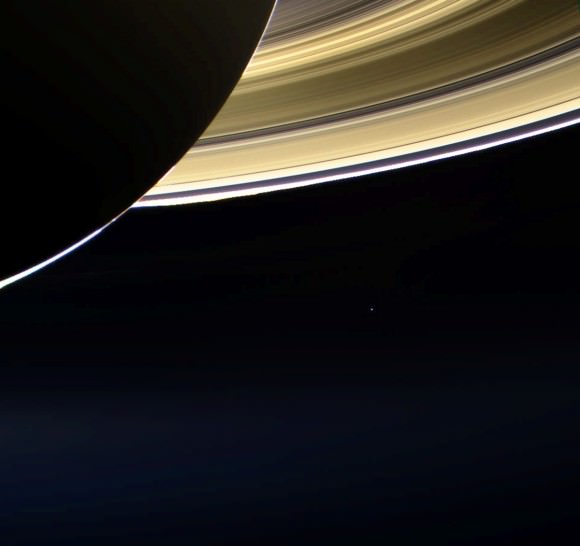
UPDATE: Here’s another RGB color composite, made from raw images acquired with Cassini’s wide-angle camera. It shows a view of Saturn and the rings in eclipse as seen from below and behind, backlit by the Sun. Earth is the bright point light near the center. (See original here.)
Raw image (RGB composite) of Saturn in eclipse with Earth in the distance — just a pale blue dot. (NASA/JPL-Caltech/SSI. Composite by J. Major.)
Images: NASA/JPL-Caltech/Space Science Institute. Composites by Jason Major.
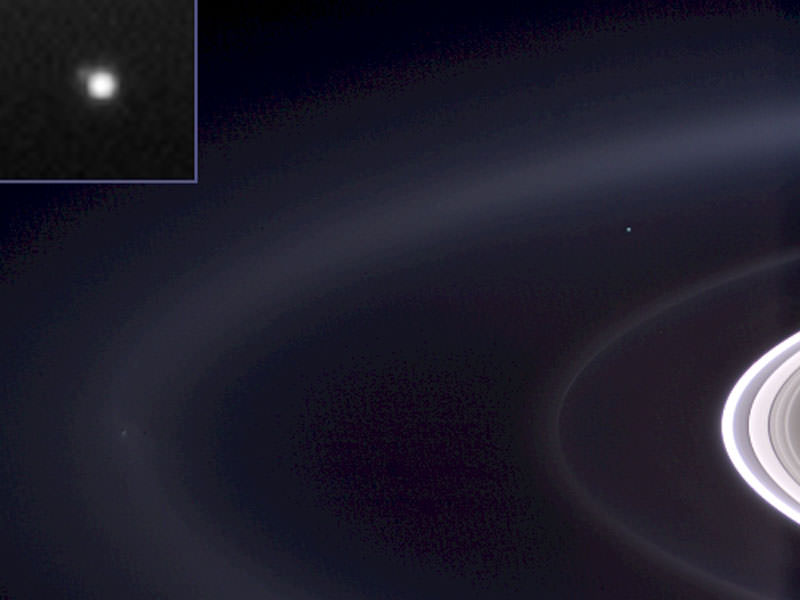
Mosaic of Saturn seen in eclipse in September 2006. Earth is the bright dot just inside the F ring at upper left. (CICLOPS/NASA/JPL-Caltech/SSI)
Citizens of Earth, get ready for your Cassini close-up: once again the spacecraft is preparing to capture images of Saturn positioned between it and the Sun, allowing for incredible views of the ring system and its atmosphere — and also a tiny “pale blue dot” in the distance we call home.
Earth seen from Cassini (NASA/JPL/SSI)
The mosaic above was composed of images captured during such an eclipse event in September 2006, and quickly became an astronomical sensation. It’s not often we get an idea of what we look like from so far away, and seeing our entire world represented as a small speck of light nestled between Saturn’s rings is, to me anyway, both impressive and humbling.
Humbling because of how small we look, but impressive because as a species we have found a way to do it.
And next month, on Friday, July 19 between 21:27 and 21:42 UTC (5:27 – 5:42 p.m. EDT) Cassini will do it again.
“Ever since we caught sight of the Earth among the rings of Saturn in September 2006 in a mosaic that has become one of Cassini’s most beloved images, I have wanted to do it all over again, only better,” said Cassini imaging team leader, Carolyn Porco. “And this time, I wanted to turn the entire event into an opportunity for everyone around the globe, at the same time, to savor the uniqueness of our beautiful blue-ocean planet and the preciousness of the life on it.”
Porco was involved in co-initiating and executing the famous “Pale Blue Dot” image of Earth taken by NASA’s Voyager 1 from beyond the orbit of Neptune in 1990.
“It will be a day for all the world to celebrate,” she said.
The intent for the upcoming mosaic is to capture the whole scene, Earth and Saturn’s rings from one end to the other, in Cassini’s red, green and blue filters that can be composited to form a natural color view of what our eyes might see at Saturn. Earth and the Moon will also be imaged with a high resolution camera — something not yet done by Cassini.
We can all consider ourselves pretty lucky, too… this is the first time in history that we humans will know in advance that our picture is going to be taken from nearly a billion miles away.
“While Earth will be only about a pixel in size from Cassini’s vantage point 898 million miles [1.44 billion kilometers] away, the Cassini team is looking forward to giving the world a chance to see what their home looks like from Saturn,” said Linda Spilker, Cassini project scientist at NASA’s Jet Propulsion Laboratory. “With this advance notice, we hope you’ll join us in waving at Saturn from Earth, so we can commemorate this special opportunity.”
So on July 19, remember to look up and wave… Cassini will be watching!
Read more on the CICLOPS news release here and on the NASA/JPL Cassini mission site here.
“That’s here. That’s home. That’s us. On it everyone you love, everyone you know, everyone you ever heard of, every human being who ever was, lived out their lives… There is perhaps no better demonstration of the folly of human conceits than this distant image of our tiny world.”