Mimas
If you search around Universe Today, you'll find more than just a couple of articles here referring to Mimas as the Death Star moon. That's because it does look like the Galactic Empire's planet-blasting Death Star – round and with a large circular depression at the side. If you're from one of the younger generations, we're referring to the first Star Wars trilogy.
Mimas, which is actually one of Saturn's natural satellite, also has a large circular depression which is actually a very large crater. The crater is named Herschel, after the astronomer who discovered Mimas – William Herschel. Mimas, along with most of Saturn's moons, are named after the Titans of Greek mythology.
Herschel, the crater, is so large that at 139-km wide, it easily covers almost a third of the entire diameter of Mimas. If you want to picture that with respect to the Earth's dimensions, imagine a crater slightly wider than the area occupied by Canada. The impact of the asteroid that may have caused the crater could have been enough to shatter the moon.
Scientists believe that fractures located in the opposite side of the moon may have been caused by shock waves emanating from the point of impact. The walls of Herschel are estimated to be about 5 km high. At the center of the crater, a structure protrudes conspicuously from the the crater's floor to a height of about 6 km.
Mimas' mean radius is 198 km. For comparison, our Moon has a mean radius of 1,737 km.
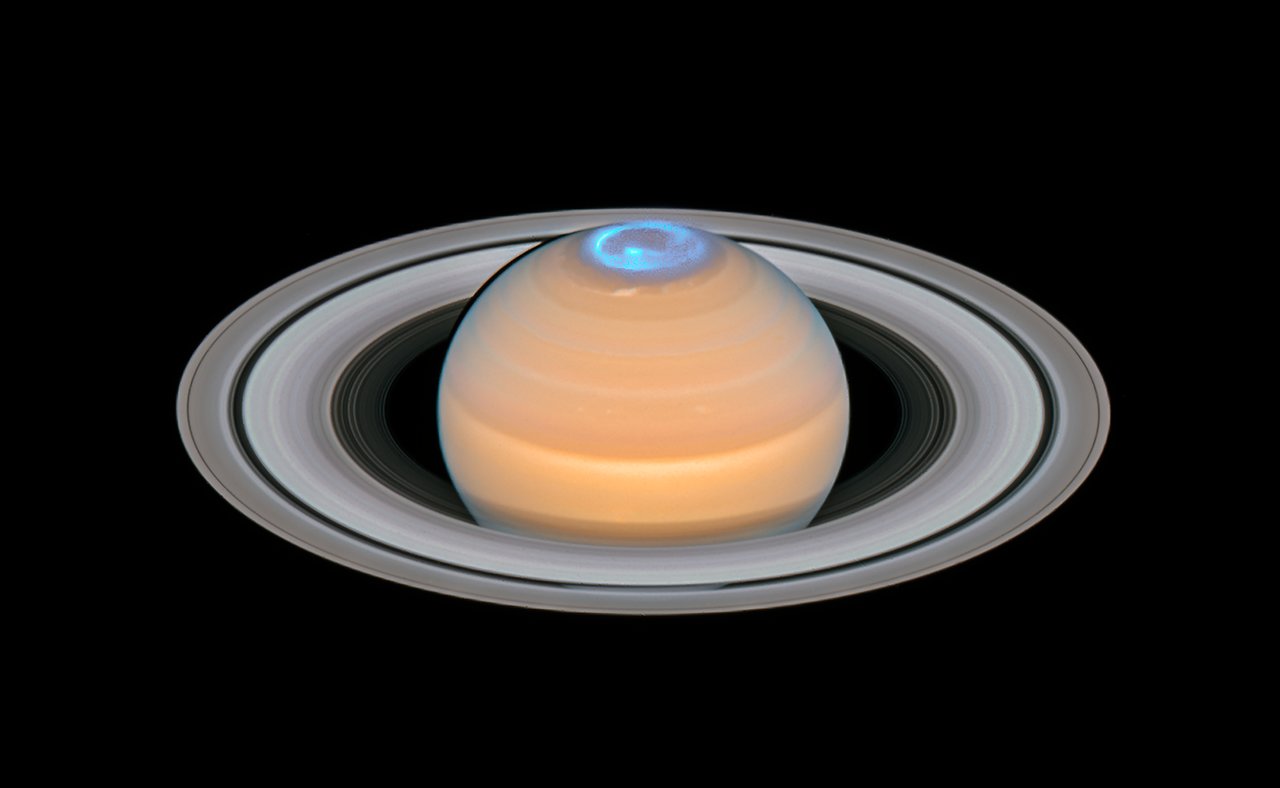
Saturn has 62 moons all in all and Mimas is one of those considered as its major satellites. However, just like all the other major satellites, the size of Mimas is nothing compared to Saturn's largest satellite – Titan. Titan comprises 96% of the total mass orbiting around Saturn (and that already includes the rings).
The other major satellites, Mimas, Enceladus, Tethys, Dione, Rhea, and Iapetus , combine to constitute about 4%. The rest, about 50 plus moons all in all, are so tiny that they only make up around 0.04%.
Many of the images we've seen of Mimas were taken by the Cassini orbiter, with the closest shots captured very recently when the orbiter was only 9,500 km away. This was on February 13, 2010.
Here are some related articles from Universe Today:
Saturn's Moon Mimas
Cassini Survives Close Encounter of the Death Star Kind!
Want some more? Check out a couple of pages from NASA:
Up Close to Mimas
Cassini Set to Do Retinal Scan of Saturnian Eyeball
Tired eyes? Listen to some episodes at Astronomy Cast. Here are two that might interest you:
Stellar Roche Limits, Seeing Black Holes, and Water on Mars
The Search for Extraterrestrial Intelligence
Filed under: Astronomy | Comments Off