NASA |
Abyss Into Eternity: NASA Gropes for the Event Horizon
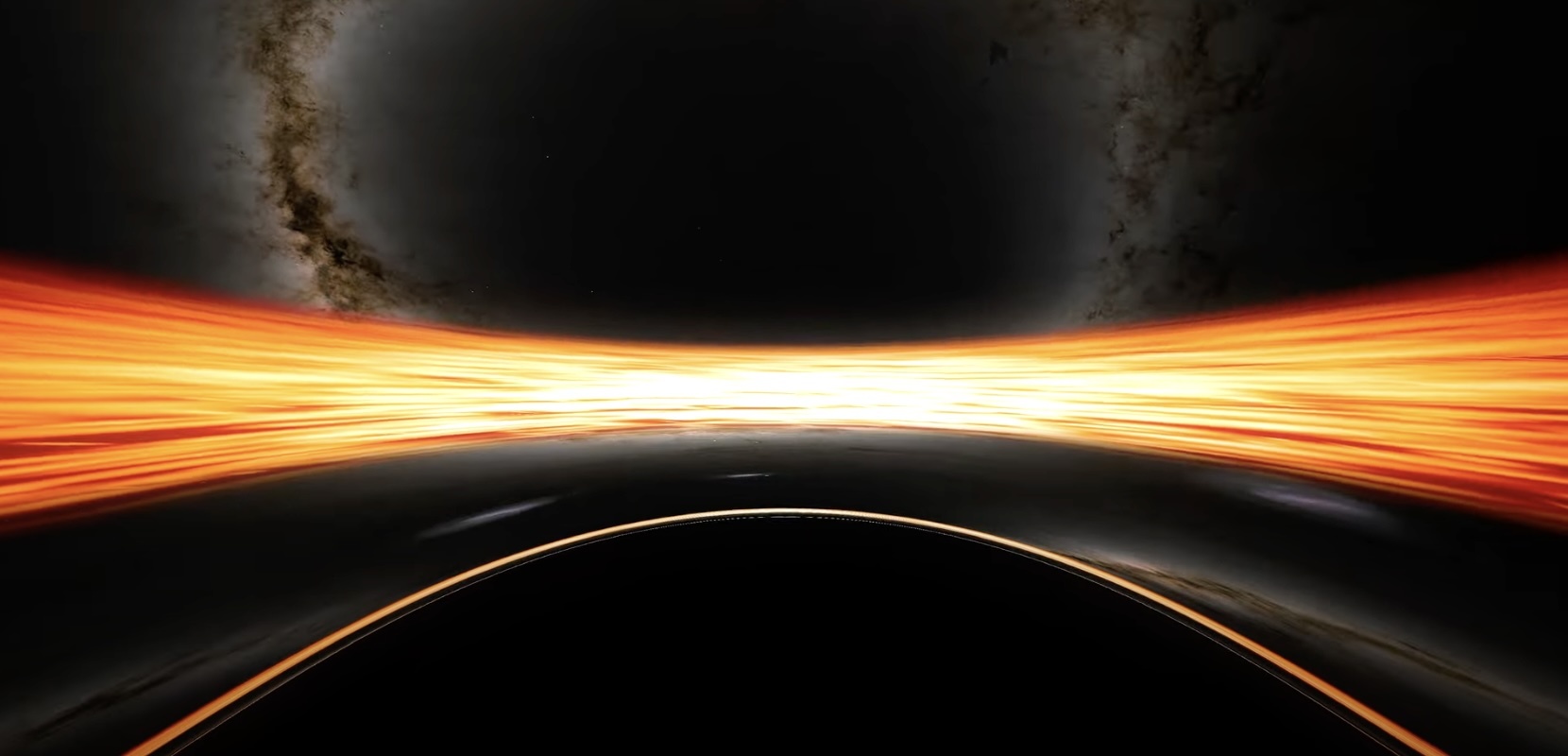
by Mark Perew Posted January 15, 2001 SAN DIEGO, Calif. - NASA is getting a lot of practice using two spacecraft to probe the secrets of astronomical objects. Last month Galileo and Cassini took a paired swipe at Jupiter. Now the Hubble Space Telescope and the Chandra X-ray Observatory have pulled a tag-team technique on Cygnus X-1, the first object identified as a black hole candidate, to find evidence that this object has an event horizon. This news was announced here today on the final day of the winter 2001 American Astronomical Society meeting. The defining characteristic of a black hole is its event horizon. This is the point-of-no-return which separates normal space from "The undiscover'd country from whose bourn no traveller returns". However, until now no one has ever found clear and compelling evidence of their existence. If you can't point and say, "Here is an event horizon," then you can't prove that black holes exist. "You would have a hard time finding an astronomer who doesn't believe in event horizons," stated Dr. Michael Garcia from the Harvard-Smithsonian Center for Astrophysics, and a lead researcher on the Chandra team. "But, you would be hard pressed to find one who says we have seen one." This seems strange in a world where black holes are featured in numerous science fiction stories, either as the title or as some plot device. Even the work-a-day world has adopted the idea of a place where things go and never come back. Projects are dubbed black holes when money goes in, but products never emerge. Facts you once knew, but have now forgotten, "Must have fallen into the black hole that is my brain." What CXO and HST have done is found nothing and something at the same time. The Chandra team of Dr. Garcia and three colleagues from CfA, Drs. Jeffrey McClintock, Ramesh Narayan, and Stephen Murray, along with Dr. Paul Callanan of University College in Cork, Ireland found an absence of energy emerging from black hole candidates. This team measured the energy emitted by X-ray novae compact stars during their dormant periods. That is, when they shining normally and not in flaring nova stage. Two types of stars are believed to produce X-ray novae, neutron stars and black holes. The latter have an event horizon, while the former do not. Using X-ray novae with similar amounts of matter falling into them, they discovered that the neutron stars have more energy emerging than the black hole candidates they studied. In fact, they found that neutron stars are producing about 100 times as much energy as the black hole candidates. "If you see a faint [X-ray nova]," explained Dr. Garcia, "you don't know if it's really that faint or it it's just not accreting a lot of matter. In this case, we have good evidence that these systems are accreting about the same amount of matter." Since roughly the same amount of matter is going in, one would normally expect roughly the same amount of energy to come out. Where is this energy going? It's going beyond the event horizon. Or, to be more technically accurate, its energy is being stretched out so far by relativistic effects that the energy becomes dark and we can no longer see it. This relativistic effect is one of the conundrums brought about by Einstein's special theory of relativity. As an object falling toward a compact star accelerates and approaches the speed of light, its clock (or a clock moving with the matter) does not change, but outside observers see the clock slow down. The faster it travels, the more the clock slows. The outside observer also sees the object turn more and more red as the object appears to slow down and the energy spreads into the lower end of the spectrum. (The relativistic effects from Einstein's general theory of relativity also play a part, but the frame dragging caused by the intense gravity is a lesser component.) According to a theory developed by Dr. Narayan and others, the matter falling into the compact star cannot effectively radiate out its energy. This theory, called Advection-Dominated Accretion Flow, explains why the matter and energy must either be delivered to the surface of the neutron star, where it does radiate and can be seen, or pass beyond the event horizon of the black hole and be lost. "There is a question if the amount of mass reaching the center is the same," Dr. Narayan admits. "But, since the amount of mass input is a function of the orbital period, there is no real good reason to think that they differ." While the CXO data was collected just 3 months ago, Dr. Joseph Dolan of NASA's Goddard Space Flight Center in Greenbelt, Maryland used 8 year-old data from Hubble's High Speed Photometer. Ironically, in 1993 astronauts on STS-61, the first Hubble Servicing Mission, removed the HSP in order to install the COSTAR system which corrects for Hubble's infamously incorrect primary mirror. Spending years analyzing very noisy ultraviolet light data, Dr. Dolan was able to identify a flare patch, a blob of hot infalling matter, which alternatively appeared, then disappeared, and so on, until it finally vanished. He was able to find two such events, each lasting 0.2 seconds. One flare patch cycled seven times and the other six times before being completely lost from view. "The light paths get deflected by the black hole," Dr. Dolan commented. "This causes the object to get dimmer and dimmer as it approaches the event horizon." This is exactly the behavior Dr. Dolan found and what astronomers expect to observe in matter falling into a black hole. It wasn't easy to analyze the 1 billion points of data to find the low level of signal hidden in the much noisier background. But, combined with the CXO results, Dr. Dolan's work with HST data has made a stronger case for the existence of black holes. "We can present a convincing case in a civil court, where the burden of proof is a preponderance of evidence," offered Dolan. We're not yet where we can prove our case in a criminal court where you must prove 'beyond a reasonable doubt'." Dr. Dolan is hoping that new spacecraft, such as the far off Next Generation Space Telescope, will be able to provide new data on other black hole candidates to confirm his Cygnus X-1 data. The Chandra team has studied 13 objects, including Cygnus X-1, and is anxious for Chandra time to collect data on other X- ray novae. All of the researchers hope that by proving the existence of the infinity dense black holes, they can advance the certainty of science for all of astrophysics. An illustration of the Chandra results can be viewed at http://www.chandra.harvard.edu and the URL http://hubble.stsci.edu/go/news will take you to the HST illustration. Mark Perew is a freelance writer, a member of the National Association of Science Writers and a JPL Solar System Ambassador. |