

[/caption]
This is one of the strangest looking craters ever found on Mars, and this platypus-tail-shaped depression, called Orcus Patera, is an enigma. The term ‘patera’ is used for complex or irregularly shaped volcanic craters, but planetary scientists aren’t sure if this landform is volcanic in origin. Orcus Patera lies between the volcanoes of Elysium Mons and Olympus Mons, but its formation remains a mystery. This is the latest image of the object, taken by ESA’s Mars Express.
It could be an impact crater that originally was round, but then subsequently deformed by compressional forces. Or, it could have formed from two craters next to each where the adjoining rims eroded. However, the most likely explanation is that it was made in an oblique impact, when a small body struck the surface at a very shallow angle.
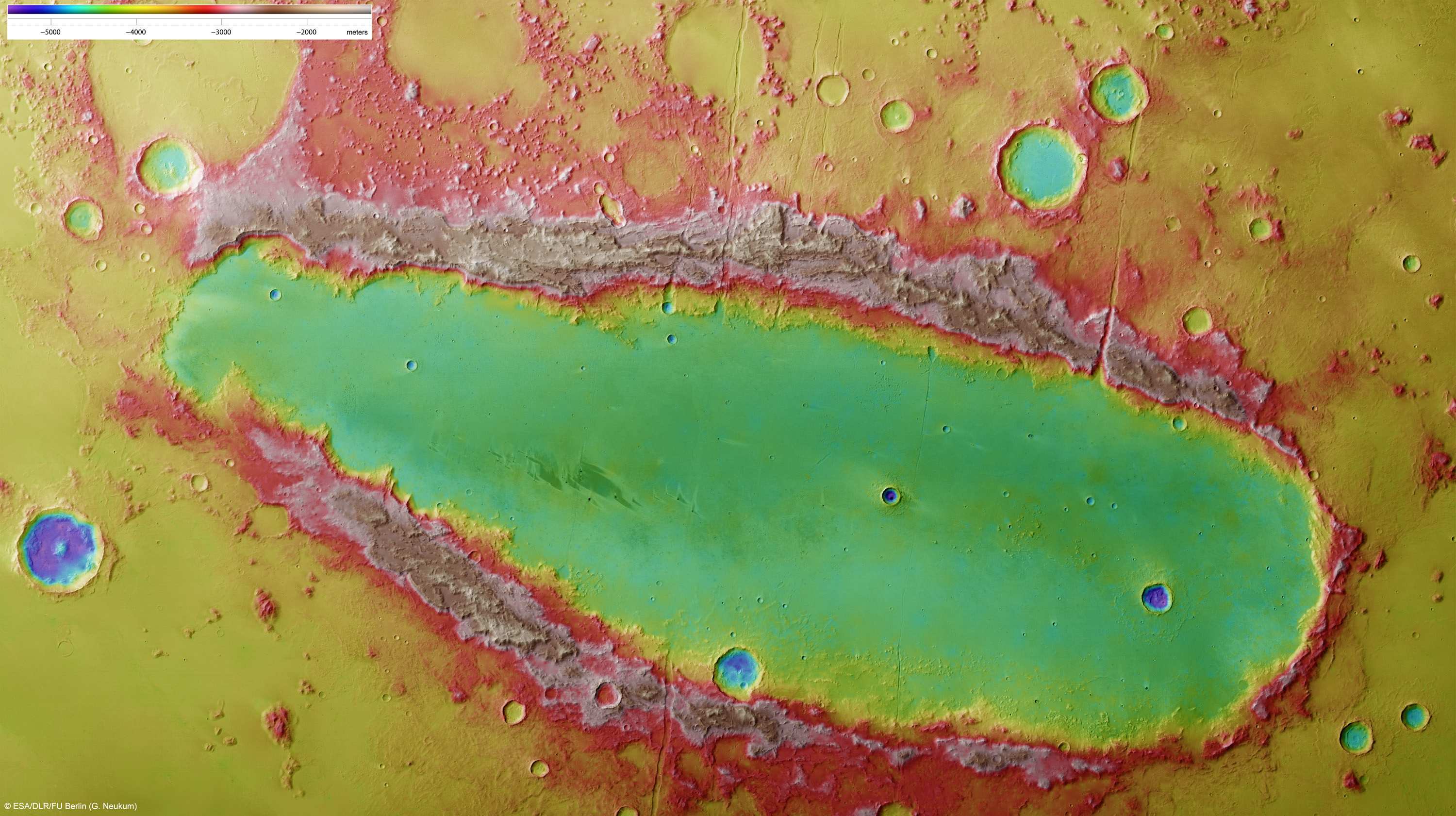
It is 380 km long by by 140 km wide, and has a rim that rises up to 1,800 meters above the surrounding plains, while the floor of the depression lies 400–600 m below the surroundings. The floor of the depression is unusually smooth.
The image above was created using a Digital Terrain Model (DTM) obtained from the High Resolution Stereo Camera on ESA’s Mars Express spacecraft. Elevation data from the DTM are color-coded: purple indicates the lowest-lying regions, and beige the higher elevations. The scale is in meters.
Source: ESA
I’m not an expert by any means, but I wonder if this could be a crater chain, similar to Enki Catena on Ganymede, but caused by many different-sized objects? There’s obviously a lot more going on here, but to me it looks like there are a number of “partial craters” (for lack of a better word), especially along the left side of the feature.
Again, not an expert, but I’m sure that’s already apparent since I really have no idea what I’m talking about. 🙂
How about an extremely close crater chain – meteor or volcanic? A sequential impact pattern fracturing the crust along a line? OR maybe an elongated object impacting flat to the length of the object? SPLAT! Whatever… sure is trick! But wouldn’t that be the color Blue indicating the lowest regions?
No.. I see it now. Purple it is!
I’ve spent a while looking at this photo. I don’t think it could be much of a crater, or two combined for that matter. If it were it would probably be much deeper, like some of the surrounding craters.
Instead I’d like to say it’s a dry lakebed. Comparing it to an earthen dry lakebed, it looks quite feasible that it could have been a lake. Furthermore, it has those line-like impressions leading into it. I ask: rivers perhaps? Even though rivers on earth aren’t quite as straight, it still is a possibility. Last I see the darkened region within the impression that looks like dark dust that has been shifted by the wind. Looking at earthen dry lakebeds, they have can have patterns similar to this at their bottoms. Caused by what, I do not know, but it does seem like it would be rather out of place in crater.
What do you think? Legitimate or definitely a crater?
Someone please verify that one of three things are wrong:
1. The scale at the bottom of the first image
2. The dimensions given in the article
3. Or ME!
I wanted to get some perspective as to how big this crater is so measured out the dimensions in Google Maps and found it to be about as wide as Pennsylvania and about half as tall if you go by the size given in the article. However when I measured the width of the crater using the scale it’s closer to 600km wide. That would add New Jersey and half of Long Island to the width – not a small difference!
What gives? Am I the crazy one? 🙂
A good view of this area is available using Google Earth at Mars or WWT Mars. The ESA release gives the coordinates as: 14deg N 177deg W. It’s easy to spot the graben mentioned in the article on the left side of the crater, stopping at the rim. In one case, a faint extension of a graben on the other side of the crater is visible! More images and info here: http://www.esa.int/SPECIALS/Mars_Express/SEMDV9BO3DG_1.html
I would like to see a simulation of a shallow impact reproducing that. Meanwhile a crater chain that have been heavily modified is much easier to buy.
“simulation – could be a scale model experiment. The point is that not only are shallow impacts giving ellipses few due to the very shallow angle required, it’s not at all given what track would result.
I tend to agree with SPENCER. A dry lakebed would make sense taking into account the relatively smooth floor, shape, and size and depth. The additional impact craters that exist inside the lakebed(yes, I’m calling it a lakebed) also support this conclusion.
On second thought… it looks like somebody came out of hyperdrive a little too close to the planet!
Absolut Mars 😎
I recommend you take a look at
46°03’36″N 81°03’18″W
It’s called the Sudbury Igneous Complex.
http://ottawa-rasc.ca/wiki/images/d/d3/Odale-sudbury-00_shade_topo.jpg
That’s the first thing I thought it looks like.
I recommend you take a look at
46°03’36″N 81°03’18″W on Earth.
It’s called the Sudbury Igneous Complex.
http://ottawa-rasc.ca/wiki/images/d/d3/Odale-sudbury-00_shade_topo.jpg
That’s the first thing I thought it looks like.
I remember this, that’s where the saucer section of the enterprise D crashed.
For another view of this feature, check out:
http://cdn.physorg.com/newman/gfx/news/hires/474-20103007-2216-2238-6-3D-1-01-OrcusPatera_H1.jpg
I say it was an oblique impact crater that by chance occurred when there was a very large still partially molten area of lava from either Olympus or Elysian Mons. Could that not explain it’s shape as well as smoothness, as well as, perhaps the pattern of the high elevation northern and southern walls that are wider at the smaller southern end and taper off to the east, and are non-existent on the southern and eastern most rims?
I would agree with durga2112 & Aqua, in saying a crater chain, I can see possibly 6 craters and there could be more. Looks like the impactors hit at an angle and like what Nancy says in the article above but instead of one oblique impact their appears to be more.
Those who say a lakebed have to into account the relief map also, notice how the edge of the depression rises up out of the surrounding plains, this is more associated with crater formation, it may be possible that a lake existed there after the formation of the feature.
If we take an object like comet shomaker levy 9 that broke into some 21 fragments or the crater chain Enki Catena on Ganymede as well as dozens more of these features throughout the solar system we have a way of explaining the crater chain formation, take also into account the erosion and deposition qualities that Mars possesses, (dust storms etc) and we have a explanation as to how the crater floors have a relatively even surface fill.
A extremely interesting feature and a great place to send a geologist, human preferably :).
God, I love the 2nd pic. It’s punk plastic Andy Warhol.
We should send Radar Satellite to Mars so that we can see the topography under the surface fill.
Any skier or snow boarder could pick this immediately. It’s a face plant.
@ Emilio
I would like to see the topography beneath the surface fill also.
We have a radar instrument in Mars orbit, SHARAD on the MRO.
Lets get it there.
The lake bed hypothesis doesn’t explain the surrounding ridge. But crater chains, which explain the ridges and shape, don’t leave smooth floors. It must be combination of events over time.
Start with a crater chain. Assume the event allowed magma to initially smooth over the crater floor, then allow water to flow in over time, cutting the access channels we see and further smoothing the lake bed as silt is deposited.
Love the ‘platypus’ description Nancy! It looks almost like a glancing blow, and fairly recent, judging by the lack of fresh cratering within. Mars Express continues to delight.
Looks like it impacted,rolled,impacted,rolled,Impacted Hard!! an split Mars Crust an finaily Slid to stop an exploded probly like are moons Tyco creator but with alot more inward motion
Looks like a shalow-angle inpact in mud.
I’m about as amateur as you can be in this field, but I wonder if it could have been an impact into the side of a small volcano, or at least a hotspot on the side of a long slope.
Looks like an angled impact that skidded forward as it burrowed deeper into the surface.
I’m going to vote for a heavily modified crater chain again, so it will edge closer to a win. 🙂
Really, the oblique angle impact needs a case picture. To be even slightly elliptic an impact, that typically expands ~ 20 times for a high speed impactor and so naturally swamps the impact ellipticity, would need to be ~ 80-90 degrees. That explains the commonality of round impact craters and the scarcity of even slightly elliptic.
<blockquote
It's a face plant.
I’ll buy that: it could be a face plant after hearing about Hoagland’s “face on Mars”.
The terraces on either side can be ‘cruised’@: http://hirise.lpl.arizona.edu/PSP_006471_1975
Impact scenario: An object, perhaps a piece of Demos or Phobos(?), for eons orbits Mars. Aerobraking events during particularly energetic planetary dust storms lowers this object’s orbit. The gravitational stresses eventually shatter object into a cohesive flying mass of smaller objects composed of silica, carbon, water ice, heavy water ice and frozen gases. As the lead object enters the Martian atmosphere it generates a plasma shock wave in front of it. Behind it a hot ion tail heats up some of the following pieces to fusion temperatures. A sword of hot plasma crashes into the surface and melts its way through to a magma reservoir/chamber below. Pressure from molten magma in the nearby volcano’s pushes molten magma back through the fractured units and slowly fills the cratered depression into a pond like surface.
Addendum: Doesn’t that look like a great place to put a spaceport!
I wonder if there’s residual or other geothermal heat to be tapped?
I’d like to see what the mag. field looks like at Orcus Patera!
Seems there is a lot of speculation as to the origins of Orcus Patera (and that makes for good reading) so I add the following:
What if this feature is the final resting place of an earlier Martian moon? Possibly a small body snatched from the asteroid belt into an unstable, decaying orbit similar to Phobos. Or maybe it was a companion body to Phobos or Deimos that that was destroyed when Mars captured them aeons ago. We now know binary asteroids are not that uncommon. Pure speculation……..and food for thought.
“Absolut Mars”
Would give a whole new meaning to the phrase “plowed under” 😀
Aqua,
Seems that you had a similar idea (I missed it before I posted mine).
My initial impression was a modified crater chain and that seems somewhat favored in comments here. Of course, for Dick Hoagland, this may be the landing strip for alien craft from the Phobos mothership. 🙂
Anyone else feel that the surface was wet, or mud-like? It can be a real thick mud, and doesn’t have to be a soaking wet surface.
I had a closer look at the image and have you guys seen the blue patch in crater thats almost in the middle of the the main “wierd crater” ? Looks like water ? Interesting. Its a stand out anyway. Can someone explain that?
@RUF – Yeah… recently newly formed craters at Mars equator showed signs of pure water ice! It may be that there is a frozen ocean of water below much of Mars’ surface… The impact of a cloud of hot plasma as I posited above might then melt an elongated trench? Conversely, a closely spaced meteor chain would do the same?
Have you noticed that MANY of the craters we see on Mars look as though a rocky object smashed into mud? The patterns of ejecta surrounding indicate tsunami like waves through a viscous slurry! KER SPLAT!
It obviously is geologic activity within the planet and not a meteorite impact, because it is located between two volcanic craters. The expansive rock outcrop have a smooth texture to them that only finely crystalline molten rocks would have after cooling. this implies a basaltic lava composition flow that filled a lower elevation basin when the volcanoes erupted.
I’m surprised no one else noticed this: it’s a giant footprint!