
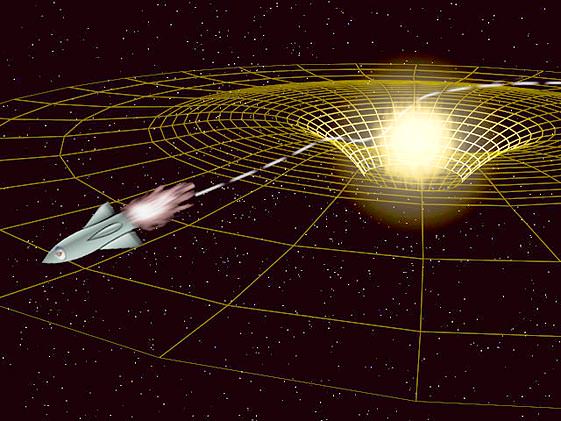
The axiom that what goes up, must come down doesn’t apply to most places in the universe, which are largely empty space. For most places in the universe, what goes up, just goes up. On Earth, the tendency of upwardly-mobile objects to reverse course in mid-flight and return to the surface is, to say the least, remarkable.
It’s even more remarkable if you go along for the ride.
If you launch in a rocket you will be pushed back into your seat as long as your rockets fire. But as soon as you cut the engines you will experience weightlessness as you arc around and fall back down again, following a similar path that a cannon ball fired up from the Earth’s surface would take. And remarkably, you will continue to experience weightlessness all the way down – even though an external observer will observe your rocket steadily accelerating as it falls.
Now consider a similar chain of events out in the microgravity of space. Fire your rocket engines and you’ll be pushed back into your seat – but as soon as you switch them off, the rocket ship will coast at a constant velocity and you’ll be floating in free fall within it – just like you do when plummeting to your accelerated doom back on Earth.
From your frame of reference – and let’s say you’re blind-folded – you would have some difficulty distinguishing between the experience of following a rocket-blast-initiated parabolic trajectory in a gravity field versus a rocket-blast-initiated straight line trajectory out in the microgravity of space. Well OK, you’ll notice something when you hit the ground in the former case – but you get the idea.
So there is good reason to be cautious about referring to the force of gravity. It’s not like an invisible elastic band that will pull you back down as soon as you shut off your engines. If you were blindfolded, with your engines shut off, it would seem as if you were just coasting along in a straight line – although an external observer in a different frame of reference would see your ship turn about and then accelerate down to the ground.
So how do we account for the acceleration that you the pilot can’t feel?
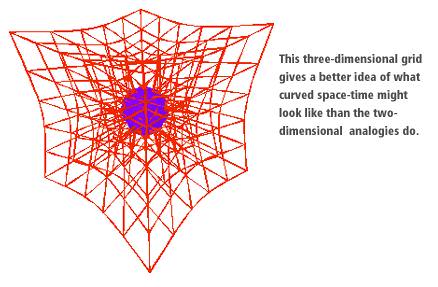
Without a blindfold, you the pilot might find the experience of falling in a gravity field a bit like progressing through a slow motion movie – where each frame you move through is running at a slightly slower rate than the last one and where the spatial dimensions of each frame progressively shrink. As you move frame by frame – each time taking with you the initial conditions of the previous frame, your initially constant velocity becomes faster and faster, relative to each successive frame you move through – even though from your perspective you are maintaining a constant velocity.
So – no force of gravity, it’s just geometry.
Mr. Crowell always manages to make my head spin. I can almost hear the chalk furiously scraping against the board as he illustrates his equations.
Is this going to be on the exam? 😉
This is so hard!
I watched a documentary recently with Brian Cox (the documentary was with Brian Cox, I had not the pleasure watching it with him 😉 ) about gravity and “its history” (Newton, Einstein, string theory). It was very interesting, and tried to explain the “geometry-thing” as well. But whenever this is tried one encounters the impossibility of human imagination. At some place you will always hit the limit. This is so hard!
For that, you’ve done very well Steve! Although the last longer paragraph was again very hard ;). Still, a good job!
Recent research in cognitive science suggests people might have the capacity to appreciate four-dimensional reality given suitable computer graphics.
See
Ambinder MS, Wang RF, Crowell JA, Francis GK, Brinkmann P. (2009). Human four-dimensional spatial intuition in virtual reality. Psychon Bull Rev. 16(5):818-23. doi:10.3758/PBR.16.5.818
Nice article!
Right, the Newtonian gravity force/energy theory is today a falsified model approximation of a (yet unfalsified) effective theory. But this seems to sell it short, as the only requirement for a force is that you can have a F = d/dt(m*v) = [ m*a | m = constant ] relationship, or nearly so. Newtonian gravity is a good enough model in most mundane cases, no strings attached.
What is described here is the Einstein equivalence principle. Gravitational acceleration or force is something in general zero. If V is a four dimensional velocity then in a cryptic form the equation of motion is
dV/dt + G*V*V = 0
is the geodesic equation which is zero. The apparent acceleration of gravity is due to ignoring the G*V*V, or connection term. The G is a three indicial object called the Christoffel symbol or connection.
This turns out to be not the entire story though. If you are falling in a closed box, then since the box is falling with the same acceleration as you then you perceive no gravity. The space shuttle is like this box which is falling towards the Earth, but moving fast enough to keep missing it. Now if you are falling radially towards a spherical body in this box there will be some deviation from this. If you were to place two small masses at opposite sides or top corners of the box you will observe they move slightly inwards towards each other. This is because the spatial extent of the box is sufficient so the two test masses are falling inwards along different radial vectors. So the weightless observer will find that these two masses experience as small acceleration towards each other. Similarly two test masses set along the vertical or along the radial directed axis of the infalling box will find these two masses move away from each other. This is because the acceleration of free fall for the mass at the leading side of the box is slightly larger than at the trailing side. This is the effect of curvature, and this tells us how different geodesics for point masses will deviation from each other.
Curvature is a geometric obstruction which prevents a space, or in this case spacetime, from being flattened. This also determines how two geodesics in spacetime move towards or away from each other in some curved spacetime. This can’t be made zero by any coordinate transformation, whereas what we call ordinary gravitational acceleration can be transformed away by a choice of frame or coordinates.
LC
As a lay person, I’ve always wondered whether gravity should still be regarded as a force?
In General Relativity it appears to be just the curvature of four dimensional spacetime, caused by the presence of mass…. a completely different scenario to that envisaged by Classical Mechanics and Newton’s ‘action at a distance’.
If gravity is purely due to the geometry of spacetime, is the idea of a force carrying particle (i.e. graviton) unnecessary…. and if it is, how will a theory of quantum gravity ever be achieved?
If the sun suddenly disappeared, how long would it take for the earth to leave its orbit?
How long does it take the Sun’s gravity to reach Earth?
Is this instantaneous, or does it take 8.5 minutes, or what?
General Relativity theory doesn’t need gravitons, but that’s not to say the real world doesn’t need gravitons.
For now GR and quantum mechanics both seem to explain different aspects of the real world very well, but it’s not clear if either can ever explain everything (hence the ongoing search for a Theory of Everything).
@tponeill: It would take the 8.5 minutes or so for the information to get here. There is a theorem by Birkoff which says any spherical distribution of mass appears gravitationally equivalent to a black hole. So if we placed a surface around the sun and measured its gravity there it would be the same regardless of its actual configuration, black hole or otherwise. Now stars don’t disappear, but only slightly less improbable would be if all the atoms in the sun turned into photons. The orbit of the Earth would continue as is for that 8.5 minutes as the mass-energy of the erstwhile sun streamed out. We would not get any change in gravitational information until that blast front of photons passes us. For Jupiter it would take about a 45 minutes for this to happen, where in the mean time Jupiter would keep orbiting as if nothing has happened gravitationally.
As for gravitons, these are quantized forms of the Einstein field equation. For weak gravity the Einstein field equations may be expanded in post Newtonian formalism, where the first order term is Newtonian, the next order are correction terms which replace some symmetries of Newtonian gravity, such as the Lense vector isometry, and the next order is remarkably similar to Maxwell’s equations. These can be quantized into a type of photon-like field, but with spin = 2. These are gravitons in the most elementary sense. Yet these don’t capture quantum gravity in its fullest sense.
Gravitons are field effects which occur with respect to various string types in a perturbation expansion larger than the string length. The terms in this expansion in the action are with the curvature, curvature squared and so forth. So an expansion with post-Newtonian gravity is an expansion in just the first term on the order of the curvature — there is an expansion within an expansion in a sense. Since gravity contains mass-energy, which is the source of the field gravitons can interact with gravitons, which makes the perturbative approach to quantum gravity horrendous. To lay a bit of group theory down, the type IIB superstring theory contains the SO(8) transverse representations in bosons and fermions as
(8_v + 8_c)(x)( 8_v + 8_c) = (1 + 28 + 35_v + 28 + 35_c)_B
= (8 + 8 + 56_s + 56_s)_F —- (x) = otimes or tensor product
where the 35_v is the graviton, 28 a second rank antisymmetric tensor field, and 56 a fourth rank antisymmetric field. Now the alternative approach is to consider strings as interacting with Dp-branes. This leads to a nonperturbative approach to the graviton, but the field is in the D-brane which is not a quantized object, but a soliton defect in superspace. So in a sense the graviton is not exactly a quantum particle, but the 35_v graviton is a field effect from a soliton field on a D3-brane.
LC
Many thanks for the replies Steve and Lawrence…. so the graviton should still exist if we’re talking about quantum physics, as per the Standard Model. It will be interesting to see if this comes out of the CERN LHC, along with the Higgs!
The graviton exists at best I think as a semi-classical object. I don’t think that general relativity is fully quantized, but rather the graviton is weak quantum field effect on the tree or one-loop level. General relativity is I think better thought of as emergent from something else. I would like to explain what that is, but it requires discussing some very advanced topics. I seriously recommend that to understand this one needs to study general relativity and to look at the role of string theory with black holes Susskind and Lindsay
http://books.google.com/books?id=cxJCBRUNmVYC&pg=PP3&lpg=PP1#v=onepage&q=&f=false
is fairly readable for anyone with some reasonable background in physics.
LC
I really enjoy reading all the posts on this site, but this one ( and others ) infuriate me. I hate not understanding stuff to the point that it has no meaning. Like when you say a word so much it loses all meaning, i’ll sit here a while longer in my ignorance trying to understand. =(
Richard Feynman wrote that our culture is one which is founded on science, and that to be culturally literate it behooves one to know as much as possible. In our age with the web and wikipedia one can read some summaries of these topic, most of which I have found are pretty reasonable.
LC
Hi Mr Youngie,
I genuinely regret my attempt to communicate a complex issue has not worked for you. This is a hard and very non-intuitive area.
Send me an email and I could suggest some reading material maybe? I love this stuff and would be thrilled to be able to help someone else understand it.
Didn’t Kaluza and Klein manage to combine GR and quantum theory in 5 dimensions somewhere around 1925? Obviously it doesn’t work in our 4-dimensional one or the 10/11 ones. Can anyone explain why it works in 5 but not the others.
This is a great subject. Solve it, and you are a shoe-in for a Nobel Prize.
Right now, you cannot mix theories and formulas from Special Relativity and General Relativity… neither fit in the other. As Steve stated… the “Theory of Everything” eludes us… and it eluded Einstein as well… it was his main subject of study in the last years of his life.
With special relativity, when working with the ‘graviton’ you have to state which definition of it you are using.. since there are different theories surrounding it….such as whether or not you believe the Higgs field exists. It can also change based on theories not directly related to it… like “string theory”.
It is all a matter of how you believe the graviton particle interacts with other particles, and other things… like photons.
I am a bit confused on some parts of this article. Being inside a rocket which is launching and getting pushed back into your seat isn’t the result of gravity. It is the result of acceleration. As long as the rocket is accellerating you will feel like you are being pushed back in your seat. However, even if the rocket is still firing, but it gets to a point where it is no longer gaining speed, you are no longer being pushed back in your seat; even if the rocket is continuing to expel energy.
Accelleration in a falling is due to gravity becoming stronger as you get closer to Earth.
In confusing energy with elevation and gravity. I disagree with you. If gravity didn’t exist, the energy required to elevate the object would be far less. In fact, nearly zero; so it wouldn’t have enough stored to make the return trip down 🙂
What the KK theory involves is considering general relativity with an extra fifth dimension, and where the ordinary space and time (3+1=4) coordinates are independent of this fifth dimension. Then you crank through the general relativity calculations, you find that the connection coefficients in general relativity produce for this fifth dimension the electric and magnetic fields and the Einstein field equations give Maxwell’s equations. This can be continued in other dimensions beyond five dimensions. The reason for 10 and 11 dimensions is a bit difficult to explain, but it has to do with algebraic systems involved with string theory. The books by Green Schwarz and Witten are a good reference for this.
The idea works great, except for a couple of hitches. If we return to just five dimensions, then what is the meaning of this extra fifth dimension? The independence of the space and time coordinates with this fifth coordinate is compatible with the compactification of this dimension into a circle. That is fine, except that if you have this extra dimension compactified into a circle of radius R then the wave equation for a photon has a fifth term in the Laplacian (a second order differential operator) which gives a term 2pi-hbar/R that is a mass. For R very small that mass is huge, which means that in four dimensions the photon would be an enormously massive particle. This is where something called T-duality comes in. To make a rather difficult subject somewhat accessible, it is how a compactification of a space, say the circle in 5-dim, into a radius R results in effective field theory which as an energy term that is the reciprocal of the mass, or R and 1/R are dual descriptions and for R very small this gives a tiny mass for the field of interest.
I hope this makes the matter at least a bit clear. There is a lot of stuff behind this.
LC
@ Aodhhan: This is the point of the Einstein equivalence principle (EP): acceleration and gravity are entirely equivalent. The other aspect of the EP is the being weightless in free fall is equivalent to being in a falling reference frame. This is exact for an infinitesimal frame. Yet parallel transport of vectors between frames can result in a curvature. This is an obstruction to flatness of the space. This means for a falling frame of finite size two particles falling that frame might have some accelerated motion relative to each other. This is due to tidal forces or the Weyl portion of the Riemann curvature.
LC
In response to: ‘However, even if the rocket is still firing, but it gets to a point where it is no longer gaining speed, you are no longer being pushed back in your seat; even if the rocket is continuing to expel energy’.
Maybe not pushed back in your seat, but when you ‘hover’, you will experience 1G (or whatever depending on altitude). It is not free fall and you are not weightless.
Agree you need more thrust to move ‘up’ through more highly curved space-time. The article does not dispute that gravity exists as a consequence of space-time curvature.
LBC… I’m quite aware of the obvious. However, that isn’t what is being presented.
If you are in Earth’s atmosphere, whether you are hovering or moving at a constant speed you are experiencing 1G. If you were in space, away from any gravity and you were hovering or moving at a constant speed, you would experience zero G.
It is general theory, if the sun suddenly went *poof*, gravitational affect on Earth would be immediate. The fabric of space time is connected throughout space, it doesn’t have to travel from point A to point B.
This is demonstratable by a the popular 2D model using a rubber plane, a heavy ball for the sun and a penny, nickle or marble for Earth…. No matter how fast or slow you remove the sun, the Earth will be immediately affected.
LBC
If you are saying gravity and acceleration is equal, then you are wrong. I believe you may be misreading Einsteins EP; which is a debateable subject in itself. …and it in no means states gravity = acceleration.
Also, there are more than one “equivilency priciple”.
No, you are wrong. Gravity is the force some solid body exerts to keep a mass at a constant radius, such as the surface of the Earth. For a small enough of a frame this is indistinguishable from being on a frame with a constant acceleration equal to that gravity. This is the equivalency between accelerated frames and gravity. The other form of the EP is the equivalency between a frame in flat spacetime and a frame falling in curved spacetime, if that frame is sufficiently small.
There are the strong and weak forms and some variations therein of the EP. Yet for purposes here this suffices.
LC
@Aodhhan: Uhmmm, you are wrong as well on the gedanken experiment about the disappearance of the sun. Look, if you don’t take my word for it Brian Greene did a NOVA series where he iterated exactly what I said.
LC
“This is demonstratable by a the popular 2D model using a rubber plane, a heavy ball for the sun and a penny, nickle or marble for Earth…. No matter how fast or slow you remove the sun, the Earth will be immediately affected.”
For us humans it will look that way. Are you saying that the information that the “sun” has been removed will travel to the “earth” faster than light? How big a rubber plane are we talking about? I bet if we made the plane big enough the propagation would be noticeable to the human eye. High speed video cameras are pretty fast these days and they could prove enlightening in your experiment. Have you seen the high speed captures of bullets in Mythbusters?
Einstein’s motivation for formulatng general relativity was to make it consistent with the causality conditions of special relativity. Newtonian gravity is instantaneous, and this appeared in conflict with light speed invariance. If the sun were removed by some means the curvature of spacetime would adjust in a wave of sorts which would propagate outwards at the speed of light.
LC
I think there is consensus agreement that a gravitational effect moves at the speed of light (and a problem with Newtonian gravity is that this is assumed to be instantaneous).
Not sure about the idea of seeing or filming the propagation of a wave moving at the speed of light in a vacuum – though I welcome comments.
I assume that because the first information you will get about it is when it hits you, you can only ‘see’ its after effects, not the progressing wavefront.
You could potentially see or film the wavefront of a light beam moving through glass or some other dense medium – since that will slow it down. I don’t think you can slow down a gravitational effect though.
I just found the Brian Greene clip where he uses some multi-media stuff to make this point.
http://www.youtube.com/watch?v=O-p8yZYxNGc
Aodhhan has some interest in trying to show I am wrong about nearly everthing — for some odd reason.
You could detect a gravity wave moving through space according to how light rays pass through it, obviously propagating in a different direction from the gravity wave, at different times.
LC
@ Aodhhan
No, yet again you are completely wrong in what you say, especially on the thought experiment of the disappearance of the Sun.
All you have done is show your usual lack of knowledge, and it really does you no favours.
Yet what is far more obvious to the rest of us, is your obsessive behaviour in attacking Lawrence B. Crowell at every opportunity. Belittling others just to get some attention is pretty inept and childish. It is clearly not appreciated nor respectful to others.
That’s really laughable coming from Crumb, who on another thread on this site said:
I would prefer to see someone answer Aodhhan’s queries with something other than ridicule and double-speak.
From the article “From your frame of reference – and let’s say you’re blind-folded – you would have some difficulty distinguishing between the experience of following a rocket-blast-initiated parabolic trajectory in a gravity field versus a rocket-blast-initiated trajectory out in the microgravity of space.”
Aodhhan “If you are in Earth’s atmosphere, whether you are hovering or moving at a constant speed you are experiencing 1G. If you were in space, away from any gravity and you were hovering or moving at a constant speed, you would experience zero G.”
I think what Aodhhan might be getting at is that on earth, you would feel the addition of Earth’s gravity during the launch phase and you would not during the engine burn in space.
… but, if we’re using the same rocket (same engine thrust in space and on earth), the force one feels pushing them back in the seat should be the same, no? I don’t have the calculations to show this but the rocket would be “fighting” gravity as well and the rocket would not be accelerating relative to the earthbound observer as fast as it might far away from earth. But the passenger should feel the same weight. This assumes the same rocket.
Aodhhan also said “Accelleration in a falling is due to gravity becoming stronger as you get closer to Earth.”
The gravitational difference between ground floor and 5th floor are negligible and essentially uniform when compared to the change in speed an apple will experience (acceleration) when dropped from the 5th floor. An apple thrown vertically up, moving away from the earth will also feel an acceleration towards earth until it reaches a speed of 0 and fall back to the ground.
@ davesmith_au
Oh come on. This whole section and reply was clearly tongue in cheek, and was pointing out the kind of statements often made by plasma universe / electric universe supporters. If you didn’t get it, it is not my fault.
As to Aodhhan, all I was doing is pointing out his usual predictable behaviour. It is not the first time the he has tried to attack Lawrence B. Crowell (or others), and time and time again he has been shown to be incorrect.
Really. Most of us these days can’t even be bothered responding to his misguided “queries” or his wrong “theories.”
“I would prefer to see someone answer Aodhhan’s queries with something other than ridicule and double-speak.”
This has happened (not counting my attempts). Maybe you missed them.
What Aodhhan says here is not only wrong it is dangerously misleading. Some of the most basic ideas of General Relativity start with the equivalence principle (not as Aodhhan’s wrongly spelt “equivilency priciple”) and its interpretation is plain wacky.
Glad I am not learning about relativity theory reading from this serious of comment.
Crumb is absolutely right when he says;
“Yet what is far more obvious to the rest of us, is your obsessive behaviour in attacking Lawrence B. Crowell at every opportunity. Belittling others just to get some attention is pretty inept and childish. It is clearly not appreciated nor respectful to others.”
Ignore the fool!
I sense there might be a bit of confusion about gravity, accelerated frames and accelerating in a gravity field. In an experiment it is usually the case you vary one variable, and then hold the rest fixed. You may then repeat the experiment with variables readjusted and fixed while now varying that variable and so forth. In detecting nuclear magnetic resonance the two variables are the magnetic field and the radio frequency you apply. So you hold one fixed, usually the magnetic field, and then vary the RF. Much the same protocol holds for a thought experiment as well.
So with the equivalence principle applied to gravity and acceleration, we need to take care. So we consider an accelerated frame in flat spacetime, where there are no gravitating masses. This might pertain well enough out beyond the Kuiper belt or interstellar space. You the observer are in an enclosed box or capsule and a rocket engine in fired so you accelerate at a constant g = 9.8m/s^2. For a small capsule, which determines the size of the local frame, is identical for an observer in the same capsule sitting on Earth. Of course we ignore issues of cold and other physical aspects (isolating and considering the one variable or parameter of interest). The inertial version of the EP is that if the capsule is not accelerating in free space far from any gravitating body, this is again equivalent to falling through a gravity field.
Departures from this occur from the physical extent of these frames. The capsule has some spatial extent and within the capsule freely falling in a gravity field test masses will have some small acceleration relative to each other. This is due to tidal forces across the extent of the capsule’s dimensions. This is due to curvature, and results in this deviation between the inertial frame far from any gravitating mass and the falling frame. One the flat space frame far from any gravity you would observe no acceleration between test masses distributed around the capsule, while on a radially freely falling frame you would observe tiny relative accelerations between test masses. This is due to curvature which is an obstruction against some flatness “map” from a space to a flat space.
Now once you have this straight, you can now mix and match, where one can have accelerated frames in a gravity field, say a rocket lifting off the Earth’s surface or if one accelerates away from a black hole before crossing the event horizon.
As for posting things, if one is unsure about things it is best to indicate that. Cross posting and erroneously stating that something is in error can create some confusion. There is some evidence for that which occurred over the last day. This blog is not research oriented, where errors can be thought through be most people, but is of an informative or semi-educational nature. So errors posted here can have an influence over people not familiar with certain concepts.
LC
LC,
Yeah, I stay out of the black hole discussions cause my knowledge is limited.
Wow, what a twit.
I’m just going to quit commenting here since it appears the participating audience just wants to babble about what they THINK is reality.
Although, I must admit it is very good for laughing at.
C’mon: “So with the equivalence principle applied to gravity and acceleration, we need to take care”
I laughed so hard when I read this. If you wonder why, read wikipedia’s equivalence principle page.
The rest of what was said is a bunch of babble with no transitions. Many sentences don’t even make sense. C’mon: “The capsule has some spatial extent and within the capsule freely falling in a gravity field test masses will have some small acceleration relative to each other.”
I also love the point about “no gravitating masses”
You go from one thing to another… never defining anything…never transitioning. You talk about 2 of the 3 different EP concepts and don’t even reference the difference or correctly bridge them. Perhaps we are to assume you are talking about the more common “Weak EP”. However, it is hard to, since this concept DOES NOT APPLY TO PHYSICAL BODIES experiencing tidal forces or if the body changes the gravitational field around them… and you clearly talk about a capsule and tidal forces…so it can’t be, RIGHT? A perfect example of how you read something, but don’t understand it fully… and come up with some oddball presentation or interpretation.
You make sense like, “The wind changed velocity, so we put up the main sail on the boat to increase our chances for successfully climbing the mountain.”
Do yourself a favor. Read wikipedia. Read what each concept is, and what each DOES NOT APPLY TO. At least know in each, they only apply to point masses.
So I thank you, for the future laughs you will bring me. Provided I don’t just skip your comments.
The business about particles accelerating relative to each other in a freely falling volume is an example of how the equivalence principle is not exact. These tidal force deviations are important though, and lie at the foundations of general relativity. You might want to watch the Susskind lectures on relativity. I think in lecture #2 he covers this
http://www.youtube.com/watch?v=s8UrYIZhm60&feature=SeriesPlayList&p=6C8BDEEBA6BDC78D
If he does not discuss EP here, then it is in lecture #1 or 3.
Did anyone else fail to see what I was referring to?
LC
@ Aodhhan, who said: “Wow, what a twit.”
Got it in one.
As for the rest of your written tripe, what a contrived lot of spin. (You should perhaps become a politician!)
Now let’s see. You actually wrote “It is general theory, if the sun suddenly went *poof*, gravitational affect on Earth would be immediate.” and “This is demonstratable by a the popular 2D model using a rubber plane, a heavy ball for the sun and a penny, nickle or marble for Earth…. No matter how fast or slow you remove the sun, the Earth will be immediately affected.”
Is this really what YOU believe is true?
Do you mean to say that the Earth would instantly move from its circular orbit to one of a straightly line?
Or instead, does it do so about 400 seconds later?
Ergo. If we are wrong, then say why, else “No, you are wrong.” and associated cometary is absolutely true.
I was certainly right when I said;
From you last reply with lots of spin, we can all now see why!
Why would time slow? Wouldn’t it speed up?
It is related to red shifting. We all know that long wave length photons have less energy than short ones. Also if you are detecting an electromagnetic wave that has a long wavelength the time between when the wave crests pass you is longer than for short wavelength radiation. Both EM wave travel past you at the same speed, but the wavelength might be thought of as cars on a train, and a train with long cars will have them pass by you than a train with short cars, even if the two trains are traveling the same speed.
Now consider an object falling into a gravity field, and we will make it a black hole — the most complete case. The body has a certain set of atoms which all emit the same wavelength of photons. A laser does something like that. Now we all know that if these photons are emitted far down into the gravitational energy potential pit that the photon must lose energy to climb out of the pit. So its wavelength becomes longer by gravitational red shift. Now as I indicated above the redder long wavelength radiation has its wave crests pass by you at a much lower frequency. If you watch something fall into the black hole that emits radiation back, you will see it become ever more red shifted. Further the wave crests of this radiation come by you at a slower rate: bip, bip, …, bip, ……,bip, ………….bip, and so forth. These wave crests you detect are a measure of the frequency of this atomic transition, or a form of atomic clock. So any clock you see approaching a large gravity field is observed to slow down.
Curiously if you are falling into a black hole and look directly up (radially outwards) you see much the same thing! This is a little complicated to explain, but it involves the tidal acceleration and Weyl curvature. This does not pertain to an observer who puts on the rockets near the black hole and hovers stationary there. Then things get really strange.
LC
To Aodhhan. If the sun suddenly went ‘ptoof’ it would take eight minutes for the resulting gravity waves [the space-time rebound] to reach the earth. We’d then go flying off in the direction we’re ‘facing’. I believe Newton thought that gravitational effects were instantaneous.
Bear with me please…
An attempt at visualizing the “non-intuitive”…
Using the Newtonian inverse square method I draw a classical inverted bell curve. The bottom of the curve/line is what I will consider the center of mass and at the top of the curve/line, 0G or the flat space continuum. Using my center of mass point as a pivot, I move/plot that curve/line in every conceivable direction in 3D space without moving the pivot point/center of mass (unless I want to include time in this exercise). Eventually this will progress through an increasing number of overlapping “spagettified” curve/line images until have an image of a solid sphere, the surface being the gravitational horizon for this mass where space flattens out again; unless of course there is another mass nearby. What a messy universe we have to contend with.
Does this work? If so, Maybe someone with the graphics expertise could come up with a movie.
Now if someone will just tell me what the fabric is made of. Otay, I’ll go to my room now.
Oops, back to the drawing board. Must have been that 4th beer.