
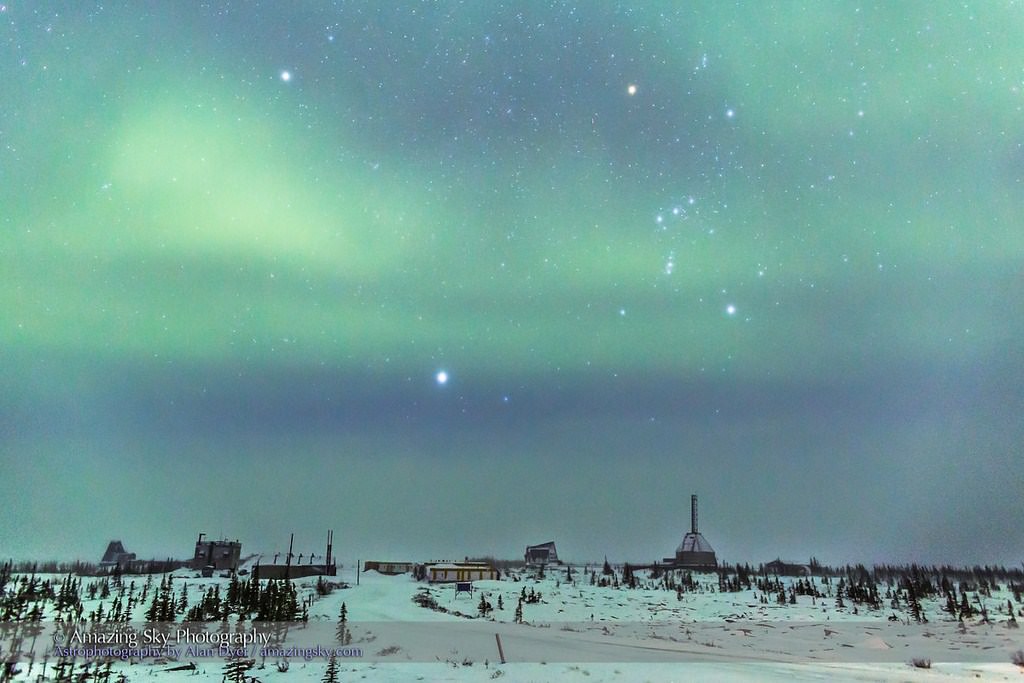
What’s the brightest star you can see in the sky tonight?
If you live below 83 degrees north latitude, the brightest star in the sky is Canis Alpha Majoris, or Sirius. Seriously, (bad pun intended) the -1st magnitude star is usually the fifth brightest natural object in the sky, and sits high to the south on February evenings… but has it always ruled the night?
Brightest Star Today
Sure, the brightest star in the sky (next to the Sun, of course) is Sirius. At 8.6 light years distant, Sirius can even be seen against the deep blue sky while the Sun is still above the horizon if you known exactly where to look for it. In fact, spotting Sirius was so important to the ancient Egyptians that they based their calendar on its first summer sightings (known as a heliacal rising) at dawn.
-Fun factoid: the brightest star north of the celestial equator is -0.04 magnitude Arcturus.
Remember the star Vega of Contact fame? Keep that name in mind, as Sirius will hand over the title of the ‘brightest star in the sky’ to Vega over 200,000 years from now.
It all has to do with motion. Our Sun — and the solar system along with it — is moving at about 250 kilometres per second around the core of the Milky Way, completing one revolution around the galaxy about every quarter of a billion years. Think about that for a second: in the 4.5 billion year history of the Earth, we’ve orbited the galaxy only 18 times. A quarter of a billion years ago, the Permian-Triassic extinction event was well underway.
Feel puny yet? Well, in addition to our orbit, the solar system is also oscillating up in down through the galactic plane, taking 93 million years to travel from peak to trough. All the stars around us are in motion as well, like hurried travelers along a busy Manhattan sidewalk.
And just like people, this stellar motion is wonderfully chaotic over vast stretches of time. We currently see some ordinary pedestrian stars like Sirius or Alpha Centuari as ‘bright’ because they’re close by in the stellar ‘hood, and some — such as Rigel and Deneb — seem bright to us only because they’re luminous stars that are far away. This is what’s known as apparent magnitude. To make sense of the true properties of stars, astronomers refer to a star’s absolute magnitude or its brightness if it were placed 10 parsecs (32.6 light years) distant. Place massive Deneb 10 parsecs away, and it would be easily visible in the daytime at magnitude -8.4.
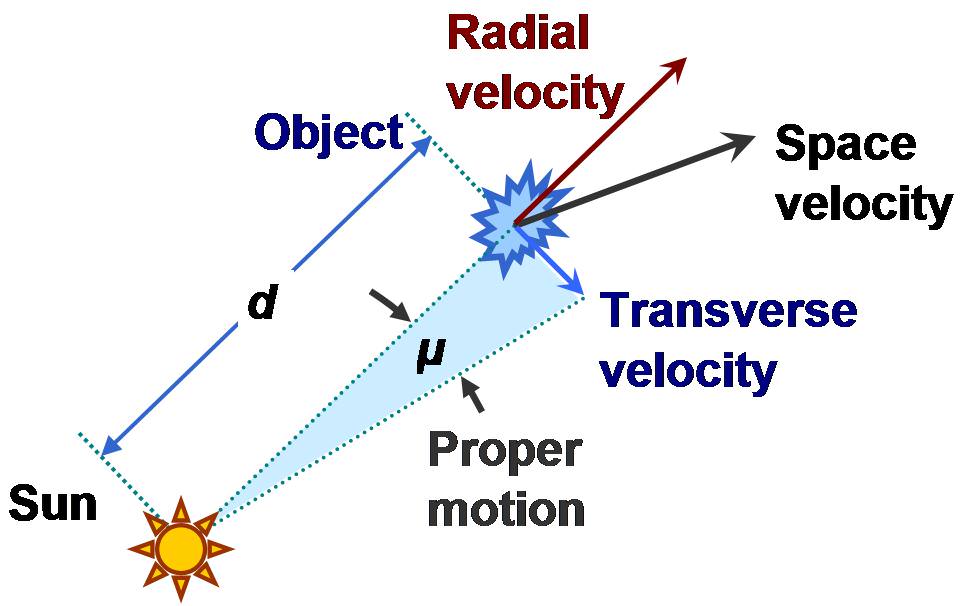
The stars appear fixed during our short human life spans: Orion looks pretty much the same on the day you were born as the day you die. Watch the stars over centuries, however, and they slowly move with respect to our terrestrial point of view. This is what’s known as proper motion, which is a star’s apparent movement across our sky. Even fast movers such as Barnard’s Star or 61 Cygni only exhibit a proper motion of 10” and 3.2” arc seconds per year. Think of driving by a grove of trees: the closer trees appear to move by faster than the distant ones. This tiny motion gave early 19th century astronomers an inkling that these ‘flying stars,’ though not the brightest, may be close by. Of course, going back to the forest analogy, this motion is an illusion: ‘proper’ motion measures the traverse velocity along our line of sight, which is merely a product of a star’s true vector through space and its radial velocity towards our away from us.
Brightest Star in the Past
And radial motion is the key to who is ‘top dog’ in the brightness game over time. Like gravity, light fades intrinsically with the inverse square of its distance. Move a candle twice as far away, and its one fourth (1/22) as luminous. This is actually pretty nifty, as 5 magnitudes in brightness corresponds to a hundredfold (102) change in luminosity.
We’re currently moving toward the solar apex located near the star Omicron Herculis at a speed relative to local stars of 16.5 kilometres per second.
And there’s a wiki for that: here’s a breakdown of selected bright stars over the current 10 million year epoch, which was itself adopted from Sky and Telescope.
Note that past 1,000,000 A.D., +2.4 magnitude Delta Scuti will swell to magnitude -1.8, topping Sirius’s brightness today. And way back in the day in 4.7 million B.C., the +1.5 magnitude star Adhara (Epsilon Canis Majoris) was a chart-topping -4 magnitude, easily visible in the daytime.
Arcturus is another fast mover, and is currently plunging through our galactic neighborhood at a blazing 2 arc seconds per year. Arcturus is near maximum brightness and gets a few hundredths of a light year closer to us 4,000 years from now before slowly fading from view.
Brightest Star in the Future
And in the distant future, the star party fave Albireo will be 300 light years closer and shine at -0.5. Perhaps by then, those far future star party patrons will know for sure if Albireo is a true naked eye binary pair or not…
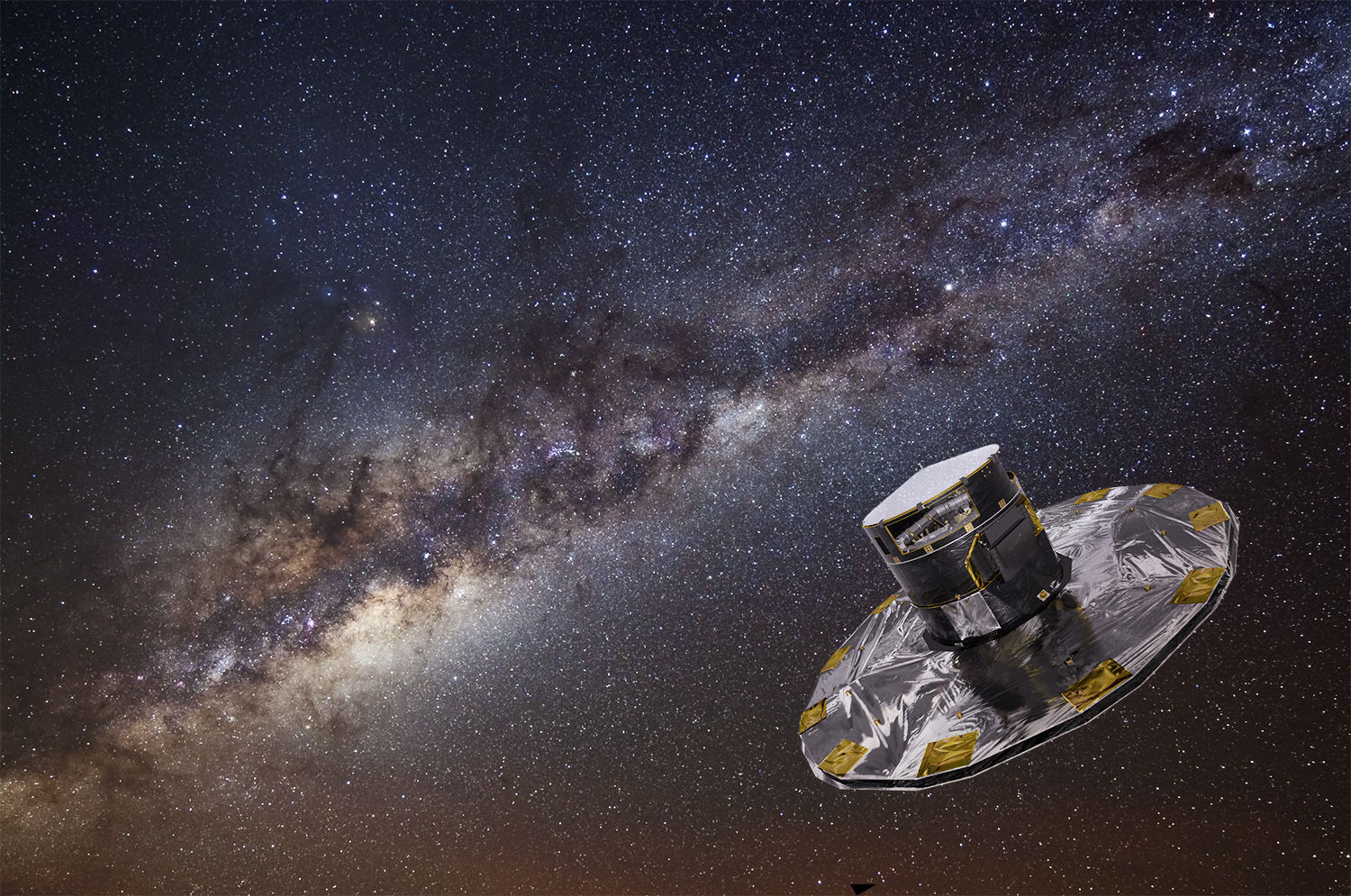
How do we know this? Missions such as Hipparcos have measured and defined the parallax and proper motions of stars to an unprecedented degree of accuracy. Contrast this to astronomers of yore, who had to rely of a wire-welding transit instrument, a stopwatch and quick reaction time.
Surveys such as NEOWISE have turned up even fainter nearby brown and red dwarf stars in their all sky surveys, and missions such as Gaia promise to bring our knowledge of astrometry to a new level of accuracy.
It’s also worth noting that in most cases, ‘brightest’ does not mean closest. Take the example of the recently discovered red dwarf Scholz’s Star which may have passed as close as 0.8 light years distant 70,000 just years ago. Even then, it may only have topped +7th magnitude in Earthly skies. The future passage of HIP 85605 300,000 years from now at 0.5 light years distant may fair much better, at an apparent -2 magnitude. Looking farther back in time, the +4.7 magnitude star Gamma Microscopii passed within 6 light years from the Sun 3.8 million years ago, and would’ve shined at magnitude -3.
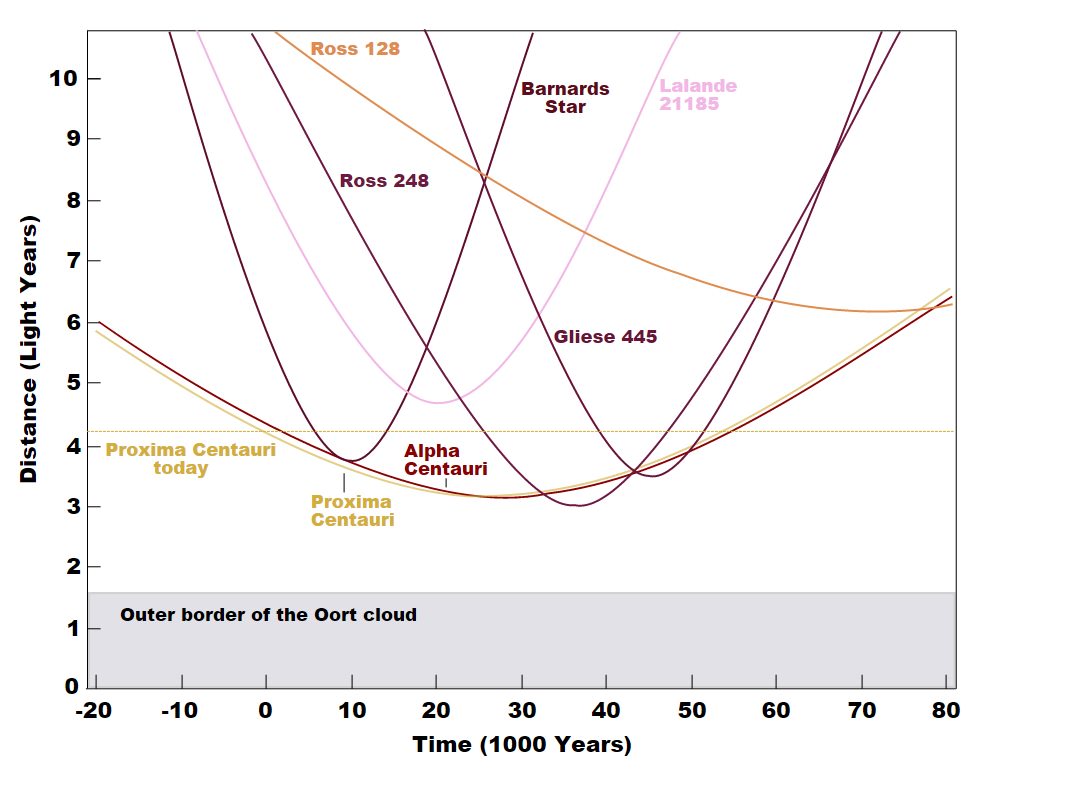
All great thoughts to ponder as we enjoy the night skies gracing our little epoch of space and time. What will the hopes and dreams of those eyes that gaze upon those distorted skies be, million years hence?
What a great article! I definitely learned some interesting things.
One question: What is the mechanism for our oscillation in our orbit of the Milky Way? Are we following some sort of contour of Dark Matter or is the entire galaxy teetering or wobbling relative to our orbital path? I’ve always wondered this.
Thanks!
Y’know what: I’m not certain what the exact mechanism is that causes stars to oscillate up and down through the galactic plane as they orbit the galaxy. My best guess is that the net attraction from local stars are pulling low velocity stars back and forth, but it would be interesting to know.
It was tough enough to find the 2.7 times oscillation per orbit info… what I’ve yet to see is exactly where Sol is now in this oscillation.
Very interesting article, thanks so much!
Informative stuff, Dave.
Each Astronomer, profesional or home grown, contributes to man’s knowledge not only of our neighborhood but the surrounding space. The vast spacial distances and the enormous number of years involved are truly awesome and humbling. On our home, a tree can live for many years. Some even 3-4 thousand years. They know nothing. Say nothing. Wish nothing or aspire for anything. Yet, Man can do all that (and more) but will be gone before he knows it. Great article.