
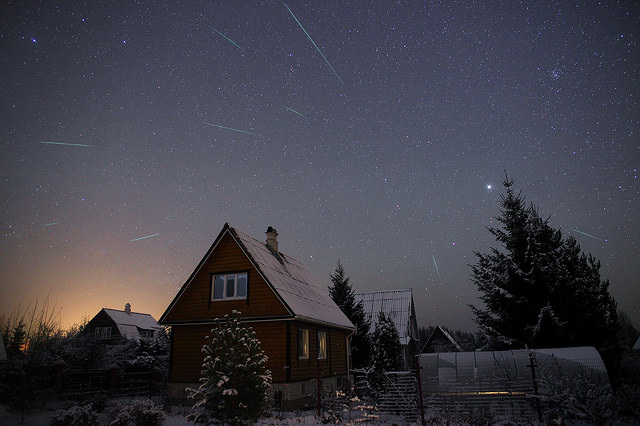
A November rain hails from the Sickle of the Lion.
Hot on the heels of the October Orionids and the Halloween fireballs of the Taurid meteors comes the Leonid meteor shower. On most years, the Leonids are a moderate shower, with hourly local rates reaching around 20. Once every 33 years, however, the Leonids are responsible for putting on one of the greatest astronomical shows ever witnessed, producing a grand storm with a zenithal hourly rate topping thousands per hour.
Prospects for 2015
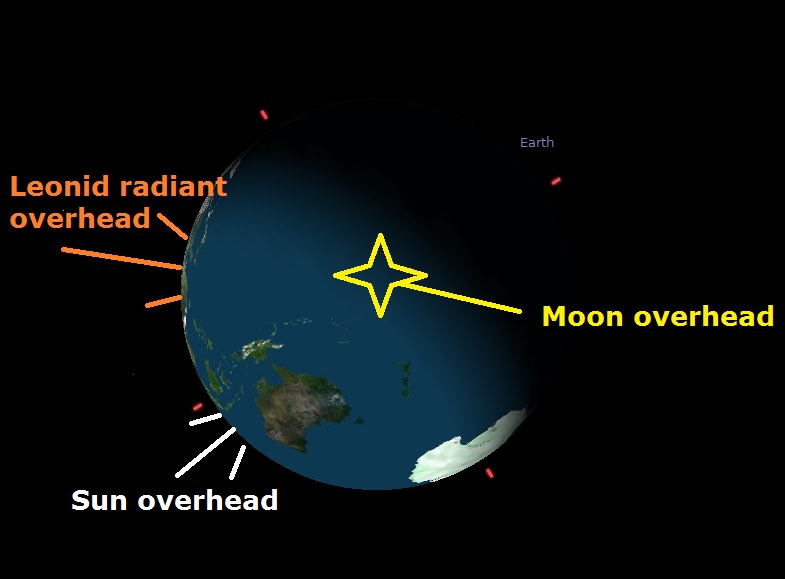
First, the bad news. 2015 isn’t forecast to be a ‘storm year’ for the Leonids, though that shouldn’t stop a vigilant observer from watching. The good news is, we’re just about midway betwixt the storm years of 1998-99 and 2031-32. The Leonids intensify once every 33 years, and if the increased activity seen in the late 1990s was any indication, we’d bet we’ll start seeing a pickup in rates from the Leonids in the late 2020’s or so. The good news for 2015, however, is that the peak for the Leonids occur on November 18th at around 4:00 Universal Time (UT)/ (11:00 PM EST on November 17th). This places the waxing crescent Moon out of the picture, just a day before reaching First Quarter phase. New Moon for November 2015 occurs on November 11th at 17:47 UT/12:47 PM EST.
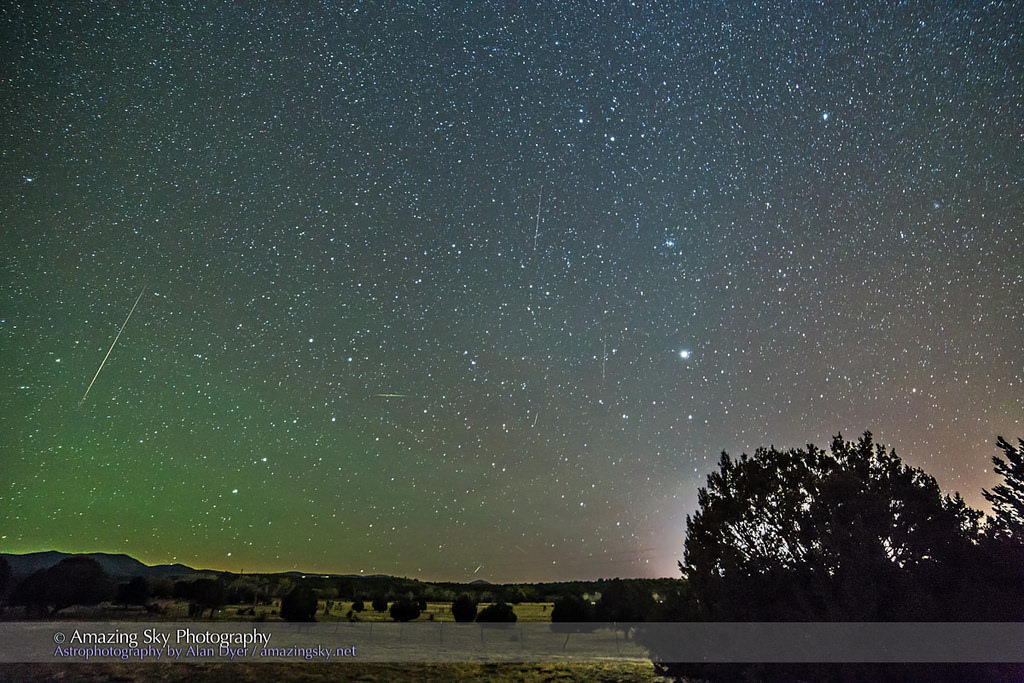
Fun fact: the August Perseids, November Leonids and the December Geminid meteor showers are spaced out on the calendar in such a way that, when the Moon phase is favorable for one shower on a particular year, it is nearly always favorable across all of them.
The Leonids are mildly active from November 6th through November 30th, and though the above prediction for activity in 2015 favors European longitudes at dawn, some predictions have the peak arriving up to seven hours early this year.

The Leonids are the dusty remnants laid down by periodic comet 55P Tempel-Tuttle on its 33-year path through the inner solar system. The Leonids are fast-movers, hitting the Earth nearly head-on in the dawn. You can see this in the relative position of the radiant, which rises in mid-November around 11PM local, and reaches the zenith around 6AM local time.
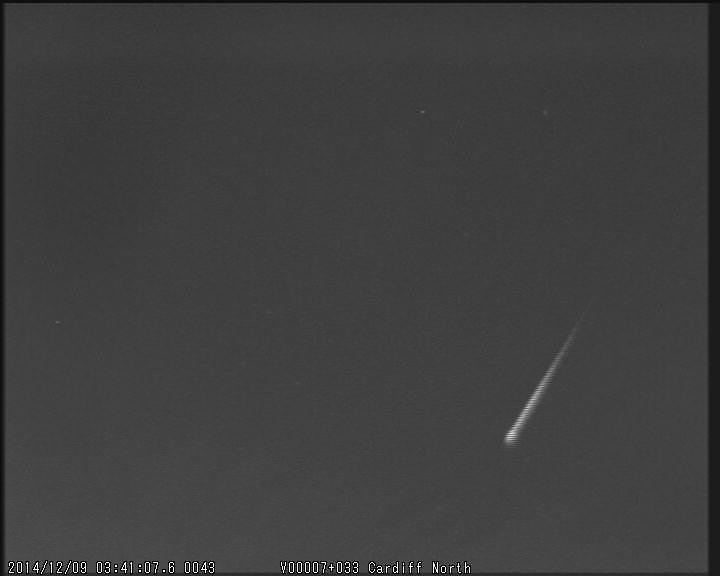
Often bluish in color, the Leonids hit the Earth’s atmosphere at over 70 km/sec… almost the fastest theoretical speed possible. For best results, watch for Leonids to spike in activity close to local dawn.

The Leonids have a storied history, going back 902 AD report from Arabic annals of the ‘Year of Stars.’ The Great Meteor Storm of 1833 dazzled (and terrified) residents of the eastern seaboard of the United States, and the spectacle not only inspired astronomer Denison Olmsted to pioneer studies into the fledgling field of meteor shower science, but has been attributed to adding fervor to many of the religious revivalist movements that sprang up in the 1830s in the United States as well.
The last outburst from the Leonids that reached such an apocalyptic scale was in 1966, when observers across the southwestern United States reported hourly rates approaching an amazing ZHR=144,000. Witnesses that remember this spectacle say it produced an illusion reminiscent of the Star Trek ‘warp speed’ effect, as Earth rammed headlong into the dense Leonid meteor stream.
Our own personal encounter with a Leonid meteor storm in 1998 from the dark desert skies of Kuwait wasn’t quite that intense, but thrilling to see nonetheless. Rates neared one every few seconds towards sunrise, with several fireballs punctuating the action, lighting up the desert floor. Here, as US coalition forces were on the verge of unleashing what would become Operation: Desert Fox over Iraq, the Universe was putting on a fireworks show of its own.
The Leonid meteor storms are the stuff of astronomical legend, a once in a lifetime event. Ever since we witnessed just what the Leonids are capable of, we never miss this annual shower, as we remember one night back in 1998, and look forward to the storms of 2032.
Here’s what the Leonids have been doing on previous recent years:
ZHR=15 +/-4 (2014)
Mostly washed out by the near-Full Moon (2013)
ZHR=47 +/-11 (2012)
ZHR=22 +/-3 (2011)
ZHR=32+/-4 (2010)
- Report those Leonid sightings to the International Meteor Organization, and also be sure to Tweet em to #Meteorwatch
- Got an image of a Leonid meteor? Send ‘em in to Universe Today at our Flickr Forum… we just might feature it in an after-action round up!
It should be noted that the last Leonids “storm” happened in 2001. I remember the big media hype in the late 90’s. Even NASA had special broadcasts on Leonids nights starting in ’98 only to have several newcomers to the astronomy disappointed when 1999 came and went with a dud feeling. I was lucky enough to witness the 2001 mind blowing show from a good observing site in western Canada. For 20 minutes, the sky looked just like the wood cut illustration above with numerous fireballs.
Thanks for the input… its seems that the last Leonid storm was radically different from a perspective of longitude from year to year. 1998 from Kuwait was a grand spectacle… we were clouded out in Italy on 1999 and 2000.
The 2001 Leonid meteor storm was spectacular here. We counted over one thousand an hour… THAT was the best birthday present ever! I can only hope to see another!