Half Comet-Half Asteroid a Fluke? Nope

by Nancy Atkinson on August 5, 2009

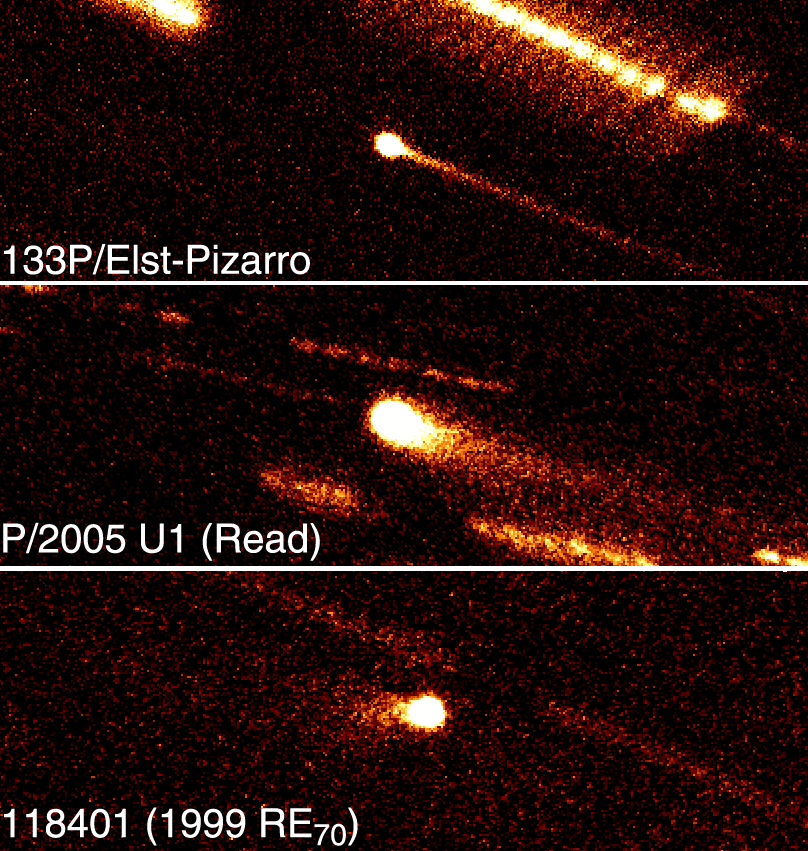
Images of known MBCs from UH 2.2-meter telescope data. Credit: Henry Hsieh

Images of known MBCs from UH 2.2-meter telescope data. Credit: Henry Hsieh


Back in 1996, astronomers discovered a strange object in the asteroid belt. They decided it was either a “lost” comet or an icy asteroid, as it ejected dust like a comet but had an orbit like an asteroid. No one had ever seen anything like the object, called 133P. Ever since it was found, astronomers have wondered if it was just an oddity — one of a kind. We now know it is not, and the discovery of more of these half asteroids/half comets means there is a new class of objects in our solar system.

One of these new objecst, 176P/LINEAR is also emitting dust as it orbits in the asteroid belt. It was found by Henry Hsieh at Queen’s University, Belfast in Northern Ireland. Hsieh has been working to figure out the unusual behavior of 133P. He hypothesized that either one of two things could explain the existence of the comet-asteroid: “(1.) 133P is a classical comet from the outer solar system that has evolved onto a main-belt orbit, or (2.) 133P is a dynamically ordinary main-belt asteroid on which subsurface ice has recently been exposed,” Hsieh wrote in his paper. “If (1) is correct, the expected rarity of a dynamical transition onto an asteroidal orbit implies that 133P could be alone in the main belt. In contrast, if (2) is correct, other icy main-belt objects should exist and could also exhibit cometary activity.”

Hsieh thought it was unlikely a comet could have been kicked around enough to end up in orbit in the asteroid belt, so he followed the assumption that 133P was a dynamically ordinary, yet icy main-belt asteroid. He set out to prove the hypothesis that 133P-like objects should be common and could be found by an well-designed observational survey.

Hsieh made 657 observations of 599 asteroids in the asteroid belt and found 176P/LINEAR. He also determined the asteroid is partially made of ice, which is being ejected following a collision with another object, thus the comet-like attributes.

Additionally, since there is evidence for past and even present water in main-belt asteroids, Hsieh says statistically there should be around 100 currently active Main Belt Comets (MBCs) as these objects are called, among the kilometer-scale, low-inclination, outer belt asteroid population.

The Technology Review blog offered suggestions for what to name these new objects that are half comet and half asteroid: “Comsteroids? Asteromets? Hsiehroids?”

Hseih’s paper,
Hseih’s website on MBCs
Sources: Technology Review Blog, arXiv


  • ND

    The point is that this contradicts your assertion that not ice/water was found at all and you have no evidence that there is no water on the comet while there is observational evidence for it.

  • ND

    ElroyJetson,

    I’m not familiar with sputtering so I’m reading up on it. It would appear that sputtering on comets has been studied. The following paper from 1977 talks about OH production from sputtering.

    http://www.springerlink.com/content/h0771w612w235113/

    At the end of the abstract is this:

    “The observed OH production rates in comets are however too large to be explained in this way and are certainly the results of sublimation and dissociation of H2O from an icy nucleus.”

    Unfortunately this is just and abstract and from 1977.

    So the question is how does the observed OH production from comets fit in with the the OH production from sputtering and water. If a nucleus is expelling water, it’s my understanding that OH will also be produced.

    Here’s another paper from 1990 talking about sputtering and comets. I have not read it, but I’m throwing out there as a point that sputtering has not been ignored:

    articles.adsabs.harvard.edu//full/1990ApJ…365L..39M/L000039.000.html

  • Nereid

    @ElroyJetson: I’m not sure how you came to your conclusion; would you care to explain?

    Even as a newbie here, I can see that anyone who doesn’t just nod and smile in agreement gets shouted down by a small group of , quite rude, “inquisitors”.

    For my part, the only alternative idea that has been presented is a PDF document, complete with a copyright notice, stating it is a poster at an international science conference.

    As I had spent quite a bit of time, a while ago, going through this document in great detail, I considered it appropriate to bring the results of my work to the attention of all readers.

    Further, I invited you – explicitly – to discuss any part of my findings.

    Concerning this:

    As far as density goes, low density does not automatically mean ice. It could also just simply be highly porous rocky material, like pumice. The point being that density alone says nothing about composition.

    That’s quite right.

    However, AFAIK, the distribution of the estimated bulk densities of comets and asteroids is bimodal: comets have bulk densities below approx 1 g/cc, asteroids around 3 g/cc, with none as low as 1 g/cc (caveat: I’m going from memory, and IIRC this refers to main belt asteroids and NEAs, possibly Trojans too). Would you be interested in some references?

    Further, there is a great deal of detailed material in the preprint I cited earlier, and it the papers it references, on the mass outflow from comets and its composition; may I ask if you read that material? If so, what did you learn?

    Regardless, I was talking about the possible connection with sputtering on Mercury, but nobody seems to have addressed that idea. Instead it’s been avoidance and obsfucation.

    As you know, plenty of comets exhibit ‘cometary’ behaviour well beyond 60 million km from the Sun (the approx radius of Mercury’s orbit); in particular, they are active at about 1 au, and even at Mars’ distance. Yet, AFAIK, no ‘Mercury-like’ sputtering has been observed on the Moon, Eros, Phobos, or Deimos, despite quite intensive in situ studies of the Moon (and somewhat less intensive ones of the other three).

    Comments?

  • ND

    To follow up on my last posting to ElroyJetson:

    Looks like Rosetta will be studying sputtering on it’s target comet “67P/Churyumov-Gerasimenko”

    rosetta.jpl.nasa.gov/dsp_structureComets.cfm?buttonSel=scienceObj&buttonSelL2=knowledge (search for sputtering).

    Also:
    - Sputtering on comets has been considered and looked into for decades.
    - lab experiments on sputtering and other processes have been done to compare with observations (Anaconda will like this I’m sure, he loves this sort of stuff :)
    - sublimated from a comet is expected to produce OH along with sputtering.

    There are quite a few papers out there talking about sputtering on comets and sometimes at the same time with astroids and our Moon.

    And yet with all this sputtering astronomers are still talking about water on comets. Are they being dogmatic about an old idea or do they understand something you don’t?

  • ND

    In the course of looking into detecting ice/water via spectra, I came across the following and posting here for curiosity:

    http://www.lowell.edu/users/grundy/H2Oice.html

    The paper I linked to regarding detecting ice on the surface mentioned absorptions at 1.5 and 2.0 um. This fits in with the above absorption profile’s 2 largest peaks.

Previous post:

Next post: