Universe Today
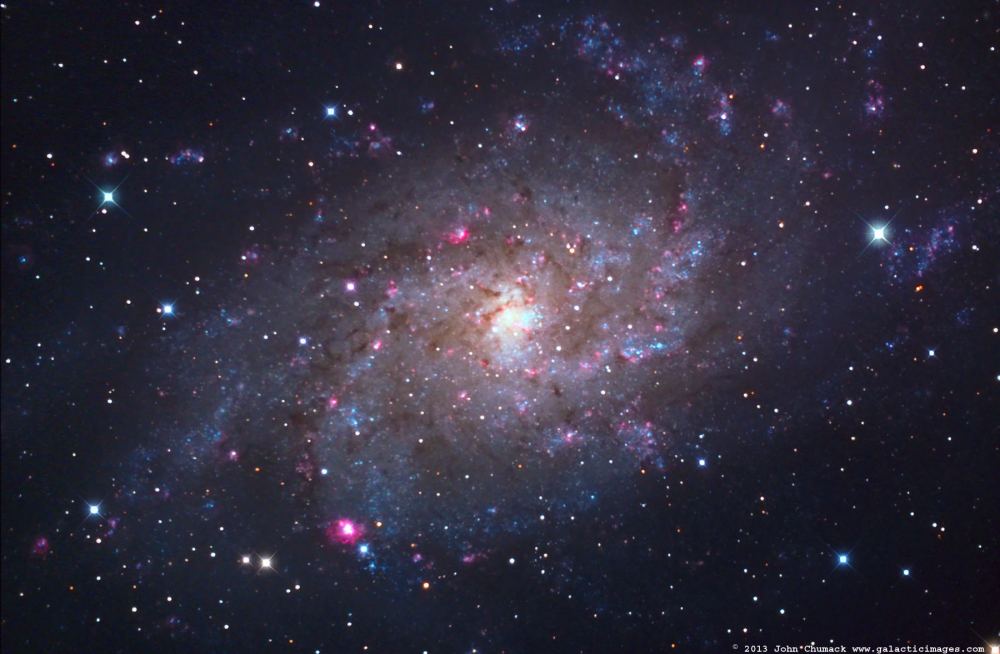
Welcome back to Messier Monday! In our ongoing tribute to the great Tammy Plotner, we take a look at the Triangulum Galaxy, also known as Messier 33. Enjoy!
During the 18th century, famed French astronomer
Charles Messier
noted the presence of several "nebulous objects" in the night sky. Having originally mistaken them for comets, he began compiling a list of them so that others would not make the same mistake he did. In time, this list (known as the
Messier Catalog
) would come to include 100 of the most fabulous objects in the night sky.
One of these is the Triangulum Galaxy, a spiral galaxy located approximately 3 million light-years from Earth in the direction of the
Triangulum constellation
. As the third-largest member of the
Local Group
of galaxies (behind the
Andromeda Galaxy
and the
Milky Way
), it is the one of the most distant objects that can be seen with the naked eye. Much like
M32
, M33 is very close to Andromeda, and is believed to be a satellite of this major galaxy.
Description:
At some 3 million light years away from Earth, the Triangulum Galaxy is the third largest galaxy in our Local Group and it may be a gravitationally bound companion of the Andromeda Galaxy. Its beautiful spiral arms show multitudes of red HII regions and blue clouds of young stars. The largest of these HII regions (NGC 604) spans nearly 1500 across and is the largest so far known.
It has a spectrum similar to the Orion Nebula - our own Milky Way's most celebrated starbirth region. "M33 is a gigantic laboratory where you can watch dust being created in novae and supernovae, being distributed in the winds of giant stars, and being reborn in new stars," said University of Minnesota researcher and lead author Elisha Polomski. By studying M33, "you can see the Universe in a nutshell."
Of course, our curiousity about our neighboring galaxy has driven us to try to understand more over the years. Once Edwin Hubble set the standard with Cepheid variables, we began measuring distance by discovering about 25 of them in M33. By 2004 we were studying the red giant star branch to peer even further. As A.W. McConnachie said in a
2004 study
of the galaxy:
By 2005, astronomers had detected two water masers on either side of M33 and for the first time ever - revealed what direction it as going in. According to Andreas Brunthaler (et al), who published a study about the distance and proper motion of the galaxy
in 2005
:
Yes, it's moving toward the Andromeda Galaxy, much like how Andromeda is moving towards us! In 2006, a group of astronomers announced the discovery of an eclipsing binary star in M33. As A.Z. Bonanos, the lead author of the
study that detailed the discovery
, said:
By studying the eclipsing binary, astronomers soon knew their size, distance, temperature and absolute magnitude. But more was yet to come! In 2007, the Chandra X-ray Observatory revealed even more when a black hole nearly 16 times the mass of the Sun was revealed. The black hole, named M33 X-7, orbits a companion star which it eclipses every 3.5 days. This means the companion star must also have an incredibly large mass as well....
Yet how huge must the parent star have been to have formed a black hole in advance of its companion? As Jerome Orosz, of San Diego State University, was quoted as saying in a 2007 Chandra
press release
:
Stellar bombs? You bet. Gigantic stellar explosions even. Although no supernovae events have been detected in the Triangulum galaxy, it certainly doesn't lack for evidence of supernova remnants. According to a
2004 study
by F. Haberl and W. Pietsch of the Max-Planck-Institute:
Or the creation of black holes...
History of Observation:
While the Triangulum Galaxy was probably first observed by Hodierna before 1654 (back when skies were dark), it was independently rediscovered by Charles Messier, and cataloged by him on August 25, 1764. As he recorded in his notes on the occasion:
While Sir William Herschel wouldn't publish papers on Messier's findings, he was an astronomically curious soul and couldn't help but study M33 intently on his own, writing:
Yet it would take a very special observer, one named Bill Parsons - the third Earl of Rosse - to become the very first to describe it as spiral. As he wrote of it:
Quite the description indeed, since it would eventually lead to Rosse's description of M33 being "...full of knots. Spiral arrangement. Two similar curves like an "S" cross in the center", and to other astronomers discovering that these "spiral nebulae" were extra-galactic!
Locating Messier 33:
While actually locating Messier 33 isn't so difficult, seeing Messier 33 can be. Even though it is billed at nearly unaided eye magnitude, this huge, low surface brightness galaxy requires some experience with equipment and observing conditions or you may hunt forever in the right place and never find it. Let's begin first by getting you in the proper area! First locate the Great Square of Pegasus - and its easternmost bright star, Alpha. About a hand span further east you will see the brightest star in Triangulum - Alpha.
M33 is just a couple of degrees (about 2 finger widths) west. Now, the most important part to understand is that you
must
use the lowest magnification possible, or you won't be able to see the proverbial forest because of the trees. The image you see here at the top of the page is around a full degree of sky - about 1/3 the field of view of average binoculars and far larger than your average telescope eyepiece.
However, by using the least amount of magnification with a telescope you are causing M33 to appear much smaller - allowing it to fit within eyepiece field of view range. The larger the aperture, the more light it gathers and the brighter the image will be. The next thing to understand is M33 really
is
low surface brightness... Light pollution, a fine haze in the sky, moonlight... All of these things will make it difficult to find. Yet, there are places left here on Earth where the Triangulum Galaxy can be seen with no optical aid at all!
Enjoy your quest for M33. You may find it your first time out and it may be years before you see it in all its glory. But when you do, we guarantee you'll never forget! Be sure to enjoy this video of the Triangulum galaxy too, courtesy of the European Southern Observatory:
Enjoy your quest for M33. You may find it your first time out and it may be years before you see it in all its glory. But when you do, we guarantee you'll never forget!
And here are the quick facts on M33 to help you get started:
- Object Name
-
Messier 33
- Alternative Designations
-
M33, NGC 598, Triangulum Galaxy, Pinwheel Galaxy
- Object Type
-
Type Sc, Spiral Galaxy
- Constellation
-
Triangulum
- Right Ascension
-
01 : 33.9 (h:m)
- Declination
-
+30 : 39 (deg:m)
- Distance
-
3000 (kly)
- Visual Brightness
-
5.7 (mag)
- Apparent Dimension
-
73x45 (arc min)
We have written many interesting articles about Messier Objects here at Universe Today. Here's Tammy Plotner's
Introduction to the Messier Objects
, ,
M1 – The Crab Nebula
,
M8 – The Lagoon Nebula
, and David Dickison's articles on the
2013
and
2014
Messier Marathons.
Be to sure to check out our complete
Messier Catalog
. And for more information, check out the
SEDS Messier Database
.
Sources: