
[/caption]
Here’s another “rogue black hole” theory, which hopefully doesn’t set the doomsday crowd off on a new tangent. But new research suggests that hundreds of massive black holes, left over from the early galaxy-building days of the Universe, may wander the Milky Way. Astrophysicists Ryan O’Leary and Avi Loeb say that rogue black holes originally lurked at the centers of tiny, low-mass galaxies. Over billions of years, those dwarf galaxies smashed together to form full-sized galaxies like the Milky Way. But they also predict that Earth should be safe, as the closest rogue black hole should reside thousands of light-years away.
“These black holes are relics of the Milky Way’s past,” said Loeb, from the Harvard Smithsonian Center for Astrophysics. “You could say that we are archaeologists studying those relics to learn about our galaxy’s history and the formation history of black holes in the early universe.”
Astronomers say if these wandering black holes could be located, they could provides clues to the formation of the Milky Way.
The theory predicts that each time two proto-galaxies with central black holes collided, their black holes merged to form a single, “relic” black hole. During the merger, directional emission of gravitational radiation would cause the black hole to recoil. A typical kick would send the black hole speeding outward fast enough to escape its host dwarf galaxy, but not fast enough to leave the galactic neighborhood completely. As a result, such black holes would still be around today in the outer reaches of the Milky Way halo.
This sounds similar to another “rogue black hole” theory released in 2008 from Vanderbilt University, where a supercomputer simulation predicted colliding black holes created in globular clusters would be kicked out of their home and left to wander the galaxy. Astronomers have been looking for them for years, and even after all that searching, they’ve only come up with a couple of tentative candidates.
But Loeb and O’Leary say hundreds of rogue black holes should be traveling the Milky Way’s outskirts, each containing the mass of 1,000 to 100,000 suns. They would be difficult to spot on their own because a black hole is visible only when it is swallowing, or accreting, matter.
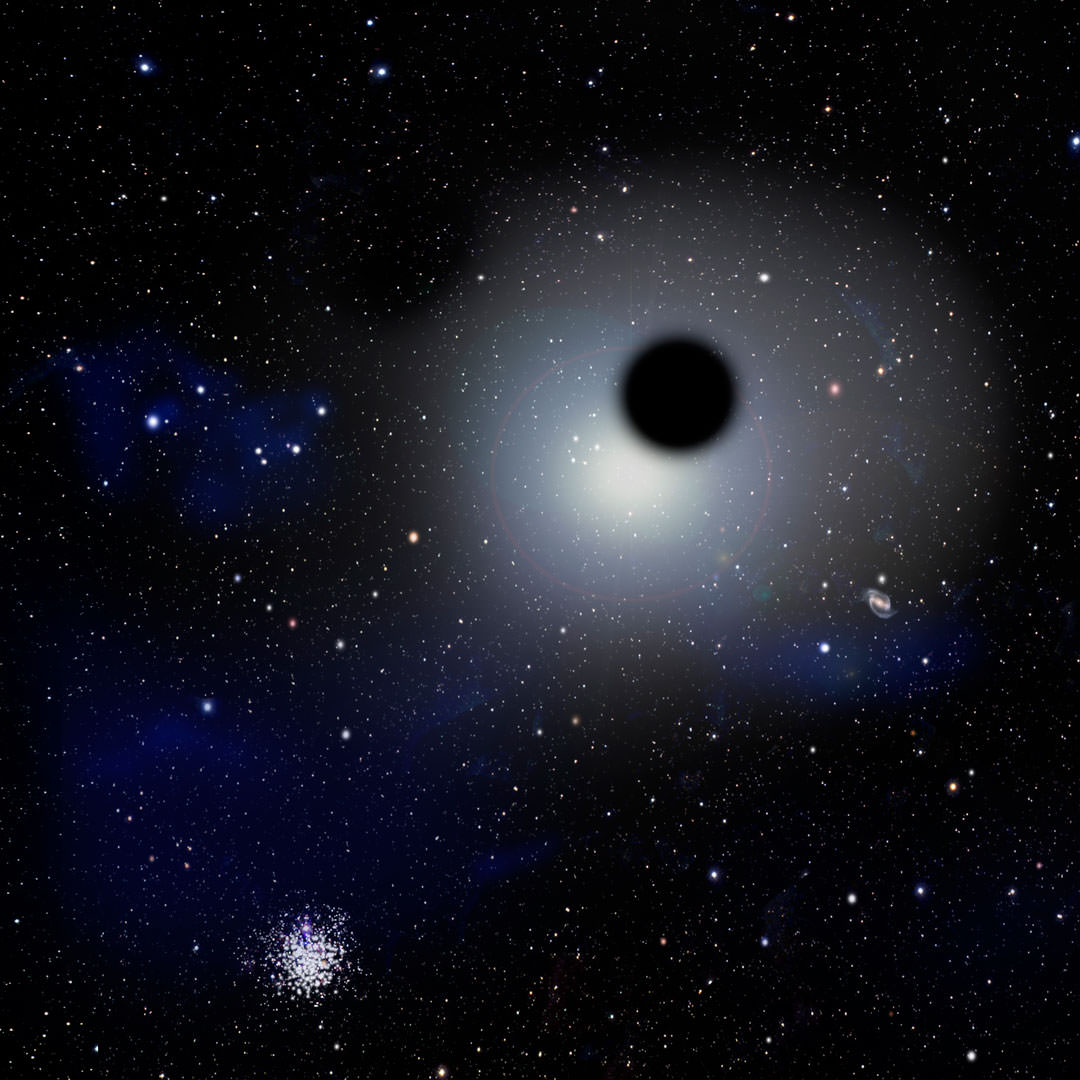
There could be on telltale sign, however. A surrounding cluster of stars could be yanked from the dwarf galaxy when the black hole escaped. Only the stars closest to the black hole would be tugged along, so the cluster would be very compact.
But still it would be hard to determine. Due to the cluster’s small size on the sky, appearing to be a single star, astronomers would have to look for more subtle clues to its existence and origin. For example, its spectrum would show that multiple stars were present, together producing broad spectral lines. The stars in the cluster would be moving rapidly, their paths influenced by the gravity of the black hole.
O’Leary and Loeb say now that they know what to look for, astronomers should begin scanning the skies for a population of highly compact star clusters in the Milky Way’s halo.
The number of rogue black holes in our galaxy will depend on how many of the proto-galactic building blocks contained black holes at their cores, and how those proto-galaxies merged to form the Milky Way. Finding and studying them will provide new clues about the history of our galaxy.
Loeb and O’Leary’s journal paper will be published in the Monthly Notices of the Royal Astronomical Society and is available online at arXiv.
Presumably black holes (whether rogues or not) would show up in OGLE type gravitational lensing surveys?
Man, make people register to comment, and the comments drop off like the Kuiper cliff.
I can’t wait to hear more on this “wandering blackholes” issue. I’m quite positive that we will learn one way or another.
Can anyone explain what is meant by this statement from the article?
“During the merger, directional emission of gravitational radiation would cause the black hole to recoil”
Thanks in advance of your help 🙂
@Emission Nebula: Man, make people register to comment, and the comments drop off like the Kuiper cliff.
This has been a good thing… the number may have dropped off, but the quality sure has gone up. I’ll take quality over quantity any day on this web site. =)
@Rob_Bowman: Can anyone explain what is meant by this statement from the article?
My guess is that the collision would be so violent that gravitational waves kicked off by the black hole merger would jettison the newly joined black hole out of the cluster. At least that’s my take on it. Let me know if I am wrong, for those that are smarter than I (and I know you’re out there!)
we have to look for things coming at us,meteroids,asteroids.. an Now things disipiering from us coming at us…heh
This article and the paper profiled goes right to the heart of the matter: So-called “black holes” are poorly constrained, so in essence can be fit into almost any situation.
Hence, the proliferation of “black hole” papers and theories.
Why poorly constrained, do you say?
Because Science doesn’t even know how strong gravity would need to be to make a “black hole”, or if it is even physically possible — neither have been quantified.
Yes, “infinity” can’t be quantified.
Let’s see, how many different situations and timings are there for “black holes”?
It’s become like the Baskin Robbins of astronomy with 31 flavors of ice cream, or in this case, “black holes.”
The tragedy of the commons has come to “modern” astronomy: As each individual or team wants to say something original about “black holes”, they stretch the constraints of “black holes” until it is so loose — “Black holes roaming the galaxy” — there is no meaning and people outside the astronomy “community” such as myself, look and point out, “here a ‘black hole’, there a ‘black hole’, everywhere a ‘black hole’.
The whole “black hole” concept is being overused because people who want papers published know that “black holes” are poorly constrained, so it’s hard to reject one “black hole” hypothesis as unworthy and accept another as worthy.
As fortunate as this situation may be for those individuals that desire to get published, it will eventually lead to the tragedy of the commons for the whole of “modern” astronomy.
Yeah, roaming “black holes” in the galaxy: Sure thing, buddy.
No Constraints — Zero Credibility.
Something “modern” astronomy needs to think about very hard.
As opposed to Anaconda’s “Zero Credibility – No Constraints”
Jon Hanford:
Does your comment answer the substance of my comment or is it an ad hominem response?
@ vagueofgodalming: in principle, yes, rogue black holes (BHs) should be ‘visible’ via microlensing events such as those OGLE, MACHO, MOA, etc have searched for.
However, the space density of such BHs would be extremely low, much, much, much lower than ordinary stars, so OGLE-type searches would have to run for thousands or millions of years to have a chance of seeing one.
@ Anaconda, No it was merely an observation of your take on currently accepted mainstream theory, nothing more, nothing less.
@Anaconda: you write “Because Science doesn’t even know how strong gravity would need to be to make a “black hole”, or if it is even physically possible — neither have been quantified.”
I don’t know how you arrived at this conclusion, but it’s clearly wrong, and easy to show that it’s wrong.
A black hole will form when the local gravity of a dense object is greater than the pressure to oppose collapse, for any and every known physical process. The greatest such pressure comes from generate nuclear matter, or, possibly, quark-gluon condensates.
If you’re interested, I can give you links to papers which quantify aspects of my nutshell summary.
Re “people outside the astronomy “community” such as myself, look and point out, “here a ‘black hole’, there a ‘black hole’, everywhere a ‘black hole’”: you seem to be decrying an aspect of modern astronomy simply because you don’t understand it; is that so?
Anyway, O’Leary and Loeb, in the preprint, make some quite specific, concrete, testable predictions concerning their hypothesis; surely you don’t fault that aspect of their work, do you?
That should read “DEgenerate nuclear matter” 🙁
@ Nereid:
Nereid states: “A black hole will form when the local gravity of a dense object is greater than the pressure to oppose collapse, for any and every known physical process.”
Yes, a fine word picture. And I appreciate the offer of linking papers. Please do link a paper or two, that should suffice.
Nereid, can “infinity” be quantified?
A “black hole” is an infinite density singularity.
How do we quantify infinite? Nereid, I’m all ears.
Nereid, I see you completely passed over my phrase dealing with the physical impossibility of the density required.
Truth is mathematics can’t be used to predict a physical state of being is possible or not possible if the supposed state of matter is beyond observation & measurement.
Nereid asks: “Anyway, O’Leary and Loeb, in the preprint, make some quite specific, concrete, testable predictions concerning their hypothesis; surely you don’t fault that aspect of their work, do you?”
No, testing is important in Scientific analysis & interpretation.
But simply stating some observation or another is a valid test doesn’t make it so.
And alternative theories must be actively considered because it does not always follow that because an observation is made, which is in sync with the hypothetical cause, it is the actual cause.
@ Nereid:
I’m sorry, I passed over a question of yours, I’d be remiss if I failed to answer it.
Nereid restates my [Anaconda’s] statement and asks a question: “people outside the astronomy “community” such as myself, look and point out, “here a ‘black hole’, there a ‘black hole’, everywhere a ‘black hole’”: you seem to be decrying an aspect of modern astronomy simply because you don’t understand it; is that so?
No, I understand the concept very well. That is why I reject it.
Nereid, are you suggesting that it’s impossible for somebody to reject an aspect of astronomy if they understand it well?
Nereid, is there a limit to the number of different kinds of “black holes” you would accept?
Would an infinite number of “black hole” theories and hypothesis be acceptable to you?
I understand there is concern from some quarters that the supercollider may produce minni “black holes”.
I also understand that those concerned have the mathematics to prove it.
@ Anaconda:
Black holes are not beyond measurement. They have mass. They have an event horizon. They spin.
You seem to be decrying the possibility of black holes because of their description involving an infinitely small point. Regardless of the actual state of matter within the event horizon, those events which happen as a star turns into a black hole – i.e. it gets compressed small enough that it traps light – CAN be described by physics.
Besides, wouldn’t the size of a singularity actually be the Planck length, not zero?
@Anaconda: You’re right, I skipped over the “Yes, “infinity” can’t be quantified.” paragraph.
From your later comments it seems you are referring to the singularity which arises when you solve the relevant General Relativity (GR) equations for a non-spinning, symmetrical, collapsing mass (are you?). If so, then may I suggest that a) any such singularity is not observable, period (so its existence is not testable), and b) well before – infinitely before in fact – a massive collapsing object reaches a singularity it enters a physical environment in which we know – and have known for many decades – GR and quantum theory are mutually incompatible (the “Planck regime”). That says that either GR or QM, or both, no longer describe the behaviour of matter, and as there is no quantum theory of gravity (or similar), we have – today – no way to describe what happens there.
Of course, a great many physicists would LOVE to find a way to test theories applicable to the Planck regime! But it seems that’s unlikely to happen for many decades yet.
Further, as Andrew says, the event horizon of a BH is, or should be, observable, and as Jon Hanford said (elsewhere?), the event horizon of the SMBH that is SgrA* should be ‘visible’ within a few years (via mm VLBI observations).
I’ll address your other comments later (thanks to you for responding to mine).
@Anaconda (continued): “But simply stating some observation or another is a valid test doesn’t make it so.”
I read this as a rejection of astronomy, but I’m sure you don’t mean that (do you?).
Take the O’Leary and Loeb paper as an example.
Via some work whose details are not relevant, for the moment, they conclude that there might be ~a hundred objects out in the Milky Way halo which resemble stars but are in fact extremely tight clusters of stars around IMBH (intermediate mass black holes).
The observational signature of such objects would be clear and unambiguous. Should astronomers find one – say in SDSS-III or from Pan-STARRS or LSST data – that matches that signature it would be a pretty powerful confirmation of the O’Leary-Loeb hypothesis, wouldn’t it? And if detailed statistical analysis concluded that there are ~a hundred of such objects, in the MW halo, that’d be even stronger evidence, wouldn’t it?
Now I suspect that I’m missing something vital wrt your objections, but I can’t see what it might be.
“And alternative theories must be actively considered because it does not always follow that because an observation is made, which is in sync with the hypothetical cause, it is the actual cause.” – yes, of course. But let’s wait and see if such objects are, in fact, to be found in the MW halo, shall we?
(more to come)
@ Nereid:
Nereid states: “If so, then may I suggest that a) any such singularity is not observable, period (so its existence is not testable)…”
Yes, agreed.
But if “infinite” density is not required then what is the requirement?
I have seen no such substitution for “infinity” in the literature for so-called “black holes”.
Nereid, do you subscribe to “black holes” roaming the galaxy?
So much for my “quality over quantity” comment…
The paper “Is There a Supermassive Black Hole At The Center Of The Milky Way?” published last year by Mark Reid can be found here: http://arxiv.org/PS_cache/arxiv/pdf/0808/0808.2624v1.pdf . The discussion on the visibility of the BH ‘shadow’ at millimeter radio wavelengths is on page 20. This is a great general paper on Sag A* with several lines of evidence for a SMBH laid out and some great pictures to boot.
Even rougue black holes are observable. Just because you can’t observe something coming from the event horizon does not mean BHs do not have observable consequences.
A few months ago I did some analysis of predicted physics due to Susskind’s stretched horizon and holography. This includes using ultracold quantum gases and Bose-Einstein condensates to measure the Hawking radition from a BH.
I would be thrilled if surveys of Oort cloud, Kuiper belt or plutoid objects detected an invisible large gravity field coming within .1 lightyears of our solar system. We could send a VASMIR propelled spacecraft (semi-relativistic at v = .01c) to take a close look. This would be the ultimate spaceprobe experiment!
This is different from the rouge black holes discussed here, but I suspect they exist out there.
I noticed that UT requires logins for writing, and I hoped that some of this ridiculous noise over Plasma-C and EU would go away. Apparently not. I am dismayed that so much bandwidth is being chewed up over this. The constant objections to black holes big-snake makes (infinity etc) have been addressed previously, but they keep reappearing. This PC/EU stuff is just simply garbage.
Lawrence B. Crowell
@ Lawrence B. Crowell:
Did you see Nereid’s response: ““If so, then may I suggest that a) any such singularity is not observable, period (so its existence is not testable)…”?
Apparently, it’s not so cut and dried as you would suggest.
A singularity is wrapped up by the event horizon. We can for the sake of most astrophysics ignore the black hole interior completely. Further, anything approaching a black hole is never observed to actually pass the event horizon r = 2GM/c^2 as it is — which is related to holography principle. We can then observe physics for r > 2GM/c^2. The absence of a radiative signature for a splash of material onto a surface is evidence for a black hole.
The interior singularity only becomes of physical interest for small quantum black holes, where the field theoretic data on the horizon (blurred out by quantum fluctuations) is dual to data at the quantized singularity, which makes it no longer an infinite point of curvature.
Small channel amplitudes for the production of quantum black holes (small probability amplitudes corresponding to a black hole) are evident in the RHIC (Relativistic Highenergy Ion Collider) tests of QCD. Quark-gluon plasmas exhibit black hole-like properties. This is real stuff folks.
Lawrence B. Crowell
Anaconda, you seem to have some deep misgivings about black holes, or perhaps about General Relativity. In turn, this may reflect some misunderstanding about the nature of contemporary physics.
Let me try to address “infinity”.
Certainly from the time of Newton, physics has been a thoroughly quantitative science, and has incorporated a great deal of mathematics. So much so that contemporary physics is essentially devoid of meaning without its mathematical base; this applies to classical physics (e.g. plasma physics) just as much as it does to areas such as nuclear physics (which are based on quantum mechanics).
The mathematical base of contemporary physics (including plasma physics) includes infinities; many of these infinities correspond to aspects of reality that the theories which incorporate them model well, for example infinite temperature (and negative infinite temperature).
There’s nothing magical, or irrational, or strange about any of this, it is simply a consequence the extraordinary success of physics in being able to model reality to an astonishing degree and features of the math those theories are built from.
Next, observables.
For physics, and indeed all of science, one thing is supreme; namely, where the rubber meets the road. You can ask no more of physics than that it provide a completely consistent account of everything that you can observe. One corollary: if you can’t observe it, even in principle, then you can’t test it, and it’s beyond the scope of physics.
This is directly relevant to black holes: if what’s behind the event horizon of a black hole is not observable, even in principle, then who cares? (I’m simplifying at a furious rate, so please, by all means, ask for clarification of anything you don’t get).
So, back to black holes.
In a nutshell, they have observable properties: mass, charge, and angular momentum (spin). And these are directly associated with the observable property that goes by the name ‘event horizon’.
Finally, you can ask if hypotheses, or theories, concerning black holes are testable, even if only in principle. The resounding answer is YES! And per the paper Jon Hanford references, direct observations of the event horizon of one object (expected to be a super-massive black hole) will likely be reported within a few years.
Now I suspect that the above doesn’t fully address your issues, misgivings, etc about black holes, so please don’t hesitate to ask more questions.
Nereid: These guys don’t believe in gravity period! They have bizarre ideas that gravity is some “myth,” or occult idea and that EM is ultimately what causes planetary orbits and the rest. This is serious “alt-physics,” of a sort badly deformed by repeated blows from a ball-peen hammer. A number of us have been around the block with these guys, and reasoning does not work. Any attempt to reason with them is of value if nonscientific lay-people are pursuaded to the real science, instead of pseudoscience. Somehow making these PC/EU people go away would be the best solution.
Lawrence B. Crowell
Anaconda
I am no expert as my career ended in Network Admin-I know from Jr. High science a star like our Sun will shrink to the size of the Earth when it ends its’ main sequence stage becoming a white dwarf and will be made of ‘degenerate matter’ which has the unique properties of shrinking the star size when more mass is added-white dwarfs has been viewed for 150years. A much heavier star will explode and shrink to about 10miles(16KM) diameter- this has been measured for about 45 years by measuring the rotation period., this is also known in Middle High School by my growing Sons
Without trying to give a 10000 word description , actually, ,in a maximum of 5 words- when a even much heavier star explodes and tries to gathered itself back together again, what is your answer?!?!?!
Anaconda.
My grandsons are in a special science class ,the project is creating a ‘livable universe’ there was NO input from the instructor and no intermingling with over 4 students. They found the most important factor was starting with gravity, and electrical energy is important to ‘jump start’ things like galaxy-.star forming but is of little or no concern otherwise and these students had all the opportunities to ‘think outside the box’!!. To be fair, I was trying to follow your ‘explanations’ with flowcharts., about 40 of them-but I was either left dangling in mid-air or went off the edge of the universe as you don’t either finish your explanations or you’ve left too many facts out and you started to talk almost not of the subject matter or actually left the subject matter to argue for which I try to keep neutral about
@ Nereid:
Nereid states: “In a nutshell, they have observable properties: mass, charge, and angular momentum (spin). And these are directly associated with the observable property that goes by the name ‘event horizon’.”
The so-called “event horizon” has never been directly observed either. Both the “black hole” and the “event horizon” are unobservable.
The “event horizon” according to the hypothesis is the location where light can’t escape the “black hole’s” gravitational pull.
According to the hypothesis, only enities outside the “event horizon” can be observed.
Crowell misstates my position: Gravity is a fact. A Fundamental Force of the Universe.
star-grazer west coast asks: “when a even much heavier star explodes and tries to gathered itself back together again…[what happens]?”
Supernova doesn’t equal “black hole”.
Please, Nereid, answer the question asked, not the question you want to answer.
Nereid, can “infinity” be quantified?
My previous statement: “Truth is mathematics can’t be used to predict a physical state of being is possible or not possible if the supposed state of matter is beyond observation & measurement.”
Agree or disagree.
“But if “infinite” density is not required [for a “black hole] then what is the requirement?”
A singularity is a concept and an “event horizon” is a location. How can the two be mixed and still be a meaningful explanation?
As a passing note: Nereid, I do appreciate your courtesy.
Thank you.
@ star-grazer west coast:
I appreciate your grandsons’ efforts.
“…and electrical energy is important to ‘jump start’ things like galaxy-.star forming…”
I’ll gladly note your grandsons’ insights.
Their consideration of electrical energy is more than many commenters on this website are willing to do.
I appreciate your flow chart tracking — I’ll acknowledge that in this format, not everything is neatly tied up at the end of the discussion, and I will keep my failure to finish flow charts in mind.
I appreciate your comments, they are constructive.
Anaconda – you seem very fixated on the singularity. Many physicists, in general, would readily admit that it is a completely uncertain thing whether an actual singularity exists. Personally, I highly doubt it – I feel that GR will break down in the singularity region much the same as Newtonian mechanics breaks down in the high speed or strong field limits. However, a mass doesn’t have to shrink to anywhere near that small in order to be considered a black hole. It simply has to be compressed to smaller than it’s Schwarzchild Radius. The equations of GR are quite valid in this regime, in that there are no logical inconsistencies, infinities or clashes with quantum ideas – GR is wholly self-consistent here.
What you are essentially arguing for then is that there is some immense force that prevents collapse to black-hole densities. The degeneracy of electrons prevents White Dwarfs from collapse to Neutron Stars – and electron degeneracy is already an immensely strong quantum effect. This eventually has to give way though once the wavefunction of atomic electrons overlaps enough with nuclear protons enough to be captured, and the White Dwarf transitions to a Neutron Star. These have their own degenerate effect – an inconceivably strong effect, but even this has its limits! So you must be postulating that there is either some fault with quantum theory, some mass loss mechanism that sheds enough mass to not cross the Neutron degeneracy limit, or that some other exotic force comes into play to prevent black hole formation that has never been even postulated, let alone observed…
Am I wrong?
@Lawrence B. Crowell: as you know, I’m new here (though, as sorley noted, am an old hand on BAUT Forum).
I’m not sure who the “these guys” you refer to are, but I’m rapidly coming to the conclusion that Total Science either has an appallingly low standard when it comes to veracity, or something more sinister (I’m trying to be nice).
Anaconda? Well, in the comments on a different UT story I’m investigating the extent to which we (Anaconda and I) may be mis-communicating, due to a possibly deep difference in some scientific basics wrt astronomy. In any case, wrt the O’Leary and Loeb preprint – which is what the UT story is ultimately based on – it seems largely irrelevant (if Anaconda rejects black holes, then we have nothing to comment on, in a conversation with him, wrt that preprint).
@Anaconda: I assumed that you concluded very low bandwidth stuff (Yes or No) is not very good; was I wrong?
In any case, here goes.
“can “infinity” be quantified?” I don’t understand the question (so I can’t give either a YES or a NO answer).
“Truth is mathematics can’t be used to predict a physical state of being is possible or not possible if the supposed state of matter is beyond observation & measurement. –
Agree or disagree.” Disagree.
“if “infinite” density is not required [for a “black hole] then what is the requirement?” I don’t understand the question, can you clarify please?
“A singularity is a concept and an “event horizon” is a location. How can the two be mixed and still be a meaningful explanation?” I don’t understand the question, can you clarify please?
Anaconda, you wrote “The so-called “event horizon” has never been directly observed either. Both the “black hole” and the “event horizon” are unobservable.”
As I said in the comments on a different UT story, I suspect that you and I have very different views of what “directly observed” means, in contemporary astronomy (and, very likely, contemporary physics too). Unless and until we can come to a mutual understanding of this term, I fear many long comments will be written which amount to little more than ‘talking past each other’.
And we must, I submit, agree on “observed” before we can tackle “observable”.
Correction: it was Ignoramus, not solrey (whose handle I misspelled as “sorley” anyway).
Infinity doesn’t need to be quantified in order to understand black holes.
For starters, that’s one interpretation of the results, it’s not the only interpretation possible.
The only requirement to form a black hole is that the radius of the object is less than the schwarzchild radius of the object – for example at the density of water, an accumulation of 150,000,000 solar masses worth of water would fall within its own schwarzchild radius.
@jonhanford
Thanks for the link. It was interesting, but contains no hard evidence for a black hole. About the only conclusion made is that there is some powerful force at the center of the Galaxy. Declaring that to be a black hole is pure conjecture.
The only alternatives to SMBH’s, mentioned yet dismissed, were globular star clusters or “Hypothetical concentrations of exotic dark particles…”
A Z-Pinch plasmoid explains all of the observational data.
http://images.nrao.edu/Galactic_Sources/Galactic_Center/14
@solrey: you write “A Z-Pinch plasmoid explains all of the [SgrA*] observational data”.
I could write: A Z-Pinch plasmoid explains NONE of the SgrA* observational data. And attach a link to ESO Press Release 17/02
http://www.eso.org/public/outreach/press-rel/pr-2002/pr-17-02.html
I’m sure you’d be among the first to agree that this would be a pointless exchange of comments, wouldn’t you.
So would you be kind enough to provide some links, or references, to papers in which the observational data on SgrA* is explained by a z-pinch plasmoid?
In my next comment I’ll provide a reference that supports my assertion.
Fulvio Melia, “The Galactic Supermassive Black Hole”, Princeton University Press, 2007 (ISBN-13: 978-0-691-13129-0).
http://press.princeton.edu/titles/8453.html
@solrey: as from my comment exchanges with Anaconda, I suspect that there is a wide gap in our (you and I) mutual understanding of certain scientific basics, or at least astrophysical or astronomical ones.
In the comments on UT story Hubble Discovers a Strange Collection of White Dwarf… Dwarfs I’m engaging with Anaconda in an attempt to reach mutual understanding on such basics as detection, observation, and inference. These seem directly relevant to you too, given your comments (“no hard evidence”, “pure conjecture”, etc).
I’ll copy the last of my comments there here; would you mind providing your opinions please?
solrey, here it is:
To help me understand how you parse detection from direct observation from inference, in astronomy, I’ve prepared a series of examples. If you could please indicate the extent to which there is detection, direct observation, indirect observation, and inference in each I’d appreciate it.
Of course, my list is very terse, and so you may not grasp what an item is about; if so, please ask for clarification.
-> DLA systems (objects detected by the absence of photons)
-> transiting exoplanets (ditto)
-> exoplanets discovered solely by doppler shift methods (detection vs inference)
-> objects discovered solely by microlensing (ditto)
-> 10 TeV gamma-ray emission by the Crab nebula (detection/observation/inference wrt IACTs)
-> energy and source direction of UHECRs (detection/observation/inference distinctions)
-> proper motion and parallax of Barnard’s star as determined by HIPPARCOS (ditto)
-> CMB angular power spectrum as determined by WMAP (ditto)
-> galactic 408 MHz emission as synchrotron radiation (ditto).
In case others are interested, I’ll provide some links which may serve as introductions to each of the points above; one per comment (to avoid being hung up ‘awaiting moderation’).
DLA (“dampled Lyman alpha”) systems:
http://astro.berkeley.edu/~jcohn/lya.html
Exoplanets (extra-solar planets); the Tutorials page of exoplanet.eu (not all the links are useful, but in English the ASU and Scholarpedia: Microlensing exoplanets ones between them cover the three methods I refer to):
http://exoplanet.eu/overview.html
H.E.S.S. (High Energy Stereoscopic System, a system of Imaging Atmospheric Cherenkov Telescopes) page on detection of ~100 GeV -10 TeV+ gammas from the Crab:
http://www.mpi-hd.mpg.de/hfm/HESS/pages/home/som/2004/10/
Auger Observatory, established with an objective to study UHECRs (ultra-high energy cosmic rays):
http://www.auger.org/observatory/
If you click on News, and then the top story (“Highest-Energy Cosmic Rays Linked With Violent Black Holes”) you’ll find an article, aimed at the general reader, on the source directions of UHECRs.
The Hipparcos Space Astrometry Mission:
http://www.rssd.esa.int/index.php?project=HIPPARCOS
Click on High Proper Motion Stars, under Educational Resources, for a few words about Barnard’s star.
WMAP (Wilkinson Microwave Anisotropy Probe) Five Year Data Scientific Papers page:
http://lambda.gsfc.nasa.gov/product/map/dr3/map_bibliography.cfm
Click on the Nolta et al. one (“Five-Year Wilkinson Microwave Anisotropy Probe (WMAP) Observations: Angular Power Spectra”) for details of the angular power spectrum.
APOD (Astronomy Picture of the Day), 5 February 2005 is a visualisation of the 408 MHz radio sky, based on data compiled by Haslam et al.
http://antwrp.gsfc.nasa.gov/apod/ap050205.html
None of the links in this APOD seem to take you to the source, a 1992 Astronomy and Astrophysics Supplement Series paper (“A 408 MHz all-sky continuum survey. II – The atlas of contour maps”) by Haslam et al.; if anyone’s interested, ask and I’ll provide a link to that too.
One thing not mentioned about black holes, is the affect of time dilation.
Essentially,, the gravitational field is so intense, that time starts to flow more slowly as you approach the event horizon from outside, and continues to slow down inside..
From what I understand, the time taken for matter to reach the point at the centre, increases asymptotically the closer it gets to the centre.- according to General Relativity.
Hence, no infinity is created within a finite time interval.
Since we can only observe things outside the event horizon, we cannot see what is happening inside. But that does not stop us from proposing theories about what is happening inside the event horizon – we can evaluate the theories based on how well the explain what we observe outside the event horizon.
In the centre of our galaxy, we observe stars orbiting at very high speeds. This means we can calculate the amount of mass around which they are orbiting. Other observations can give us an upper estimate as to the diameter of the central object. From that and other observations, we deduce that an object matching that predicted by black hole theories exists.
One of the key things to remember, is that mathematics helps us model the universe and produce theories. However, mathematics itself, is not reality. though immensely useful.
I hope this helps.
I have been interested in black holes for over 40 years.
Note that General Relativistic time dilation has to be allowed for in order for GPS systems to be sufficiently accurate.
The relativistic time dilation for a black hole is,
s = (1 – 2GM/c^2r)t.
Time intervals you observe on a clock approaching the horizon, here the standard time t, and where s is the propertme of the clock becomes huge for any interval s on the clock’s frame. Things which approach a black hole will then slow down and never reach the horizon.
There are also interesting spatial contractions. The apparent length of a body along the radius of the black hole will contract as well by (1 – 2GM/c^2r). However, since time is slowing down the size of oscialltors (say atoms or strings) must also appear to increase. So a superstring will appear to spread across the horizon! As the string approaches the horizon it will begin to densely cover the horizon, and all the high frequency ‘folds” or bends in the string are smeared around. This is the essense of Lenny Susskind’s “stretched horizon.” This then leads to the holographic principle and lots of theoretical fun with duality principles between conformal fields and cosmological spacetimes.
Lawrence B. Crowell
As for Nereid’s question about my remark on “these guys,” I don’t know their particular ideas by their moniker here. There is one plasma universe wag with the name “OilsMastery,” who is really out there. He insists there is no such thing as gravity.
One thing they have in common is that they talk a lot about plasma physics, but they make few references to actual magnetohydrodynamics MHD. PU is more of a scientism-ideology than anything else.
Plasma physics or MHD is a very difficult area of physics, for the dynamical equations have no known system of solutions in closed form. In fact the basic hydrodynamic equation, the Navier-Stokes equation, is not well understood. Clay-Math has a $million prize open for a mathematical understanding of its solution set.. MHD involves coupling this with the Maxwell equations which makes things very tough.
Lawrence B. Crowell
Lawrence B. Crowell, what do you think of this:
http://en.wikipedia.org/wiki/Gravitational_time_dilation
Crap! I forgot the square roots on what I wrote! Yes, this is basically the physics of gravity and time. You might think of gravity as a slowing of time in the presence of a source or spacetime configuration. Fermat derived something called the “principle of least time” for optics. So the slowing down of time is similar to an index of refraction of a lens. Here the index is determined directly by the time dilation, as just as with a lens it bends the paths of particles and light.
Lawrence B. Crowell