

[/caption]
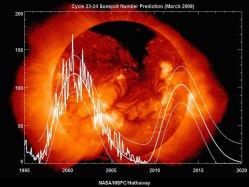
There’s not a lot happening on the sun these days, at least in the sunspot department. “We’re experiencing a very deep solar minimum,” says solar physicist Dean Pesnell of NASA’s Goddard Space Flight Center in Greenbelt, Md. In 2008, no sunspots were observed on 266 of the year’s 366 days (73 percent). Sunspot counts for 2009 have dropped even lower, percentage-wise. As of March 31st, there were no sunspots on 78 of the year’s 90 days (87 percent). Those who keep an eye on the sun say this is the quietest sun in almost a century. So, what does this all mean?
Sunspots are planet-sized islands of magnetism on the surface of the sun, and they are sources of solar flares, coronal mass ejections, and intense UV radiation. The sun has a natural cycle of about 11 years of high and low sunspot activity. This was discovered by German astronomer Heinrich Schwabe in the mid-1800s. Plotting sunspot counts, Schwabe saw that peaks of solar activity were always followed by valleys of relative calm—a clockwork pattern that has held true for more than 200 years.
The current solar minimum is part of that pattern. In fact, it’s right on time. But is it supposed to be this quiet?
Measurements by the Ulysses spacecraft reveal a 20 percent drop in solar wind pressure since the mid-1990s—the lowest point since such measurements began in the 1960s. The solar wind helps keep galactic cosmic rays out of the inner solar system. With the solar wind flagging, more cosmic rays penetrate the solar system, resulting in increased health hazards for astronauts. Weaker solar wind also means fewer geomagnetic storms and auroras on Earth.
Careful measurements by several NASA spacecraft have also shown that the sun’s brightness has dimmed by 0.02 percent at visible wavelengths and a whopping 6 percent at extreme UV wavelengths since the solar minimum of 1996. Radio telescopes are recording the dimmest “radio sun” since 1955.
All these lows have sparked a debate about whether the ongoing minimum is extreme or just an overdue correction following a string of unusually intense solar maxima.
“Since the Space Age began in the 1950s, solar activity has been generally high,” said forecaster David Hathaway of NASA’s Marshall Space Flight Center. “Five of the ten most intense solar cycles on record have occurred in the last 50 years. We’re just not used to this kind of deep calm.”
Deep calm was fairly common a hundred years ago. The solar minima of 1901 and 1913, for instance, were even longer than what we’re experiencing now. To match those minima in depth and longevity, the current minimum will have to last at least another year.
In a way, the calm is exciting, says Pesnell. “For the first time in history, we’re getting to observe a deep solar minimum.” A fleet of spacecraft — including the Solar and Heliospheric Observatory (SOHO), the twin probes of the Solar Terrestrial Relations Observatory (STEREO), and several other satellites — are all studying the sun and its effects on Earth. Using technology that didn’t exist 100 years ago, scientists are measuring solar winds, cosmic rays, irradiance and magnetic fields and finding that solar minimum is much more interesting than anyone expected.
Modern technology cannot, however, predict what comes next. Competing models by dozens of solar physicists disagree, sometimes sharply, on when this solar minimum will end and how big the next solar maximum will be. The great uncertainty stems from one simple fact: No one fully understands the underlying physics of the sunspot cycle.
And the only thing scientists can do it to keep watching. Pesnell believes sunspot counts should pick up again soon, “possibly by the end of the year,” to be followed by a solar maximum of below-average intensity in 2012 or 2013.
Source: NASA
Eternal shine of the spotless Sun !
I can’t wait until someone in the pseudo-science community picks up on this and blames the Earths use of resources for the reason behind the solar minima.
The EU’ers probably scared them off. God’s revenge for their obvious stupidity.
Funny. I don’t feel any lighter, and the gravitational constant hasn’t seemingly change.
Maunder Minima II ?
that’s funny, the sun is at a solar minimum and yet we experience a Global Climate warming, than it must be our fault.
Gee, with that deep commentary, what isn’t mentioned is that deep solar minimums of time past have also resulted in, ahem… cooler global temperatures. And hardly ever are we treated to honest reports regarding the fact that global temperatures have been falling for the past several years, ice caps are increasing in size, and basically the whole global warming nonsense is just a convenient lie to impose a socialist agenda on the planet. So here we are, with a monumentally clear and observable hunk of evidence that the worlds temperature is a function of the sun’s activity, but no, we don’t talk about that. While an enlightened bunch of crazed maniacs in London is demanding and end to the industrial age, and screaming “Save the Planet!” and “Abolish Money!”… We’re living through an era of worldwide mass insanity.
I’ve been following for over 3 years and astronomers have said it has been awful quiet-few if any auroras’ seen outside the polar latitudes. I guess the Sun figure it is time to stay cool for awhile, perhaps a hundred years.
@ Dave
So are you saying that governmentally funded research scientists are saying that there is most definitely a trend of rising global temps and independently or privately funded scientists are saying the opposite?
SAY IT AIN’T SO!!!
As a former (amateur) solar observer I feel for current solar observers equipped with only neutral density filters. How many days do I see sunspot counts on Spacerweather.com at ZERO. I can recall seeing at least a few good sunspot complexes even during solar minimum in the 70’s & 80’s. I’m sure the sun is just being itself here, but a spotless sun gets boring to look at (unless you own a narrowband filter or like observing faculae).
Jon Hanford-I’ve quit looking at the Sun for over 3 years as the size and number of sunspots has been zero!!. In the past, I’ve also seen sunspots thru solar minimums
and some were quite hugh, considering it was the solar minimums. I guess the Sun will stay cool for about 100 years or so, and people in Western Europe 2 or 3 generations from now can ice-skate on the frozen rivers and canals in winters like they did 300 years ago during the Maunder Minima, they better raise more sheep to bring out the wool!!
From the perspective of a ham radio operator, this is lousy! But I am glad some are getting some benefit out of it.
Maybe the sun’s acne just cleared up.
Does this mean the sun is out of puberty?
How do the EU proponents explain this?
And what effect has it on the plasma and Birkley currents 🙂
I wonder how much the Sun expands when it cools off like it is doing , and how much the Sun contracts when it needs to warm up?
The Sun is a great natural thermostat but not perfect but still, so big an object is still a wonder to me!!!
Does Al Gore care to comment on this obvious inconvenient truth?
Interesting point, so now we can say that maybe in the future our planet is cooling down than the opposite. What are you talking about, and all the money we have spend, the trips to the artic, the report´s, multi bilion euro´s … (sorry dollar´s) wasted for satelite observing or the proposels to fight the credit crunch. Here, in mine country (netherlands) there will be special fund´s for people who make improvemends to there house to prevent climate change.
I think nobody is for sure what will come out about the climate change for the coming future.
Only americans say the theres no clobal heating problem hmm maybe its because u guys is such a big part of the problem. wake up and smell the polution get some windmills and max secure nuclear reactors. and stop given all the arabs your money for gas. do it the eu way!!!
Sometimes I wonder where they anti-global warming folks get their information. 95% of scientists say one thing, so they go and find the 5% that say what they want to hear.
I’m no glacial scientist, but I live around glaciers, and if they have started expanding again, that would be news to me.
Hmmm solar maximum on the 2012…Mayan Calendar stuff 😀
I’m with Miss Universe on this one 🙂
I’m an American and know the world is warming up,and dispite the Sun cooling off, the Earth will continue to warm up due to the ‘momentum’ of C02 into the atmosphere, however, if the Sun is going into a Maunder Minima for a prolonged period, the Sun will eventually have the final say on how the Earth’s’ climate will be. I talk about generations which to me is 20 years, it will not be a sudden change, just a gradual change like global warming over the last few generations. There are Solar scientist and Astronomers who studies the Sun, however, they really don’t know what will happen with the Sun for the next 100 years, and really don’t know why the Sun goes through a warming or cooling periods. Perhaps far into the future, technology and sensors not know known will be able to ”penetrate’ or view deep into the Sun and be able to tell if the Sun will go through cooling or warming periods thousands of years in advance.
@olaf
Independent of specific hypotheses, energetic pulsations of various kinds are observed throughout the cosmos.
According to EU theory, Active Galactic Nuclei and stars are externally powered plasmoids, formed in an electromagnetic “pinch” between Birkeland currents, which exhibit behavior analogous to a capacitor or condenser. The current powering the sun is not steady, it surges or pulsates. Solar maximums would indicate a surge condition followed by capacitance discharge of the excess stored energy over time leading to a minimum. The buildup and discharge could explain the magnetic polarity reversal between cycles. The normal solar minimum, IMO, would be equivalent to the baseline voltage potential powering the sun.
The deep minimums, like the current one, or weak maximums could be due to “shunting” of the current by dense areas of interstellar dust, which we happen to be moving through one now and do so periodically. Since the density and volume of those “dust clouds” varies, that could explain the differences in various deep minimum periods.
An interesting aspect of this minimum is that the luminosity has only decreased slightly, but the solar wind pressure has decreased significantly. The magnetic torus closely surrounding the sun has become invisible to satellites also. This torus is a ring current that directs the external current into the sun. Less current means a less energetic torus.
As long as the voltage of the current powering the sun remains within a certain, relatively broad range, the luminosity shouldn’t change much since that relationship is mathematically a “step function”.
The Birkeland currents connecting Earth and Sun should be less energetic, however, and this is observed in decreased auroral extent and activity.
This site is crazy, it tells me it did not take
my posts
Sorley:
“As long as the voltage of the current powering the sun…”
Sorley, are you serious? Or is this an extended April Fools joke or something?
I was told to get off the planet before 2012, a solar flare so huge it’s going to wipe out all human life, we need to move to mars with our greenhouse gases, mars will become a warmer place to live, we have to expand if we are to grow!
Move to Mars? That is a little extreme, however, I am sure the very wealthy and governments have their own safe houses built somewhere on earth or beyond; no doubt.
For the rest of us; we sit and watch and wait. Hopefully, ET will come to the rescue or even Christ. Death is not something I fear, in fact I welcome the Time when it is my turn to go home. We are all part of a bigger plan beyond our knowing.
2012 Promises to Be Interesting, in one way or another.
Have you seen the movie, Knowing? Wow…
For Now, everyone pray for the best and prepare for the worst. Get your Food, Water, Shelters ready for anything that could come our way.
Sunspots will return with Mighty Fiery, I believe. This is like the calm before the storm…
Just relax and LOVE your life and Family and Friends, NOW, for none of us know what tomorrow will bring…
Kachina
Screw CO2.
Lack of Sun Spots is causing the warming trend.
Sun Spots are COOL.
Thus, lack of them means increased solar radiation.
End of story,
Simple in your face stuff.
Duh!
Triskilion
The sunspot cycle has little effect on thermal radiation arriving at our planet. As seen in the figures above the big dip in this minimum is at the UV end of the spectrum. Mankind is carbonating the atmosphere here at such a rate as to swamp such tiny differences in Sol’s infra-red output @1AU.
It’s not a burst of sun spots, the sun is going to increase in size!
I have a theory, back in the ice age when half the US was covered with ice, the Caveman’s campfires caused global warming and melted the ice. So if we stop producing Co2 we will freeze again.
So what is normal? big ice caps, no ice caps? or some ice caps?
Before we panic and jump off a cliff we should know.
I was expecting at least one Uranus joke but there was none.
Since I live on the gulf coast how does lack of sunspots figure into Hurricanes?
Nothing out of the ordinary is going to happen in 2012.
There is no global warming, it’s all a hoax.
The only thing worth mentioning about the lack of sunspots is that for amateur astronomers it makes the Sun less interesting to observe.
@Sorley:
“As long as the voltage of the current powering the sun…”
That voltage would come with a huge current, causing a huge magnetic field – where is that field ?
According to calculations, that field would overpower the earth’s magnetic field, causing my compass to point towards the Sun. My compass still points roughly northward…
EU fails the compass test, EU fails.
@triskilion:
Actually, you’ve got that backwards. It probably seems odd, but the solar output typically -increases- during the solar maxima. While sunspots themselves are slightly darker than the average solar surface, the regions immediately surrounding them (faculae) become hotter and brighter, more than compensating.
@ star grazer:
I’m not sure I understand your statement because even “Man-made global warming” proponents when you pin them down will admit the Earth has been slightly cooling the last couple of years.
Originally, according to saint Al, we were supposed to be in the middle of the “hockey stick”, that claim has since been withdrawn.
Where does that leave us?
Does the “nuclear furnace” model have any explantion for, The Day the Solar Wind Disappeared(Science@NASA) — “For two days in May, 1999, the solar wind that blows constantly from the Sun virtually disappeared — the most drastic and longest-lasting decrease ever observed.”
A “nuclear furnace” doesn’t up and nearly shut down for whole two days.
And Olaf, one or two of these observational items and I’d let it slide, but over ten observations suggests to me that “modern” astronomy doesn’t understand the Sun’s mechanics.
If so, shouldn’t alternative hypothesis be actively considered?
@excalibur
If the electricity powering the sun were coming over a single “wire”, then the magnetic field would be huge. That’s the problem with the calculation you speak of, it’s erroneous and a gross misinterpretation of electric currents in plasma. The electricity powering the sun is distributed over a large area, it’s called a drift current, and produces minimal magnetic fields, until it’s concentrated on the Sun where the magnetic field is quite strong.
Your “compass test” is bogus and quite non-applicable.
@ Excalibur
I made a brief calculation myself. To provide the energy for the 10^26 J/s of the sun’s output a steady current into the sun should be of the order of 10^16 A. This results in an tremendous magnetic field. It would be of the order of 0,05T, which is much stronger than the earth’s magnetic field of the order 10^-6 T.
The mathematics (of simple electrodynamics) do not support the EU claim of a current powering the sun!
@ solrey
But still it has to be of the order 10^16A, concentrated or not. Assuming a non concentrated current, still numbers of electrons (or protons, depending on which species the current is made of) of the order 10^35 have to penetrate the sun in one second (!!) to account for 10^26 J/s of solar output. Such high numebers are not measured anywhere….
middenrat Says
“The sunspot cycle has little effect on thermal radiation arriving at our planet”
middenrat -have you not read my statement
“I’m an American and know the world is warming up,and dispite the Sun cooling off, the Earth will continue to warm up due to the ‘momentum’ of C02 into the atmosphere, however, if the Sun is going into a Maunder Minima for a prolonged period, the Sun will eventually have the final say on how the Earth’s’ climate will be.”
Granted, humans can to a point and duration make a change on Earths’ climate, but DON”T OVERESTIMATE what humans’ can do and UNDERESTIMATE what the SUN can do-the Sun runs the show, no Sun, no Humans.!!!!!!!
From Don Scott:
“Juergens’ model implies that the outer surface of the heliosphere is the collector of the necessary current stream from the nearby region of our galaxy. Inside the heliopause (within the “solar wind” plasma) the movement of electrons would consist of a “drift current” moving inward toward the Sun superimposed on a vastly stronger “Brownian (random) motion” and therefore be difficult to measure.”
Also, the current would likely be concentrated over the poles and possibly “field aligned” in those regions and we have yet to send a probe within that polar “cone”, so we haven’t been monitoring the proper areas to measure total current.
Until we develop satellite missions to specifically measure current in the right places, we can’t say for certain that the current does, or does not, exist or how strong it is. We can’t say for certain whether “dark matter” does, or does not, exist either.
It’s amazing to me that people are OK with undetected “dark matter” and other “dark” stuff, yet refuse to even acknowledge the possibility of an electrically powered sun, of which about the only definitive proof remaining is the quantification of the current.
@anaconda
Thanks for bringing up those important points about deficiencies in the fusion model, of which those phenomena are inherent properties of an electric sun.
Anthropogenic global warming, what a farce. How many times have some of those scientists been caught fudging and cherrypicking data or even falsifying data to support their claims. Way too often for there to be any credibility left. Also, many temperature monitoring stations are located in the vicinity of heat sources so even much of the raw surface temperature data is skewed. But I’m sure those situations are just honest mistakes. 😉 They like to create the illussion of consensus, but the reality is that it is far from a scientific consensus with many respected climate scientists denouncing the claims of AGW. And guess what, much of their claims are based entirely on…drum roll please…computer models. Go figger.
And what is up with this 2012 nonsense? Another apocalyptic prediction that will simply pass quietly in the night, just like all the other declarations of impending doom that have come and gone throughout history. I guess with all the sensationalist headlines, and the dumming down of the populace, one can’t blame the sheeple for being a bit twitchy. 🙂
Anaconda-If indeed the ‘global warming’ proponents have says the climate is slightly cooling or staying in flux, then if the Sun is indeed going into a Maunder Minima
event, the cooling will start sooner but will of course be gradual and changes will be noted by the next generation, the 2nd generation of humans will really notice the cooling more.
Anaconda-the way I interprete middenrats’ statement, he states humans will continue to warm up the Earth and the Sun will NOT EVER have an effect. I’ve stated if the Sun stays relatively cool for a long period of time, like the Maunder Minima event, eventually the Sun will have the final say on Earths’ climate. To me, middenrat overestimates what humans can do, and underestimates what the Sun can do-if the Sun feels like cooling off for a few hundred years, humans better raise more sheep to bring out the wool because even the filthy air period of ‘open coal ‘ burning of the early industrail revolution on Earth will not do much to prevent further cooling of the Earth if the Sun is in a prolonged Maunder Minima event..
@ solrey and Anaconda
Oh dear to two fraudulent jackasses again talking absolute nonsense together.
Electric sun. Ha ha – probably more like ideas from fried brains with the convulsive therapy turned up too high with the current, perhaps?
Now let’s see, where do you think the OBSERVED neutrinos from the Sun come from – you know those inconvenient little atomic particles that pop through those underground reservoirs. How does your stupid EU theory create those, eh? (Oh I see they don’t exist – figments of some theorists wacky mathematical imagination, again.) Funny electrons, perhaps?
Now let’s see. You claim we cannot observe the centre of the sun, so therefore everything is apparently ‘theoretical”. However, on the other hand you claim to know all about the centre of the Earth, and you how the magnetic field of the earth is generated. Prove it. Based on you crazy logic, we cannot observe the centre of the Earth, so therefore everything is “theoretical” – you know those computer models.
Clearly the only flow of electrons that is defective here are those flowing through you own neurones in your wacky brains of yours. Fried synapses seems the only sensible conclusion we can draw.
Dunderbolts.Info clearly needs new management against such wanton stupidity!!
anaconda “But there are over ten observations of the Sun that the standard model doesn’t explain: … ”
So what if I understand you standard model is wrong since it cannot explain it all.
But EU cannot explain time dilution we can actually mesaure and the orbit of mercury, so EU must be wong.
Also EU cannot explain why gravity does not change since those currents at those z-pinch aka the Sun, has changed so Earth must at least have a longer orbit duration right now since it”s orbit is further from the sun.
Anaconda= apparently, middenrat did not read my 5:22 PM April2,2009 post- I try to stay neutral on these feeds.
Oh dear, I see the 2012 idiots have found this thread too. ET? Christ? Who next? The Annunki? Not only do we have to contend witht he EU lunatics like Oils Anaconda and solrey but jokers such as Kachina. They also brought the ‘No geomagnetic reversal in 2012’ thread to an end a few days ago. Some of us fought a five month battle with them and they just wouldn’t take no for an answer. Just like Oils et al they changed the thrust of their arguments every time they were challenged or supplied with explanations. Good fun for a while riling and poking fun at them but ultimately pointless rather like the upper-classes in the 18th century when they went to the local Bedlam and poked the inmates with sharp sticks.
No Annunki, it is Anaconda. :-p
Actually the neutrino issue is a problem for the fusion model because only 1/3 the amount of neutrino’s there should be have been detected. The ad-hoc explanation is that they change “flavor” on the way to Earth.
For the electric sun model the neutrino’s would be from fusion taking place in the plasma “double layer” component of the photosphere.
From Don Scott:
“It is also observed that the neutrino flux from the Sun varies inversely with sunspot number. This is expected in the ES hypothesis because the source of those neutrinos is z-pinch produced fusion which is occurring in the double layer – and sunspots are locations where there is no DL in which this process can occur.”
Basically, every bit of data collected about the Sun supports the electric sun hypothesis while many aspects do not fit predictions of a fusion powered sun, including neutrino flux. Did the fusion model predict the magnetic torus, or ring current, surrounding the sun? That’s an integral part of an electric sun. About the only thing missing is a direct measurement of the “supply current”, which should be possible with the right probes in the right locations. 🙂
solrey:
Actually, NASA is already conducting an experiment “with the right probes in the right locations”, as reported here.
That should be ‘right up your street’! 😉
IVAN3MAN Says-
LOL- Sal should check dis out.!!!! LOL
solrey said;
“For the electric sun model the neutrino’s would be from fusion taking place in the plasma “double layer” component of the photosphere.”
What? Where does the energy come form to do that? For this to actually happen in the photosphere is totally crazy. Fusion cannot happen in the core but it can happen in the photosphere. Even if this were true, where does the elemental abundance chemical evolution of the star fit into the equation? Fusion not only makes energy it makes hydrogen and helium into heavier atoms. Isn’t that why some red stars preferentially sometimes produced exotic elements like technetium – something EU can never explain. (Or is spectra an illusion too!)
Spoof-catcher
I’ll think I change my avatar name to South Park character of Eric Cartman! Really, this latest rubbish given here by solrey and Anaconda is here is absolutely hysterical. Nuts!
Fusion in a plasmoid:
http://focusfusion.org/index.php/site/article/78/
Actually, ES theory says that metals are created by the fusion taking place in the photosphere.
Regarding the solar neutrino problem… according to several articles on wikipedia:
– the idea of neutrinos changing flavor (neutrino oscillation) was first suggested by Bruno Pontecorvo in 1957.
– the solar neutrino problem was not realized until the late 60’s
– the solar neutrino problem has been resolved through experiments such as the one in Sudbury.
en.wikipedia.org/wiki/Neutrino
en.wikipedia.org/wiki/Solar_neutrino_problem
en.wikipedia.org/wiki/Neutrino_oscillation
@ solrey
Oh, wait a minute, not long ago, you said:
So: The current is sopposed to be distributed over a large area. It is definitly not in the ecliptic, we should have measured it somehow from earth by now (and other probes watching the sun in the same plane). The Ulysses probe (currently freezing to death AFAIK) flew right across the solar poles (and thus flew a semi circle around the sun perpendicular to the ecliptic – its orbit is elongated and reaches out to Jupiter).
That means that we have some regions where those currents can’t be. It has to go into the sun under a specific angle and has to leave the sun at the other side. But the dimension of that current shrinks a lot, I think. That, on the other hand, would result in a stronger magnetic field. Still, non to see.
Question: Why should this happen in a double layer? Why should there be holes in the DL?
Btw: We are observing (fairly strong) magnetic fields leaving or entering the sun in sunspots. Such magnetic fields tend to give a “preferred direction” to the sorrounding material. A preferred direction on the other hand reduces the random movements due to temperature. That results in a lower tempereture and thus in a darker spot. This is in a short version the story “mainstream” science will tell you.
And a note to the current surrounding the sun: Although I haven’t heard much of it, it does not surprise me. The earth has such a current, too. It would be interesting how the current around the sun changes with the 11-year cycle.
It’s funny how Anaconda and his ilk always bugger off onto another thread when their opinions are challenged.
Youi may want to see this site:
http://www.globalwarminghoax.com/news.php
No, I don’t think so….
@ivan3man
Ummmm, it’s spring and I have a big garden to plant. Kind of a higher priority than opinions being challenged here. That’s what breaks and rainy days are for. 😉
Nonetheless, experiments with fusion in a Dense Plasma Focus suggest a possible 2:1 power ratio for plasmoid fusion. Plasma physics experiments confirm fusion to happen in a high energy z-pinch. If the Sun is indeed an electrically driven plasmoid, then the current powering it would only be about half of it’s total output, due to fusion. That’s based on what can happen in a lab and I would expect that process to be even more efficient on the Sun. I’d predict about a 3:1 ratio or even as much as 4:1. Meaning that the current powering the sun is likely to be much less than some of you are suggesting.
@ Jon Hanford:
What happened to the supposed “nuclear furnace” during these two days?
Even a ratio of 4:1 wouldn’t change the order of magnitude too much (probably by 1). So, instead of 10^16 A, there are probably 10^15 A needed. Still a hugh number, I guess.
So what happened to these massive currents the day the solar wind disappeared?
A cross section of the Suns plasma sheath is directly analogous to a pnp transistor, in terms of the plots of energy, E-field, and charge distribution. Even a slight decrease in the Sun’s voltage would produce a negative feedback effect causing fluctuations in the flow of +ions, i.e. solar wind. All of the components and dynamics are in place for a “transistor cutoff” process to be initiated, imo when the voltage decrease is sudden and steep enough, that would cutoff the flow of +ions (solar wind) until circuit balance was re-established. It’s a basic mechanism with all of the components in place to explain fluctuations, or a stoppage, in the solar wind.
Also the photospheric tufts are much like the filaments between anode and cathode in a Dense Plasma Focus, or Plasma Gun, if the Sun were looked at in cross section and the filaments were tightly packed. A lower energy, ionizing plasmoid for a core is one side of a magnetic containment field, the outer magnetic field is the other side, and the components of the plasma sheath are the anode and cathode, where the filamentary tufts occur within which fusion takes place. Sunspots are just where streams of either +ions or -electrons cause local instabilities, basically diocotron instabilities, and punch through the photospheric tuft layer to reveal the cooler, ionizing plasmoid of the core. The diocotron instability mechanism is why sunspots often take on geometric morphology and the propensity for two or more to interact.
Or something like that. 😉
Anaconda:
You don’t respond to logic!
sorley:
So, then, what is the source of the ‘current’ that is allegedly powering the Sun?
@ivan3man
From the linked paper. Mainstream, not EU, BTW. 🙂
“Ordered fields with spiral structure exist in grand-design, barred, flocculent and even in irregular galaxies. The strongest ordered fields are found in interarm regions, sometimes forming ‘magnetic spiral arms’ between the optical arms.”
http://arxiv.org/PS_cache/arxiv/pdf/0812/0812.4925v1.pdf
That’s pretty much an idea of how Birkeland currents are organized within galaxies. Basically that’s a map of the magnetic fields created by those currents.
The current would be following/creating those magnetic fields, which can be both cellular and filamentary, as noted in the “magnetic spiral arms”. Where there are magnetic fields, there is electric current. 😉
The current is likely entering the solar system influenced/guided by the heliospheric current sheet.
From WIKI:
“The electric current in the heliospheric current sheet is directed radially inward, the circuit being closed by outward currents aligned with the Sun’s magnetic field in the solar polar regions. The total current in the circuit is on the order of 3×10^9 amperes. As a comparison with other astrophysical electric currents, the Birkeland currents that supply the Earth’s aurora are about a thousand times weaker at a million amperes. The maximum current density in the sheet is on the order of 10^-10 A/m² (10^-4 A/km²).”
The HSC is more like a self generated feedback circuit to me, probably getting some of its energy from the fusion in the photosphere. The external current would come through the middle of the conical, polar outflows of the HSC. I believe the poles have a circular aurora pattern that outline the boundary of this form on the surface.
Question:
Where is the current that gives birth to the magnetic field, which in turn can lead to those “Birkeland” currents?
A “Birkeland” current needs a magnetic field in the first place, it does not creat its own (guiding) magnetic field (only a secondary one due to the flowing charges (and that in turn depends on the content of the current, i.e. how many ions and electrons flow through the current)).
Note to add:
What about the “granules”? (Take a look at today’s APOD)
They are definitly a sign of convection!
@drflimmer
The current creates it’s own magnetic field, it’s called a field aligned current. It’s a primary function of the self-organizing filamentary/cellular structures that plasma forms. Those individual current filaments follow the galactic magnetic field, basically the “magnetosphere” of the galaxy. A Birkeland current is a magnetic field aligned current.
I think I can clarify a previous post dealing with the mapping of the galactic magnetic fields and the “magnetic spiral arms”. The galactic current forms those magnetic spiral arms The optical arms are where the interstellar plasma gets magnetically pinched inbetween, forming/powering the stars of the optical arms like a string of lights.
Electric current creates magnetic fields which themselves can induce secondary electric currents which produce their own magnetic fields, etc. This is one of the primary reasons that plasma morphology can get so complex, yet still retain a semblence of ordered simplicity.
The “granules” are the photospheric tufts I talked about in a previous comment, to wit:
“Also the photospheric tufts are much like the filaments between anode and cathode in a Dense Plasma Focus, or Plasma Gun, if the Sun were looked at in cross section and the filaments were tightly packed.”
Instead of convection columns, they would be electric vortices within the suns plasma sheath, basically within the area of strongest voltage potential across the double layer. That’s where fusion would be happening, also.
BTW, thanks for inquiring without insulting. 🙂
Actually, a plasma globe is a good visual demonstration of how electric currents self organize into magnetic field aligned filaments.
I blame Global Warming for the current Solar Minimum.
@ sorley,
DrFlimmer and I have heard all that jabberwocky before from Anaconda on a thread at Bad Astronomy, and, like Anaconda, you’re sounding like that pet shop proprietor in Monty Python’s “Dead Parrot” sketch. You guys are singing from the same goddamn song sheet!
So enough of that sophistry and obfuscation BS!
Since you didn’t understand the question, like you don’t understand the laws of physics, I’ll rephrase it:
A plasma globe — which you “Electric Sun” proponents imagine is analogous with the Sun — requires electrical power from the mains supply in order to work, and the electrical mains supply is itself driven by a multitude of power stations all connected to the National Grid — the distribution system. So, assuming that these “Birkeland currents are organized within galaxies” like the National Grid, then what is the source of those “Birkland currents”?
Dammit. Hit the wrong button and everything’s gone. Try it again…
@ solrey
That seems to contradict everything that I know about currents and magnetic fields.
A current creates its own magnetic field, of course it does. But the magnetic field is in a plane perpendicular to the current.
A current can follow a magnetic field. The particles gyrate around the field line while the “center of guidance” follows the line. That seems to be the explanation of a “field aligned current”.
But: It is not possible that a current creats a magnetic field in the first place and then starts to follow it. That sounds like a perpetuum mobile.
The current must lead out of the galactic plane (like jet but bigger or spread out) in order to creat magnetic fields that can exist in the galactic plane. AFAIK there is no evidence for such currents. Where are they? As long as they are not found, they are as theoretical as dark matter….
Do you know that the spiral arms of a galaxy disappear if you look at a galaxy in the infrared? The reason is that red stars (normally known as older ones) are evenly distributed in the galactic plane. Blue and (thus) bright stars are distributed in the spiral arms. Those stars are normally referred to as being young, because the bluer a star the hotter it is and the more massive it is. And those stars tend to die young (in the normal explanation). Why should red stars be distributed evenly and blue stars not? Does EU give a reason for that?
That’s true, of course. But I think, gravitational collapse into a potential well is even simpler than that. Physics has performed well, when it first tried to stick with the simple explanation.
Although Anaconda tries to avoid the fact that “mainstream” science does include EM forces into calculations of star formation (by using the term “gravitational only”), it is done and it even improves our picture of star formation. That picture is very good by now and can explain many strange things we see out there.
Speaking of granules:
Since a potantial drop always tries to get rid of itself (positive and negative charges always attract each other in order to eleminate the potential), I think the double layer should destroy itself. That is due to the fact that both parts of the DL are connected by those “wires”, just like a short circuit. On the other hand, this would lead to a very instable layer. But according to you, the layer must be a stable thing, otherwise the sun wouldn’t shine.
It is nothing but a fact that the surface (photosphere) of the sun has a temperature of about 5800K. I consider it to be “one side” of the double layer. There can be no fusion, it’s just too cold! (And even in the chorona above it is quite unlikely to happen, because the chorona is much too thin for any reasonable number of collisions).
As far as I understand the related wikipedia article: Field aligned, yes, but aligned to electric field lines. Probably the magnetic fields of the currents squeeze the currents. But the currents are definitly not “magnetic field aligned”.
Unbelievable that physicist can behave that way, is it not? I try not to insult as far as I can. Insulting results in nothing – most likely like this discussion (taking in mind previous discussions with folks of the EU-side…)
@ solrey
Truly. You are seemingly just a legend in your own lost mind.
Clearly several known forces act in unison to produce astronomical phenomena. It is never one sole force that controls what we see. You seem happy to dismiss logical deductions and replace them with either unproved science or fiction to hold your views. Such bias says only one thing – your professed postulates are mere illusions – illusions of feasible knowing against something being just speculate on.
If you want to convince something about EU, you should do so from established theory, why it is wrong or misguided, then submit a plausible alternative explanation. All you do is give the alternative without any rationality nor progressive thought that is wrapped in some form of formal logic.
Bottom line is YOU don’t know where the energy comes from. Your assumption is solely based on the “observable”. As we cannot see the core of the sun in action, means in your twisted mind, therefore the energy source of the sun in current science is a fiction. (Just like the core of the Earth and what cause the generation of the Earth;s magnetic field – also by your logical another comparable fiction!
Were we to assume you argument here were true, you cannot explain the picture of the evolution of stars we have ascertained by even statistical means. I.e. How do stars like the sun turn into red giants. From your silly perspective, red giants can only swell by either increasing electric or magnetic field. Why is it that, say nearly all A-type stars exhibit stronger magnetic phenomena? In the end, there is no correlation between surface temperature of stars and their magnetic activity. The only conclusion you can draw is simply that it has something to do with the central core of the star or Sun – else you really have no explanation. This draws one basic conclusion, magnetic fields on stars cannot be the only force driving their evolution – both chemically and by their source of energy production.
So please stick to nonsense that is at least plausible and not place in the realm of argument for arguments sake. We already know most of the boisterous objecting to astrophysics is posturing and nothing to do with establishing fact from objective science advancement. If you understood that you might not look as stupid as you do currently appear.
So please, just grow up and avoid these unhealthy fixations based on unfathomable logic and unintelligible chaff.
@drflimmer
I see where you’re confused. You say that the current spirals around a pre-existing “field line”, if I understand you correctly.
“A current can follow a magnetic field. The particles gyrate around the field line while the “center of guidance” follows the line. That seems to be the explanation of a “field aligned current”.”
There are no magnetic field “lines”. Don’t rely on Wiki for that one, an electrical engineer knows better. That’s just how we describe a magnetic field, much like a topo map describes the contours of the ground or an isobar contour map outlines pressure gradients. The surface of a magnetic field aligned current is a cylindrical double layer that seperates the moving charged particles within from the surrounding plasma environment, basically forming it’s own insulating conduit. The flow of charged particles within the broader magnetic field forms this charge sheath when the charge density reaches a critical point. It’s the self organizing radial field that creates the filaments/lines and surface DL, whos path is influenced by its magnetic interaction with the encompassing magnetic field, and by the fields of other filaments. Yes, the magnetic field extends radially. The law of electromagnetic attraction and repulsion means that the higher the charge density, the stronger the magnetic field and the more likely the filament is to spiral and “kink” around it’s own magnetic axis, or to join with other filaments in a twisted configuration where the fields spiral around a common axis created by the interacting fields, or to even become unstable and form “knots”. We see this pattern everywhere in space.
BTW, magnetic reconnection is also another field “line” myth, it’s actually the collapse of a localized magnetic field within the encompassing field when the flow of charged particles that created the local field is suddenly disrupted and the field collapses. Two opposite flowing filaments can disrupt each other, destroying their magnetic fields and releasing all the energy of both fields at the point of interaction. A collapsing magnetic field (an exploding double layer is one) near instantaneously releases all of the energy that had been contained in the field or circuit.
DL’s are well known in plasma physics and certain high energy electrical equipment since at least the time of Irving Langmuir and are also known as a Langmuir sheath. Child-Langmuir law is well established and is even being applied to quantum conditions. Their ability to remain stable, as well as the triggers of instabilities, have been well documented, for filamentary, cellular and sheet structures.
You are correct that plasma physics does have an important role in cosmology these days. But when it comes to space plasma, cosmologists don’t seem to treat it with the same physics as what is demonstrated in the lab, there are a few key elements missing for them. I see more and more research getting on the right track in that regard though, like the recent experiments about the cause of knotted jets involving plasma and magnetic fields. Plasma physicists have known about that for decades.
@ivan3man
I only use the plasma globe to illustrate the way current in plasma self organizes into filaments, as well as some morphology of lower energy filaments. I never said it was analogous to the Sun, it’s just a toy that clearly demonstrates some basic plasma physics, sheeessh.
solely said;
“You are correct that plasma physics does have an important role in cosmology these days.”
Absolute Bull. You have no means of measuring it! You reject an expanding universe or its behaviour by gravitation, yet you accept this nonsense on non-observable and unproved fallacies.
Cosmology. Bah! You can’t even get even the basic astrophysics right!
We might as well accept the Earth is flat and the Moon is made of cheese, or that you have been putting you fingers too often in the power points! The only person here is confused is your own.
Just more plasma unsubstantiated nonsense.
solrey said;
“Don’t rely on Wiki for that one, an electrical engineer knows better.”
What! This is like saying an astrophysicist knows more about brian surgery or pharmacology! Sure I’d trust an electrical engineer in wiring my house, but I would let them near a surgical doctor operating on a table or pulling ones teeth.
Using electrical engineers knowledge is exactly what the problem is with their applications to astrophysics or cosmology.
Frankly if you apply such disciplines across multiple subjects you end up believing (by faith) in the tooth-fairies or ghosts that go bump in the night.
So what should I do from now on – read some electrical engineering manual to work out the function of stars, galaxies and the whole universe!
You are even a bigger fool than I’ve ever thought!
solrey said;
“There are no magnetic field “lines”. Don’t rely on Wiki for that one, an electrical engineer knows better. That’s just how we describe a magnetic field, much like a topo map describes the contours of the ground or an isobar contour map outlines pressure gradients.”
You condescending jackass! Isn’t that is why it s called a “field.” What the hell do you think it is also called a “gravitation field.” Of course field lines are just a simplistic way of description in portraying the natures of the field. I.e. Field strength but the number of lines per unit length.
To suggest otherwise to Dr.Flimmer is not only unfair it is rude and disrespectful. All it shows is the lack of respect you have for mainstream science and your attitude that any means to discredit current theory just to supplant your own twist one.
No wonder most EU proponents, right is wrong, are held as idealistic stupid wackos!
@sbc
drflimmer described the lines and the flow of current along them:
“A current can follow a magnetic field. The particles gyrate around the field line while the “center of guidance” follows the line. That seems to be the explanation of a “field aligned current”.”
I’m not being condescending, it sounds like they’re describing magnetic field lines to me, as they also erroneously think that the current in plasma cannot create it’s own filamentary magnetic field. Even a plasma globe demonstrates that basic phenomena.
“You reject an expanding universe or its behaviour by gravitation, yet you accept this nonsense on non-observable and unproved fallacies.”
Non-observable and unproved fallacies…you must be talking about “dark matter” or “dark energy”. Or maybe “dark flow”, now that’s a good one.
Or just use the basic, well established and experimentally tested laws of electromagnetism and plasma physics to describe (which they do) the observed structure, radiation signatures, motions and such in the universe, without the need to prop up the formulas with made up entities to fill in the gaps.
@ solrey
Sorry, man. But I have to tell you something:
A magnetic field can NEVER extend radially. That is impossible. Here is the proof (I’m sorry, it’s of theoretical nature, but it is well proven by every experiment you can do with magnetic fields):
A radial field does have a form like this:
vec(B)=c*vec(e_r)
What we have is the magnetic field vector (yes, a magnetic field IS a vector) vec(B), the radial vector vec(e_r) and all other constants and things inside of c (what really is the content of c is of no use to us, so I just equal it to one: c=1):
vec(B)=vec(e_r).
Have you ever heard of the “divergence” of a vector field? This term can tell you something about “sources” and “wells” in your field. If you do the math, you’ll find:
div(vec(B))=div(vec(e_r))=3.
I think I am not wrong, but what is just important is the fact that the divergence of a radial field is NON-zero. That means that we have a “source” (or “well”) of the field.
The elctrostatic field has a divergence that is non-zero. It’s sources are the charges (positive and negative). The (newtonian) gravitational field is also a radial field. Its source is the mass of an object.
BUT: We do not know of any sources for a magnetic field. There are no “magnetons” anywhere. That is what experiments tell us!
That means, in turn, that the divergence of the magnetic field has ALWAYS to be exactly zero.
This is the mathematical reason that a magnetic field cannot extend radially!
Are you probably confusing magnetic and electrostatic fields?
BTW: Your three other sections do not correspond to anything I said. I was talking about star formation. That had nothing to do with cosmology, even not with dark matter or some sort.
Why weren’t you referring to what I said or the question Ivan3man gave you (because it’s a very intersting one and I’d love to know the answer!)?
Although I disagree with SBC’s style of answering you, he is right:
Magnetic field lines are a concept how one (or physicists) can talk about magnetic fields. It’s just a picture of the vectors that you have to write down in the way I did before. Field lines are an analogy, and EVERYone uses them.
Since it’s getting late in Germany that’s it for today. As you can see, english isn’t my native language and I’m struggeling to become better. The problem is that I have to go through your respons one more time when I have the time to do it. This was merely a “quick respons”.
Good night…
I did said;
“You reject an expanding universe or its behaviour by gravitation, yet you accept this nonsense on non-observable and unproved fallacies.”
Yet I said this is regard COSMOLOGY.
Were is the evidence of magnetic fields on cosmological scales? They have not be proven not observed. The expansion has as does the background radiation!!
I have made absolutely no comment here on “dark matter” nor “dark energy” at all.
Correction:
I meant “magnetic monopoles”, not “magnetons”! Sorry.
hmmm, ‘electric Sun’ , I wonder why it no flicker like floresent light tube when ballast going out…….. Plasma physics?
Is that why heat? I no expert this subject, but this sounds like voo-doo thinking. I believe Sun heated by charcoal burning before I believe ‘electric Sun’- no light flicker,
no believe ‘electric Sun!!!
It was noted earlier that magnetic field lines along arms in spiral galaxies acted as conduits to supply currents to stars for them to radiate light (or something to that effect). What mechanism supplies currents to stars in dustless, armless, gas-depleted elliptical galaxies? What mechanism creates such currents in elliptical galaxies?
solrey:
Oh, excusez-moi(!). I got the distinct impression from Plasma-Universe.com that the plasma globe is analogous to the “Electric Sun”, since it is featured so prominently next to an actual image of the Sun!
So if the plasma globe is “just a toy” and is not analogous to the “Electric Sun”, then kindly demonstrate to us what the bloody hell is analogous to it, with peer reviewed experiments, or STFU!
Furthermore, as DrFlimmer kindly pointed out, you still have not answered my question: What is the source of the so-called “Birkeland currents”?
solrey:
I would like to draw your attention, solrey, to this PDF file from the National Society of Professional Engineers: Code of Ethics for Engineers
In particular, I would like to draw your attention to these Rules of Practice in Section II:
Furthermore, I would like to draw your attention to Professional Obligations in Section III:
So, solrey, sorry (pun intended) to have to tell you this but you are clearly in breech of those ethics, if you really are an engineer as you claim to be. 😉
Two simple questions.
1) One of the most interesting ideas in rejecting EU and plasma in the universe is an interesting question that proponents of this theory have difficulties answering. This is simply why are objects like the Sun are generally very round spherical objects?
This at first this question seems trivial but goes to the heart of explaining the relative importance of magnetic fields and gravitational fields in astronomical and plasma phenomena.
Were it the case, as solrey seems to be constantly saying, that magnetic fields and their process of generating currents – explaining apparently the energy process of fusion of the Sun, then why is the Sun for all intents and purposes round? If the violence of these events and the variance between solar activity are so pronounced, the instability in the solar surface should be far from being truly spherical – more like enormous waves on a storm ravaged sea.
If the sun is not actually like that then, then how does the magnetic (or electric) fields maintain the sun’s actual shape?
2) Also how does the entire magnetic forces keep the sun collapsing onto itself? Current theory says the gravitational force is balanced by the radiant energy – the case of stellar thermal equilibrium. If the sun roughly radiates 10^26 Watts, therefore the pressure keeping the Sun round and from collapsing means the magnetic fields keeping the sun basically in equilibrium must be the same. Therefore why is it that the energy we observe, according to our eminent electrical engineer here, is merely 10^14 or 10^15 (energetically speaking)?
Where does the difference (c. 10^11) in energy between these two opposing forces lie? (I.e. Where is it, tthen?)
So according to the EU’ers, why doesn’t the sun collapse under the typical explained gravitational forces? (Especially, according to OilisMastery gravitation is an example of electromagnetism via the generation of magnetic fields as we see in the sun, for example.)
Should be a piece of cake to answer by any EU proponent, I think!
@ solrey
Your description of “field aligned currents” reminds me somehow of coaxial cables. And although I read it a few times now, I still don’t see the point, so I cannot comment further on it for now.
But you can comment a bit – quite much to be precise. I worte a lengthy post and the only thing you referred to was my description about a gyrating particle. What about all the other little things I wrote about? What about Ivan3man’s question? What about SBC’s latest questions?
Probably a lot to do, but hopefully you’ll take the time. It would result in really interesting answers!
Why won’t solrey or Anaconda answer? The suspense is killing me!
They cower away when the going gets tough and others cotton on to their deceptions.
I think from now on we should hit them directly with the simple questions, like why the sun is spherical, because they have to both elaborate current theory and why EU is a better explanation.
I too am very eager for a response, but the kit and run tactics are all too familiar.
@drflimmer
“Probably a lot to do, but hopefully you’ll take the time. It would result in really interesting answers!”
Only gardening, pruning, bonsai care…on top of a long list of other projects. Fortunately I think and type quickly.
Apparently this article is archived but if you check back I promise I’ll answer those questions when I have more time after I take advantage of a near perfect spring day.
For now, I’ll answer the question that everyone wants to know. What is the source of the electric current?
EU scientists are studying this carefully so as to provide a definitive answer so as to avoid speculation due to the importance of the issue.
But I won’t cop-out with that answer alone. My hypothesis is:
Space is an infinite volume of tenuous, inhomogenous plasma. Therefore, charge density is not distributed evenly. The voltage potential induces charged particle flow, creating E and associated B fields. There is a constant state of voltage potential across vast distances between regions of disimilar charge density, which in the process of achieving electric equilibrium produces new voltage potentials with other regions. It’s like an ongoing domino effect. Therefore the total E field, as well as B field, for the infinite volume of plasma will never be 0.
solrey said;
“Therefore the total E field, as well as B field, for the infinite volume of plasma will never be 0.”
Who said it was! You sound like Norwegian Birkeland and his contention of the Royal Society in Britain (under Kelvin’s view) thought they saw space as “simply as an empty vacuum.” Clearly it is not, and no one here has denied it! All you fail to recognise that it shares a place with gravitation. Simply gravitation, except in extreme phenomena, is the dominate influence in the universe. Why can’t EU accept that.
You play like a gambler using tactics of all or nothing, when the truth is it is somewhere in between. Not accepting this basic fact means EU is mostly fringe science – or in extremists of EU, an action of zealots on a quest for faith over science!
Please get real!
What about time? If time is infinite as well, then all the inequalities should have equaled out by now. We would have a nice sweet equilibrium. Or gravity takes over….
Btw: You say, all of space is filled with plasma. To gain a plasma you need temperatures of a few thousand Kelvin. Where do you get this from?
After a long time (it doesn’t have to be infinite) the particles will cool down (because they will in any case radiate away themal radiation – this is inevitable). Finally the temperatures are too low and the atoms will recombine. And we know that this is the case!
We observe LARGE hydrogen clouds, consisting NEUTRAL hydrogen. We even observe large molecules in outher space that can only form if they consist of “normal” atoms. Those neutral atoms/molecules out there can be measured and studied in great detail. And we found that they are revolving around the galaxy just as we expect them to (with the same velocity as the stars!). How can that happen, since neutrals are not affected by electromagnetic fields.
So, when you come back, you have something more to consider….
@sbc
EU is not saying that gravity doen’t exist or that it’s not a part of the equation. It says that EM forces are dominant and gravity is a result of mass accumulating due to EM, which provides a dampening or flywheel effect on low energy E field systems.
What I said about non-0, E and B fields, was simply describing the source of the electric current that you were screaming for an answer to. It has nothing to do with any opinions over whether space is an empty vacuum or not.
You frequently create a strawman to knock down where none existed, and the above is a good example of that. It’s a common, amateur debate tactic when you have no valid counterargument, either attack the messenger instead of the message, or create a strawman argument to obfuscate facts.
@drflimmer
My answers will take a bit more time to put together for you than what it takes exposing sbc’s strawmen.
Wow. This is really new…
“gravity is a result of mass accumulating due to EM,”
So which came first, the EU or the gravity aka the mass?
Furthermore, you still haven’t explained the spherical problem!
“It says that EM forces are dominant and gravity is a result of mass accumulating due to EM,”
Where is the proof for such a sweeping statement.
Is this fact or speculation?
solrey said;
“EU is not saying that gravity doen’t exist or that it’s not a part of the equation.”
Oops! Where did I say that? (OilisMastery also disagrees, by the way.) That is YOUR assumption! It is not AND/OR it is only AND and by degree!
As for;
“You frequently create a strawman to knock down where none existed, and the above is a good example of that.”
I should remind you YOU made that original contention, not me.
As for “obfuscate”, isn’t that calling the kettle black? All EU’ers I’ve encountered are the true masters of obfuscation – the illusion of OilisMastery, methinks.
Again. Accuse the accuser. (Your now sounding like the desperately quite like the apparently lost Anaconda)
Why is it taking you forever solrey to say what EU thinks and explain why the sun is almost perfectly spherical?
If you can answer such simple questions, the EU cannot cannot explain neither observation nor basic stellar evolution. I.e. What is the EU explanation of the HR-Diagram (no, too complicated) – colour magnitude diagram?
My previous quesion should read;
If you CANNOT answer such simple questions, then EU cannot cannot explain neither observation nor basic stellar evolution. I.e. What is the EU explanation of the HR-Diagram (no, too complicated) – colour magnitude diagram?
@sbc
No offense intended, for real, but is english not your primary language? The reason I ask is because your grammar, sentence structure and spelling are frequently…odd. English being a second language I can understand, but other than that, the poor language skills expose an underlying ignorance, imo.
A previous post seems to have evaporated, and I don’t have time to waste on dumbasses who don’t even know basic physics.
I”m talking to you:
sbc
ivan3man
drflimmer
among others
The EU version of the HR diagram:
http://www.holoscience.com/news/img/H-R%20diagram.jpg
Plasmoids are inhrently spherical, but that doesn’t mean perfectly round. They can be elongated, or football shaped, as well, specifically in high energy systems like galactic or nebular cores.
The Sun is mostly round because the forces that create it are mostly balanced.
Now bugger off, I’ve got sh!t to do.
solrey,
wow, so what’s your background in science again?
@nd
What is YOUR background?
I have a degree in Aerospace Technology, which includes additional studies in electrical, mechanical and structural engineering. Physics was a major focus as well, with an emphasis on fluids. Honors student in math, english and history. Plus over 20 years of practical application of the aforementioned disciplines. I can tell when people are clueless or otherwise un-informed.
@ solrey,
Did you not understand teh (sic) Code of Ethics for Engineers that I had highlighted for you; it basically says to all engineers:
MIND YOUR OWN BLOODY BUSINESS!
P.S. You still haven’t answered the question that I had put to you:
What is the SOURCE of the “Birkeland currents”?
P.P.S. As for your ad hominem remark of “dumbasses” directed at those of us who do not share your misguided view of the Universe, I’ll counter that unwarranted remark by stating that you and your “Electric Universe/Plasma Cosmology” proponents are unmitigated Jive Ass Maternal-Fornicators!
@ solrey,
Did you not understand teh (sic) Code of Ethics for Engineers that I had highlighted for you; it basically says to all engineers:
MIND YOUR OWN BLOODY BUSINESS!
P.S. You still haven’t answered the question that I had put to you:
What is the SOURCE of the “Birkeland currents”?
P.P.S. As for your ad hominem remark of “dumbasses” directed at those of us who do not share your misguided view of the Universe, I’ll counter that unwarranted remark by stating that you and your “Electric Universe/Plasma Cosmology” proponents are unmitigated JAMFs!
TESTING…1…2…3…
Excuse me for the double posting; it was due to an uploading problem with IE7.
Note to self: Use Firefox 3.0.8.
solrey:
Well, that explains where you got your “hypothesis” from! 😉
Why should I repeat myself just because you’re not paying attention? I’ve already answered the question of the source of the Birkeland currents from solar to galactic and beyond, and even gave a link to a non-EU paper with information about galactic magnetic fields, which basically map those currents within galaxies. If you’re not willing to take the time to read my posts, why should I take the time to duplicate them? Or spend time explaining basic, non-plasma specific, physics to some folks?
My inclination is to not be insulting, but I’ll respond after receiving enough of it, especially when it’s born of maliciousness or ignorance. You say stfu jamf, I reply with bugger off…that’s real productive. Can’t folks agree to disagree but still be respectful?
Anyways, ever think about trying Linux? I’ve had no problems with it on my oldass ‘puter, other than adding a couple of simple lines of code for my soundcard for dolby5.1surround. Rock on!
solrey said;
“Plasmoids are inhrently spherical, but that doesn’t mean perfectly round. They can be elongated, or football shaped, as well, specifically in high energy systems like galactic or nebular cores.
The Sun is mostly round because the forces that create it are mostly balanced.”
What? We are mostly talking about the Sun here. Really, It sounds like you actually don’t know.
If you think the problem is your EU theories – especially the nature of solar energy source – means the sun shouldn’t be spherical. EU as you profess is in serious problem if it cannot explain simple phenomena, then how can it answer more complex ones?
Gravitation simply answers the question of a spherical sun, whose balance is maintained by the thermal pressure generated by fusion source in the solar core. Even if EU plays an important role, gravitation must be the primary cause of the sun and energy creation for the sun to be approximately spherical.
I am amazed you can’t ask such a very simple question!. Really extraordinary .
(To your question. I have trouble typing, and my replies are mostly don now from a speech. I try to correct some of it, but it does take some time to do. Thanks for your consideration)
Note: I doubt your post was deleted. I seems their might have been a problem in multiple postings.
Wow. The link Solrey on the EU diagram is so revealing.
So the surface temperatures of stars equal 1/ current density
I.e. T (K) = 1 / Current density
How do you measure the current density of stars then? eh?
The observational evidence is only in some bleak laboratory instead measured from the stars themselves.
I now understand where the EU people are wrong.
Note: Other here will like this site and article. Just read the explanation of Electric Gravity!. The holes are bigger than Taxas – literally!! Truly unbelievable. (Anaconda will never show his head again!) See
http://www.holoscience.com/news.php?article=89xdcmfs
I’m probably not the cleverest man, but I want to inform you that I am studying physics for 3,5 years, now. I will finish it next year with a master’s degree in (theoretical) astrophysics.
(Now, I’ve given them everything they need: a theoretical physicist… come on, wear me down!)
Btw: I don’t see a significant difference between the “normal” HR-diagramm and the new one. Just turning the temperature-axis around and adding a note saying “current density” doesn’t give many new insights or explanations, does it?
Too sad that your post “evaporated”, I would have loved to see it. Now, I don’t get any new answers.
I, now, turn to the link of SBC at “holoscience”… the article kills itself with this section:
That is awesome. Maxwell’s theory required an aether? That is the dumbest thing I’ve ever heard! The aether was introduced by physicist because Maxwell’s theory didn’t fit with the Galilei transformation. But it fits with the Lorentz transformation. And the only thing, Einstein did, was to show this little fact. His special relativity was “only” a theory of electromagnetism (at first). He later found (well, later… the same year) how to handle it in mechanics and that Newton’s principles were an approximation when v is much smaller than c (this also true for the Galilei transformation being an approximation for the Lorentz transformation). It was Maxwell’s theory that required c to be the boundary that it is.
Get it: Special relativity is a consequence of Maxwell’s theory (in a historical view!).
The aether had unbelievable properties, it was a contradiction in itself. And just because Einstein said “Maxwell and not Newton is right”, he gave us one of the most succesful theories and he “completed” Maxwell’s theory by prooving it to be true! (There have been doubts about it, too!)
solrey:
The usual excuse given is: “My dog ate it”!
My background in science is rather disappointing. I have a BA in Astronomy, but that was years ago and I have since moved on to the IT industry since I did not see a future for myself in Astronomy. I was never a good student. I have not applied myself to any scientific endeavors since graduating and as a result my math and physics is rather poor at the moment.
That said, I’m surprised, given your background, that you assert that 1/3 neutrino deficit as an argument against nuclear fusion in the sun’s core. This issue was actively pursued observationally and scientists feel that this has been resolved. It should be noted that the deficit issue was reported by experiments that could only detect one type of neutrino, thus missing out on the other types that neutrinos could change to.
I am such an idiot. Now I know where the fault is.
Probably the most impotant argument of our PC/EU friends is the following:
Yes. You can probably scale the effetcs over several orders of magnitude. But there is little difference between a “ball” of plasma in the lab and and a “ball” of plasma in outer space: You cannot scale the mass. Or in other words: You cannot scale gravity!
The ball in the lab only feels the pull towards the earth but it’s definitly not “self-gravitating” (can one use this word? 😉 ). A ball in outer space, called “star”, is so massive that it its own gravity must be taken into account! And so you have another force to consider that changes the outcome of the “experiment” dramatically!
(That is probably the reason, why OIM must reject gravity!)
Oh, gee. Sometimes it’s really easy. Sorry!
@sbc
Gotcha on the typing thing. I hope it’s just something mundane like ‘can’t type worth a damn’ rather than an ailment. I wish you well either way, though.
The EU version of the HR diagram is based from the same datasets, so of course it will plot the same. They just flip the x-axis plotting to flow left to right with an additional element/label of current density. (which is correct, intuitive plotting with the low or null points at the x-y axis junction) As more is known about specific star compositions, and they do vary even within the same “class”, then adding a composition element to the plotting would be appropriate.
Re-read my comment about why the Sun is a sphere. I mention a number of forces at work that balance the whole.
@drflimmer
Wear you down for what? Pursuing a scientific career? I admire that.
As far as the comments about the holoscience article…so? That’s one persons opinion on the matter, it’s not any sort of official declaration in EU theory. Plus EU/PC is/are a theory that quite a few scientists are exploring, each within their own perspectives and not stuck in a specific EU dogma. I think the more people involved working to develop a theory (to a point) results in a more robust theory. I’m familiar with Einstein/Maxwell, as well as ongoing debates and waffling over aether or no aether. Do we really understand what causes gravity? I think we’re waiting on LHC for that one, but what if they don’t find anything like that? Would that usher in new research to discover the causative factors? Or would they build an even bigger, more expensive collider? Probably the latter.
Since you’re studying physics, don’t you think that competing theories are healthy in science and that it drives new research and understanding?
@ivan3man
The comment evaporating was just a fopa on my part ’cause I was in a hurry to get back to what I was doing. No biggie, I don’t know why I even mentioned it other than a feeling of arrrrrgggggghhhhh. 🙂
So relax, it’s all good.
@drflimmer
Gravity is not ignored in EU. The debunkers often say that it’s ignored or mocks claims of “doesn’t exist”, but those assumptions are totally false. EU is, however, open/tolerant to a variety of theories about causation.
Actually, plasma physics scalability at the stellar level has been confirmed. The aurora, the “flux ropes” connecting Earth and Sun, the Io and Saturn plasma environment, the magnetic torus around the sun, to name a few. Since these things, and more, are confirmed at the stellar level, why not investigate the scalability further? I think the statistical probability, based on what we know from lab to stellar, is quite favorable.
DrFlimmer,
OilIsTrollery is a looney. His rejection of gravity is for reasons other than EU/PC.
@ND
The neutrino issue is just one among at least ten others. Unless they are now actually detecting all three neutrino ‘flavors’, and they total at least somewhere close to prediction, then the problem is not definitively resolved.
@solrey
Especially Anaconda has a big hate for theoretical physicist, because he things that they just do a little math (what he cannot understand). He does not see the “thing” behind theoretical works. This point was not specifically meant for you, but rather for other EU propenents.
I think, you’ll agree that matter has a property that we call “mass”. We know it is there. Where it comes from and why it exist, these are questions that need to be solved (probably and hopefully with the LHC). So, matter has mass, and mass causes gravity (and, of course: mass is just another form of energy, which in turn means that any form of energy causes gravity. And that is the reason why photons can interact gravitationally, or are affected by gravity; gravitational (not cosmological!) redshift, etc).
But there are similar question to ask: Why does the universe have four dimensions? Why do c, h, alpha, e and G have their specific values? Why aren’t the dimensions of the universe 5 or 6? Or why are the values of the natural constants as they are? Why do we have four fundamental interactions and not three or five? (And why not 42? 😉 )
These are all similar question that we fail to answer (yet). We do know, that different values of the constants would have led into a very different universe, most likely without stars and life! We see, it is fundamentally important that c is almost 3*10^8 m/s and not something else – but why does it have this value?
Of course, I do. But my problem with EU/PC is so far, that it seemed to be a good idea 20 years ago, but “current” theories are more supported by the new data (e.g. cosmological red-shift; Arp’s ideas have been debated, but it was shown that his conclusions were merely based on flawed statistics (that was the information I got from a professor for astronomy)).
Also the current understanding/theory of star formation is really succesful. It includes electromagnetic effects by now, which made it even better, but it starts with the gravitational collapse of a gas cloud. The steps of star formation are all seen by now (collapse in dark, hence cool clouds, accretion, etc). The picture is (almost) complete, especially for low-mass stars like the sun.
On the other hand: All I know about the solar wind makes it really hard for me to consider the sun to be charged (to be on a potential), the flow of equal numbers of charges with the same velocity is not reasonable if the sun would be charged. Also EU says that the sun is powered by a current. But those currents are not observed, we do not detect an influx of particles that is strong enough to be considered a “current”. Also the galaxies are kept together by those interstellar currents or magnetic fields. But the galactic magnetic field is not strong enough to be able to do this (and how?). And where are those currents? We detect (almost) none. Anaconda spoke of “currents in dark mode”, but that reminded me of dark matter.
And what about the microwave background? It’s the best thermal spectrum man-kind has ever detected. How does PC/EU explain it? Anaconda (who rejected antimatter and at first quarks, too) said something about the “heliopause acting like a window”. But he never reacted again on my comment, that a fluctuating and non-isotropical thing like the heliopause cannot account for such a smooth and highly isotropical spectrum.
A few reasons I stick to “mainstream” science.
But I like these discussions, because I can test myself, how much I’ve really understood so far, and what else I need to learn (and there is much!).
Btw: Believe it or not, I am not such a big fan of the dark matter/energy thing. I consider it to be the best explanation we have so far, but it reminds me of the aether (we talked about that earlier…). We have to look out, what we’ll find out. Probably the LHC can give us some insights – we’ll see.
Here’s the quote from wikipedia:
And here are links to a text “written for all audience” and a talk:
arxiv.org/ftp/physics/papers/0406/0406040.pdf
arxiv.org/PS_cache/nucl-ex/pdf/0312/0312001v1.pdf
The problem is definitly solved. And just as we expect them.
Btw: Have you ever heard of “helio-seismology”? We detect soundwaves (5-minuite osscilation) that run through the sun. We can test the inside of the sun with them, just as we use earthquakes to probe the interior of the earth. And what do you think? The “sunquakes” support our model of a dense core, a radiative zone and a convective zone.
@drflimmer
OK, but neutrinos are basically a non-issue because ES theory says that fusion is happening, but in the photosphere.
Could the “sunquakes” be alfven waves propagating through a dense plasma? They’ve been detected in the corona, at least. A plasmoid formed in a pinch would have a dense plasma core and an outer plasma sheath, with a thinner plasma “atmosphere” in between. A very similar structure to the fusion only model, imo.
The CMBR is like electric “noise” from the Birkeland currents. Peratts galaxy simulation actually produced a background radiation signature nearly identical to what’s measured, among other parameters that closely match observational data, which were not plugged in to the simulations’ equations originally.
It’s experimental results like those that seem to validate a further inquiry into the voracity of EU theory.
No, they have been identified as sound waves.
The Wikipedia entry serves as a good overview (as usual):
en.wikipedia.org/wiki/Helioseismology
If you like deeper insights, I found two “massive” papers:
arxiv.org/PS_cache/arxiv/pdf/0902/0902.2406v2.pdf (chapter 2 is interesting….)
arxiv.org/PS_cache/astro-ph/pdf/0207/0207403v1.pdf
About the CMBR:
Electrical noise produces a thermal spectrum? Can you provide a paper, please?
And although we find galaxies “everywhere”, I have serious doubts that it would produce such an isotropic spectrum. Everywhere we look it’s the same.
I would guess that the “electrical noise” of the Milky Way should be far stronger than the noise of any other galaxy. And nearer galaxies, like M31, should produce a “louder noise” than galaxies farther away, like M87. That would result in spots that are “louder” than the typical background. And such spots would be distributed randomly and could be traced back to known objects.
WMAP should be sensitive enough to measure such an effect. And the new Planck satallite (due to launch in early May) will be able to measure the CMBR in even greater detail.
Yes, I’ve made a comment on this earlier which stated that I find it quite unreasonable that fusion could happen in the photosphere. I guess that about 6000 Kelvin are far to cold for fusion. Even the chorona (although hot) cannot provide a good environment for fusion, because it’s much too thin.
I guess, it is more reasonable that fusion takes place in the core. About 10^30kg are pressing from above. That should result in a really strong pressure. And pressure causes heat. A good environment for fusion.
Depending on what the “sheath” is.
The standard model characterizes four different regions: the core, the radiative zone, the convective zone (topped by the photosphere) and the “atmosphere” (chorona, etc). It’s going from dense to thin. If the “sheath” is the heliopause (and the corresponding region), then you are probably right that both models seem to (almost) agree on this point.
But: What about the interior of the sun? The standard model charactarises, as I said, three regions that are confirmed by helioseismology. What does EU say about the interior?
solrey:
Like, er… enough to make GPS work; enough to use gravity assist to send space probes into the outer regions of the Solar System; enough to program the on-board computer(s) in the Cassini-Huygens spacecraft to automatically maintain precise orbits around the planet Saturn and its moons; ditto the Galileo spacecraft around the planet Jupiter and its moons; et cetera, et cetera, et cetera…
@ Solrey:
I’ve reviewed the thread, you handle the aggressive tone of sbc and I3m with aplumb, as well as the more important discussion of electromagnetic theory.
Drflimmer, I got tired of you when I tried to break off a very lengthy discussion politely and your response was to write I shot myself in the head with a bullet. Very gracious? No, just a cheap shot.
Also, I got very disgusted with you when you dogmatically insisted there was no charge seperation in space.
I see now, you know better. Good to see.
Finally, mathematics must always remain the servant and never the master.
Mathematics is important to quantifiy physical relationships. But in “modern” astronomy, theoretical physics has become unhinged from established physical relationships and instead is based on assumed a priori theoretical mathematical equations. And if one examines the history of “modern” astronomy, one sees that the derived equations have been rejiggered almost everytime an anomalous observations was made which after several changes (rejiggerings) meant that the new equations didn’t have much to do with the original equations which undermines the whole theoretical basis.
The empirical scientific method is the best way forword in science.
“Modern” astronomy has lost it’s way in a theoretical jungle.
Do you really have to address me as if you think I’m stupid? The funny part is that you are completely missing the point. How smart is that?
We don’t really understand what CAUSES gravity or how it MANIFESTS.
Sure we can measure it’s EFFECTS and use that to calculate orbits and navigate probes, but beyond that, we don’t know much.
Ever hear of the Pioneer Anomaly?
http://www.usatoday.com/tech/science/space/2008-02-29-nasa-spacecraft-anomalies_N.htm
Well, solrey. The cause of gravity is mass (or energy). Where the mass comes from is another question that is probably solved with the Higgs particle and is also of interest for particle physics.
It’s like the question what causes the em-force. Of course, it’s the charge of particles. But I am not sure if we know what causes charges (but I am not sure, probably it is known already).
Yes, I’ve heard of the Pioneer Anomaly. What ever the cause is, those probes are the only ones where such an anomaly is observed. The Voyeger probes are reaching the outer ends of the solar system and are on the way we expect them to be.
Maybe the Pioneers crossed those currents that power the sun? What would such an effect look like?
solrey:
You can blame OilIsMastery and Anaconda for my sarcasm; those two, especially OIM, came ontoBad Astronomy denying gravity. So, I have a tendency to view all proponents of EU/PC the same as those two.
@anaconda
Thanks.
[quote]Finally, mathematics must always remain the servant and never the master.[/quote]
Well said. It’s just that simple, why all the fuss from some folks?
@drflimmer
If you read the article I linked, it talks about several probes, not just the Pioneer mission. Even some ‘slingshot’ maneuvers around Earth have had an anomaly, I believe.
If the heliopause is indeed a plasma sheath/double layer, a probe is going to essentially be a charged particle, but with a tremendous amount of mass/angular momentum, compared to a charged atomic particle. They should respond if the voltage potential is high enough to affect the momentum of the probes, that likely have a negative potential. Remember, there should be an over electron ‘drift’ current, pulling the solar volume of otherwise random motioned electrons towards the sun. That’s what makes it difficult to measure. Maybe the probes do act as an electron because they have noticed a teeeny bit of deceleration over time as they’re getting closer to the charge layers of the sheath, even though they’re getting farther from the sun. The deceleration might get stronger the closer the probes get to the charge layers.
It seems that both gravity and magnetic fields essentially impart angular momentum, but in different ways. By what mechanism? Gravity is a ‘mechanical’ manifestation and magnetism is a ‘charge’ manifestation, of a common root, perhaps?
We definitely know that there are many unknowns.
DrFlimmer, you would be well advised to check out thePioneer anomaly article in Wikipedia (click on the link), which gives details of several possible explanations of the Pioneer anomaly and links to sources.
@ Ivan3man
I was asking our friends here, if it could be a possible mechanism, because I wanted to see what they have to say about it. I know that there are loads of possibilities. I once listend to a talk at my university about it and the speaker talked about the possibility that the anomaly is due to dark energy. I think, this is quite unlikely, but it was interesting nonetheless.
@solrey
You are talking about a unified theory, aren’t you? That’s what physics is searching for all the time. Three of four interactions are unified by now. The only refusing one is gravity. The reason is that gravity has resisted to be treated in a quantum mechanical way so far.
That’s the advantage of physics. There is always work to do! 😉
So how much neutrino does the EU hypothesis predict should be generated by the sun? We have lots of energy output data from the sun. EM spectral and neutrino wise.
DrFlimmer,
Can’t there be some fusion going on in the chromosphere given the temperature? I know there’s the density issue but that place is pretty hot to say the least.
Someone surely impersonating ND, methinks
“Can’t there be some fusion going on in the chromosphere given the temperature? I know there’s the density issue but that place is pretty hot to say the least.”
Chromosphere : 20000K
Core : Several million + K
Workout the energy required for atomic nuclei to fuse requires high pressures and high temperature for the 4% energy liberation by E=mc^2 at the observed total output 10^28 Watts.
Go figure how this occurs in the chromosphere – which happens to be the solar atmosphere only 20000 kilometres.
Learn some stellar evolution Anaconda and OiisMastery!
Since I am asked, I answer:
The chromosphere has a temperature of up to 20.000K (Amund Helland already stated this) and a density of 5*10^-6 kg/m^3 which is really thin. That means: collision rates are low and the average speed of the particles is far to low to pass the Coulomb wall. This rules out any possibility of fusion.
The corona is quite hot, up to 5*10^6 K, which is just 1/3 of the cores temperature. On the other hand the density is just about 10^-11 kg/m^3. That is 16 orders of magnitude thinner than the core. Collisions are really low and the odds of fusion are as low.
Actually the core isn’t hot enough, as well. But the density is high enough to provide good chances for collisions.
Actually that was actually me asking. I have been known to ask silly questions and make odd comments on occasion 🙂
I was thinking of the corona instead of chromosphere where the temps are in the millions. Should have double checked.
Thanks for the corrections.
Oils did impersonate me once. Was very obvious.
DrFlimmer, I did not mean to imply that you did not know of the possible explanations of the Pioneer anomaly; my intention was to counter the ‘argument’ by our ‘friends’ here, by providing a link to the Wikipedia article. That’s all.
@ Ivan3man
Thanks for the clarification! I almost feared to be misunderstood 😉
@ Ivan3Man:
I have never denided gravity, but thanks for stating that falsehood.
Apparently, for you, Ivan3Man, the end justifies the means.
if time was infinite, then we would have a singularity by now, and we haven’t…… gravity is taking over!>