
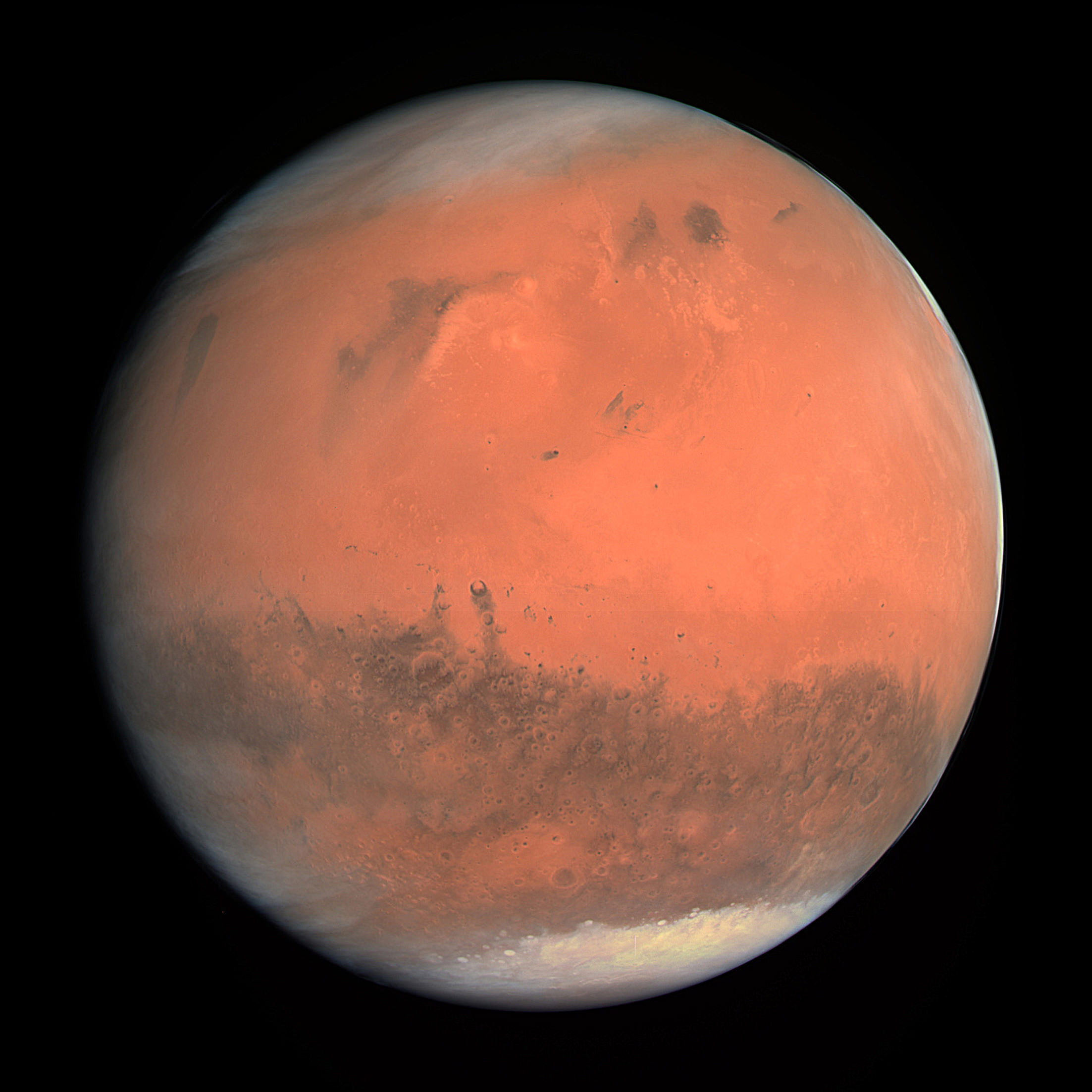
Some proponents of human missions to Mars say we have the technology today to send people to the Red Planet. But do we? Rob Manning of the Jet Propulsion Laboratory discusses the intricacies of entry, descent and landing and what needs to be done to make humans on Mars a reality.
There’s no comfort in the statistics for missions to Mars. To date over 60% of the missions have failed. The scientists and engineers of these undertakings use phrases like “Six Minutes of Terror,” and “The Great Galactic Ghoul” to illustrate their experiences, evidence of the anxiety that’s evoked by sending a robotic spacecraft to Mars — even among those who have devoted their careers to the task. But mention sending a human mission to land on the Red Planet, with payloads several factors larger than an unmanned spacecraft and the trepidation among that same group grows even larger. Why?
Nobody knows how to do it.
Surprised? Most people are, says Rob Manning the Chief Engineer for the Mars Exploration Directorate and presently the only person who has led teams to land three robotic spacecraft successfully on the surface of Mars.
“It turns out that most people aren’t aware of this problem and very few have worried about the details of how you get something very heavy safely to the surface of Mars,” said Manning.
He believes many people immediately come to the conclusion that landing humans on Mars should be easy. After all, humans have landed successfully on the Moon and we can land our human-carrying vehicles from space to Earth. And since Mars falls between the Earth and the Moon in size, and also in the amount of atmosphere it has then the middle ground of Mars should be easy. “There’s the mindset that we should just be able to connect the dots in between,” said Manning.
But as of now, the dots will need to connect across a large abyss.
“We know what the problems are. I like to blame the god of war,” quipped Manning. “This planet is not friendly or conducive for landing.”
The real problem is the combination of Mars’ atmosphere and the size of spacecraft needed for human missions. So far, our robotic spacecraft have been small enough to enable at least some success in reaching the surface safely. But while the Apollo lunar lander weighed approximately 10 metric tons, a human mission to Mars will require three to six times that mass, given the restraints of staying on the planet for a year. Landing a payload that heavy on Mars is currently impossible, using our existing capabilities. “There’s too much atmosphere on Mars to land heavy vehicles like we do on the moon, using propulsive technology completely,” said Manning, “and there’s too little atmosphere to land like we do on Earth. So, it’s in this ugly, grey zone.”
But what about airbags, parachutes, or thrusters that have been used on the previous successful robotic Mars missions, or a lifting body vehicle similar to the space shuttle?
None of those will work, either on their own or in combination, to land payloads of one metric ton and beyond on Mars. This problem affects not only human missions to the Red Planet, but also larger robotic missions such as a sample return. “Unfortunately, that’s where we are,” said Manning. “Until we come up with a whole new trick, a whole new system, landing humans on Mars will be an ugly and scary proposition.”
Road Mapping
In 2004 NASA organized a Road Mapping session to discuss the current capabilities and future problems of landing humans on Mars. Manning co-chaired this event along with Apollo 17 astronaut Harrison Schmitt and Claude Graves, who has since passed away, from the Johnson Space Center. Approximately 50 other people from across NASA, academia and industry attended the session. “At that time the ability to explain these problems in a coherent way was not as good,” said Manning. “The entry, descent and landing process is actually made up of people from many different disciplines. Very few people really understood, especially for large scale systems, what all of the issues were. At the Road Mapping session we were able to put them all down and talk about them.”
The major conclusion that came from the session was that no one has yet figured out how to safely get large masses from speeds of entry and orbit down to the surface of Mars. “We call it the Supersonic Transition Problem,” said Manning. “Unique to Mars, there is a velocity-altitude gap below Mach 5. The gap is between the delivery capability of large entry systems at Mars and the capability of super-and sub-sonic decelerator technologies to get below the speed of sound.”
Plainly put, with our current capabilities, a large, heavy vehicle, streaking through Mars’ thin, volatile atmosphere only has about ninety seconds to slow from Mach 5 to under Mach 1, change and re-orient itself from a being a spacecraft to a lander, deploy parachutes to slow down further, then use thrusters to translate to the landing site and finally, gently touch down.
No Airbags
When this problem is first presented to people, the most offered solution, Manning says, is to use airbags, since they have been so successful for the missions that he has been involved with; the Pathfinder rover, Sojourner and the two Mars Exploration Rovers (MER), Spirit and Opportunity.
But engineers feel they have reached the capacity of airbags with MER. “It’s not just the mass or the volume of the airbags, or the size of the airbags themselves, but it’s the mass of the beast inside the airbags,” Manning said. “This is about as big as we can take that particular design.”
In addition, an airbag landing subjects the payload to forces between 10-20 G’s. While robots can withstand such force, humans can’t. This doesn’t mean airbags will never be used again, only that airbag landings can’t be used for something human or heavy.
Even the 2009 Mars Science Laboratory (MSL) rover, weighing 775 kilograms (versus MER at 175.4 kilograms each) requires an entirely new landing architecture. Too massive for airbags, the small-car sized rover will use a landing system dubbed the Sky Crane. “Even though some people laugh when they first see it, my personal view is that the Sky Crane is actually the most elegant system we’ve come up with yet, and the simplest,” said Manning. MSL will use a combination of a rocket-guided entry with a heat shield, a parachute, then thrusters to slow the vehicle even more, followed by a crane-like system that lowers the rover on a cable for a soft landing directly on its wheels. Depending on the success of the Sky Crane with MSL, it’s likely that this system can be scaled for larger payloads, but probably not the size needed to land humans on Mars.
Atmospheric Anxiety and Parachute Problems
“The great thing about Earth,” said Manning “is the atmosphere.” Returning to Earth and entering the atmosphere at speeds between 7-10 kilometers per second, the space shuttle, Apollo and Soyuz capsules and the proposed Crew Exploration Vehicle (CEV) will all decelerate to less than Mach 1 at about twenty kilometers above the ground just by skimming through Earth’s luxuriously thick atmosphere and using a heat shield. To reach slower speeds needed for landing, either a parachute is deployed, or in the case of the space shuttle, drag and lift allow the remainder of the speed to bleed away.
But Mars’ atmosphere is only one per cent as dense as Earth’s. For comparison, Mars atmosphere at its thickest is equivalent to Earth’s atmosphere at about 35 kilometers above the surface The air is so thin that a heavy vehicle like a CEV will basically plummet to the surface; there’s not enough air resistance to slow it down sufficiently. Parachutes can only be opened at speeds less than Mach 2, and a heavy spacecraft on Mars would never go that slow by using just a heat shield. “And there are no parachutes that you could use to slow this vehicle down,” said Manning. “That’s it. You can’t land a CEV on Mars unless you don’t mind it being a crater on the surface.”
That’s not good news for the Vision for Space Exploration. Would a higher lift vehicle like the space shuttle save the day? “Well, on Mars, when you use a very high lift to weight to drag ratio like the shuttle,” said Manning, “in order to get good deceleration and use the lift properly, you’d need to cut low into the atmosphere. You’d still be going at Mach 2 or 3 fairly close to the ground. If you had a good control system you could spread out your deceleration to lengthen the time you are in the air. You’d eventually slow down to under Mach 2 to open a parachute, but you’d be too close to the ground and even an ultra large supersonic parachute would not save you.”
Supersonic parachute experts have concluded that to sufficiently slow a large shuttle-type vehicle on Mars and reach the ground at reasonable speeds would require a parachute one hundred meters in diameter.
“That’s a good fraction of the Rose Bowl. That’s huge,” said Manning. “We believe there’s no way to make a 100-meter parachute that can be opened safely supersonically, not to mention the time it takes to inflate something that large. You’d be on the ground before it was fully inflated. It would not be a good outcome.”
Heat Shields and Thrusters
It’s not that Mars’ atmosphere is useless. Manning explained that with robotic spacecraft, 99% of the kinetic energy of an incoming vehicle is taken away using a heat shield in the atmosphere. “It’s not inconceivable that we can design larger, lighter heat shields,” he said, “but the problem is that right now the heat shield diameter for a human-capable spacecraft overwhelms any possibility of launching that vehicle from Earth.” Manning added that it would almost be better if Mars were like the moon, with no atmosphere at all.
If that were the case, an Apollo-type lunar lander with thrusters could be used. “But that would cause another problem,” said Manning, “in that for every kilogram of stuff in orbit, it takes twice as much fuel to get to the surface of Mars as the moon. Everything is twice as bad since Mars is about twice as big as the moon.” That would entail a large amount of fuel, perhaps over 6 times the payload mass in fuel, to get human-sized payloads to the surface, all of which would have to be brought along from Earth. Even on a fictitious air-less Mars that is not an option.
But using current thruster technology in Mars’ real, existing atmosphere poses aerodynamic problems. “Rocket plumes are notoriously unstable, dynamic, chaotic systems,” said Manning. “Basically flying into the plume at supersonics speeds, the rocket plume is acting like a nose cone; a nose cone that’s moving around in front of you against very high dynamic pressure. Even though the atmospheric density is very low, because the velocity is so high, the forces are really huge.”
Manning likened theses forces to a Category Five hurricane. This would cause extreme stress, with shaking and twisting that would likely destroy the vehicle. Therefore using propulsive technology alone is not an option.
Using thrusters in combination with a heat shield and parachute also poses challenges. Assuming the vehicle has used some technique to slow to under Mach 1, using propulsion just in last stages of descent to gradually adjust the lander’s trajectory would enable the vehicle to arrive very precisely at the desired landing site. “We’re looking at firing thrusters less than 1 kilometer above the ground. Your parachute has been discarded, and you see that you are perhaps 5 kilometers south of where you want to land,” said Manning. “So now you need the ability to turn the vehicle over sideways to try to get to your landing spot. But this may be an expensive option, adding a large tax in fuel to get to the desired landing rendezvous point.”
Additionally, on the moon, with no atmosphere or weather, there is nothing pushing against the vehicle, taking it off target, and a la Neil Armstrong on Apollo 11, the pilot can “fly out the uncertainties” as Manning called it, to reach a suitable or desired landing site. On Mars, however, the large variations in the density of the atmosphere coupled with high and unpredictable winds conspire to push vehicles off course. “We need to have ways to fight those forces or ways to make up for any mis-targeting using the propulsion system,” said Manning. “Right now, we don’t have that ability and we’re a long way from making it happen.”
Supersonic Decelerators
The best hope on the horizon for making the human enterprise on Mars possible is a new type of supersonic decelerator that’s only on the drawing board. A few companies are developing a new inflatable supersonic decelerator called a Hypercone.
Imagine a huge donut with a skin across its surface that girdles the vehicle and inflates very quickly with gas rockets (like air bags) to create a conical shape. This would inflate about 10 kilometers above the ground while the vehicle is traveling at Mach 4 or 5, after peak heating. The Hypercone would act as an aerodynamic anchor to slow the vehicle to Mach 1.
Glen Brown, Chief Engineer at Vertigo, Inc. in Lake Elsinore, California was also a participant in the Mars Road Mapping session. Brown says Vertigo has been doing extensive analysis of the Hypercone, including sizing and mass estimates for landers from four to sixty metric tons. “A high pressure inflatable structure in the form a of a torus is a logical way to support a membrane in a conical shape, which is stable and has high drag at high Mach numbers,” Brown said, adding that the structure would likely be made of a coated fabric such as silicon-Vectran matrix materials. Vertigo is currently competing for funding from NASA for further research, as the next step, deployment in a supersonic wind tunnel, is quite expensive.
The structure would need to be about thirty to forty meters in diameter. The problem here is that large, flexible structures are notoriously difficult to control. At this point in time there are also several other unknowns of developing and using a Hypercone.
One train of thought is that if the Hypercone can get the vehicle under Mach 1, then subsonic parachutes could be used, much like the ones employed by Apollo, or that the CEV is projected to use to land on Earth. However, it takes time for the parachutes to inflate, and subsequently there would only be a matter of seconds of use, allowing time to shed the parachutes before converting to a propulsive system.
“You’d also need to use thrusters,” said Manning. “You’re falling 10 times faster because the density of Mars’ atmosphere is 100 times less than Earth’s. That means that you can’t just land with parachutes and touch the ground. You’d break people’s bones, if not the hardware. So you need to transition from a parachute system to an Apollo-like lunar legged lander sometime before you get to the ground.”
Manning believes that those who are immersed in these matters, like himself, see the various problems fighting each other. “It’s hard to get your brain around all these problems because all the pieces connect in complex ways,” he said. “It’s very hard to see the right answer in your mind’s eye.”
The additional issues of creating new lightweight but strong shapes and structures, with the ability to come apart and transform from one stage to another at just the right time means developing a rapid-fire Rube Goldberg-like contraption.
“The honest truth of the matter,” said Manning, “is that we don’t have a standard canonical form, a standard configuration of systems that allows us to get to the ground, with the right size that balances the forces, the loads, the people, and allows us to do all the transformation that needs to be done in the very small amount of time that we have to land.”
Other Options and Issues
Another alternative discussed at the 2004 Mars Road Mapping session was the space elevator.
“Mars is really begging for a space elevator,” said Manning. “I think it has great potential. That would solve a lot of problems, and Mars would be an excellent platform to try it.” But Manning admitted that the technology needed to suspend a space elevator has not yet been invented. The issues with space elevator technology may be vast, even compared with the challenges of landing.
Despite these known obstacles, there are few at NASA currently spending any quality time working on any of the issues of landing humans on Mars.
Manning explained, “NASA does not yet have the resources to solve this problem and also develop the CEV, complete the International Space Station and do the lunar landing systems development at the same time. But NASA knows that this is on its plate of things to do in the future and is just beginning to get a handle on the needed technology developments. I try to go out of my way to tell this story because I’m encouraging young aeronautical engineering students, particularly graduate students, to start working on this problem on their own. There is no doubt in my mind that with their help, we can figure out how to make reliable human-scale landing systems work on Mars.”
While there is much interest throughout NASA and the space sector to try to tackle these issues in the ensuing years, technology also needs a few more years to catch up to our dreams of landing humans on Mars.
And this story, like all good engineering stories, will inevitably read like a good detective novel with technical twist and turns, scientific intrigue, and high adventure on another world.
This is an excellent article. I was not aware of the magnitude of the problems in landing on Mars before.
As for a space elevator, on our site on MSN groups, our folks came up with a solution that was elegant and simple.
Use the top of the Olympus Mons, which rises above the Martian atmosphere, as a landing base and run a train or trail to the plains from there.
Of course that is still a hugh project, but it reduces landing on Mars back to a lunar scale, and gives us access to the planet.
Building the trail or rail to the base of the mountain would be a huge project and perhaps would stimulate some serious off world colonization.
The colony would require crops and support infrastructure, so at the least it would be semi permanent.
Just a thought.
Again, Thanks for your article.
No, this is a great article. And no, the space elevator will not work because even the X-Prize challenges have not been completed yet. After reading this article, I feel enlightened and depressed at the same time.
It’s refreshing to read an article about the challenges of landing larger payloads on Mars rather than what seems to have been more typical treatment of this issue, namely ‘landing is impossible and a waste of money.’ This article is a reality check and at the same time asks us to think outside the box in identifying alternate means of landing heavy / human-rated payloads on Mars. After reading this, perhaps space elevator plans really would be best. The issues fall away with a space elevator, and the masses sent down or brought up could eventually be enormous. Based on current work being done in this area, we could see a rudimentary space elevator here on Earth within 15 years, and at NASA’s pace, that technology could supersede their eventual heavy Mars lander plans anyway.
this is too long
its so crap !!!!!
For Robert Browning,
Where can I read about your Olympus Mons plans?
A fantastic article that I missed the first time round. Thanks. Ignore the trolls. :/
Has anyone considered using a “space balloon” of sorts? Both for braking and landing.
Great article, loved it. 🙂
On earth, a space elevator tether requires a breaking strength of 50 gigipascals to be practical. But a big part of that requirement is the 24,000 mile length of cable mass that must be supported. We don’t even need a geosync orbit at mars. We could lower a tether from low Mars orbit, such that the tether end is traveling in the upper reaches of the Martian atmosphere at sub sonic speeds, to drop the load at a reasonable landing speed. The tether need only be interacting with the Martian atmosphere while actually dropping a load or picking one up, as it can be retracted as it’s no longer needed and thus drag on the orbital craft can be minimized.
GAry 7
A rotating tether can be lowered from a very low orbit to something like Olympus Mons in a way that the tether achieves zero speed relative to the ground for many seconds at a time, allowing both the lowering and the raising of loads from the surface. The same can be done on Earth, but the problem is much more difficult with our higher minimum orbit and much greater atmospheric density. Since the atmospheric density on top of Olympus Mons(26 kilometers) is about that found in Earth’s atmosphere at around 60 kilometers, a satellite would probably only have to lower a cable for about 30 or 40 kilometers to drop or pick up an object on the surface of Olympus Mons. The base for such operations could be Phobos, since it is the most likely to contain water, or we could use Deimos, since it stays above a particular area for a much longer time, making communication and control much easier. Either way, the satellite doing the tether swinging would have much, much lower requirements than any satellite swinging a tether down to Earth, and the tether likewise. Also, since both Phobos and Deimos are carbonaceous chondrites, carbon for tethers would be quite available on site.
In any case, no manned flight should try to proceed directly to Mars. Establishing a base on Phobos and/or Deimos would be quite easy, and allow for using local resources for the final steps, both up and down, while allowing astronauts to more easily return to Earth until a permanent presence could be established.
Great input, rarchimedes
. I would like to insert your comment or at least put a link from the Bad Astronomer blog. Propagating such insights is the way to new paradigms. Maybe someone at NASA has already picked up on it???
GAry 7
landing on mars requires enough propulsive braking using retro rockets
to shed 11000 mph starting in mars orbit .
with a chemical rocket burning h2 +
o2 this requires a 3/1 mass ratio in
a mars landing vehicle. The best solution is use nuclear thermal rocket propulsion
for going to mars.The critics are not objective and they have a pre ordained conclusion that fits their radical left wing political ideaology against everything nuclear and against manned space flight .
That is what the truth is.
mars escape velocity is 11000 mph orbital
velocity about 70 % of this value,but you need extra fuel for course corrections
on the way down from orbit.
tim
chemical rockets are almost totally useless for crewed interplanetary spaceflight . This requires nuclear propulsion, and nuclear power.
tim
this was very insteresting and informal to listne to although the other day a space shuttle landed on mars and needed inforamtion about that please help kind regards jaz
Fab article, many thanks, enjoyed the read.
I agree with many of the comments stating that next generation fuels is the way to go.
The most substantial problem to over come in a Mars landing is deceleration, which requires extra fuel, which means extra weight on launch and thus tending towards prohibitive costs.
However clean nuclear fuels such as the proton/boron11 or even possibly Helium3/Helium3 (If we can ever refine enough) would provide substantially more power/weight ratio.
Focus fusion is a very promissing step towards using these future fuels.
It is a great shame that £4 billion has been cut from the UK physics budget this year and the USA is suffering just as badly from funding cuts.
There is also a novel comment by rarchimedes, good stuff.
Keep up the fab work!
Loved the article and rarchimedes’ reply. I have always thought that use of the 2 moons should feature in any Mars manned mission, either as a place to park in orbit, or to source some of the materials needed.
I have also thought that the mission would need several parts landed separately,utilizing relevant and tried landing technologies for the non-human components.
I agree with tether concept..it’s an elegant solution and material science can help with the cable tech.
As previously said any infrastructure work can/will be done in layers
robotics first since the technicalities needed to land small robotics is well developed..
Funding might be easier if key technologies such as inflatable structures for extreme environments would be obvious candidates for spin-offs applicable for widespread use here on Earth and elsewhere. High speed Construction technologies would valuable in may places.
Cutting the weight of payloads by making components more space efficient might help where every bit helps:
example: using lightweight formwork and CO2 activated foams to build structures and seals by using the locally available materials to build airtight structures.
Another weight saving measure: locate some basecamp near ot at high concentrations of dry ice to facilitate chemical production of rocket fuel.
Back to the tether concept: more and more elegant
Since exploratory craft would be based in orbit for the tether
why not tack on a photovoltaic solar array and add a few super-conduction conduits.. to beam down gigawatts of power to the surface which might be used fir chemical conversions.
Another obvious candidate for funding.. since obviously this has great spin-off potential..
I agree with this article – we don’t have the technology to land people on Mars yet. I would actually go further. Manned missions to Mars are complete moonshine at the moment because :
1. A 3 year round trip – no mechanical system ever designed is this reliable. The ISS crew couldn’t fix the toilet without a repair kit from earth.
2. Radiation would kill the crew – if not during the mission anyone going would know that they would probably die prematurely afterwards.
3. The crew would be multinational and politics would play a large part in selection. Would such a crew really be able to remain sane, healthy and effective – or would cabin fever set in ?
4. As the article mentions there are serious issues with actually landing on Mars. Neil Armstrong turned off the autopilot and nearly ran out of fuel landing on manual. He was very skilled in bringing Eagle down safely – and lucky. But can we afford to depend on luck ?
People will go to Mars – but probably not for another 50 years. Of I was a politician I would only fund a manned Mars mission (beginning with orbital flight with no landing) if we had the technology to :
(a) Get there in a month, not a year. Advanced nuclear propulsion systems are a necessity, nuclear thermal isn’t good enough. Need exhaust velocities 10 times higher than current chemical rockets.
(b) Have more than enough ship shielding to protect the crew.
(c) Transport all hardware and living quarters to the surface before the crew get there – minimises the landing weight problem.
(d) have completed an unmanned test flight schedule that demonstrates all this.
“There’s no comfort in the statistics for missions to Mars.”
Simplest would be to send transport pods to Mars orbit awaiting humans to set up for landing. Fuel, equipment, and the needs for life to be included. No reason a transport pod can’t be assembled in Earth orbit with podlets that would be able to use the airbags and drop greater quantities of small-sized gear from a main frame. A control pod or a manned orbiting station could be used to gather the pods into a central location. Even a Mars lander and takeoff vehicle could be sent remotely. It take a lot less energy to put a package in Mars orbit than land.
Why must the transporter enter Mars’ orbit at Mach-5? Couldn’t the vehicle slow down sufficiently to get in orbit around the red planet and then a pod vehicle with crew and supplies be released, at a substantially lower speed, thereby ameliorating some of the difficulties associated with deceleration? Alternatively, couldn’t the transport “skim” the atmosphere of Mars, gradually descending and decelerating as it completes a number of orbits?
Even at Mars atmospheric density, a 10m heat shield should drop a 5 metric ton craft from Mach 5 in around a minute, with a peak acceleration briefly on the order of 10G?
So it sounds like the problem is really just to avoid “hitting Mars” (falling too fast) during that critical minute or so of aerobraking.
Instead of using thrusters to brake “horizontal” velocity, why not use them only to slow the rate of descent? I.e. thrust vertically during aerobraking to maintain altitude and limit vertical velocity – then land with a combination of rocket and parachute for a fast but controlled descent that minimizes rocket fuel.
why not a single human, with an oversized thrusterpack, deploying a inflatable nose cone type device then a chute? I think if you played with the numbers it could work good.
excellent article any thoughts i may have had about using a front mounted rocket system to slow the shuttles speed in the thin martian atmosphere have been put to rest. oh and ivor weener the article was too long for you because you know nothing and are totally ignorant to the point you can’t actually read this from someone who knows exactly what they are talking about!!!
great article once again and keep up the good work
matt
Very nice article!
“1. A 3 year round trip – no mechanical system ever designed is this reliable. The ISS crew couldn’t fix the toilet without a repair kit from earth.
2. Radiation would kill the crew – if not during the mission anyone going would know that they would probably die prematurely afterwards.
3. The crew would be multinational and politics would play a large part in selection. Would such a crew really be able to remain sane, healthy and effective – or would cabin fever set in ?”
A perfect sample of the kind of misconceptions found among armchair novices.
1.) No mechanical devices made that reliable? How about the Voyager spacecraft? Made decades ago, and it has lasted decades. Any mission would have triple redundancy anyway.
2.) Radiation would not kill the crew. You are simply wrong here. But even if we want to reduce radiation, we could simply provide an inner room surrounded by the several tons of water needed for the mission.
3.) The crew would probably be all American. Or all Russian, or all Chinese. No nation is going to pay for this project then not send their own people. And the ISS demonstrated that cooperation is more expensive than taking a project on your own.
We have had people stay in space for over a year, working well with others. Sure it isnt the most fun thing ever. But getting to go to mars is a good incentive.
I agree with you on one point: we are unlikely to go to mars any time soon. But not because the challenges are all too great, rather it is because even people with a basic understanding of space exploration, have huge misconceptions. Read a book some time. I suggest “The Case for Mars.”
The greatest barrier to manned exploration to mars is the lack of effort, lack of motivation, and the misconceptions. Lousy articles like this one certainly dont help.
oh my god i got an idea,what if first they send an unmanned spacecraft to mars that contains a giant bouncy castle(landing site)
and pump air through it and when the crew come they would bash into it .but before that they could try to slow dow with parachutes and thrusters. oh and 1 question out of the topic,how long would it take to get to mars by using antimatter rockets?
Real science doesn’t need humans in Earth orbit much less on Mars. The ISS is a $100 billion waste of money. Sending people to Mars would simply be folly.
We have great machines called computers that are already doing a brilliant job of Martian exploration. Let’s stick with what works and leave the childish fantasies of ‘Wagon Train to the Stars’ to Hollywood.
As much as I would like to see men on Mars, it’s clear we will have to start with the Moon as a means of gaining experience. As for Mars, it might be feasible to use Phobos or Deimos as natural “space stations” to serve as staging points to prepare to land on Mars using smaller vehicles which can utilize present methods to reach the surface, and then put together the units like “Lego” blocks for the various requirements. All we need are lots of time and $$$$$.
I’m surprised that the article made no reference to the detailed humans-to-Mars ideas contained in the book “The Case For Mars” by Robert Zubrin.