 Universe Today
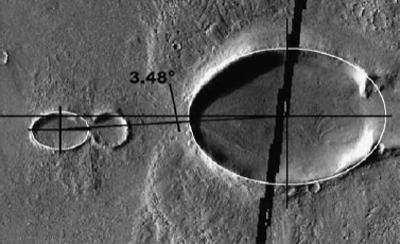
[/caption]Was there a third Martian moon orbiting the planet? Did Phobos and Deimos have a triplet sibling? According to the discovery of two elliptical impact craters, there might just have been another moon, but it ploughed into the Red Planet's surface a long time ago. The moonlet would have been approximately 1.5 km wide (0.9 miles), and it will have succumbed to the Mars gravity, entering the atmosphere at a shallow angle. As it tumbled through the atmosphere it broke in two, hitting the surface and creating two elongated impact craters, near-perfectly aligned.
It is thought that the "third moon" of Mars dropped from orbit a billion years ago and the same will happen with Phobos in a few million years. However, there might be another explanation, with no third moonlet in sight...
Observations of the Martian surface, just north of Olympus Mons, show two oval-shaped craters (
pictured top
). Usually impact craters are approximately circular, so the elongated craters indicate the impactor(s) entered the atmosphere at a very shallow angle. This isn't the only strange characteristic of these two craters. They lie 12.5 km (7.8 miles) apart and they are almost exactly aligned from east to west (they are off-alignment by only 3.48°). The larger crater is 10 km (6.2 miles) wide at its longest point, and the smaller crater is 3km (1.9 miles) wide.
There are two possible answers to this puzzle, but researchers are having a hard time in agreeing on which one. In a
recent publication
, John Chappelow and Rob Herrick of the University of Alaska, Fairbanks, have calculated that the impact craters were caused by a small moon that entered the atmosphere, broke into two (due to atmospheric drag) and then struck the surface at an oblique angle of 10° or less. The moonlet would have been 1.5 km (0.9 miles) in diameter. This sounds feasible, after all for both craters to be aligned, one would think they came from the same mass, right?
[caption id="attachment_20065" align="alignleft" width="250" caption="The lunar Messier craters (NASA)"]
[/caption]This moon-impact theory has a few drawbacks however. The first problem is that the impact craters are located at 40° latitude in Mars' northern hemisphere. One would expect natural satellites to orbit around the equatorial plane if their orbits are stable (hovering around 0° latitude). "
Any close natural satellite must, like Phobos, orbit in Mars's equatorial plane
," said Jay Melosh, a crater expert at the University of Arizona in Tucson, who is highly sceptical of Chappelow and Herrick's findings.
However, Herrick believes that the moonlet may not have established a stable orbit, above the equator. "
We don't know the details of the [moonlet's] capture mechanism, so I don't know that we can definitively say that the object must have moved to an equatorial orbit before spiralling in
," countered Herrick.
[caption id="attachment_20066" align="alignleft" width="250" caption="Artist impression of binary asteroid 90 Antiope (ESO)"]
[/caption]Melosh argues that the craters may have been caused by a binary asteroid (or "double asteroids") entering the Martian atmosphere at a very shallow angle. After all, there is a confirmed example of a binary asteroid impact on the Moon (a.k.a. the Messier craters on the Moon,
pictured above
). Chappelow however disputed this claim saying, "
In such a case, the craters should be oriented randomly
." After all, wouldn't the binary asteroid have a randomly oriented orbital plane?
Apparently not. It appears that over hundreds of thousands of years of asteroid evolution, the effect of sunlight has a huge role to play in the dynamics of binary asteroid formation. A process known as the "Yarkovsky-O'Keefe-Radzievskii-Paddack Effect," or the
YORP Effect
, causes the uneven heating of an asteroid. Carrying a tiny jolt of momentum, photons are emitted from the surface in jets, eventually causing the asteroid to spin. Eventually a piece of rock breaks loose, forming the binary asteroid. It would appear there is an observed trend for the majority of binary asteroids to orbit in the same plane as the rest of the Solar System.
So it seems possible that a binary asteroid
could
create the two elongated and aligned impact craters after all.
Regardless, whether a third moon or binary asteroid hit Mars, it will be of little comfort to Phobos. The moon (with a mean radius of 11 km) is slowly dropping in altitude due to tidal forces. In about 11 million years it will either crash into Mars or be ripped apart through gravitational shear. Either way, Phobos is a doomed moon.
Space.com