

This article was originally written in 2008, but we created a cool video to go along with it yesterday
Let’s find out why Pluto is no longer considered a planet.
Pluto was first discovered in 1930 by Clyde W. Tombaugh at the Lowell Observatory in Flagstaff Arizona. Astronomers had long predicted that there would be a ninth planet in the Solar System, which they called Planet X. Only 22 at the time, Tombaugh was given the laborious task of comparing photographic plates. These were two images of a region of the sky, taken two weeks apart. Any moving object, like an asteroid, comet or planet, would appear to jump from one photograph to the next.
After a year of observations, Tombaugh finally discovered an object in the right orbit, and declared that he had discovered Planet X. Because they had discovered it, the Lowell team were allowed to name it. They settled on Pluto, a name suggested by an 11-year old school girl in Oxford, England (no, it wasn’t named after the Disney character, but the Roman god of the underworld).
The Solar System now had 9 planets.
Astronomers weren’t sure about Pluto’s mass until the discovery of its largest Moon, Charon, in 1978. And by knowing its mass (0.0021 Earths), they could more accurately gauge its size. The most accurate measurement currently gives the size of Pluto at 2,400 km (1,500 miles) across. Although this is small, Mercury is only 4,880 km (3,032 miles) across. Pluto is tiny, but it was considered larger than anything else past the orbit of Neptune.
Over the last few decades, powerful new ground and space-based observatories have completely changed previous understanding of the outer Solar System. Instead of being the only planet in its region, like the rest of the Solar System, Pluto and its moons are now known to be just a large example of a collection of objects called the Kuiper Belt. This region extends from the orbit of Neptune out to 55 astronomical units (55 times the distance of the Earth to the Sun).
Astronomers estimate that there are at least 70,000 icy objects, with the same composition as Pluto, that measure 100 km across or more in the Kuiper Belt. And according to the new rules, Pluto is not a planet. It’s just another Kuiper Belt object.
Here’s the problem. Astronomers had been turning up larger and larger objects in the Kuiper Belt. 2005 FY9, discovered by Caltech astronomer Mike Brown and his team is only a little smaller than Pluto. And there are several other Kuiper Belt objects in that same classification.
Astronomers realized that it was only a matter of time before an object larger than Pluto was discovered in the Kuiper Belt.
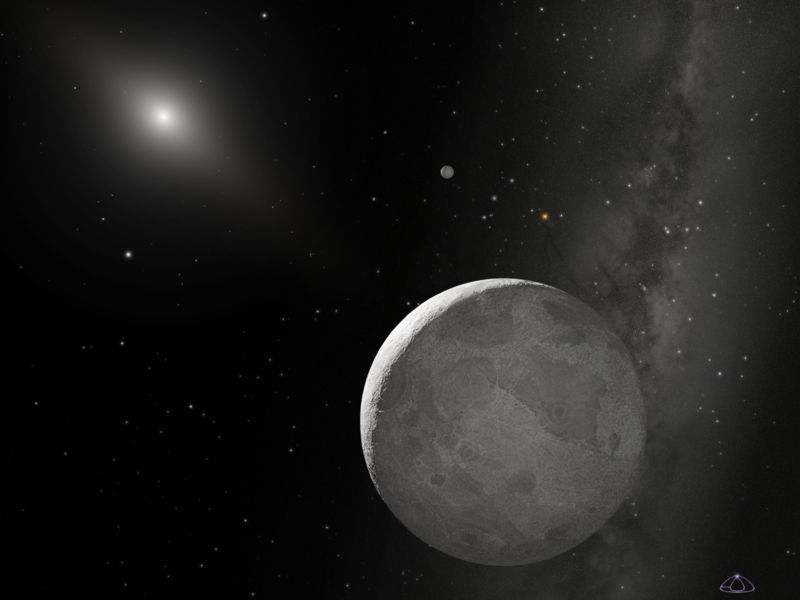 And in 2005, Mike Brown and his team dropped the bombshell. They had discovered an object, further out than the orbit of Pluto that was probably the same size, or even larger. Officially named 2003 UB313, the object was later designated as Eris. Since its discovery, astronomers have determined that Eris’ size is approximately 2,600 km (1,600 miles) across. It also has approximately 25% more mass than Pluto.
With Eris being larger, made of the same ice/rock mixture, and more massive than Pluto, the concept that we have nine planets in the Solar System began to fall apart. What is Eris, planet or Kuiper Belt Object; what is Pluto, for that matter? Astronomers decided they would make a final decision about the definition of a planet at the XXVIth General Assembly of the International Astronomical Union, which was held from August 14 to August 25, 2006 in Prague, Czech Republic.
Astronomers from the association were given the opportunity to vote on the definition of planets. One version of the definition would have actually boosted the number of planets to 12; Pluto was still a planet, and so were Eris and even Ceres, which had been thought of as the largest asteroid. A different proposal kept the total at 9, defining the planets as just the familiar ones we know without any scientific rationale, and a third would drop the number of planets down to 8, and Pluto would be out of the planet club. But, then… what is Pluto?
In the end, astronomers voted for the controversial decision of demoting Pluto (and Eris) down to the newly created classification of “dwarf planet”.
Is Pluto a planet? Does it qualify? For an object to be a planet, it needs to meet these three requirements defined by the IAU:
- It needs to be in orbit around the Sun – Yes, so maybe Pluto is a planet.
- It needs to have enough gravity to pull itself into a spherical shape – Pluto…check
- It needs to have “cleared the neighborhood” of its orbit – Uh oh. Here’s the rule breaker. According to this, Pluto is not a planet.
What does “cleared its neighborhood” mean? As planets form, they become the dominant gravitational body in their orbit in the Solar System. As they interact with other, smaller objects, they either consume them, or sling them away with their gravity. Pluto is only 0.07 times the mass of the other objects in its orbit. The Earth, in comparison, has 1.7 million times the mass of the other objects in its orbit.
Any object that doesn’t meet this 3rd criteria is considered a dwarf planet. And so, Pluto is a dwarf planet. There are still many objects with similar size and mass to Pluto jostling around in its orbit. And until Pluto crashes into many of them and gains mass, it will remain a dwarf planet. Eris suffers from the same problem.
It’s not impossible to imagine a future, though, where astronomers discover a large enough object in the distant Solar System that could qualify for planethood status. Then our Solar System would have 9 planets again.
Even though Pluto is a dwarf planet, and no longer officially a planet, it’ll still be a fascinating target for study. And that’s why NASA has sent their New Horizons spacecraft off to visit it. New Horizons will reach Pluto in July 2015, and capture the first close-up images of the (dwarf) planet’s surface.
Space enthusiasts will marvel at the beauty and remoteness of Pluto, and the painful deplaneting memories will fade. We’ll just be able to appreciate it as Pluto, and not worry how to categorize it. At least now you know why Pluto was demoted.
If you’d like more information about Pluto, we did two podcasts on this topic at Astronomy Cast. The first discusses the IAU’s decision, and the second is about Pluto and the Icy Outer Solar System. Check them out.
Here is much more info about Pluto, including pictures of Pluto.
References:
NASA Solar System Exploration Guide
Caltech
The most accurate measurement currently pegs Pluto at 1,195 km (743 miles) across. Although this is small, Mercury is only 2,440 km (1,516 miles) across.
I think those are radii, not diameters. Same for Eris.
I thought that Pluto is not even considered its own planet, even in the dwarf category.
I am under the impression that Pluto and its counterpart, Chiron, rotate around a shared center of gravity, thus making it a binary system. Why am I thinking that Pluto-Chiron is classified by the IAU as a “Double Dwarf Planet?”
Pluto is made up of the same materials as Uranus, Neptune, Titian, and Triton. This is only one factor that determines the type of planet it is. Mass is a second factor. Clearly, Pluto lacks the ice giants mass, but has enough to be round. Location is another. Pluto was exiled early the solar system’s history to the Kuiper Belt.
The Neptune Effect made the current configuration of the solar system. It moved the ice giants, Uranus and Neptune to the outer solar system with Pluto and probably Eris.
Dwarf stars are still considered stars. Dwarf galaxies are also considered galaxies. Pluto, Ceres, and Eris should be considered smaller planets. We are going to find a lot bigger objects out there. S. Alan Stern predicted Earth sized Kuiper Belt Objects. Let’s keep Astronomy honest. These are just a new class of planet. Stern believes they are the largest category of planets.
Sad? Really? I find it a great opportunity to demonstrate with a timely and easy example that scientific knowledge is provisional and changes as our understanding changes. It’s one of the best ways to steer learning minds clear of absolutism and dogma, which is often confused with actual science.
I was always excited by the idea of Pluto as a planet had gone un-noticed for a long time, but while the sentimentality of its status is lost, the change creates a great opportunity for education and understanding of science as a changing body of knowledge, not static.
Oops, you’re right. Thanks!
At least Bill Arnett had a sense of humor about it when his domain name proved to be incorrect (look at the title): http://nineplanets.org/
Plus he also had the foresight to add eightplanets.org to his stable to domain names.
For one side, you can be happy as you are not Pluto, who has the right to demoting it?
There are animal protection groups, Pluto would have to have its own. (That lazy astronomers…).
But yes, it could be more acurate to say that pluto and its neighbour are a planet in formation and the New Horizonts is of prime importance to study this medium.
Actually, I still think this definition makes very little sense. Not because of Pluto: Pluto’s status is, or should be, pretty much irrelevant in the debate, but because of other things:
– The “clearing the neighborhood” thing is totally arbitrary in what constitutes a “clean neighborhood”, or even a “neighborhood”.
– The fact that in our solar system planetary neighborhoods are clean, whatever that might mean, does not imply that the same is true in other planetary systems: theoretical studies have shown that 1:1 resonances between planets as large as gas giants are completely possible, and, given the vastness of space, what’s possible will almost certainly be found, somewhere. In my opinion, any definition of planet that isn’t universal or that excludes gas giants is… er… dumb.
– As planetary sistems evolve, neighborhoods become increasingly “cleaner” with time, in average. In young systems, you’ll have planets as large as the Earth, or even larger, with “dirty” neighborhoods, wereas in old systems, smaller and smaller bodies get their orbits cleaned up. Ceres might well become a planet some day, without changing the least bit.
– Furthermore, due to the shorter distances and faster speeds involved, neighborhoods clean up faster in the inner system than in the outer system. I find it hard to accept a definition that is capable of calling “planet” to a body that is at the same time smaller and less massive than another one just because it’s closer to its star.
– And so on.
So, personally I think the gravitationally caused roundness criterion would have been much, much sounder, even if it isn’t perfect. And after deciding that planets are thnigs forced to roundness by their own gravity, they should be subdivided in categories. The only real change would be that dwarf planets would be planets too, albeit dwarf. It even makes more linguistic sense than saying that dwarf planets are not planets.
I have to agree with Gorge on this one.
As far as I know as well, the definitions for the planet and dwarf planets are applicable to our solar system only.
I mean if we find a young system with a body larger than earth that is still in the middle of a plantery disc surrounded with dust, rocks and what other junk you may find, it isn’t classified as a planet until a much later date.
Seems to sound like a planet will go through a cycle much like a star being from main sequence to red giant, it will just take much less time for inner, terrestrial planets to gain the status, despite having massive jovian planets multiple hundreds of times larger still being classified a dwarf planet because they take much longer to orbit and may not have “cleaned” it up.
Should have just stuck with 9 planets and classify the KBO’s as what they are, KBO’s.
I think that, with a nod to a colorful history (Percival Lowell), we should just keep Pluto as a planet.
¿Por qué Plutón no es un planeta? Esta tiene que ser una de las preguntas más desgarradoras que me han hecho. Y me la preguntan seguido. Esperaba que algunos años después de que la Unión Astronómica Internacional (IAU) tomara esta decisión polémica, el debate decayera y la gente finalmente lo aceptara. Pero no, todavÃa es un asunto delicado para mucha gente. […] Fraser Cain para Universe Today
I’ve never understood why this gets people so worked up.
Wasn’t the thinking behind the “clears its orbit” criteria basically that there probably are a large number of probably spherical objects orbiting the sun, and it would become confusing if one day there were, say, 35 planets.
In that case we’d probably have to create a categorization of “major planets”, which would exclude pluto anyway.
I saw a good t-shirt the other day: it had a picture of Pluto with a sad looking face on it, and said: “Don’t worry Pluto – I’m not a planet either…”
But seriously…
Look, the term planet is just an arbitrary human classification anyway. In reality, nature is more continuous than discreet, and has more variety in its processes than we could ever hope to have a label for.
It reminds me of an interview with Richard Feynmann, where he was talking about how his father had taught him to look beyond superficial labels – it went something like this: His dad took him for a walk and showed him a bird. He said “people will tell you that that bird is a (insert name of bird here), but they don’t really know what it is or anything else about it. To know that, you have to actually look at what it is and what it does. How it behaves and acts. They are just giving it an arbitrary label.”
Do it is with the Pluto debate to a certain extent. Pluto is still there – it is an inanimate object. It doesn’t care what you call it, because it is what it is. We should be much more concerned about studying it, not getting worked up over precise definitions of it, no matter how useful such things may be to our very human need to classify everything into neat little compartments.
Yes, it is a controversial descision, and yes, the IAU definition certainly lacks, because how do you define ‘cleared out its orbital neighborhood’ in any quantitative way that is not completely arbitrary? But the fact is, Pluto is fundamentally different from those objects that we call ‘planets’ based on the available evidence, so it makes sense to classify it officially as such.
Personally, I could care less if its a “dwarf planet” or other wise. I do think that todays elementary school books should include ALL of these known massive solar bodies. When I was in school Pluto was a planet. But they also taught us in school that South America and Africa werent ever connected!! This is obviously ludicris now. We now know that at one time all the continents were one giant continent.
Anyway, my point being that schools should teach about all the massive solar objects beyond Neptune.
Infact, Im a little dissapointed in the fact that I wasnt taught about Varuna or Orcus or any of the objects beyond Neptune except Pluto 🙁
Even in a book I own (thats new btw) about astonomy, it doesnt even mention these other objects. Dwarf Planets, Planets, giant Astroids, I think they should all be in the same section.
And isn’t there also one called Ixion…?
Let’s not forget that the asteroid Ceres in the main asteriod belt between Mars and Jupiter is almost 600 miles in diameter and is spherical like a planet. It, like Pluto, meets only two of the three IAU criteria for defining a body as a planet. If Pluto is a planet than Ceres and all the outer dwarf planets must be full-fledged planets as well. Considering that there may be HUNDREDS of large spherical bodies not yet discoverd in the outer solar system, we better be happy with just Eight planets…I, for one, do not want to have to remember the names of the dozens and dozens of planets in our solar system the next time I play trivial pursuit!
Hi There,
Cleared its own orbit? Well even Jupiter has Trojans, small asteroids 60 degees ahead and behind the planet but they are there because of the gravity of Jupiter.
Also Pluto comes inside the orbit of Neptune for some 25 years and its inclination to the plane of the ecliptic is high. Two features that are not like conventional planets.
I like the idea of eight planets – for young kids it is easy to grasp, then when older they can be taught dwarf planets, then again asteroids and all the families of bits of rock that orbit our Sun.
What a mess!
A lot of people seem concerned with the “how many are there?, 8?, 9?, 12?” issue that has no scientific meaning.
Although I understand the criteria, the motivation behind it seems taylored to the “How many” issue, in result the current definition of planet is not very good beacause, with it, for you to classify an object, you must know where it is, how does it moves and what’s arround it.
This is not very practical; Check these examples:
Ex 1: Think of all those exoplanets that are being discovered… According to the current definition some of them might turn up to be “exo-dwarf-planets”… Ridiculous!
Ex 2: Imagine a planet arround a sun (A planet according to the current definition) imagine, then, that some astronomical phenomenon yanks this planet out of it’s orbit mantaining all it´s characteristics… And, since it no longer is orbiting a sun, then, no longer is a planet… Ridiculous!
I would favor separate classifications for what an object is and for where it is (and how does it move).
I would say that any object that is spherical due to it’s own gravity and it’s not ignited (like a sun) nor extremely dense should be called a planet.
With this defnition in mind we could, then, say that:
-Some planets are moons (beacause they orbit other planets – our Moon would be a planet);
-Some planets are free (because they’re not orbiting anything and are just wandering in space) – I’m sure these objects exist.
-Some planets dominate their orbit…
-Etc…
You would just need to see it to state: “This is a planet!”
Nuno
…And let’s face it…
A lot of them fires up our imagination (at least mine).
Wouldn’t it be more poetic to go on a turistic travel arround, say, Planet Ceres than the same turistic travel arround asteroid Ceres?
Nuno
I agree with the above responders, by my own objections – questions:
which other body is in Pluto’s orbit?
Charon is a Pluto`s satellite or Pluto-Charon is a “binary” planet (now an ex planet), as MANY binary stars, orbiting each other by them gravitational center.
A point with i will agree to this demotion, is that Pluto`s orbit is crossing the Neptune`s respective, as Ceres is crossing Earth`s, and it is an asteroid.
Finally as a Greek citizen i have emotional reasons, due to ancient Greeks history, when Pluto was the underworld`s God, ALL THE OTHER PLANETS are named with ancient Greek Gods.
I have a lot of detailed opinion I’ll spare you all, and offer this one observation.
Few planets have inspired an interest in astronomy more than Pluto. Declassifying Pluto is yet another uninspired decision that harms the public interest in a science that already has difficulty justifying public expense. There is a better classification than the one adopted, but even if they went with the new definition, there should have been a forth qualification:
“If previously categorized as a planet”. Then we keep Pluto as a planet, and are not inundated with scores of new planets.
Pluto is still the same, It doesn’t matter what people call it.
Whatever the accepted definition of a planet is, stuff in some other solar system will still be stuff in some other solar system. People like to put things into categories, and sometimes you can look past this.
John Molina: “I am under the impression that Pluto and its counterpart, Chiron, rotate around a shared center of gravity, thus making it a binary system”
In fact John, all systems rotate around a shared centre of mass, including the Earth and Moon, which is more properly referred to as the Earth-Moon system. In this case, the centre of mass is deep within the Earth, making it *appear* as though the moon “goes around the Earth”.
Even Jupiter and its moons rotate around each other, but of course the centre of mass in this system is right in the middle of Jupiter itself.
Personally I would not consider Jupiter and its moons to be a “binary” system. I would guess that a system could be considered “binary” if the centre of gravity is somewhere close to the middle of an imaginary line drawn between the 2 objects. Put another way, the mass ratio of the objects would be close to 1.
Of course the objects remain the same regardless of how one classifies them. But if we want a classification that has some scientific value, we better make it as good as it can get.
And the fact is that the only real and universal way to split what’s planet-like from what isn’t (in the lower-mass part of the scale) is roundess caused by self-gravity. It certainly isn’t perfect, surely we’ll have a small group of transitional objects (EL61, probably Vesta), and there are also factors such as constitution to take into account, but these are much smaller problems than all those that arise from the orbital clearing thing.
As for the number… why is it even a factor? To tailor a definition in order to keep a given number of objects in a category has absolutely nothing to do with sicence. A definition of what a planet is has to be about what it IS, not about how many fitting candidates there are. So what if the Solar System has hundreds of planets? Kids can’t memorize them all at school? What does that have to do with science?
In OUR solar system, there are eight known major planets, including 4 gas giants and 4 terrestrial planets (even though Mercury is fundamentally different from the other three). In what we know about OUR solar system there is a clear distinction between those and the dwarf planets, which are officially three but might be a lot more. But in OTHER solar systems there may well be no distinction at all, although we have so far only found big bodies, with the exception of those early pulsar planets. This is what kids at school should be taught. The parroting of the names may be cute, but it’s really not teaching them much.
The most absurd feature of this new nomenclature is that it is linguistic nonsense.
So, a dwarf planet is not a planet, then?
That’s as daft as saying that a brown cow is not a cow! This is such an obvious error that it beggars belief that a bunch of so-called intelligent people can come up with such a name; if you are going to have a different category of solar-system object, you need a separate word, like ‘planetoid’ or ‘pluton’.
I rest my case.
I still don’t understand why so many people has problems with the notion of having a lot of planets in our solar system.
The problem of having a manegeable list for educational purposes is hardly a good argument.
We have a lot of Stars out there and neither in education or public opinion the interest on studying them is weakened beacause there are so many. On the contrary! (We learn the names of a handful, but there’s no need to downsize catalogs).
If we absolutely need to downsize planet lists to “humanly interesting sizes”, try the folowing:
– The number of planets that can be seen with naked eye…
– The number of planets that can be studied with a small telescope…
Also find disappointing why people view the changes in designation as demotions or promotions.
We shouldn’t gain or loose interest on these objects in function to their classification.
I hope someday they change the current criteria, not beacause of Pluto, but because it goes arround the wrong premisses.
Nuno
The number of planets means nothing.
Clearing its neghborhood… Wah! Who cares?
I admit I was a little miffed when Pluto was demoted, only because it seemed like they were killing a long time friend.
Then I saw a show that Neil Degasse-Tyson explained how Pluto has an atmosphere the fades away as it aproaches the sun, which means Pluto is more like a permanent (sort of) long- long term comet. That made the Kuiper belt all that much more COOL and Pluto became a very unique and EVEN MORE cool friend again. When we finally get out there, we are going to find all kinds of great stuff, and THAT is all that matters to us space people. That means they’ll have to come up with a new category of Cometessimals or permanent Comets and stuff. We all love Pluto, lets give him his proper attention and congrats on his great new status as being truly unique!! At least until 2015- anyway!
I wish we’d have known about the Kuiper Belt when I was in grade school!!!
Neil Degrasse-Tyson is the new Carl Sagan!!!
I couldn’t agree more with Keith Atkin…
…e concordo plenamente com o Jorge…
Oh yeah, I forgot.
The term “planet” was in dire need of a true definition. It had no real definition for 5 or 6 or 7 thousand years. (Give or take a few centuries)
The Sun was originally a planet and so was the moon. One was hot and the other was not. Sounds PRETTY stupid now doesn’t it??
As science progresses, so must our thinking.
Before we realized germs caused diseases, we thought they were caused by demons…………..
Need we say more?
Knowledge is progress, can’t have one with the other. Shall we move on?
BTW, the last article I read on Mars’ moons stated that BOTH of them are destined to CRASH into the surface, not fade away. Mars would still be a planet anyway because of its mass and orbital plane/”neghborhood”. They failed to put mass into the equation and I agree, That was a mistake.
Our Moon is fading away at 1.5 inches a year. We will still be a planet in 1 billion years, if for no other reason than because “they” SAY SO. LOL
It all seems to be a lot of teeth gnashing about nothing to me. It’s like trying to decide when a hill becomes a mountain or a stream a river. We all intuitively seem to know when that happens. So draw a line in the sand and move on. State there are 8 planets, no more, no less. Anything else is simply a “named object†unless it happens to get close to the sun and grow a tail. Then it’s a comet. Done. After all – look at an Earth globe and you’ll only see six continents. The whole Europe/Asia thing is just political…
My 2 cents worth.
I was always troubled by the 9 planet notion in my text books and numerous definitions and categories that are always present in science – any science. It seemed to me that in any field of study we spend our first couple of years in college learning the terms, the definitions, the theories that are often presented as facts and of course the categories. This is important as a way to get us speaking in terms that we can communicate on a higher level, but I always called it BSology.
If a star is being sucked into a black hole, is it not a star because it hasn’t swept up it’s orbit? If a planetoid body has moons, has it really cleaned it’s orbit? The moons of Mars are moving into a higher orbit; if they someday escape the gravitational pull of Mars, then is Mars no longer a planet? Is a binary system no longer a planet in these new definitions? The whole method of categorizing is offensive to my way of thinking.
In time we will discover newer solar systems where the planets have failed to sweep their orbits up and will that mean that they aren’t planets? What if one is larger than our Earth and hasn’t consolidated it’s mass into a ball; is it not a planet? I could go on like this without serving further purpose. I believe that we need to change our basic way of looking at things and not get stuck in definitions that don’t work. To me all of the objects in our solar system that are round are planets including our moon and other satellites that orbit Jupiter and Saturn. Without counting, there must be about 30 known planets on my list. Categorizing them doesn’t change what they are or the fact that all of them are well worth our time to study and try to understand how they came to be and why they differ from one another.
Besides, who gave one group of scientists the right to vote on the subject?
Pluto has some interesting planet – like characteristics.
It has at least 3 moons. (As many as Mercury, Venus, Earth and Mars combined.)
It has an atmosphere. (That’s more than Mercury.)
It orbits the Sun.
We need a good definition for Planet. It should work for extrasolar planets. It should work for the public. The dynamics concept does not work for the public. Worse, it’s badly stated, so to the letter, it works for noone. That comes from it’s being cobbled together at the last second. The committee proposed a definition. The IAU should have voted it in or not.
We went through this in 1850, and Ceres, which had been a planet, was demoted. The minor planets were invented. We compounded this by inventing Dwarf Planets. Now we get to argue if a Dwarf Planet is a Planet or not. But the minor planet center gave Pluto a number.
With the dynamic clause, there is only one planet. Jupiter is clearly the gravitational bully of the solar system, after the Sun. All other objects are in resonance with Jupiter. So, the Earth needs a minor planet number. I suggest zero.
Gudenboink, I know you’re just kidding, beacause you probably know that the term “Planet” comes from a Greek word that means “rogue” or “wanderer”…
Obviously the term reflected the odd nature of some objects in the sky that didn’t move along with the rest. Those objects just seemed to “wander arround”.
So it made sense to call planet to every object in firmament with this “wandering” nature (that included the Sun and the Moon).
Only later, when we got to grasp the kind of things that were seeing and the origin of the term got forgotten, the designation excluded the Sun and The Moon…
Nuno
I humbly stand corrected. The moons of Mars are indeed losing orbital radius. Thank you Gudenboink.
I think the issue that causes Pluto to be dropped from the list is that it is made of volatile material and wouldn’t stand a chance if it were closer to the sun. I still think that it deserves study and I don’t like the idea of creating a lesser category that may cause the excitement of astronomy to be dropped from kids textbooks. These outer objects, Kuiper belt objects are the most interesting things being explored in the solar system today. Many people believe that the water on the Earth has it’s origin in such objects that may have crashed into the Earth. I can’t wait to discover and learn about more of them.
I agree Ray,
Where else could all that water have come from? The fact that Pluto CAN’T exist close to the Sun means we are going to find all kinds of great new “stuff” when we finally get out there. I’ll bet all the objects we find in the Kuiper Belt have multiple moons, a second huge asteroid belt and comet graveyard.
I wish the scientific/engineering community would get over this “anti-nuclear power propulsion” crap so these adventures didn’t take so long. New Horizons made it past the moon in 8 hours and Jupiter in 3 months. I realize at that speed we only get 1 – 2 days of Pluto pictures and info, but we probably wouldn’t be able to orbit that kind of a system anyway.
It’s obvious to me that we won’t really put a dent in exploration until we come up with faster more effective and efficient propulsion.
We’ve had proven technologies on the books since the 60’s, and not only with nuclear propulsion. Safety is a huge factor, but we’ve had 40 years to make it safer.
I’d like to live long enough to find “life” out there. Selfish – I know – I guess I’m still bitter about killing the manned space program in 1972. I always will be because we wasted 25 years of huge leaps in space tech.
I agree that Pluto is not a “really” planet.
What I don’t understand is that why this type of classification is not apply in the case of moons. There are really big moons, and other small and less important objects. It’ll be easy to split them in 2 categories.
What is truly sad is the fact that the demotion of Pluto was done in a controversial political, not scientific, manner. The definition adopted was done so on the last day of the IAU’s two-week conference by four percent of its members, most of whom are not planetary scientists. The terms of the resolution adopted were changed over and over right onto the last day. No electronic voting was allowed, so the 96 percent of IAU members not present in the room had no say whatsoever. Immediately, over 300 professional astronomers led by Dr. Alan Stern, Principal Investigator of NASA’s New Horizons mission to Pluto, signed a petition saying they will not use the new definition, which Stern described appropriately as “sloppy science that would never pass peer review.”
As somebody else on this board stated, the IAU definition, which states that a “dwarf planet” is not a planet at all makes no linguistic sense. That is like saying a grizzly bear is not a bear. And the only reason it is considered “truth” is that the resolution that would have established both “classical planets” and “dwarf planets” under the broader umbrella of planets was voted down by the IAU 333-91. That’s not exactly a ringing endorsement.
In astronomy, dwarf galaxies are still galaxies, and dwarf stars are still stars (our sun is a dwarf star!).
There is no reason why an object cannot be both a Kuiper Belt Object and a planet if that object has achieved hydrostatic equilibrium, meaning it has enough self-gravity to pull itself into a round shape. These objects have geological processes and compositions far similar to those of the planets than those of asteroids or comets. Pluto is not a comet; its orbit does not take it into the inner solar system, as the orbits of comets do.
As for the requirement that an object “clear its orbit” to be considered a planet, this determination is highly subjective. Applied literally, it would exclude all the planets in our solar system. It most certainly excludes Neptune, which does not clear its orbit of Pluto. There is no reason that “clearing its orbit” should be a criteria for planethood. This is an extremely arbitrary determination. The further away an object is from its parent star, the more likely it is to have other objects in its orbital path.
The smart way to deal with the discovery of these new round KBOs is to keep the term “planet” as a broad category and then establish multiple subcategories, such as terrestrial planets, gas giants, ice giants, and ice dwarfs. Moons of planets that have achieved hydrostatic equilibrium could be considered secondary planets since they revolve around other planets rather than around stars. If this leads to over 100 objects falling into the broad category of planets, so be it.
This debate will not settle down because a flawed definition adopted through a very flawed process is a poor substitute for true science.
As a result of this decision, people have been further alienated from astronomy, and few people even know about Eris and the other round KBOs, which should also be considered as falling under a subcategory of planets. My guess is that adding these objects instead of taking away Pluto would have excited the public and led to more people developing and pursuing an interest in astronomy.
In conclusion, I will advance the definition put forth by my astronomy instructor Al Witzgall, which makes the most sense and should be the one ultimately accepted by science. In his words, a planet is “a non-self-luminous spheroidal object orbiting a star.” That’s it. And under that definition, Pluto IS a planet.
What I don’t get is why is Uranus a planet ? If Uranus has not “It needs to have “cleared the neighborhood” of its orbit – Pluto… nope.
” ?
As I know Pluto intersects Uranus orbit .
Ever heard of guinea pigs or panda bears? ALL human languages are full of nonsenses. The thing is: quite probably, we will find a body a little bit smaller than Pluto (say, 80% of Pluto’s radius), and another one (70 %), and another… Should we name them planets as well? Then we will end up calling every single bit of a rock that’s VAGUELY spheroidal (never seen a perfect ball in our Galaxy) and orbiting Sun a planet. Does that make sense? Not to me. Every criterium can be called political: mass, diameter, orbit radius, shape of orbit (couldn’t find english translation of polish mimoÅ›ród, sorry!). And, finally, does calling Pluto (and ceres, Eris etc.) a planet is really THAT important?
This is a really lovely description and article, and shows great insight in the scientific process.
One thing that I wonder about, though: what about sister planets of approximately the same mass sharing an orbit in a stable, low number configuration (very improbable, but technically possible)? Would that technically make them dwarf planets according to our current definition, independent of size?
Laurel Kornfeld, You are a Genius!
Your concept of making the planets more diverse and sub categorize them makes a ton of sense! Making more planets and expanding them is a positive way to get more interest generated especially with kids. Taking away is a negative that will dwindle excitement..
Who cares how many planets, dwarf planets or sub planets there are?
It’s as if the 4 percent of the people that voted were worried about how much paper they will use up in documenting the changes!!!!
okay lets see here.. yall say pluto isnt a planet anymore because he doesnt fit the defenition of what a planet is.. well how about this for you..say you have a brother or sister and he/she is mentally challenged.. would yall want them not considered a person?cause technically they dont fit the defention of a person.i have nothing against mentally challenged because my cousin is mentally challenged.. i just think its stupid that yall want to say that pluto isnt a planet anymore..
Hello Jessica,
It’s not to say Pluto isn’t a planet anymore, it’s just due to new scientific data, the time has come to re-define and categorize what we’ve learned. Pluto is a different TYPE of Planet. We now have EXO-planets and Hot Jupiters, it was bound to happen eventually.
I was really P-O’d when they demoted Pluto cuz it felt like they had killed a friend. Then my ten year old nephew said something that surprised me. He said “It’s the science that matters.” He’s right.
Change takes time to get used to, especially when you’ve grown up all your life believing something.
Instead of demoting Pluto, we promoted him / “it” to the top of his own category of planetary objects making room for new stuff when we get out there in a few years.
There are several objects in an Earth-orbit proximity that could classify as moons, technically. But they are more space rock than moon because they don’t really effect Earth. Similar to how some of Jupiter and Saturns moons are WAY out in La La Land- they are just rocks.
Pluto is more comet than Planet and by the time we find more of them, we will all be used to talking about Pluto in it’s new category.
I wish the space community would start using nuclear propulsion so these space probes didn’t take as long to get to where they are going as they take to invent. By now – the probes should be traveling twice as fast as they did in the 1970’s, and they could be. Nuclear isn’t as unsafe as it was 30 years ago. The public has to realize that Nuclear does not equate to destruction anymore – it means Technology – Medicine – Energy – Science and the future.
Gudenboink, you’re right in saying Pluto is a different type of planet. But that does not mean it is not a planet at all! It most certainly is not a comet, as its orbit is far more like those of the planets than those of comets. Unlike comets, Pluto’s orbit never takes it into the inner solar system. And Pluto likely has geological processes that comets and asteroids do not have. Why not add a new subcategory of planets to fit objects like Pluto, Eris and even Ceres? A huge problem with the current definition could be addressed by simply categorizing “dwarf planets” under the broader umbrella of planets. It is not good science to lump these objects in with the asteroids or comets, as they are fundamentally different from them. And we are likely to find more of these objects in the Kuiper Belt over the next few years, distinguished from most KBOs by their size and round shape.
As children talk about Pluto in their classrooms, we hope that teachers tell us correct information about space. Our teachers still are teaching that Pluto is a planet. What would you advise us to tell them?
Teachers should explain to their classes that there is an ongoing debate, describe the positions of both groups and the logic behind them, and use this as an example to illustrate how different interpretations of the facts can lead scientists to different conclusions.
PLUTO IS A PLANET.
NEXT TIME YOU MAKE THAT CLAIM, GET SOME EVIDENCE TO BACK IT UP
The fact that Pluto’s orbit intersects that of Neptune makes it a lot easier for me to feel comfortable with “changing” Pluto’s status…note: change does not mean “demote”
What is the significance of pi to the universe?
I believe in you Pluto.
Man , so Pluto isn’t really a planet. Well, I still I think it is even though you are right. i hope Pluto becomes a planet though it won’t. In school I got proved wrong cause it isn’t a planet. HEART BREAKING
Aqune, if you were graded as being wrong for saying Pluto is a planet, you can refer your teacher to this web site, where over 300 professional astronomers agree with your position. Nothing has been proven; the matter is still very much under debate, and neither viewpoint can be described as “wrong.” http://www.ipetitions.com/petition/planetprotest/
what is the new planet discovered?????
well, this has to be one of the stupidest mistakes in astronomy from my own opinion. like someone arbitrarily deciding that the wright brothers didnt fly high enough to qualify and giving the flight place in history to someone else just because people are trying to misbelieve they have some sort of political pull. much like planets we cant see yet must be thier and wow i just discovered with blurry or no photographic evidence, i find articles like this and this decision about as amusing as articles of maddonna is no longer a superstar. lets do something relevant with science and not shoot ourselves in the foot. my definition of a planet is size, moons, atmosphere + distance from star so
pluto qualifies for me regardless of a few rich astronomers out to make names for themselves
by brewing controversy and causing confusion in the astronomy community. Its kind of like me saying hey, i dont really feel that california and arizona are really as big and california is realy much bigger. sure i can do it, human beings can do anything. is it really something worth peoples time to do is the question lol.
I think this explains alot..specially to us kids who have been wondering if Pluto was still a planet or not.
The research done in this discovery was well done. The information and all the details put into explaning the discovery was also well put out.
Thank you for all this.
i think pluto should be a planet,it is not a moon,a moon orbits around a planet like earth and its moon and pluto doesnt have that,it revolves around the solar system not another planet……its a planet
We’re just making things more complicated than what they should be. Why not stick to the simplest definition of a planet and just quit this senseless debate. Is this just an excuse for prolonging things that should’ve been done a long time ago, the discovery of other celestial bodies, or composition of their atmosphere, that is something that is worth finding out, not whether Pluto, or anything out there should be a planet or not…
Since Pluto is known as a dwarf planet like others in the Kuiper belt and Pluto does orbit the sun, wouldn’t it mean Eris and others in the KB would also have to orbit the sun in order to stay in the category of “dwarf planet†because either way you would have to break the category down deeper in order to meet the characteristics of each “dwarf planet†in the Kuiper Belt.
People resist change.
There is nothing so constant as change.
Pluto has been honored as the defining member of a new classification of celestial bodies known as “Plutoids”
http://en.wikipedia.org/wiki/Plutoid
With regards to the “having cleared their neighbourhoods” requirement for planetary definition, perhaps they should have added, “in a mature system.”
And then defined what a mature system was, in terms of the elapsed percentage of the active life cycle or active life span of it’s major central body.
The condition of having cleared it’s neighbourhood perhaps should be defined as having either captured other bodies into orbit as moons, or
into the Lagrange points, or ejected them.
http://en.wikipedia.org/wiki/Lagrange_Point
And perhaps that should also be defined as being in terms of others bodies “within the plane of it’s orbit”.
That could account for the fact that the 8 planets orbit within the same plane, while even though Pluto’s orbit crosses that of Neptune, and therefore some are arguing that Neptune then hasn’t cleared it own neighbourhood, Pluto does not orbit within the same plane as Neptune, and therefore different circumstances and different opportunities for Neptune to have cleared it’s neighbourhood of Pluto exist.
And the term “dwarf planet” is just a new name. Even though it shares the same word “planet”,
New Mexico and Mexico also share the word Mexico. And even though New Mexico used to be a part of Mexico, it isn’t any longer. It would be senseless to argue that New Mexico is still a part of Mexico. Just as an example of how things change over the course of time.
Not an expert in any of this. Just some thoughts on the matter.
I thnk that Pluto should be a planet because if it isn’t what else could it be.So Pluto should be a planet and i will strike until it is i don’t care if it takes 20 years.But when i get my way i will be in the history book. The title would be Saving Pluto!!!!!
From,
a young girl in
fith grade
Working in the field of Geo-physics, it’s understandable why this decision about Pluto was made. However the amount of folks having derided those responsible must have been a surprise. Where I live we have mountains. The tallest being just over 3000ft above sea-level. By comparison they could considered hills when considering other ranges. Will some committee one day decide this? Pluto has a moon, now three so what say you about these other objects that are mentioned?. Call it what you will, it will be the last planet in my solar system! Thanks for letting an old man have a say!
This is but another example of science getting it wrong. Throughout history commonly held beliefs in science (this including astronomy, medicine and various other disciplines) have been challenged with new evidence. The new evidences in question had continually been threatening to peoples careers, publications and certain pet beliefs. This is why the truth does take time to come out. Furthermore because astronomers were looking for a certain thing to be there the mistake was made, this happened in science many times before. Right now their are a lot of ideas many hold dear that are severely challenged by new evidence but are kept undercover and vehemiently opposed. If you don’t believe me how come astronomers still cannot convince an astrologer that he/she is wrong about many aspects of the heavens? Pluto not being a planet after all is not the first time such a thing has happened and it certainly wont be the last.
Does anyone have a reasonable argument in favor of Pluto being a planet?
By the way, I read Alyssa’s comment. If Pluto isn’t a planet, then we’d classify it as something else. Simple as pie. I actually believe it should be in a subcategory of a planet, but I’m not all hardcore about the whole situation as much as other people are.
But I’m waiting for a good argument on why Pluto should stay as a main planet, though.
What I hear most is that it has been a planet for over seventy years and it has been taught to kids as a planet, and why change it? Maybe people are just attached to that sort of thinking. I think an argument shouldn’t always be based on feelings, especially when it comes to Pluto.
Personally, i think it is a good idea that Pluto is no longer a planet. As it gives us something to write about for my physics coursework.
Also it makes it much easier to remember the planets as there is one less.
i think scientists should grow up and get a life because if they find Plutos de-classification as “heart-breaking” then they should step away from the telescope and experiance true heart break.
Honestly. We are trusting these people with millions of pounds of experiment and they come out with rubbish like that.
Dont get me started on Alan Stern. No wonder he quit a year later after saying “it stinks, for technical reasons”. I wouldnt expect a child to come out with such drivel.
Hey,
I’ve grown up believing that Pluto was a planet and suddenly a board of scientist decide to take it away? I want to keep believing that it is still a planet, and so do many other people… I think it should stay in the catagory of a dwarf planet atleast because I see no reason for it not to be. Anyway, isn’t Eris bigger than Pluto? If it is, couldn’t Eris become a planet instead of Pluto? There would still be a ninth planet and it would try and smooth things down about PLuto, hopefully… All the things i have said probably arent that knowlegible, but this is because i am only a grade 11 aussie,
i never new r like pluto much but this is really not fair for pluto because even if it is not a planet for real but they should be able to let pluto be one. it is really up to us to say it is a planet or not.so what if pluto is small. doesnt mean it cant be a part of the big planet family. why does it have to be left out after it got to be in the family.so you just cant kick it out like dat,but its reall not fair. maybe ppl on earth still dont know about pluto is no longer planet.but yet in the future i would really like o see a beatuiful close up of planet pluto.and 7 more year wont hurt.cuz its already 2008 but when 2015 we can see the pic then it would be fine. just hope one day pluto could go back into the big family again. just kinda sad how they could do dat to pluto. but eh scientist can say watever they want.so wait if pluto have low mass then other planet the how come we never new about it before?so which planet have the highest mass?hope i get my answer
The definition “clean neighbourhood” is completely unrealistic. First of all not even Earth has a “clean neighbourhood”. Ya believe it or not we have asteroids flying around us in orbit too and they do pose as potential collision hazards.
Well my guess is that, basically, a comet (Pluto) from the Kuiper Belt came out, and, another comet or something (Charon) hits Pluto and they fall apart, form back, and get a spherical look. It also goes plain out of orbit. If Hydra and Nix didn’t form in the impact, they will get caught in the tiny planet’s orbit later.
I also heard during the twenty years (1979-1999) Pluto got close enough to the sun to develop its own atmosphere. And I heard it was there to stay.
And, those IAU guys had made a terrible mistake. NEW HORIZONS, IAU! IT’S BARELEY AN EIGHTH TO PLUTO! AND IT LAUNCHED 7 MONTHS AGO! WHAT DO I LOOK LIKE, A FOOL?!?!
So there is NO WAY that Pluto can be wiped out when the first probe is already heading for it (after getting a boost from Jupiter’s gravity in March 2007) By now, it’s probably reached Saturn’s orbit, or maybe already passed it.
But just because that ninth planet, who’s only companion is Charon, Hydra and Nix, has a bad orbit, does NOT mean it is not a planet.
AND, if Planet X became a planet, we would now have ten planets in our solar system. I don’t mind if it’s a planet, just as long as Pluto’s one of them.
HUH?!?!
“As they interact with other, smaller objects, they either consume them, or sling them away with their gravity. Pluto is only 0.07 times the mass of the other objects in its orbit. The Earth, in comparison, has 1.7 million times the mass of the other objects in its orbit.”
WHAT OTHER OBJECTS ARE IN OUR ORBIT? Are we going to get smuckered by some big ‘rock’ that want s to compete with our ‘home’?
There is nothing so constant as change.
I am having trouble on homework and the question is What other two bodies travel around the sun but are not considered planets? i have tried everything and i can not find the answer please help me i have a test in social studies tomorrow and this exact question will be on the test .
“It needs to have “cleared the neighborhood” of its orbit – Uh oh. Here’s the rule breaker. According to this, Pluto is not a planet”
this rule was designed with the sole purpose of tacking Pluto from the list of planets.
we know who you are. don’t bother running for presedent
sorry::: “taken”. I need to proofread first
Who cares if it has a bad orbit? That does not mean it’s not a planet. In fact, I heard that during those 20 years, Pluto had an atmosphere. And I also heard rumors that it still has it today. Maybe…maybe it’s a yearly atmosphere! And that probably signals Pluto’s 62-year and 3-month summer.
In fact, this thing reflects to something else. Let’s pull away from the outer reaches and into the North Atlantic Ocean, where, on April 15, 1912, the Titanic sank to the deep, deep bottom.
Recently, they thought of a new theory of how the unsinkable ship broke in two. I didn’t believe them at first, but when I saw the evidence myself, I agreed.
IAU does not have evidence of why Pluto is not a planet. New Horizons isn’t there yet. It’ll arrive sometime in 2015 or 2016.
Pluto and other other small bodies in the Solar System little care what we call them. They will go on orbiting the sun just the same. I think this mania to limit the number of objects called “planets” to 8 is rather silly. I’ll just go ahead and be fascinated by the large number of spherical to near spherical bodies orbiting the Sun. All are bound to teach us something new if and when we visit them.
I LOVE PLUTO <3
Muahh
Whether Pluto’s called a Planet, dwarf planet, planetoid, plutoid, or whatever… It is and will remain anyway a “clearly recognizeable “major” body on an orbit”, not too easily mixed for/with any of the other junk littering the same orbit or it’s “neighborhood”.
I’m fine with the new classification (the name of it, Pluto et al are rather small).
But, but, but – that third clause in the reasoning for the classification makes zero sense, IMHO. What if it was Jupiter sized, but out there with such an orbit it’d never be able to “clear the neighborhood”? Clearly a major planet by size, but by that 3rd clause… Uh. Makes no sense, not at all.
If Pluto is a planetoid, than so is Mercury, Venus, Earth, Mars, Jupiter, Saturn, Uranus, and Neptune!
But they probably aren’t, so Pluto is a planet.
For all you guys who still think Pluto is a planet (weel with me), here’s a webste for you:
http://plutoisaplanet.org/
when the solar system was young, lots of meteorites hit jupiter at 60 miles a second, producing with each impact, an explosion of a billion atomic bombs
now thats cool
i agree with cameron about the time will come in 2015 2016 when pluto will be classified as a planet
To Fraiser Cain:
Do you think you can list the positive things about Pluto, instead of negative stuff like this?
Thank you, from Cameron.
PS: (to Pluto Pluton Pluto) Thank you so much for agreeing with me!
Also, for those of you who say that the third part where Pluto “falls down” (which I don’t agree with), I think “clear the neighborhood” means have a good orbit, like all the other eight planets. Even so, Pluto shouldn’t be turned off from a slip like that without evidence.
Another comment: It’s funny, because IAU downgraded Pluto both too late and too early.
Reason why too late: Because they did it 7 months after New Horizons launched.
Reason why too early: Because New Horizons will arrive in 2015, if all goes well. Hopefully, they will change the planetary status back when it arrvies. Those years might seem like decades, but you’ll see eventually.
I really don’t see why it matters anyway! Someone tell me!
our school still wants to protest this decision, you sould not be racist towards dwarfs.
BRING BACK PLUTO!!!!
Dear,
Whoever
If there is somthing out there that is larger than pluto than why isin’t that a planet
Just set a minimum size. Half the size of our moon. Everything else should be a dwarf planet. I’m all for adding more planets, but I don’t want to see Ceres count as one, as that would re-order the planets in the solar system (Jupiter would be 6 instead of 5, etc.)
Neptune hasn’t cleared its orbit under this definition, and therefore isn’t a planet. Silly.
pluto is just a insignificant laughing stock of the solar system, why are you getting so worked up about it?
bout time you get over it coz trhere are bigger ones out there bigger and better than your precious little pluto, who sounds so homo anyway
all you cardigan wearing comb over nerd types need to get over little pluto ive shat bigger than that thing
world peace out brothers
I always remembered the planets with the old “Mary very easily makes jam” “sun” and then add “Pluto”. Now I suppose I don’t have to add “Pluto” anymore. However I do intend to stick around long enough to see Pluto gain mass from surrounding asteroids and eventually become a planet….officially.
It looks like a lot of people are with me. Wasica’s post however, offended me SO much.
In fact, anyone offending us, but not a specific person, is still bad.
By the way, one of the reasons why I think Pluto should be a planet is because New Horizons isn’t there yet. No proof, no agreement! There is also a post further up the page that I posted that did with the Titanic. Scientists came up with a new theroy of how the unsinkable broke in two. I believed them, after believing the old theroy for as long as I first knew about the Titanic.
So, how does that connect to why I think Pluto should be a planet? IAU has absouletly NO proof of why Pluto should be downgraded. So I should go against it.
GIVE ASHORTER DEFINITION OF PLUTO NOT BEING APLNET
Hey guys! Awesome postive news for Pluto! I spotted this website that gives a new view of the Solar System. How many planets? Here, it says, 53. You would drop your jaw when you see that. But there is a little more than that. Most of these bodies are smaller than Pluto, and, many of those smaller bodies are smaller than Pluto’s moon that is about half its size, Charon. (The body 2003UB313 is Eris.) Here’s the site to it:
http://www.gps.caltech.edu/~mbrown/whatsaplanet/howmanplanets.html
Using that site, I caused my teacher (who believes that Pluto is not a planet) to surrender to me, since most of them are smaller than Pluto.
Pluto should still be considered a planet. I don’t care if other people think its not right, but let them thhhink what they want to think.
And one more thing, if Pluto isn’t considered a planet anymore, then where is Planet X? Yoo-Hoo! Planet X!
This was facinating
i can’t believe you are still going on about poor little crappy pluto, fine go aheead and waiste your time pluto (planet or not) will still be around long after your gone, therefore pluto who has been shamed and degraded is still better than all of you. and im cheap
Hello…enjoyed piece on Pluto. I’ve asked the Dept. of Astrophysics at the University of Oklahoma this question and they won’t, or can’t respond. We are mining the equivilent of 100 tons of coal every two seconds each day in the U.S. alone. What affect does this have on Earth’s weight and overall relationship to her distance from the Sun? As a planet becomes lighter does it move closer or further away from the sun..or do you know???
Thanks,
Richard Brown
If pluto isn’t a planet what is it?
Richard Brown,
The distance of our planet Earth from the sun is not so much dependent on the mass (weight) of the earth as it is on the mass of the sun. Our orbit (and therefore, distance from the sun) is determined by the force of the sun’s gravity on our planet. Since the mass of our planet is negligible compared to the mass of the sun, I think that you have more to worry about when the sun goes into its red giant phase than our planet escaping its orbit.
BTW the force of gravity is determined by the mass of the body (the sun) multiplied by the gravitational constant (look it up) divided by the radius squared(in other words, square the distance between the earth and the sun).
That is all I remeber from high school physics (I’m an English major) but I’m sure you could look it up on the internet, if you are still confused.
Just because it’s a member of the Kuiper Belt doesn’t mean that it is not a planet. Just imagine in the future, they will find a Kuiper Belt object the size of Earth! Not a planet? Fat chance!! And I think the correct definition of a planet is only by enough mass and usually size; nothing about clearing the neighborhood, not even having to orbit a star! If the object is massive enough, it is a planet. Even if it is the size of an asteroid, we can’t call it an asteroid if it has a planet’s mass, because that would mean to class all planets as asteroids… can’t do that – never in a zillion years!!!!! And there cannot be an object with the mass of a planet, but much larger than a planet – such a mass won’t have enough gravity to even be an object! It would just be separate particles i.e. a cloud. Therefore, yes, a planet does need to have enough gravity. So don’t be sad Pluto – I’m not a planet, but you are!
haha, i tell you what happened, astronomers sat down and said,
-“look dudes we are going broke, we need money to send stuff around the galaxy, we have to send enough junk around so that we can later start a galactical trash can project to save the solar system and have the world pay us for it, they are wasting their time making weapons and killing each other anyway how could it hurt? we need more astronomical debates to get people interested and bring money in”.
-“but dude” said the other dude, “people don’t care anymore, they are like, we went to the moon so what”
-“yeah that was good debate, did we go or was it all fake…lasted years, we need something like that again”
-and finally one dude said “I know, everybody likes pluto, we’ll make a movie showing pluto wasn’t a dog, it was a robot and we point his wheel like walking legs as the proof…”
-“Sir, disney’s money brainstorm meeting is next door, I think you are mistaken this the astro room”
The dudes kicked that guy out, but the idea had sparked something…
-“I know, everybody likes pluto the planet as well, why don’t we just blow it up, we’ll say it was going to hit Neptune, a loyal planet that has been orbiting peacefully, and the debate will last years. ohh all the money..”
-“it’s too much” said the reasonable dude, “we’ll just say it isn’t a planet, that’ll get a debate going enough to get us funding to send stuff over there…once we do that we can then claim it’s evil and wants to hit neptune, since everybody will forget it was the lovely planet it’ll be a good debate and fundraiser again…oh pluto you are worth your weight in Gold!”
I say “Don’t worry pluto, whoever made you knows what you are and like the rest of us you are just going to have faith he has you doing exactly what you should be doing”
“oh forgot, you probably don’t speak english, why?are we not good enough for you? Let me guess we are so small to you that we don’t even exist in your eyes? Do you even have eyes? No wonder the astros are picking on you. Earth is so much bigger than you and even Earth is about to recognize us and start crying until it drowns us for the sad beings we are, worrying about you instead of Earth”
We can have the term dwarf planet, but it can’t include Pluto. The cut-off point between dwarf planets and perfect planets is not Pluto, Eris, or other objects like that. The cut-off point is around Ceres.
how can ice go in orbit?
Well, I kind of changed my mind. Since a dwarf planet is still a planet (that’s why it’s called a dwarf PLANET), Pluto can be considered a dwarf planet. As long as it’s not a small solar system body!
gfghjmhykjhf
this is gay
I was the Education Coordinator for Buehler Planetarium in Ft. Lauderdale for 13 years.
I wonder how many of the children I taught about the Solar System will remember that back in the 1990’s I told them that I didn’t think that Pluto was a planet, but a Kuiper object. And I believed I would be proven right in the future.
How about that!?!
My reasoning was Pluto’s orbit. It orbits much more like a Kuiper object than a planet.
Pluto is both a Kuiper Belt Object and a planet. One does not preclude the other. It’s a planet because it orbits the sun and is in a state of hydrostatic equilibrium, meaning it is massive enough for its own gravity to have pulled it into a round shape, resulting in geological differentiation akin to that on the larger planets.
Yes, I certainly agree on that. One thing does not hinder another. However, I now think that the correct planet definition is this: a) a body in orbit around a star; b) a body with a big enough mass (and usually size); c) a body with enough gravity to obtain a spherical shape whether deformation happens or not. All bodies of planetary mass fullfill the last criteria. Earth has re-obtained its spherical shape after being hit by a Mars-sized PLANET. The correct definition of a dwarf planet, then, would be this: the first 2 criteria are the same as for perfect planets, and c) is this – a body with enough gravity to obtain a spherical shape only when no deformation happens, but always with enough gravity to obtain an ellipsoid shape. So, Haumea is a scalene ellipsoid, without enough gravity to become spherical after being struck by another body, but it had enough gravity to obtain an ellipsoid (not an irregular) shape. Thus, Haumea is a dwarf planet. Since it is similar in size and mass to Pluto, Pluto should be classed as a dwarf planet. However, Pluto is still a planemo. A planemo stands for PLANEtary Mass Object. A planemo is also a ‘planet’ that does not orbit any star. The definition of planemo also includes moons which are the size of planets, like Ganymede. So, as long as Pluto remains a planemo, there is no problem.
And also, did the iau say that dwarf planets are not planets even though they are called dwarf PLANETS? They are still planemos, and that is enough. And they actually said that an object larger/more massive than Mercury unsatisfying the last criteria is a dwarf planet! No way! The third criteria is stupid, and I’m not using it! I’m using the definitions I established!
i thik pluto should be a planet because it orbits the sun
Non-being has being.
Non-being has being.
Non-being has being.
It always has and it always will.
So there. Nyaaa!
Pluto participates in being a planet to the extent that its spherical shape and solar orbit are the physical manifestation of the Universal Ideas of Being a Planet.
AND Pluto participates in not being a Planet to the extent that it’s mass is not sufficient for it to clear it’s orbit of other Kuiper objects.
Therefore, as the Great Dialectician in The Sky would say, Pluto is both a Planet and a non-Planet. Furthermore, because of the unique combination of being and non-being of planetary characteristics embodied by Pluto, for purposes of classification of celestial objects, Pluto is to be classified as a Dwarf-Planet.
This is all Immanuel Kant’s fault. He’s the one who started this crap about differentiating between the category a perceptual object will be recognized as Being-In vs. the True Identity of the perceptual object.
Reclassifying Pluto is the first step in the Dialectical Revolution of Scientific Classification. Viva la Revolucion! Viva Pluto!
Yes, I think that dwarf planets and planets are different objects, but are subclasses of planemos. A planemo is, to an extent, a planet. So that means that dwarf planets are not planets, but they are planets. So, I think a dwarf planet is kind-of a planet.
Any object that has not cleared the neighborhood is a dwarf planet? What if they find a planet like Jupiter that has not cleared its orbit? Jupiter – dwarf planet?! But it’s a giant, on the other hand, how can it be a dwarf planet?!
For now, crossover classification seems to be the best way to go, at least it could reduce the arguing and allow for more productive discussions on these issues. More input from a wider range of interested people would help also, I think the IAU decisions were both hasty and unfair, and has damaged the organization’s credibility amoung both the public and the scientific community. The recent influx of new objects being discovered has overtaken the time needed to assimilate the new information in order to allow a concensus to form. Hopefully The IAU will admit this in the next assembly and use their considerable resources and great scientific minds to be a “leading” body in astronomy instead of just a “governing” one.
No, there cannot be drastic crossover classifications. Let’s just set a limit for dwarf planets – about 3000 km in diameter with a mass of about 1/220 of Earth. Objects which are more massive, but smaller than, this limit are full-fledged planets because their mass exceeds the limit. Objects less massive, but larger than, this limit, would have a density too low and would either collapse below the size limit, or would break. The lower limit for dwarf planets would be this – 900 km across with a mass of about 1/8700 of Earth.
Are you too lazy to read? It’s short. Okay fine. Maximum radius 1500 km. Maximum mass about 1/220 times Earth. Minimum radius 450 km. Minimum mass about 1/8700 times Earth.
Thanks! The information is great. 🙂
Well, that helped me w/ my science project! Especially the 3 rules to be a planet!
pluto is leaving the solar system because of the increasing temperature of the sun and other celestial bodies.
I think we risk upsetting the Plutonians when they find out …..
All these years and they suddenly find out they are not living on a planet ….
They might turn nasty …
Thanks for the information! It willbe used in my project. 🙂
Wow i feel sorry for pluto!! lol
Thanks so much for this cause im in High skool and we are getting into the planets etc and had to find out why its no longer a planet
We are still calling ti a planet at skool because its in all the Text books, so it will take forever for people to not call it a planet….
By the third criteria, is then Neptune not a planet? Pluto spends part of its orbit inside of Neptune’s orbit, which seems to me to be “cluttering” Neptune’s orbital path. Interesting to think that a gas giant might not be a “planet”.
Pluto is as big as my Eggzzz!!!!!!
I have a few reasons why Pluto should still be a planet, and IAU should look over their decision:
1. The first probe, New Horizons, was already on its way in January 2006. They demoted Pluto in August 2006.
2. In spring 2006, Pluto was found to have two more moons. Sometime before the demotion, they were named Nix (the inner moon) and Hydra (the outer moon).
3. This last part was kind of after Pluto’s demotion. The atomosphere. Pluto is said to have an atmosphere that freezes when it gets too far from the sun. When it gets closer, however, the old atmosphere evaporates and produces a new one.
I might call Eris or Ceres dwarfs, but, no matter what, Pluto’s the ninth planet in my book.
Ohh. Pluto a planet? The hall time I was thinking that pluto was that hot guy from Popeys! LOL
wow! i really learned alot about it and i got an A on my school research project about space ! thank you a lot!
Kewl :))
This website is sooooooo cool. It really helps me with school work. Thanks!!!!!!
I rethought my definition of a planet. There needs to be some way to make to distinct types of planemos – planets and dwarf planets. My definition of a planet is this: it orbits a star/stellar remains and it is massive/big enough to achieve hydrostatic equilibrium as well as to clear the neighborhood. If an object is massive enough to be able to eventually clear the neighborhood, it is a planet. Even if it has not cleared the neighborhood yet. If Pluto is massive enough to clear its neighborhood eventually, it is a planet. If not, it is a jworf planit. Like that, we actually enhance the importance of size/mass as a criterion for planethood. After all, this definition means that a planet is BIG ENOUGH to clear its neighborhood. IAU’s definition does not care about size/mass, it only cares if the planet has already cleared the neighborhood. This is not sufficient, as (like they said) a dwarf planet can be bigger than a major planet under this definition. Absolutely not! Every type of object (minor, dwarf planet, planet, brown dwarf, and star) has an upper limit on size, but no lower limit.
this is an amaxang website love it. but i love pluto more
Dose this mean that pulto is a moon? Not too sure if thats what it says or not. Is it??
Well that is intriguing. Why did scientists choose to narrow down their defining criteria to banish Pluto instead of braodening them to include other planets? It looks like they were bent on sending Mr. Pluto to exile.
thanx so much for helping me get ubored im in in school suspention so i just start reading this and its very interestig
i hate this website
Awwww pluto was my favorite planet 🙁 sniff sniff
Thanx 4 everything tho!
fuk me r u horny
People are saying pluto is to small to be a planet. Not true it rotates so it is a planet in my opion!
Ok Ok this is my last comment i think scientests are being retarded saying pluto is not a planet i think it is a planet so they are just being retarded so thats just what i think. so to all you scintests out there PLUTO IS A PLANET!!!!!!!!!!!!!!!!!!!!!!!!!!!!!!!!!!!!!!!!!!!!!!!!!!!!!!!!!!!!!!!!!!!!!!!!!!!!!!!!!!!!-1 more comment pluto rotates even though it takes 286 years to but one thing is,PLUTO IS A PLANET!!!!!!!!!!!!!!!
@ Camryn, The reason they are saying Pluto is not a planet anymore isn’t because of its size but rather all other sem-planets roaming around the same orbit as Pluto.
An example, You know how the Solar System always shows the line of how the planets will revolve around the Sun? Well there are other semi-planets that are similar to Pluto’s orbit. So they knocked it down from being a full blown planet.
But hey, if one day It crashes with everything in its orbit and gains more mass (gets bigger,) and cleans up its orbit around the sun… it will become a planet again… HUZZA!
Pluto is still a planet. Why don’t they kick mercury out too if they want to kick out the small guys? Earth shouldn’t be a planet either compared to Jupiter.
pluto should not be kicked out of the planets list……..as its a planet for sure!!!!!!!!!!!!!!
So Pluto not a planet anymore what the big deal about it who cares not the end of the world
So if I want to do a project for the science fair I need to list that Pluto isn’t a plant but a dwarf plant and never the less I need to explain why it is no longer a planet as of 2009 but was said to be a planet in 1930 so that Pluto was a planet for only 79 years
And explain that some asshole made me get an f on my science project because all the science books in my school are out dated and needed to me up to date with that information before I to and try to explain that to a 46yr old woman that has be teaching that for years
Is it possible that Pluto , Charon, and Eris as well as others are part of another solar system neighboring to our solar system and possibly interweining with it?
Who cares if it is a planet or not. It is not as if it is making a significant difference in your puny lives…
I’m gonna venture a little of course here, because I see some “personal anger” here. I think the real reason people a making a stink about Pluto is because of the poor demoted Scorpio’s that rule the planet in astrology. Here’s some advice from one in your water family Scorpio, “get over it.” “control yourself”. You can still chill on mars with Aries. And you still can have Pluto. But it does qualify as a planet. Just like a pebble to a stone. These are the facts. The more we learn about the nature of the universe or anything in general, sometimes, what was once thought as the truth, ends up being, “reclassified”. At least be happy for the new knowledge and insight we are gaining about our planets and dwarf planets. It’s all good, no one died. ….End communication link tween Neptune and Pluto….
Before the time of discovery of Pluto, we set rules to define the different celestial bodies.
In 1930, at the time of discovery, why this was not question? Why it was name a ninth planet?
It is history. We already accepted it for years.
Is it because of the technology?
Mean to say, the remaining 8 planets is still questionable if they will be called “PLANETS”.
How about the satellites?
Why do we considered the moons?
I hope you will give us explanation on this.
This is a question raised by my son in which need better explanation.
Say what you will, I still think of Pluto as a planet. The reasons for demoting it seem to hinge on the idea that too many planets will make it too hard to remember all the names of. A planet not clearing debris in its orbital path is a pretty dubious reason to not call a body which is clearly a planet not a planet. I have listed so many more reasons on my blog why I still call Pluto a planet, and included a link to a possible reason for the highly elliptical orbit of not only Pluto but many other “far outer planets”, as I call them. We’re falling over ourselves and eachother to discover rocky extrasolar planets, but when we find them in our own solar system, we discount them. Being disappointed that the fabled 10th planet isn’t a gas giant is a pretty petty reason to discount not only newly-discovered planets but also Pluto is upsetting. Astronomers fearing the sheer number of planets to possibly be discovered is to have no faith in the Hubble, or any other satellite looking for them. It’s been a while since one was discovered. Maybe there aren’t large numbers of them because they are distinct and are planets?
8’s mean the planet s now . r only 8 planet.. oh poor ..
='( how sad..
Say what you will, pluto is still a planet. although I started to grow up w/ pluto as a planet, it will forevermore be a planet… 🙂
My last reply was grammatically incorrect…
In my eyes, Pluto will always be a planet. As a little girl, I saw on “Blue’s Clues”, that it is a planet. Now, “Blue’s Clues” may not be correct, but, I learned that at a young age and now things are drastically changing before our very eyes. Does that seem fair? Possibly. But, I think it is a very empowering thing to hear about such bold and heroic people zooming off into the night sky in order to allow us to learn more about what is in our Milky Way. Thank you! 🙂
pluto is still a planet, i dont care wat u say!
I AGREE WITH THE COMMENTS PLUTO IS STILL A PLANET NEXT YEAR YALL GONNA SAY EARTH IS NOT A PLANET AND NAME IT SOMETHING ELSE WHERE DID YALL THESE DIFFERENT NAMES COME FROM 4 OUR NINE PLANETS NOT INCLUDING THE MOON
the comments that have been left for you are very retarded and immature. wow. who knew that someone actually cares about a ball of ice that hardly anything is known about. get a grip people.
this has been a very interesting debate. but Pluto has a moon, right? then again, Mercury has no moon, and its still a planet,so who knows. i’m going with the “dwarf planet” theory.
pluto was my favorite planet though DD:
i still love it <3
Last time in school was the teacher telling a planet storey about Pluto. Many years Pluto was very small then she told me it was destroyed a long time ago I wanted more information so I looked online. One of the coments I saw said like pluto is a planet I wonder if it is true. Wait! I forgot pluto is a planet but not any more my teacher said that pluto was been destroyed It is no longer a planet. I saw in a map in school wait or was it online oh ya it was online I saw a video all about pluto.
i liked Pluto too because we have so much in common like we all both small lol … but yeah i am a little mad that it is not a planet =\
lol but youu people are funny withh the comments =D haha
because it is nnot even on the subject or you people are just sayin ohh tht suck that it is not a planet.. or talk bout ut sexually life whichh is really weird but whateverr lol
POOR OLD PLUTO =[ ii lovee youu pluto lol =p
My boyfriend and I are having an argument. He says that Pluto was once a planet but now it is no longer a planet.
I say Pluto never was a planet in the first place, only that it was once incorrectly considered to be a planet. (for example, the Earth was once considered flat and then discovered to be round; does that mean that the Earth was once flat but now is round?)
The title of this article is Why Pluto is No Longer a Planet. Does that mean Why Pluto is No Longer Considered a Planet, hence validating my argument? Or is it literally Why Pluto Used To Be A Planet but Changed Into Something Else, validating his argument?
Please help.
We have been spending most of our “lifes” learning how to spell “babies” correctly. We apologize for not spending our “lifes” trolling Internet comments.
I think that pluto is a planet, because well, when i was in school, they tought us that it was a planet, and everyone says you should turst school with their knowledge, so I think that Pluto is a planet! (^\)
i think this is a very good article.
I can’t believe that something this trivial has put so many people out.i mean..so what if it’s not a planet.it doesn’t change the fact that it’s in the sun’s orbit,it doesn’t change the fact that its billions of miles away from us and will neve bother us.
As for the “we grew up learning this therefore it will forever remain true” argument…an atom was once thought to be the smallest particle in existance.indivisible.then we discovered there are 57 different types of subatomic particles.people took this on as a fact and there was no more debate about it.this is exactly the same.Pluto is not a planet and that’s a fact,no matter what you grew up thinking it was..in a few years everyone will just have to accept this fact…
i know it’s unfortunate that we have to take time from our daily lives to learn a new rhyme so that we can remember all the planets.i feel that pain too.
i guess i’ll leave it at that.
and pluto…don’t be sad…i’m not a planet either.
Now that you put it that way danj4chilis, i now see what people are getting at, thank you for opening my eyes and showing me that we do need to move on to something better like, are ghosts real, stuff like that, but we will have to learn a new saying to figure out the planets Mercury, Venus, Earth, Mars, Jupiter, Saturun, Uranus, Neptune.
My
Very
Enterjetic
Monkey
Just
Sold
Us
Nuts!
hmmm…does that work???
I get all the arguments about why Pluto doesn’t meet the definition for a planet. What I don’t understand is why they didn’t just grandfather it? That way they still get their new, more sensible definition, and the public stays happy.
Its interesting that some guy feels its his mission in life to decommission a planet and that’s probably because he wasn’t the guy who discovered it. Just my opinion! But why stop there! Why should we call Phobos and Deimos moons? They are just two little rocks that orbit Mars. Aren’t they too small to be considered as moons?
PLUTO IS AWESOME!!!!!!! I HOPE IT R PLANET SOON!!!!
🙂 i >:( that pluto is not a planet!!!! i also :'( that pluto is not a planet
from Cole Wentworth
I was editing a video about solar system, and included pluto as one of the planets. I felt very sad when someone told me that pluto is not a planet anymore. Maybe someday i will not be that surprised when they’l demote Earth as well.
i just want to say thanks, i learned a lot, rather than reading those other unexplained sites. this is very nice & understandable. and very cool. 🙂
PLUTO=PLANET ERIS=PLANET
I personally do not agree with the whole “clearing of the neighbourhood” thing, it doesn’t really make enough sense. There could be a system out there (as space is rather large) that has, say, two planets in the same orbit around a star. Lets say both are roughly the same size as Earth. If they’re both in the same orbit, that means they haven’t “cleared their neighbourhood”, so are now defined as Dwarf planets? Even if they are slightly bigger/smaller than EARTH? Because I really don’t think that we live on a Dwarf planet.
Also, I agree with Laurel Kornfeld in saying that the definition of a planet should be broad, even if it does mean that there could be over 100 in our solar system, does that matter? Not really.
Ok then, Pluto can be a Dwarf PLANET, along with many others, and there can still be 4 terrestrial planets and so on. I reason that if a object achieves hydrostatic equilibrium and it orbits a star it should be shoved under the umbrella that is “Planets”, and sub categorized further. (Exo-planets included)
i think that pluto is a planet becuz it is round like a planet so i think there is 9 planets becuz pluto is round
i think also that pluto can not be a planet becuz it small like my my penis
so in conclusion my penis is a dwarf planet
i think that pluto is no planet becuz it was a small planet and i think that is hard for me 2 remember all 9 planets at the same time so eight makes it easier
Reading so many hostile and emotional comments here about a scientific classification is depressing.
So many people so angry and frustrated by something they simply do not understand.
None of you will ever go there.
Most of you have never even seen Pluto in a telescope.
Science is science, not a popularity contest. This isn’t American Idol, where everyone gets a vote.
Someone said “what gives them the right?”
I say what gives YOU the right to tell scientists how science should progress?
In August of 2006, the International Astronomical Union came up with a definition of the word “Planet”. According to this new definition, Pluto is no longer a planet. It is a “Dwarf Planet”. However, this has created controversy around the world among Astronomers.
The IAU members gathered at the 2006 General Assembly agreed that a “planet” is defined as a celestial body that (a) is in orbit around the Sun, (b) has sufficient mass for its self-gravity to overcome rigid body forces so that it assumes a hydrostatic equilibrium (nearly round) shape, and (c) has cleared the neighbourhood around its orbit.
A “dwarf planet” is a celestial body that (a) is in orbit around the Sun, (b) has sufficient mass for its self-gravity to overcome rigid body forces so that it assumes a hydrostatic equilibrium (nearly round) shape, (c) has not cleared the neighbourhood around its orbit, and (d) is not a satellite.
The definition is flawed, relating to “cleared the neighborhood”. Every 228 years Pluto crosses inside of the orbit of Neptune, so technically speaking, it does not clear its neighborhood. But that also means that Neptune does not clear its own neighborhood. Mars and Jupiter don’t clear their neighborhoods as they “interfere” with the Asteroids, and the Earth actually orbits the Sun with thousands of Asteroids. So the Earth doesn’t clear its own neighborhood either.
So if we use the definition set forth by the IAU, Pluto, Neptune, Jupiter, Mars, and the Earth, are NOT planets! Also, why aren’t “Dwarf Planets” known as planets? Dwarf Stars are still stars, and Dwarf Galaxies are still galaxies.
These new definitions ONLY apply to objects in OUR Solar System, making the definition even more un-scientific.
Along with the definition being both linguistically and scientifically flawed, so was the voting process. Although there are over 10,000 Astronomers in the IAU, only 237 of them voted and approved this definition. Therefore, there was NOT a majority consensus of what a planet is. Hundreds of Astronomers around the world (and this planetarium) have signed petitions to ignore the new definition and still refer to Pluto as the ninth planet in our Solar System.
Discovered in 1930, Pluto orbits the Sun, has three moons, has an atmosphere, has weather, and even polar caps. It is not that much different than any of the other planets. It has been known as a planet for more than 75 years, and to change its status with a poor definition and process, is bad science.
The Suits-Bueche Planetarium recognizes the fact that Astronomy changes as our knowledge grows, but we do not go along with the IAU’s flawed voting process and flawed definition.
Therefore, our official policy is that Pluto is STILL the ninth planet in the Solar System!
I guess NASA will have to scrub all flights to Pluto since it’s no longer a plant.
Oh, wait….it’s a planet again. Sorry for the last post. Can’t wait for the 2015 pix and data.
Hello my name is Nikos Foundas. I am 6th grader at Le Jardin Academy.Clay Dante Tuvalu McDermott is in my class and copy/pasted this site http://www.look-to-the-skies.com/why_pluto_should_still_be_a_plan.htm
I think that Pluto is not and never was a planet.I strongly agree that Pluto is a dwarf Planet. It is a dwarf because it has not cleared its orbit. Every 20 years Pluto is closer to the sun than Neptune. Pluto also has the most elliptical and the most eccentric orbit.