 Universe Today
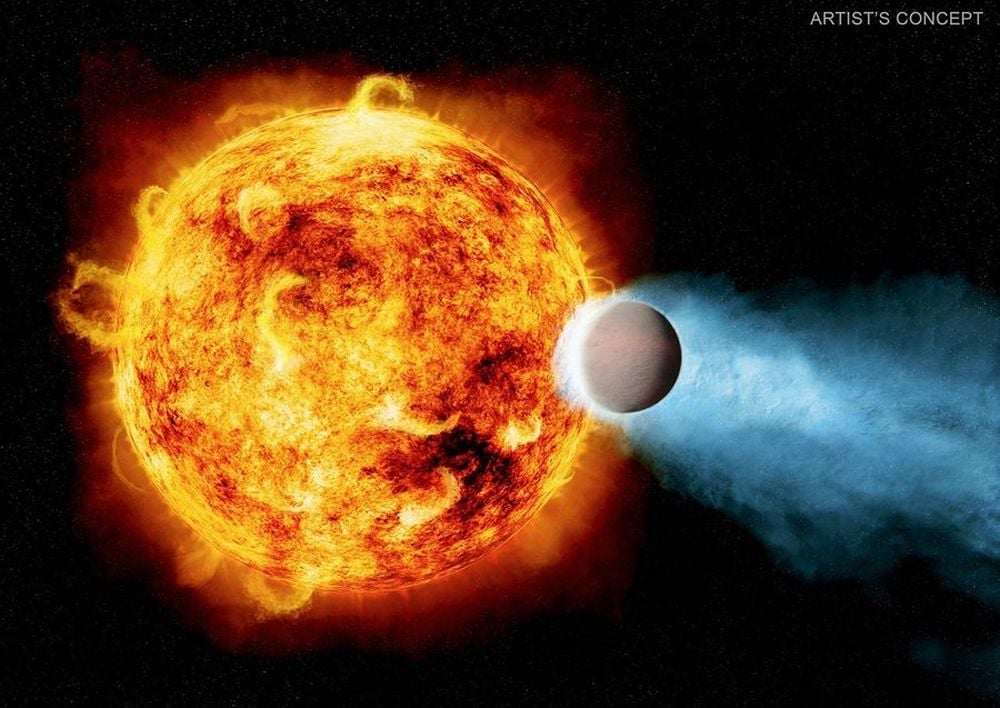
Scientists know that the behaviour of stars can dictate planetary habitability. Research shows that young stars emit powerful radiation that can strip planetary atmospheres away. And without an atmosphere, it's extremely unlikely that life could exist.
But of course stars aren't all the same. Their masses dictate what type of star they'll be, how long they'll shine, and how they'll meet their end. Along the way, their masses also dictate how much radiation they emit. Powerful x-ray radiation can strip planetary atmospheres away, dooming its prospects for hosting life.
Stars like our Sun are under increasing scrutiny in the search for habitable exoplanets. The ESA's Plato (PLAnetary Transits and Oscillations of stars) mission specifically targets Sun-like stars and the terrestrial planets that orbit them. The tentative Habitable Worlds Observatory (HWO) is also aimed at Sun-like stars and terrestrial worlds.
Why the focus on Sun-like stars? They have long, stable lives of fusion which boosts the odds for habitability on orbiting planets. Their habitable zones are accessible, since most planets likely follow approximately one-year orbits, meaning there's lots of opportunity to observe transits. We're also biased toward them because Earth is the only habitable world we know of.
But one big question regarding Sun-like stars and their habitability concerns their radiation output when they're young. If Sun-like stars can easily strip planetary atmospheres away when they're young, then it may not be worth so much effort to study exoplanets in their habitable zones.
However, new research shows that young yellow dwarfs may not be as unruly as thought when it comes to x-rays. The research is titled "X-Ray Evolution of Young Stars: Early Dimming and Coronal Softening in Solar-mass Stars with Implications for Planetary Atmospheres," and it's published in The Astrophysical Journal. The lead author is Konstantin Getman from the Department of Astronomy & Astrophysics at Pennsylvania State University.
"X-ray and ultraviolet (XUV) emission from young stars plays a critical role in shaping the evolution of planetary atmospheres and the conditions for habitability," the authors write. "To assess the long-term impact of high-energy stellar radiation, it is essential to empirically trace how X-ray luminosities and spectral hardness evolve during the first ≲1 Gyr, when atmospheric loss and chemical processing are most active."
The researchers used NASA's Chandra x-ray observatory and archival data from ROSAT to study eight open star clusters between 45 million and 750 million years old. They all contain young, Sun-like stars, and the goal was to observe these stars over different ages and measure their radiation output.
Their research showed that the yellow dwarfs in these clusters emit only about one-quarter to one-third as much x-rays as thought. It all comes down stellar mass, coronal activity, and magnetism.
"We find a mass-dependent decay in X-ray luminosity: solar-mass stars undergo a far more rapid and sustained decline, accompanied by coronal softening and the disappearance of hot plasma by ∼100 Myr, compared to their lower-mass siblings," the authors explain. "These trends in solar-mass stars are likely linked to reduced magnetic dynamo efficiency and diminished ability to sustain large-scale, high-temperature coronal structures."
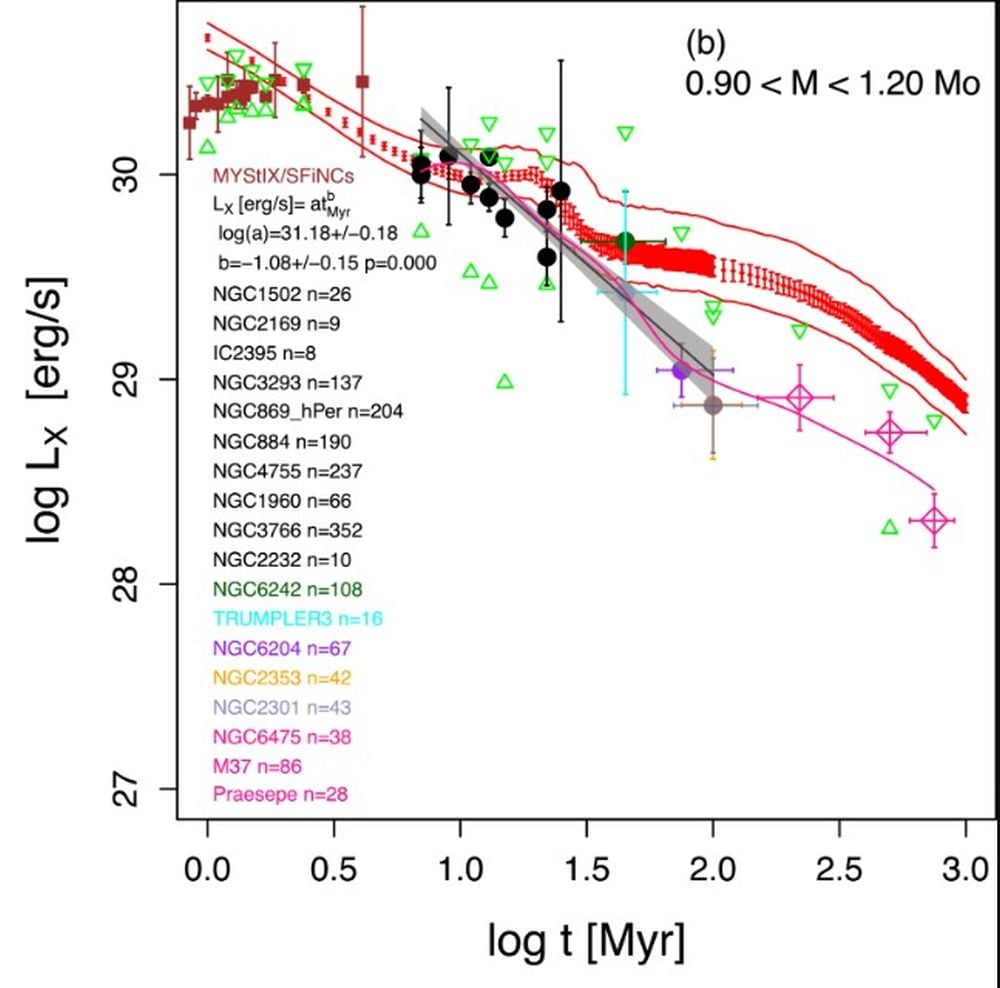 This panel from the research shows XUV emissions for Sun-like stars, with masses between 0.9 and 1.2 solar masses. The different coloured points are for different age groups of the stars in the young clusters. The pink curve shows a declining trend of X-ray luminosity over the extended 7–750 Myr baseline. Image Credit: Getman et al. 2026. ApJ
"While science fiction – like the microbes in Project Hail Mary – imagines alien life that dims stellar output by consuming its energy, our real observations reveal a natural ‘quieting’ of young Sun-like stars in X-rays,” said lead author Getman in a press release. “This is not because an outside force is consuming their light, but because their internal generation of magnetic fields becomes less efficient.”
Very young Sun-like stars emit a lot of radiation, but it drops off quickly. The results show that Sun-like stars only about three million years old emit about 1,000 times more x-rays than the Sun does today. But by 100 million years of age, that drops to only about 40 times more than the modern Sun. That's a dramatic drop with consequences for planetary atmospheres, their persistence, and their ability to form molecules important for life.
“It’s possible that we owe our existence to our Sun doing the same thing, several billion years ago, that we see these young stars doing now,” said co-author Vladimir Airapetian of NASA’s Goddard Space Flight Center. “This real-world dimming echoes the dramatic stellar change in fiction, but it may be even more fascinating because it highlights our own Sun's actual history.”
This is one of the most comprehensive studies of x-ray output from young Sun-like stars, and the results bode well for habitability. We can only see our Sun in its modern state, and astrophysicists' understanding of the x-ray radiation from young Sun-like stars was based on sparse data. Since that data was all that was available, researchers have used it when considering planetary habitability.
But now we know different. This work shows that x-ray output drops off about 15 times more quickly than thought.
“We can only see our Sun at this current snapshot in time, so to really understand its past we must look to other stars with about the same mass,” said co-author Eric Feigelson, also of Penn State University. “By studying X-rays from stars that are hundreds of millions of years old, we have filled in a large gap in our understanding of their evolution.”
"The revised trends imply systematically lower rates of atmospheric mass loss and water photolysis, as well as altered ionization environments and chemical pathways relevant to the formation of prebiotic molecules, for planets in close orbits around solar analogs," the authors conclude. "These effects persist throughout at least the ≲750 Myr interval probed in this study."

