 Universe Today
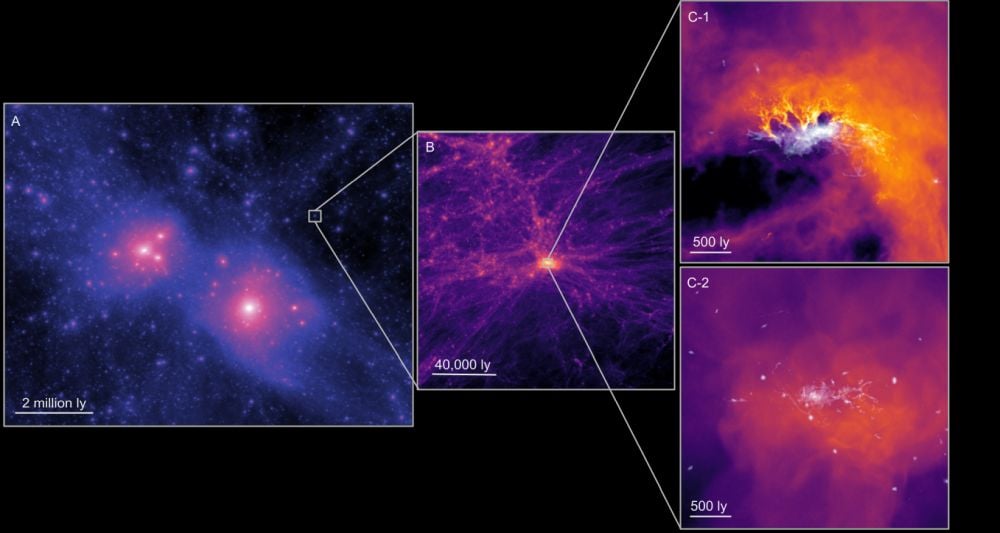
We don't know for sure how many dwarf galaxies are attached to the Milky Way because they're dim and hard to see. There's at least 50 of them, and astronomers keep finding more. Among the dwarf galaxies are the ultra-faint dwarf galaxies, the smallest and least bright of them all.
Regardless of their actual number, they're important because of what they can tell scientists about the early Universe. Scientist sometimes refer to dwarf galaxies in general as relics of the early Universe, because they can tell us something about the conditions in the Universe billions of years ago. The ultra-faint dwarf galaxies (UFDG) are an important population of dwarf galaxies because they're dominated by dark matter to a greater extent than other dwarfs.
In new research published in the Monthly Notices of the Royal Astronomical Society, a team of researchers used powerful simulations to probe the starting conditions for UFDG. It's titled "LYRA ultra-faints: the emergence of faint dwarf galaxies in the presence of an early Lyman–Werner background," and the lead author is Shaun Brown. Brown led the study while working at the Oskar Klein Centre and Durham University. Associate Professor Azadeh Fattahi from the Oskar Klein Centre led the work.
Galaxies, including UFDG, formed in and around dark matter halos, which are basic units in the cosmological structure. But not all dark matter halos form galaxies. Researchers want to understand why that is and what it tells us about the early Universe. In this work, the researchers ran simulations on UFDG to find out.
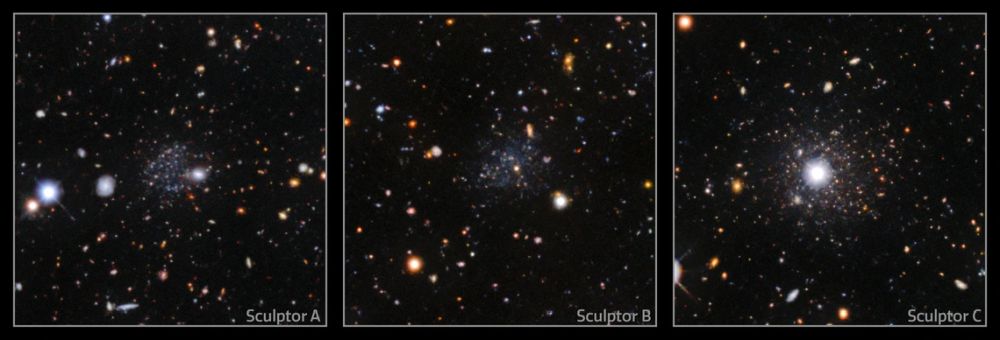 These panels show three of the Milky Way's ultra-faint dwarf galaxies. These galaxies are important probes for conditions in the early Universe. Image Credit: DECaLS/DESI Legacy Imaging Surveys/LBNL/DOE & KPNO/CTIO/NOIRLab/NSF/AURA
“In this work we presented a brand-new suite of cosmological simulations focused on the faintest galaxies in the Universe, with an unprecedented resolution," Fattahi said in a press release. "These are by far the largest sample of such galaxies ever simulated at these resolutions.”
Since UFDG are so small and dim, they're difficult to observe and study. By extension, they're also difficult to simulate.
“The smallest galaxies are called ultra-faint dwarf galaxies, which are a million times less massive than the Milky Way or even smaller,” Fattahi says. “Due to their small size these galaxies have proven very difficult to model and simulate.”
The simulations included 65 dark matter halos based on environments in the Local Group. They simulated two different prescriptions for what's called the Lyman–Werner Background (LWB) in high redshift galaxies (z > 7). The Lyman-Werner Background is pervasive UV radiation that accumulated in the early Universe. It's stellar feedback from Population III stars. Despite being non-ionizing, photons in this radiation can split molecular hydrogen (H2) apart. This is important because H2 lets gas clouds cool and form stars. With less H2, star formation is more difficult in the early Universe. The strength of the Lyman-Werner background could be the difference between which halos form UFGD and which remain starless.
“A useful analogy is to plants and crops and how the way they grow is sensitive to the weather conditions”, said lead author Brown. “In the same way that the yield of a crop in summer can indirectly tell you a lot about what the weather in spring must have been like, the properties of faint dwarf galaxies today can tell us a lot about the conditions, or weather, of the Universe at a much earlier time.”
“In the paper we studied two different assumptions about the properties of the early Universe when it was less than 500 million years old, to understand the effect on the properties of these small galaxies today when the Universe is 13 billion years old,” Brown explained.
The two prescriptions for the LWB in the simulations differed in intensity and in redshift evolution. The samples ranged from small UFDG with about 100 solar masses up to larger classical dwarf galaxies with about five million solar masses. It also included dark matter haloes that are dark and starless to this day. "The new sample probes the transition from classical dwarfs to ultra faints and small haloes unable to form stars," the authors write. It took more than 6 months to run the the simulations.
The results show that larger galaxies are less affected by the LWB than smaller galaxies. "Galaxies with are mostly insensitive to the LWB choice, whereas lower mass systems respond strongly, producing markedly different stellar mass–halo mass (SMHM) relations," the researchers write. "The mass scale at which haloes transition from being dark, and unable to form stars, to hosting a galaxy is dramatically affected by strength of the early LW radiation," the authors explain.
Overall, the simulations show that the LWB has a powerful effect on UFDG. "We have shown that the properties, and expected number, of ultra-faint dwarf galaxies ... are very sensitive to the assumed LWB at high redshift," the authors write.
Astronomers already knew that dwarf galaxies were impacted by cosmic reionization, but weren't sure about UFDG. "While it is already well established that dwarf galaxies are significantly impacted by cosmic reionization, we have shown that the ultra-faint population is also sensitive to the assumed properties of the Universe far before this epoch. The faintest galaxies therefore offer a window into the Universe before reionization, and are promising probes to constrain the Universe’s early (z = 10) SFR and the properties of the first stars."
“In the paper we studied two different assumptions about the properties of the early Universe when it was less than 500 million years old, to understand the effect on the properties of these small galaxies today when the Universe is 13 billion years old,” Brown explained. “We found that these small ultra-faint galaxies are very sensitive to these changes, while more massive galaxies, like our Milky Way, don’t really care,” he adds, “For the smallest galaxies, early conditions can decide whether they become visible galaxies – or remain starless dark matter halos.”
Stronger confirmation of these findings will depend on more data. The Vera Rubin Observatory is expected to find many more UFDG around the Milky Way. It may even find all of them, and that means that we'll gain an even better understanding of the early Universe.
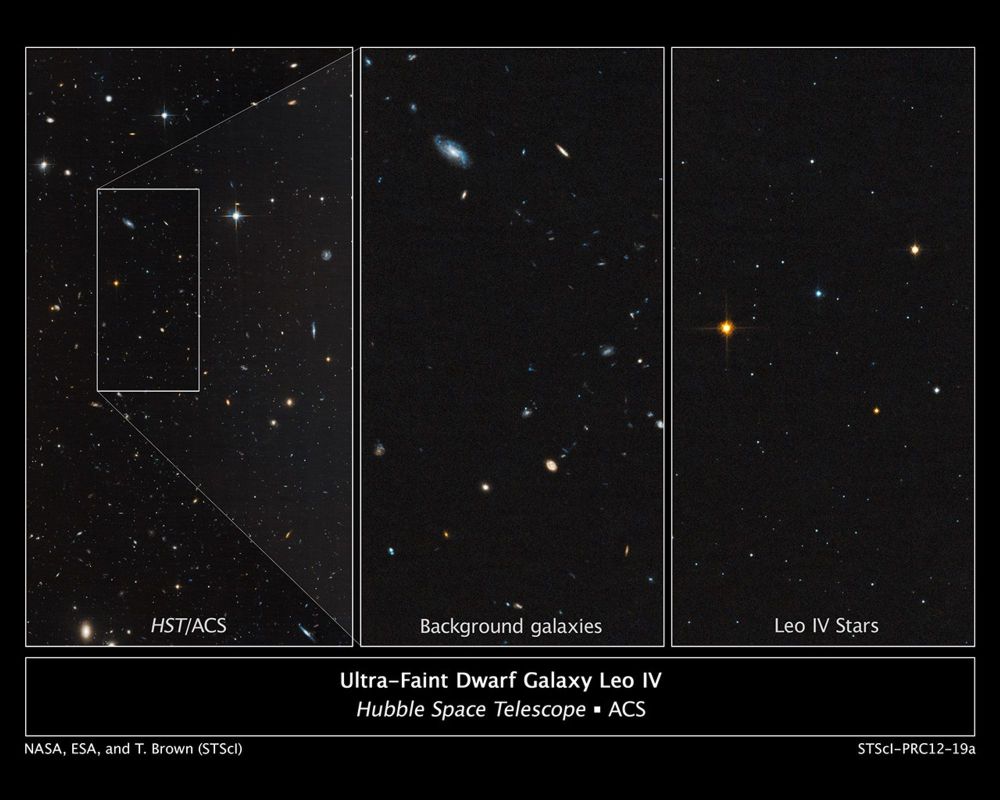 These Hubble images show the UFDG Leo IV. The images help explain why UFDG are so hard to find. Fortunately, the Vera Rubin Observatory is expected to find many more of them. Image Credit: NASA, ESA, and T. Brown (STScI)
“Our work suggests that these upcoming observations of the very local Universe will be able to constrain what the Universe at its infancy looked like, something we currently cannot directly access with other observations,” said Fattahi.
This work ties in with what the JWST has found. One of its goals is to study the very early Universe, and it has uncovered some surprises. Both black holes and galaxies seem to be much more massive much sooner than we thought.
The JWST's observations are from the distant Universe, while the Vera Rubin will be studying the local Universe. A better understanding of local UFDG, considered relics of the early Universe, could help tie everything together.
"With a concerted effort from both the observational and theoretical communities, we are poised to make great progress in dwarf galaxy science in the coming decade, and can use these systems as probes to further study the properties of the very early Universe, constrain our cosmological model, and further understand the role of feedback in driving galaxy formation," the authors conclude.

