 Universe Today
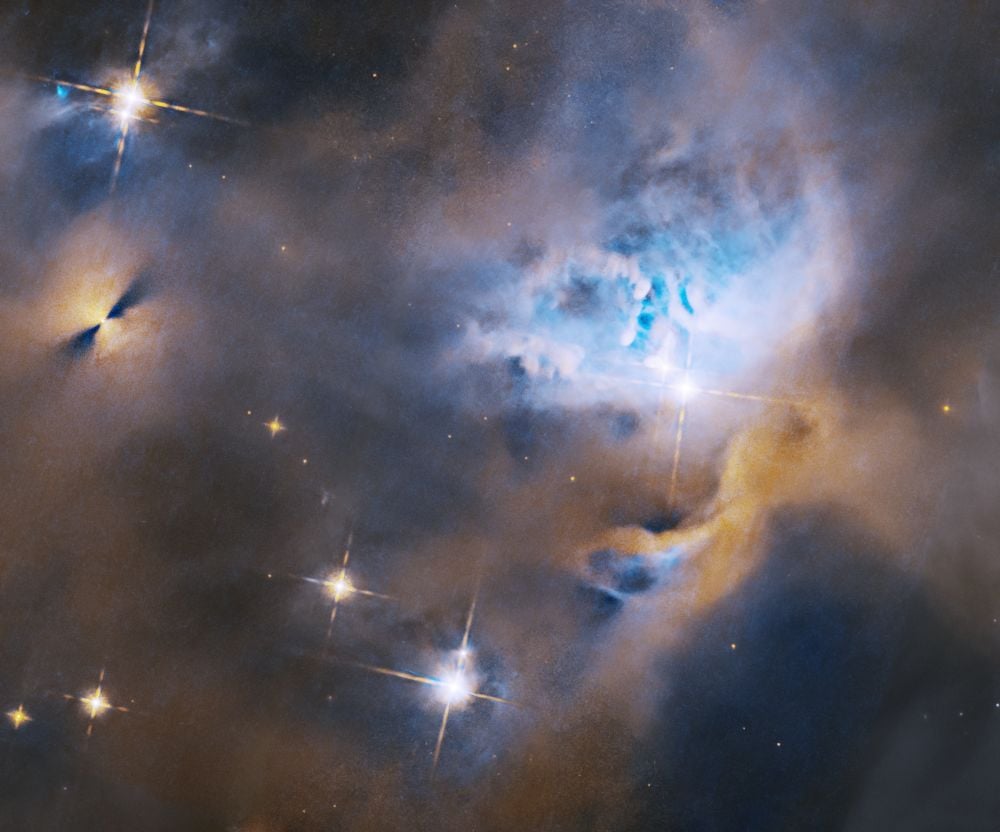
NGC 1333 is a reflection nebula in the Perseus Molecular Cloud. The cloud is relatively nearby in astronomical terms, only about 1000 light-years away. The nebula is a very active star-forming region, and since it's so close, it's very well-studied. Most of the cloud is basically invisible, but NGC 1333 is one of two visible structures.
The star clusters in NGC 1333 are considered typical, and they're still embedded in the cloud they formed in. A new image from the Hubble Space Telescope captures some interesting detail, and highlights objects and processes that are often covered here at Universe Today.
In the upper left of the image is a young protostar. Protostars are still accreting matter and haven't reached their final mass. That means they haven't yet begun their life of fusion on the main sequence. So instead of fusion, their electromagnetic radiation, or light, comes from shocked gas that's falling onto the star's surface. The protostar stage can last for several hundred thousand years, depending on the eventual mass of the star that forms.
A protoplanetary disk in the shape of a sideways hourglass has formed around the star, and this is where future planets will form. They may already be forming there. How many and what type is unknowable at this stage.
Powerful UV radiation from young stars sculpts their gaseous surroundings, and so do their stellar winds. In the center right of the image, a pair of stars are carving out a fan-shaped cavern. One of the stars is brighter than the other and is doing the bulk of the carving. The result is a small reflection nebula that changes in brightness over time due to one of the stars' variability.
The pair of stars in the center right are known as Orion variable stars. Astrophysicists think they're only variable at a young age, and will later mature into steady main sequence stars. Four stars along the image's bottom are also Orion variables.
Observing stars at different evolutionary stages is critical to understanding them. One of the difficulties in that endeavour is that very young protostars can be shrouded by dense gas and dust. While the Hubble can see through some of the obscuring material in the infrared, the JWST has more power to pierce these obscuring veils.
The JWST image below shows more detail, and a wider view of the Perseus Molecular Cloud. The protoplanetary disk can be used to orient the two images. In the JWST image, the protoplanetary disk is in the middle to lower right.
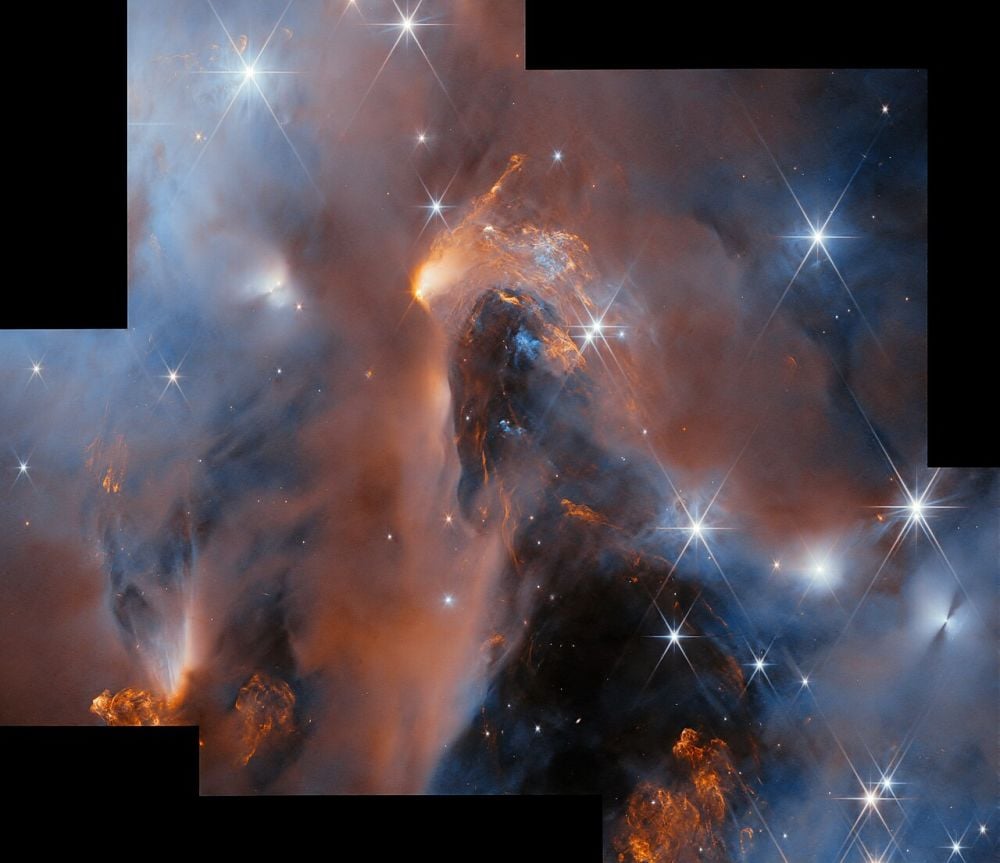 This is a mosaic of JWST images of the Perseus Molecular Cloud. It shows a wider area and more detail than the Hubble image. Image Credit: By ESA/Webb, NASA & CSA, A. Scholz, K. Muzic, A. Langeveld, R. Jayawardhana, CC BY 4.0, https://commons.wikimedia.org/w/index.php?curid=151862903
The JWST is a more powerful infrared telescope than the Hubble, and more of the region's population is visible in its images. Some of what appear to be small stars are brown dwarfs, and the large orange patches are made of gas glowing in the infrared.
The Hubble has one thing going for it that the JWST doesn't, and that means the JWST can never really replace it. The Hubble also sees in optical and UV. That makes it a more versatile telescope in some ways. It's also lasted an incredible 36 years, partly because it's in low-Earth orbit and has been serviced by the space shuttle, while the JWST is too far away at the L2 point, about 1.5 million km away. Barring some unforeseen development, the JWST will die there.
The Hubble is nearing its end though, as its gyros continue to fail. It was initially launched with six of them, with three active and three as backups. However, it's now down to just a single gyro. There may be hope on the horizon though, with talk of a privately-funded mission to service the venerable space telescope.
The Hubble is already considered by some to be the most successful science experiment ever, and if it can be renewed, its claim to that title will only strengthen. But without a servicing mission, the Hubble's time will soon come to an end.
The telescope has changed our understanding of Nature and the cosmos, and its track record speaks for itself. This image of NGC 1333 is just one example of the work the Hubble's done in the service of humanity and our ongoing effort to figure out what the heck is going on.

