Universe Today
This is Part 4 of a series on interstellar comets. Read Parts 1, 2, and 3.
So that's all nice. But why now?
That's the question everyone asks. We went decades — centuries, millennia really — without seeing a single rock that didn't have a "Made in the Solar System" sticker on it. Then, in the span of less than ten years, we get the Big Three: 'Oumuamua, Borisov, and now 3I/ATLAS.
Did the galaxy suddenly decide to start throwing its trash in our yard? Is there some kind of cosmic pile-up happening just outside the Oort Cloud?
Nah. The truth is a lot less conspiracy theory and a lot more "we finally turned on the porch lights."
You're never going to notice the strangers zooming through town if you never bother to open the windows.
For most of human history, we were looking at the sky through a straw. We could see the big stuff — the planets, the bright stars, the occasional great comet that scared everyone into thinking the world was ending. But everything else was invisible.
That is, until now.
Specifically, Pan-STARRS. This is a telescope system in Hawaii that scans the entire sky, over and over again, looking for things that move. It's a cosmic motion detector. And wouldn't you know it, as soon as we started looking for things that move, we started finding them. 'Oumuamua was the first. It was the proof of concept.
But we're just getting started.
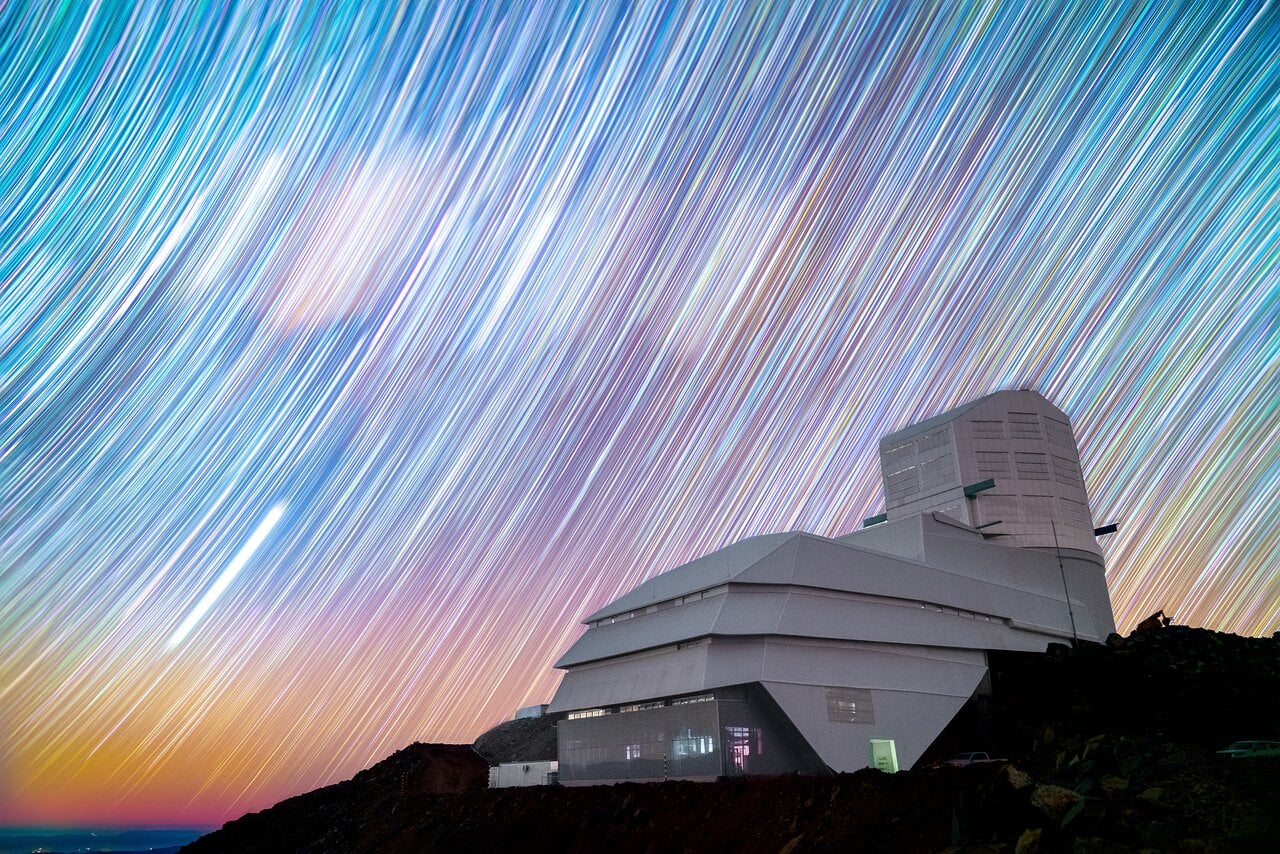
If Pan-STARRS is a porch light, the upcoming Vera C. Rubin Observatory is a stadium floodlight. Currently being finished in the high Atacama desert of Chile, the Rubin Observatory is a beast. It's got a mirror the size of a small apartment and a camera that's a three-gigapixel monster. Every few nights, it will photograph the entire visible sky. Let me say that again: the entire visible sky, every few nights. It's going to create a high-definition movie of the moving universe.
And the math on what Rubin is going to find is…well, it's a bit staggering.
Right now, our interstellar visitor count is three. We're very proud of those three. We have posters of them on our walls. But once Rubin comes online, we expect that number to skyrocket. Some estimates suggest we'll be finding one interstellar object every single month.
Think about that. One a month.
By the end of its ten-year mission, we won't have three weirdos to argue about; we'll have a catalog of hundreds. We'll move from "look at this one freak accident" to "here is the statistical distribution of galactic debris." And that is where the real science kicks in. Right now, we're trying to understand interstellar objects the way you'd try to understand an entire country by talking to three people. You can learn something, sure, but you can't draw real conclusions. You can't separate the quirks of the individual from the traits of the population. With hundreds of examples, we can start asking the questions that actually matter: What's a typical interstellar comet made of? How does that compare to our own comets? Are there patterns in where they come from, how fast they travel, what they're made of? Do certain types of solar systems produce more interstellar debris than others? Every new detection is another data point, and with enough data points, the weirdness stops being a curiosity and starts being a map — a map of what other solar systems are made of, drawn by the stuff they threw away.
So how many of these things are actually out there?
If we can find one a month just by looking at our tiny corner of the neighborhood, the implications for the rest of the galaxy are kind of insane. We're talking about a density of interstellar objects so high that there are likely trillions — and I mean something like 10^15 — drifting through the Milky Way at any given moment.
Should I mention the Comet Interceptor? Yeah, I should mention the Comet Interceptor.
This is a brilliant, slightly impatient bit of engineering. Instead of waiting for a comet to show up and then trying to build a rocket fast enough to catch it — which, let's be honest, is impossible for something moving at 33 kilometers per second — we're going to park a spacecraft in space and just…wait. We'll wait for the next 3I/ATLAS to show up. And when it does, the Interceptor will spring into action, fly past it, and give us our first close-up look at a piece of another solar system. Which is a big step up from our current capabilities, which take the world's most powerful telescopes to produce a little smudge of an image.
Maybe with enough time, those strangers won't be so strange after all.