 Universe Today
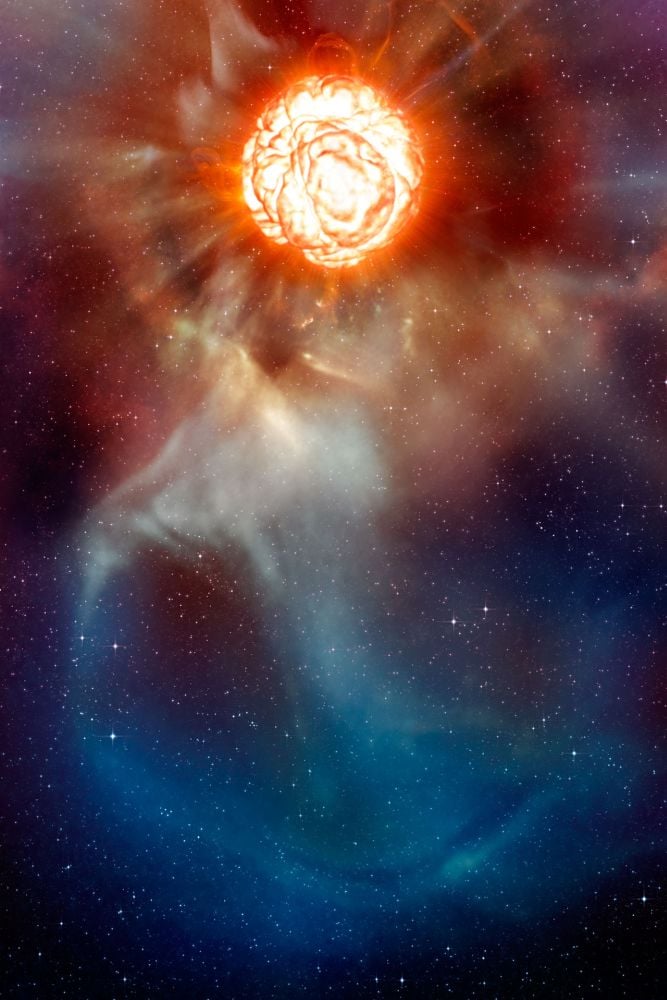
When most people think of a supernova, they're thinking of a Type II core-collapse supernova. These are massive stars that have reached the end of their time on the main sequence. They've used up their supply of hydrogen and continue fusing heavier elements until the star can't support its own mass. The core collapses and they explode, outshining their entire host galaxy for months.
When something this bright happens in the sky, it immediately captures astronomers' attention. Ancient Chinese astronomers called supernovae explosions "guest stars" because they appeared, hung around for a while, then disappeared. They documented the supernova from 1054 extensively, making it one of the ancient world's most well-documented astronomical events. That Type II supernova created the well-known Crab Nebula, one of the most thoroughly-studied objects in astronomy.
Researchers have pieced together much of the complex detail behind Type II supernovae. But astrophysicists still have questions. One of them concerns their extended envelopes and their light curves.
New research in a pair of papers has made some headway in answering these questions. The first paper is "Critical Metallicity of Cool Supergiant Formation. II. Physical Origin," published in The Astrophysical Journal. The lead author is Po-Sheng Ou, from the Institute of Academia Sinica, Astronomy and Astrophysics, Taipei.
The second is titled "Multi-wavelength Signatures of Supernova Shock Breakout from Red Supergiants in Two Dimensions," and is also published in The Astrophysical Journal. The lead author is Wun-Yi Chen, also from the Academia Sinica, Institute of Astronomy and Astrophysics, Taipei.
Only massive stars can explode as supernovae, and most precursors are red supergiants (RSGs), with blue supergiants being responsible for a small number of them. The star Betelgeuse in the constellation Orion has been a RSG for about 40,000 years, and will explode sometime in the future, most likely within 100,000 years. It already shows signs of ejecting material into an envelope around itself.
The actual physical origins of extended shells like this in SN progenitors is still somewhat mysterious, but the first paper makes some progress.
In the first paper, the authors explored the metallicity of supergiant stars with models of stellar evolution. "This study investigates the physical origin of the critical metallicity required for the formation of cool supergiants, as revealed by stellar evolution models," they write. They found that there's a threshold where the precursor star's radius determines whether a star of a given mass can become a red supergiant.
Metallicity affects a star's nuclear burning and opacity, and in turn affects the star's radius once it leaves the main sequence. A larger radius indicates that the outer envelope is more loosely bound by gravity. That means that a star's stellar winds can more easily shed mass from the star, resulting in a red supergiant. As a result, hydrogen can be removed more easily, affecting the type of supernova that results.
"Higher-metallicity stars develop larger RTAMS (radius of terminal age main sequence) and rapidly expand into the stable RSG regime during core helium burning," the researchers explain. "In contrast, lower-metallicity stars have smaller RTAMS and advance to more evolved core helium- or carbon-burning stages while retaining compact envelopes, thereby preventing expansion into the RSG regime during core helium burning."
“This study explains the physical origin of the critical metallicity required for stars to become red supergiants, providing new insight into the evolution of low-metallicity stars in the early universe," lead author Po-Sheng Ou said in a press release.
The results show that massive stars must have a metallicity at least equal to about 1/10 of the Sun's in order to become a RSG. Below this threshold, the star remain as blue supergiants.
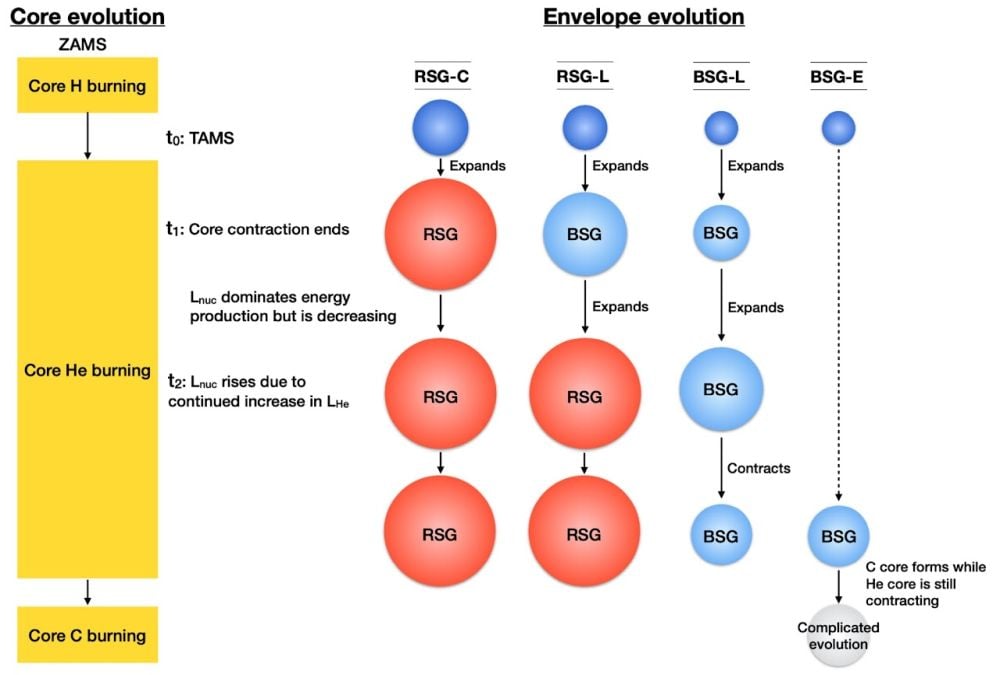 This schematic illustrates some of the findings in the first paper. A star’s size at the end of its main-sequence phase—the terminal-age main sequence (TAMS)—determines whether it becomes a red or blue supergiant. Stars that are already relatively large at the TAMS can undergo substantial envelope expansion and evolve into red supergiants. In contrast, more compact stars remain blue supergiants and eventually contract rather than expanding further. Image Credit: ASIAA/Po-Sheng Ou
The second study explored the supernova shock breakouts from red supergiant progenitors. This is the first time this phenomena has been explored with two-dimensional, multigroup radiation–hydrodynamic simulations.
"We present new two-dimensional radiation hydrodynamic simulations of supernova shock breakout from red supergiants (RSGs)," the authors write. "We consider a range of circumstellar media (CSMs) produced by stellar winds to investigate how preexplosion mass loss affects shock breakout."
The supernova shock breakout is what most people think of as a supernova. It's one of the most dramatic astrophysical events in the cosmos, and it's over in a literal flash. The breakout is the first visual indicator that a star is exploding, even though a lot goes on internally before the breakout. The shock wave starts deep in the star but takes hours to days to travel to the surface, where it's finally visible.
Astrophysicists examine supernova light curves to try and understand them, and the light curves can be quite different from supernova to supernova. Some shock breakouts take much longer than others to appear. In some previous efforts, researchers have accounted for these slow-to-appear shock breakouts by invoking extreme mass loss from the progenitor.
The simulations show that extended RSG envelopes generate longer-lasting breakout signals that are fainter than others. But extreme mass loss isn't the cause. Instead, density plays a role. So do radiation precursors. "We find that strong radiation precursors, generated by radiation leakage behind the shock, can drive fluid instabilities and move the effective photosphere outward before the shock reaches the stellar surface." That creates both weaker and slower shock breakouts.
"The dense CSM further extends the breakout rise time by increasing the photon diffusion," the authors write.
"This study presents the first ever two-dimensional multigroup radiation-hydrodynamic models of red supergiant shock breakout, revealing that radiation precursors and circumstellar density significantly shape the breakout light curves and color evolution," lead author Wun-Yi Chen said.
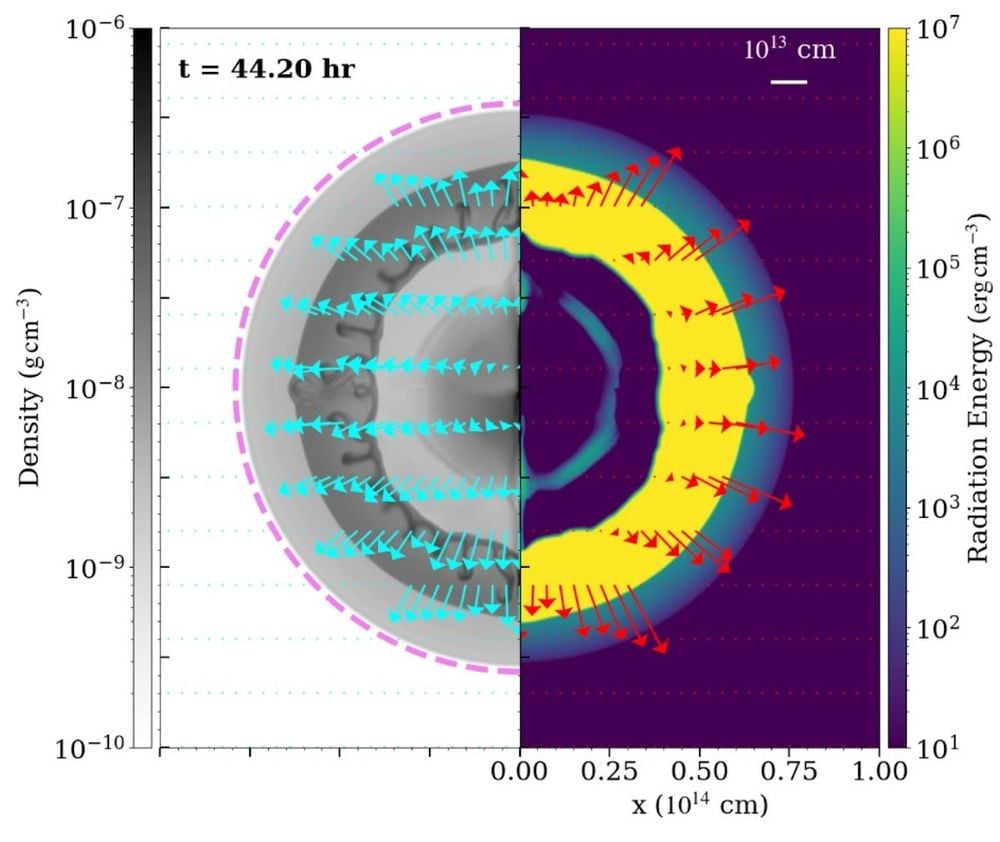 This figure shows the pre-breakout structure of a RSG with 20 solar masses. It's a snapshot of gas and radiation energy densities before the shock reaches the stellar surface, shortly before shock breakout. "A strong radiation precursor develops ahead of the shock," the authors explain. The cyan arrows indicate velocity, and red arrows indicate radiation flux. The pink dashed line is the extended photosphere that dims and slows the shock breakout. "The atmosphere expands with a velocity that is negligible compared to the shock velocity," the authors explain. Image Credit: ASIAA/Wun-Yi Chen
These studies explain what's going on behind the light curves of distant supernovae. They provide a framework for understanding them, and the work is timely.
We're about to start discovering many more SNe. The Vera Rubin Observatory will begin its Legacy Survey of Space and Time later this year. According to the observatory's website, it's poised to discover 10 million SNe in its lifetime. That's an astounding number of detections. Even though most of them will be at extreme distances, that's still a treasure chest of discoveries.
These studies will help astrophysicists understand what they're seeing when each one of these stars explodes.

