Universe Today
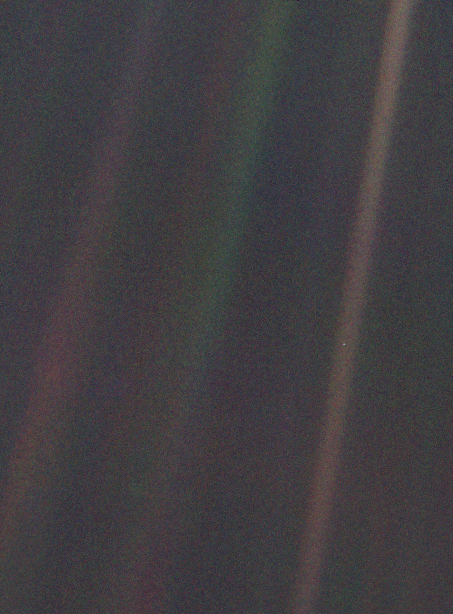
In 1990, the Voyager 1 spacecraft, then six billion kilometers from Earth and destined to become humanity's most far-flung emissary, turned around and took a picture of home. The resulting image is now legendary: a haunting portrait of our tiny, fragile world, a single pale blue dot suspended in a sunbeam.
Now imagine you're an alien species hunting for life on other worlds. You've found a promising candidate, a rocky planet orbiting a medium-sized star in its habitable zone. And let's say that even with the most advanced technology at your disposal, all you have is that pale blue dot. Or worse: a single pixel, an image not even big enough to make out a sphere.
Everything you will ever know about us has to come out of that one pixel. Oceans, continents, weather, whatever life crawls or breathes or builds down here, all of it collapsed into one tiny smudge of light.
What could you figure out? It turns out an absurd amount, but only if you're clever, patient, and willing to build the most ridiculous telescopes imaginable.
Let's start with what we can do today, with the machines already at our fingertips. Well, they're sitting a million or more kilometers from Earth, but they have dedicated channels for beaming data home, so that's sort of like fingertips.
The main trick we use to figure out what's on another planet, and especially to hunt for life there, is called transit spectroscopy. When a planet crosses in front of the face of its parent star, an event we call a transit, a sliver of starlight passes through the planet's atmosphere on its way to us. And that atmosphere is full of stuff, mostly molecules, and different molecules absorb different wavelengths of light. Water absorbs certain wavelengths, methane others, bits of cheese still others. Every molecule has a unique fingerprint of colors it likes to swallow.
So all you have to do (and I'm airily waving away a mountain of technical difficulty here) is compare the star's light with the planet in front of it to the star's light without the planet in front of it. Whatever wavelengths went missing got absorbed by the atmosphere, and there is your fingerprint, written right into the light.
The reason there's a mountain of technical difficulty, of course, is that the signal is fantastically tiny. For an Earth-sized planet around a Sun-like star, the atmosphere modifies the starlight by about one part in ten thousand. And that's on a good day, with ideal conditions and a strong signal.
Which is exactly why we build monster telescopes like the James Webb. Launched in 2021, it carries a 6.5-meter mirror, big enough to tease out these kinds of minuscule differences. It's an incredible machine, with one important caveat: it wasn't built specifically to find life. It was built to do a hundred other jobs well too, from early galaxies to star formation to black holes to planetary atmospheres. Biosignatures, the signs of life, are just one item on a very long menu.
And that means it's not going to hit a home run here. We're hunting for four molecules in particular: oxygen, ozone, methane, and water, which together make up the classic biosignature cocktail. Why these four and not, say, literally anything else? Because on Earth, they are the atmospheric evidence for biology. Photosynthetic life exhales oxygen. Sunlight in the upper atmosphere converts some of that oxygen into ozone, which then blocks ultraviolet light, one of the reasons Earth is habitable in the first place. Microbial life, especially the anaerobic kind that hates oxygen, exhales methane: cow guts, swamps, termites, deep-ocean vents. And water isn't a biosignature by itself, but it's the solvent that every kind of life we know of requires.
These four are what life on our planet lives and breathes, and since Earth is the only example of life we have anywhere, it's as good a starting point as we're going to get.
Crucially, they need to show up as a package. A lot of oxygen on its own isn't enough, because there are dull, purely chemical reactions, like sunlight breaking apart water vapor, that can produce it in abundance. Same with methane: belching volcanoes can make plenty. So what we're really after is these gases in disequilibrium, an abundance of them coexisting when they have no business coexisting, unless something keeps topping them off. Oxygen and methane in the same atmosphere at the same time would normally react and cancel each other out within a few thousand years. See them together, and something is replenishing the supply.
On Earth, that something is life. One of the defining features of living systems is that they shove a planet out of chemical equilibrium and hold it there. So that's the signature we go looking for elsewhere.
And the James Webb? It's got a chance, I'll give it that. But not a good one. The trouble is that the smallest signal it can reliably detect for anything is around 10 parts per million, meaning it simply can't confidently measure an atmospheric signal fainter than that. For an Earth-like planet around a Sun-like star, the biosignature cocktail is much fainter than that. The James Webb could be staring straight at a living world and it would just look like noise.
Its one real shot is a rocky planet around a small red dwarf star. Because those stars are so dim, the planet's atmosphere blocks a bigger fraction of the total light, boosting the signal. But that's a genuine stroke of luck: you need such a system, and you need it close enough for the trick to work. Best case, we're talking maybe two or three planets over the entire lifetime of the James Webb, and that's just to have the chance to even glimpse biosignatures. Those two or three worlds could easily be dead, and statistically they probably are, because most worlds are dead.
So is it hopeless?
In Part 2, we meet the machine being designed for one job and one job only: to find another living Earth.