Universe Today
The giant planets in our solar system—Jupiter, Saturn, Uranus, and Neptune—have challenged our understanding of planetary formation and evolution. Specifically, their atmospheric formations and compositions have provided awe-inspiring images from spacecraft and given scientists key insights into the interior mechanisms of these massive worlds. But what about exoplanets? What can their atmospheres teach scientists about their formation, evolution, composition, and interior mechanisms? And how do longstanding exoplanet models stack up against the real thing?
Now, an international team of researchers might help close this knowledge gap by studying the atmosphere of a super-Jupiter exoplanet using one of NASA’s most powerful space telescopes. Their findings were recently published in The Astrophysical Journal Letters and hold the potential to challenge our understanding of planetary atmospheric mechanisms, compositions, and models.
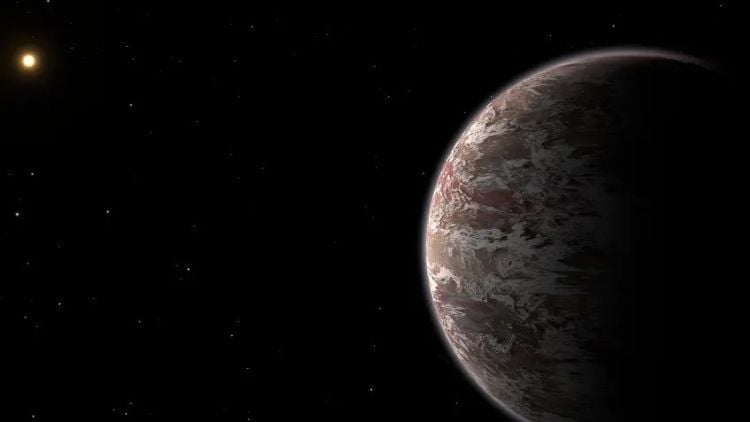
For the study, the researchers used NASA’s James Webb Space Telescope (JWST) to analyze the atmosphere of Eps Ind Ab, which is estimated to be several masses larger than Jupiter, and located approximately 12 light-years from Earth. It orbits approximately 30 astronomical units (AU), or about the orbit of Neptune, from its K-type star, Eps Ind A. While this system does have two brown dwarfs that orbit each other, Epsilon Indi Ba and Bb, they are located approximately 1,460 AU from the primary star of Eps Ind A.
Eps Ind Ab is known as a cold exoplanet with an estimated temperature of approximately 275 Kelvin (2 degrees Celsius/35 degrees Fahrenheit). For context, Jupiter’s temperature is 140 Kelvin (-133 degrees Celsius/-208 degrees Fahrenheit). Astronomers note that the temperature of Eps Ind Ab being warmer than Jupiter indicates the exoplanet is early in its formation and will cool off as it evolves.
While ammonia had previously been discovered in the atmosphere of Eps Ind Ab in a 2024 study, that team also observed the atmosphere of Eps Ind Ab to be brighter than they anticipated. Using a higher observation wavelength than in the 2024 study, this study found that Eps Ind Ab was even brighter at this new wavelength, but the team found the amount of ammonia was lower than anticipated. For context, Jupiter has large amounts of ammonia gas and ammonia clouds in its upper atmosphere.
The researchers concluded this extra brightness is attributed to water-ice clouds within Eps Ind Ab’s atmosphere. They discussed how longstanding computer models for simulating planetary atmospheres haven’t included clouds in their calculations due to maintain simplicity regarding the calculations. Thus, finding water-ice in Eps Ind Ab’s atmosphere challenges these models and could provide incentive for re-evaluating how these models are built.
“It’s a great problem to have, and it speaks to the immense progress we’re making thanks to JWST,” said James Mang, who is a PhD student at the University of Texas at Austin and a co-author on the study. “What once seemed impossible to detect is now within reach, allowing us to probe the structure of these atmospheres, including the presence of clouds. This reveals new layers of complexity that our models are now beginning to capture and opens the door to even more detailed characterization of these cold, distant worlds.”
Additionally, the researchers provided new estimates of Eps Ind Ab’s mass and eccentricity (orbital shape) at approximately 7.6 Jupiter masses and 0.24, respectively. Orbital eccentricity is measured from 0 to 10 with 0 being a perfect circle. For context, the eccentricity of Earth and Jupiter are approximately 0.01 and 0.04, respectively.
The study encouraged future research to focus on cold exoplanets to ascertain the accuracy of atmospheric models and why the low ammonia levels in Eps Ind Ab’s atmosphere was lower than current models predicted. They also aspire to learn if the low ammonia levels are isolated to Eps Ind Ab or if other cold exoplanets also possess these characteristics.
While the 2024 study observed Eps Ind Ab using direct imaging, this follow-up study used an indirect method known as astrometry to confirm the exoplanet’s mass and orbital characteristics. While direct imaging involves blocking out the glare of the host star to observe an exoplanet, astrometry involves using angles and measurements of positions to calculate a planet’s size and orbital characteristics.
What new insight into exoplanet atmospheres, and specifically cold exoplanets, will researchers make in the coming years and decades? Only time will tell, and this is why we science!
As always, keep doing science & keep looking up!