Universe Today
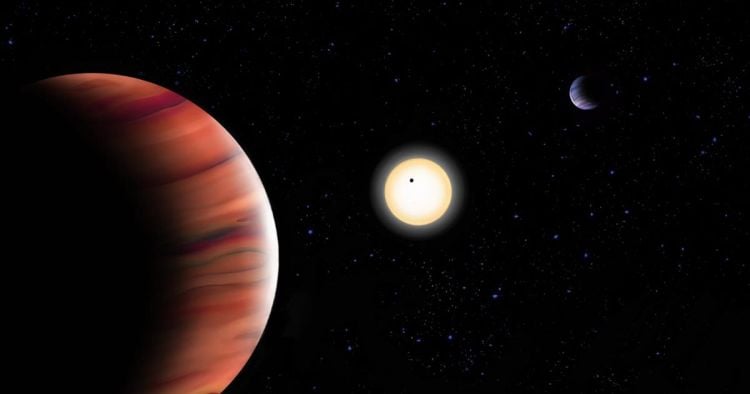
It turns out that even after studying our solar system in depth and discovering more than 6,100 exoplanets across more than 4,500 exoplanetary systems, not all solar systems are created equal. The longstanding notion is that planets orbit almost entirely in the same orbital path, also called an orbital plane. But what if an exoplanetary system was found to have exoplanets that not only orbit in different planes, but also exhibits changing behavior regarding when they pass in front of their star?
Recently, an international team of more than 50 researchers addressed this conundrum, as they observed three exoplanets of varying sizes, orbital times, and orbital angles. Using a combination of data obtained from several worldwide telescopes and computer simulations, the team evaluated the architecture of a very unique exoplanetary system, with their findings published in the journal Science Advances earlier this month. One of the telescopes was located at the ASTEP (Antarctic Search for Transiting ExoPlanets) facility, which benefits from having between 3-4 months of consecutive darkness during the winter months from March to September.
For the study, the researchers examined the TOI-201 system, which hosts an F-type star, is located approximately 371 light-years from Earth, and consists of a super-Earth, gas giant (TOI-201 b), and a massive gas giant (TOI-201 c) with estimated orbital periods of approximately 5.8 days, 53 days, and 2,900 days (7.9 years), respectively. For context, F-type stars are both larger and hotter than our Sun. Also, unlike our solar system, where all the planets orbit in mostly circular orbits, TOI-201 c has a highly elliptical (oval-shaped) orbit, which is similar to comet orbits in our solar system.
In the end, the researchers found that the orbital times varied for the exoplanets, meaning that the time when the astronomers observed an exoplanet passing in front of its stars changed. Not only did this puzzle the large team of researchers, but they also found that the orbital angles of the exoplanets changed, as well. Finally, the researchers found that the orbital angles were changing so fast that observations could be made in real time, meaning astronomers can observe the evolution of the planetary system on human timescales, as opposed to needing millions or billions of years to evolve.
Through a series of computer models, the researchers estimated that all three exoplanets will stop passing in front of their star, from our point of view, in approximately 200 years, and will take another approximately 10,000 years to start transiting again. The team concluded that the highly elliptical orbit of TOI-201 c throws the orbits of the two inner exoplanets in disarray when its orbit takes it closer to its star.
“Usually, planets are like metronomes with each transit in front of the star happening exactly one orbital period after another,” said Dr. Amaury Triaud, who is a Professor of Exoplanetology at the University of Birmingham and a co-author on the study. “However, we were following TOI-201b, and suddenly the planet started transiting about half an hour late. This sudden jump was very surprising, and we reported our observations. Other astronomers around the globe noticed intriguing signals too, and by working together, the team could start to understand this system.”
Dr. Triaud thanked the ASTEP telescope in Antarctica, noting its unique observational capabilities during long periods of darkness proved ideal for this study.
The researchers note the TOI-201 system draws parallels to other exoplanets whose orbits are also tugged by a large and eccentric outer planet, including Kepler-419 b, Kepler-448 b, and Kepler-693 b. While the two exoplanets in Kepler-419 and Kepler-448 are confirmed, the second, and elliptical, exoplanet in Kepler-693 is not yet confirmed to exist.
What new insight into rapidly evolving exoplanetary systems will researchers make in the coming years and decades? And how will unique telescopes like ATSEP in Antarctica contribute to this research? Only time will tell, and this is why we science!
As always, keep doing science & keep looking up!